REVIEW Oct 2026 ‘Linder: The Return of Linderland’ at Grundy Art Gallery Blackpool
Charlie Currid
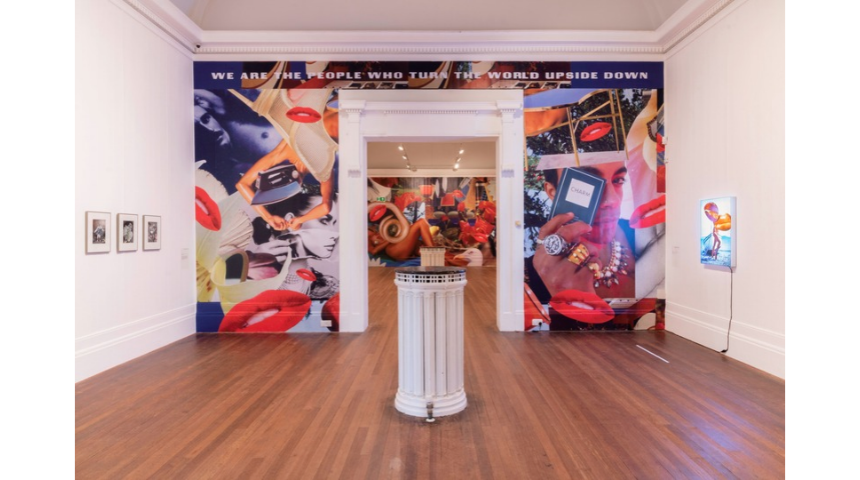
Linder: The Return of Linderland 2026, Grundy Art Gallery, Blackpool Council, Curated by Hayward Gallery Touring. (c) Linder, Courtesy Grundy Art Gallery, Blackpool Council. Photo: Brendan McGregor
‘Linder: The Return of Linderland’ opened at the Grundy Art Gallery in Blackpool in July, a month befitting its vibrant, extroverted character, and closed on 3 October 2026. Amongst the introduction of a new PM, a juicy, political version of the world cup, and a damning forecast of summers to come, the opening of ‘Linderland’ seemingly boiled down the sweat, sex and stress of the last month into digestible photomontages, emblematic of Linder’s anachronistic catalogue. Artist and writer Charlie Currid visited the exhibition, and writes of his experience below.
I called a friend the night before going, asking if he was available to accompany me. He recently embarked on a performance-esque phase of wearing almost entirely vintage European military garb, a fact I used to justify why he should see the show: ‘You’ll look great in there!’ While researching in preparation for my visit, I’d encountered Head to Head (2017) and a snapshot of the gallery interior adorned with striking, layered photomontages extending from the gallery floor, around its doorways, and back down the other sides again. I encouraged him to picture a mismatched military uniform against the wall, camo and dazzle perfectly complementing the frenetic collage, the confused image of male libido, overpowered by floral prints and (what I later found out were referred to as) ‘Linderlips’. I persisted with my luckless persuasion. Recent job interviews had rendered him unavailable for the foreseeable.
I was one of the unlucky ones, working throughout summer, therefore only able to see the show once the days had shortened, and general consciousness had moved on from summer and the politics of escapism, reduced to back-to-school, first-time-full-time, day-in-day-out survival tactics. I had never been one to give in to nostalgia (hell, I’m not yet 23), but my point here is that visiting in September, I had a small but nameable hankering to see a show stained in fruit juice and exuding youthful playfulness, something that would give me the impression of being away from things while simultaneously being at the center of everything.
From what I knew about Linder Sterling (artist name Linder), she had been a working figure in the English (post) punk scene since the late 70s. She had fronted the band Ludus, and created several iconic punk images of the era, most famously the single cover of the Buzzcocks’ ‘Orgasm Addict’ (1977). Research told me that I had also seen her work before, at the ‘Women in Revolt!’ exhibition at the Tate a couple years prior, and perhaps had run into her work in the public sphere, at a train station, or reproduced on posters and postcards. Her postmodern, heavily pop-art-influenced style has enabled her work to exist both as a series of subtly radical acts of feminism, but also a practice so easily digestible it can pass as trivial.
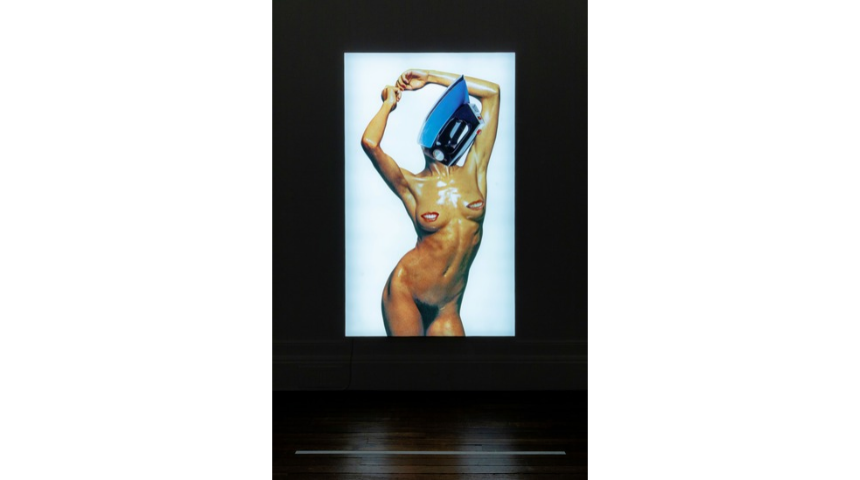
Linder: The Return of Linderland 2026, Grundy Art Gallery, Blackpool Council, Curated by Hayward Gallery Touring. (c) Linder, Courtesy Grundy Art Gallery, Blackpool Council. Photo: Brendan McGregor
Hosting some of Linder’s more recent photomontage works, this exhibition acted as a sister exhibition of sorts to ‘Danger Came Smiling’, her landmark show that has been touring the UK since last year. This iteration of the show brings together photomontages from across Linder’s career, two bespoke photomontage-murals and a series of works – paintings, drawings and sculptures – pulled from the collections of Gallery Oldham, Lowry, and the Grundy Art Gallery. There is a concerted effort, in collating these works, to highlight the north-western voice with which much of Linder’s work speaks. As stated in the exhibition’s accompanying leaflet, the selected works are included in some cases to draw connections between the artist and the space – see a 1952 seascape by L.S Lowry, which alludes to Linder’s coastal upbringing – and other times to link thematically with the socio-political narratives cut and pasted throughout the artist’s photomontage portfolio. In an exhibition that at times feels like a travel brochure to a flashy, simultaneously pre and post-gentrification cityscape, these archive pulls effectively anchor the exhibition to the ground. They helpfully prevent it from becoming a victory lap, and instead open our eyes to the wider contexts surrounding the work’s production.
On entering the gallery: Small reproductions of works sit neatly across the walls, a pair of lightboxes placed in the corners seem almost like vending machines, while frozen snapshots of the sea recall saltspray ingested moments before entering. The room has all the appeal of the short walk from Blackpool North Train Station to the gallery, a route dressed with numerous posters for Elvis, Michael Jackson and Adele tribute acts, a recreation of the iconic ‘Welcome to Fabulous Las Vegas’ sign (which itself could also be read as a tribute act), welcoming visitors to ‘Ma Kelly’s North’, and the Funny Girls cabaret bar, looming over an endearingly titled ‘Pizza Luigi’. Blackpool, and all its accessories, have simultaneously a transcontinental and hyper-local aesthetic, one echoed throughout the exhibition. We Are The People Who Turn The World Upside Down (2026) recalls American advertising of the 70s, though also specifically Sandgrownun rehashes of, or tributes to, popular culture. The location, one chosen by the artist herself, and the exhibited work utilise the punk sensibility of creating an identity through layering.
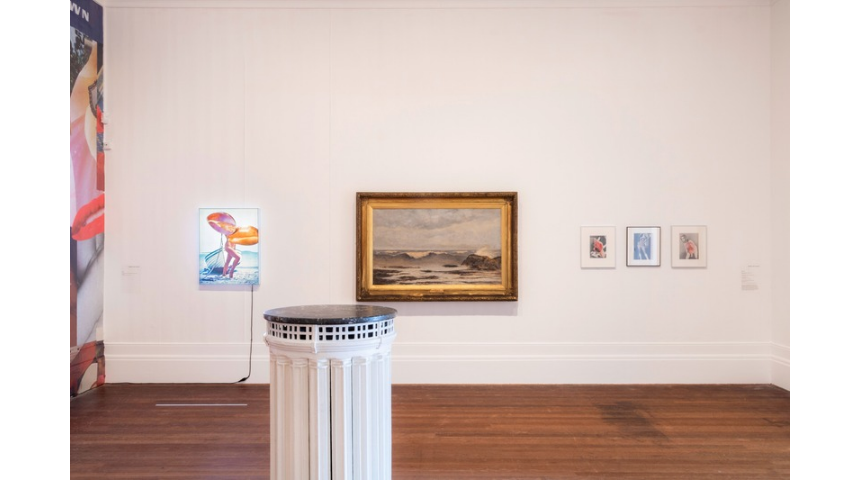
Linder: The Return of Linderland 2026, Grundy Art Gallery, Blackpool Council, Curated by Hayward Gallery Touring. (c) Linder, Courtesy Grundy Art Gallery, Blackpool Council. Photo: Brendan McGregor
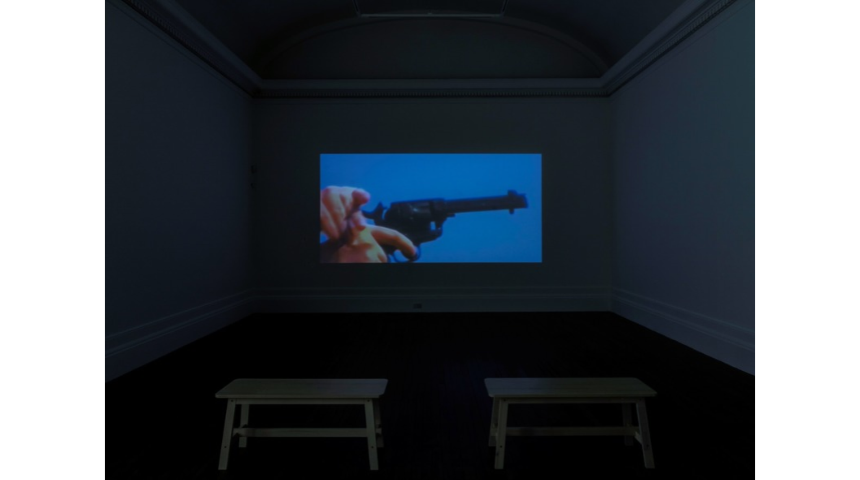
The gallery body has two consecutive main rooms, with two extras tacked on its side. The first is reserved for a silent screening of Light The Fuse (2000), a video piece documenting the pack-like hierarchies adopted/explored by adolescents in Manchester, and recreations of Western shoot-outs by the Blackpool and Fylde cowboys. It’s here the image of my camo-ed friend appeared to me again, seemingly plucked from the same toy box as the men featured in the video. It’s not as affectingly direct as the collaged works that precede it, only worsened by its proximity to a lightbox-lit reproduction of the Orgasm Addict cover, as enticing now as it was then. All necessary reprieves from said collaged works come with the pieces pulled from gallery archives, thus the video does not leave much of an impression.
The absence of sound in the video is a nice stylistic touch, presumably preventing any kind of machismo from infiltrating the surrounding galleries, and instead allowing audiences to regard the antics of the men featured as innocent, potentially homoerotic choreography. This became the first I noticed of the installation’s ‘flattening’ of work, as much metaphorically as literally, and for reasons both positive and negative. In the case of Light The Fuse, subtracting the sound works in its favour. Exiting the room, though, to see a continuation of We Are The People Who Turn The World Upside Down, I am struck by the realisation that it is printed digitally, and not collaged directly onto the gallery walls as I had anticipated.
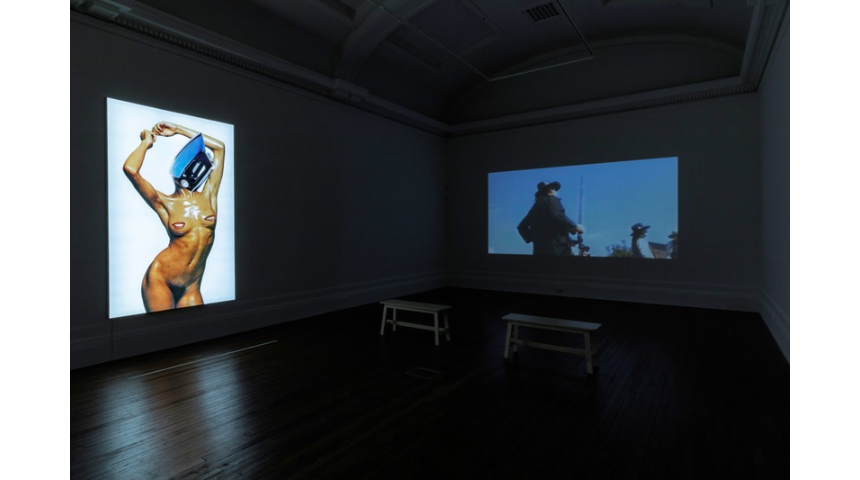
Linder: The Return of Linderland 2026, Grundy Art Gallery, Blackpool Council, Curated by Hayward Gallery Touring. (c) Linder, Courtesy Grundy Art Gallery, Blackpool Council. Photo: Brendan McGregor
In an interview with Sophie Porter for Rolling Stone in 2023, Linder speaks about the poignancy of the photomontage, and its proclivity for establishing a kinaesthetic connection to the world. She touches on all sorts of issues addressed in her work, most pressingly the ‘loss of sovereignty over one’s image’, and speaks very eloquently about the evolution of ‘punk’, both as a noun, verb and most recently an adjective recognising one’s own worthlessness [Linder & Porter, 2023]. She is both an auteur and a vessel through which the agonies of women and queer people the world over are channeled. It is a wonderful, telling portrait of the artist, and a great source to pull from before entering the final room of the exhibition, which is guarded by a sticker cautioning visitors not to take photos. (In as respectful a way as possible, I thought to directly transcribe my notes from lingering in this final room, which housed my favourite works from the whole show. My transcription follows the main body of this review).
This fourth room reaffirmed that, stopping to look at any of the small reproductions of collages, particularly in the third and fourth rooms, you would notice their stylish un-complexity. I’m drawn to a black and white series – In the bardo II-IV (2025) - obscuring portraits of Brigitte Bardot with porcelain figurines from collection catalogues. The accompanying text details the artist’s aversion to the film star, who she regards as a husk of her former self, embodying a ‘politically calcified idea of the world’. Grouping works in tight series of threes makes it all the easier to gloss over these hidden gems sprinkled throughout the show, as, while not overhung, the curation does not encourage us to investigate works beyond their surface level. From a distance, each collage resembles another.
I returned to the fourth room with an invigilator, discussing my surprise at the Girl With Bows drawings by L S Lowry (which, as my highly unprofessional notes specify, I was ‘OBSESSED’ with), venting my frustration that I had never seen the works before, nor could I photograph them. This simple request – of the exhibition, asking visitors not to take photos – is not particularly intrusive or difficult to follow, but certainly interesting in an exhibition personified by the recontextualising of images, taken from sources typically without accreditation. This could signify, being cynical for a moment, some kind of imbalance of power, establishing the status of ‘artist’ as an elevated counter to ‘consumer’, a thought which in all honesty did linger in my mind while recording my notes in a sketchbook. Realistically it appeared as an attempt to reintroduce the agency of the artworks, and on a personal level, it momentarily scratched the itch to feel, as stated, as though away from things while simultaneously at their center.
Before leaving, I picked up an enamel ‘Linderlips’ pin, managing to circumvent my usual frustrations upon seeing artwork transformed into merchandise, because the pins looked fantastic (though I did feel once again as though I was being forced into my ‘consumer’ costume). Linder has the unfortunate disposition, as all artists do in our post-advertising, consumer-oriented world, that in order to critique the system, she has to participate within it. In her case, her collages, frankensteined magazines, critiquing the sexism and oppression of women and queer people, are largely composed of images of conventionally beautiful and sexually attractive women. This is no news, neither a criticism per se. The exclusivity of the women included in these magazines says more about patriarchy and the role of women in pop culture than there is space to discuss here, but upon leaving I did not feel radicalised or transformed in the way I had hoped I might have, perhaps down to my own misplaced resentment, and my decision to sport the cheeky red Linderlips pin. I, theoretically, purchased my own un-transformation. Had I been wearing head-to-toe camo, this pin might have had much more effect.
What is made clear throughout, though, is the playful, razor-sharp (or indeed scalpel-sharp) wit of the artist. Linder is an artist with an instantly recognisable visual language, one that permeates into fashion, perfume and performance. Her most recent effort at the Grundy Art Gallery feels like an advertisement of this artist, or trailer for her film, with all the best bits trimmed off, so as not to reveal its twists and turns.
Linder: The Return of Linderland 2026, Grundy Art Gallery, Blackpool Council, Curated by Hayward Gallery Touring. (c) Linder, Courtesy Grundy Art Gallery, Blackpool Council. Photo: Brendan McGregor
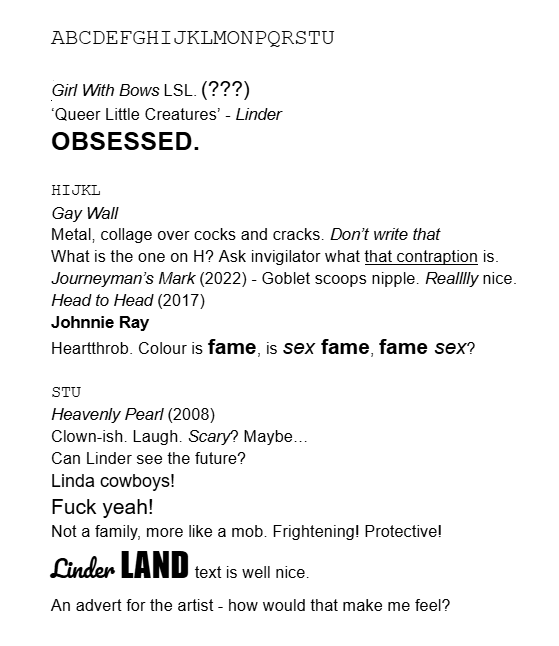
RECORDINGS FROM THE NO-PHOTOGRAPHY ROOM: