INTERVIEW Feb 2026 Sophy King and John-Paul Brown at Lowry
Sadie Rogerson

John-Paul Brown and Sophy King The Guardians of Living Matter (2026) photo Michael Pollard
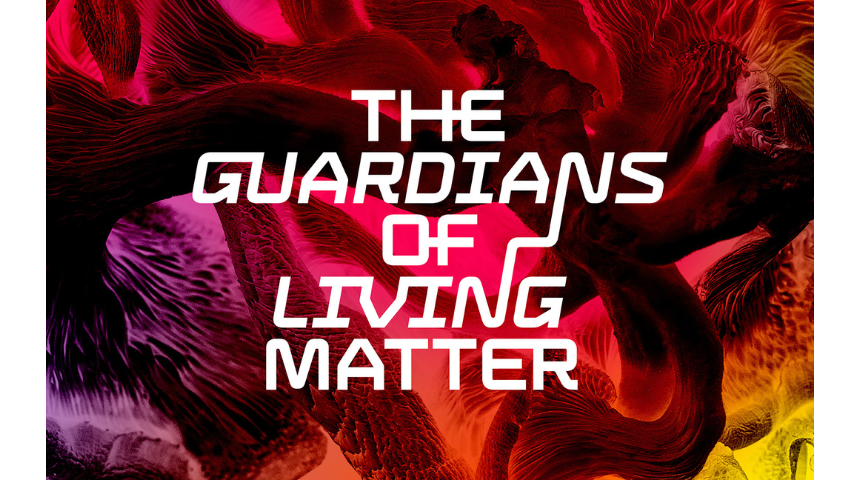
Lowry inspires care, collective action and hope for the future with ‘The Guardians of Living Matter’ by John-Paul Brown and Sophy King, a brand new commission enabled by flagship artist development programme Developed With, which supports ambitious upscale in the work of artists from the north of England by providing time and curatorial support. ‘The Guardians of Living Matter’ presents installations and staged environments combining climate research with low-carbon AI prototyping that offer a reenvisioning of planet Earth salvaged from guaranteed destruction by a collaboration between artificial intelligence and the natural biosystem mycelium.
The exhibition programme at Lowry is supported by Arts Council England and Salford City Council and ‘The Guardians of Living Matter’ is also supported by the Henry Moore Foundation, with additional support from the University of Salford, SODA (School of Digital Arts) at Manchester Metropolitan University, HOME Manchester, and Royal Exchange Theatre. Artist and writer Sadie Rogerson assisted with the installation of the exhibition, gaining first-hand insight into the innovative creative processes behind its development, and had the opportunity to interview both artists here.
See the exhibition until 29 March 2026.
EVENTS
Curator & Artist Led Tour: 12 Noon Saturday 7 February 2026
BSL Tour: 11AM Saturday 21 March 2026
Closing Event - Mycelium Rave with Bin Collective: 7-9PM Wednesday 25 March 2026
https://thelowry.com/the-guardians-of-living-matter-myvx
The year is 2076. The climate crisis has eased, not through human ingenuity, but through an unexpected alliance between more-than-human forces, artificial intelligence and vast mycelium networks. In this imagined future, where humanity is granted a second chance at stewardship, the Guardians of Living Matter dedicate their lives to researching this phenomenon. Visitors to Lowry are invited to step into their laboratory Headquarters, don their lab coats and explore a new dawn of the Anthropocene shaped by collaboration, hope and possibility.
Upon entering, visitors encounter John-Paul's work The Tapestry of Future Past, a thirty metre-long drawing which documents the period between 2026-2076. Intricate threads of symbolism run through it, a bricolage of visual references including the Rosetta Stone (196 BC), Bruce Nauman's video work Good Boy, Bad Boy (1985), Victorian truffle pigs, Claude Monet's Musée de l'Orangerie rendition of The Water Lilies (1914-26) and Blackpool Tower. The work entangles the local with the universal, highlighting the nature of the climate crisis as something that touches us both immediately and on a global scale.
In the next room we find, Behold… The Emergence of the Oracle, a collaborative installation suspended above the viewer. This work was made using mycelium and artificial intelligence, the AI controls the lighting, interpreting environmental data such as: weather patterns, forest cover and CO₂ levels harvested from 2025. The Guardian’s findings are then exhibited in the Laboratory of Affirmations, a studious space within the exhibition which showcases ecological research. The laboratory is lived-in; post-it notes with messages such as ‘check portals’ collect on coffee stained paperwork, as if this workspace has only been left untouched only for a few moments.
Sophy's striking installation Bureau of Entanglement provides a finale, transcending the boundaries between human and non-human ecologies, as developments in AI and mycelium unravel new portals of existence. Theatrical, impactful and enveloping, I wasn't surprised to learn Sophy's background as a set-builder and prop-maker for film and theatre. Sophy and I had shared our admiration for Roger Hiorns and Olafur Eliasson during the installation process. I believe their influence runs through her work, there is an insistence on total environment and atmosphere, where non‑human life seems to creep through the fractures of the human world. Being involved in the process raised questions about human labour too; it took us hours of sanding to create damage that, in this imagined world, these creatures could have produced in a single effortless swoop.
Working on the install, I had the privilege of stepping into this realm before it fully existed. What now stands as an ambitious exhibition – three large-scale works and The Laboratory of Affirmations – unfolded through layers of paint, unfurling ideas and the input of unpredictable non-human collaborators. As I worked alongside Sophy and John-Paul, I began to see how ecological research and climate hope were not just conceptual themes, but fundamental aspects of their artistic practice and ethos. That glimpse into their process – a show which was now living and breathing – made me want to hear more about the ideas driving their work, and became a starting point for this interview.

Sophy King and John-Paul Brown Photo © Phil Tragen 2023
Sadie Rogerson: World-building has become a prominent strategy in contemporary art, especially in response to ecological crises. Do you see this exhibition as a form of world-building?
John-Paul Brown: For me at least it’s a reimagining of our future. It’s 50 years from now, 2076, it’s turning pessimism into optimism, it’s rebuilding, it’s future-visioning from the perspective of activations that would make a difference in the world today. A lot of our research, if that was triggered now, would already make a difference. We also said that AI is here to stay, but what we can challenge is that AI has to be this big carbon intensive programme – that’s kind of what the show is, it’s challenging what is acceptable. For industry standards, for what is normalised by the government, big tech, capitalism and geo-politics. So, we invite collaborators and audiences to go on a journey, to explore what might be possible rather than accepting things for the way they are.
Sophy King: I think that we’re trying to open up a world, build a world, where possibilities still exist. It’s very easy to feel hemmed in by what’s happening now. So, by looking forward, and looking to fantasy ideas of what could happen, we can get that idea of hope back – things don’t stay the same, you’re in a bit of a push-back at the moment but everything’s possible and things are possible with what’s actually available now.
J-PB: Hope is the main driver of the concept, previously by doing lots of protests and participating in activism there’s been a big wave of this through younger generations across the planet. Like Sophy said there’s been a push-back on that, capitalism and geopolitics has got a handle on protesting rights. Everything has been nullified to a point, so, when you lose hope, it’s difficult to come back from, it’s difficult to regain that energy and that trust in a future that you are hopeful about.
SR: AI remains a contested presence in art, particularly around authorship and labour. How did you position your use of AI within these debates?
J-PB: Art history has always rejected the new medium of the day, but it exists, it’s not a fad, it’s not going anywhere – there’s too much money in it for a start. So, it’s right there in the middle of everything, you can embrace it or avoid it. When new tools come around, I think it’s at least important to give it a test, mark-make, explore ideas – it might not be the tool for you, but keeping up with technology, having an idea of how something works is important for artists. It is just a tool, it’s what you do with it. Not all artists will use it in an ethical way, we were seeing a lot of plagiarism of Intellectual Property. I think laziness is a big part of using a prompt tool, cream rises to the top no matter what, it’s how you engage with it responsibly.
SR: Do you view the AI as a "creative collaborator"?
SK: Yes, because it’s creating, but I have to say, I think of Alasdair [Swenson] as our collaborator and the AI is what he is developing to collaborate with us. The first thing I said to him this morning, was “I’d be really interested, after the exhibition, if we could start communicating with the AI, but not now because we’re in the middle of install!” I think in terms of that collaboration with AI, at the moment we’re using it via Alasdair as a tool. With his support, the three of us can really dig a bit further into the AI he has created to see what else we can make together. Then it becomes more of a collaborator, really it’s a baby at the moment who we’ve just started communicating with.
SR: I guess, having also helped with the installation, I’m very aware of the human labour, time and thought behind the show too.
J-PB: This show is highly labour intensive. I think AI is still, in a lot of people’s minds, ask a question – get an answer, give it a prompt – get an instant image or video. Our use of AI has been through conversations with digital technologists at universities, we’ve been attending conferences – all these conversations have been where the real action is. With the physicality of the show, there was so much hand labour from myself and Sophy.
SK: But also, the labour of Alasdair, writing these pages and pages of code – he’s been doing that in his evenings, in his research days, that is not writing a prompt, he’s gone deep, deep, deep into it and how to give it parameters. I guess what he’s doing is creating a whole language for him and the AI to communicate in. So, then the authorship becomes very muddy between the artist and the medium, as it were.
John-Paul Brown and Sophy King The Guardians of Living Matter (2026) photo Michael Pollard
SR: I think that’s an interesting point of tension because there’s such a strong link to this network of people, but the exhibition relies primarily on the more-than-human world.
J-PB: We focused on the idea, what if we got a second chance of being custodians of this planet? It’s these extra, external, unseen networks – by bringing them together by accident or by chance encounter, we need to put ourselves in the middle of that to help hold those networks together.
SK: Also, that’s our only frame of reference. And by putting ourselves within a network, that includes the more-than-human network; it creates a link between the “us” and the “not-us” and you can’t have that without the “us”.
J-PB: We’ve asked for help, we’ve been given it, what are we going to do with it?
SR: When people think about progress, they often imagine technological innovation and linear progression. I’m intrigued by your reference to cave painting in The Tapestry of Future Past, the circular structure of this piece suggests a "looping" of history. How does this relationship to the deep past influence the way progress appears here?
J-PB: I was thinking about this, and I thought about that old adage ‘the more things change, the more they stay the same’. I feel like there’s always been an ebb and flow between technological advancements and grounding rituals. With the James Webb telescope and the discoveries in the last four or five years, one thing I’ve learnt in this journey is that facts are temporary.
In the drawing I’ve used a material that already looks aged, there’s references in there to the Rosetta stone, cave painting, stone circles, star constellations. And we are going to end the show with a mycelium puppet rave, bringing together people in celebration through the form of community dance.
SK: In many ways, that’s what art is. Sadie, you and I were talking about stone circles and land art and their role in creating. Whether that be an image or a performance, a space, we’re all trying to create something that gives connection. And that hasn’t changed for thousands and thousands of years, that’s what humans do. The more we do it, the better.

John-Paul Brown and Sophy King The Guardians of Living Matter (2026)
SR: Sophy, your work the Bureau of Entanglement imagines more-than-human life; these tree-like creatures seem to exist on their own terms, how do they fit into a post-Anthropocene way of thinking? Are they protectors, or perhaps legal entities as "bureau" suggests in this new world?
SK: They’re like an embodiment. I’ve framed them as coming from another dimension, a different world. But they’re an embodiment of nature, something inanimate that’s come to life. I guess something we can understand better. If you can really see that something is living you have a different empathy towards it.
I mean there are really interesting things we have been learning about mushrooms. They’re not a plant, they’re not an animal, they’re closer to animals than they are to plants. It blows your mind, you’re looking at this thing, you’ve eaten them for ages, and then you look at them with a completely different frame of mind: what they are, what they’re doing and how they’re connecting other plants beneath the soil. So, I think, it’s just a different way of looking at it. It does touch on environmental rights, imagining a place where that is the case, where everything does have equal standing in the world.
SR: Working with AI in a nature-focused project inevitably raises ecological questions. How did sustainability and environmental impact factor into your decisions around the technology you used?
J-PB: I think we’re very conscious artists anyway, we are into low-carbon art making, we always think about our material choices, where they come from, whether they have been salvaged for example. And what we will do with the materials in the show afterwards is just as important, think about the endgame before the start point. A big question we tend to ask ourselves is what if? A lot of good material comes from that. There’s nothing too silly or unrealistic as a starting point, if the idea is good, we are going to see ways to bring that to fruition with minimal impact, we place a high value on that.
How to make a show about AI more environmentally friendly: what if we don’t use generative prompts, what if we don’t use live data, what if we don’t use an internet connection? So, figuring out all these ways to reduce data processing, data storage. They are big concerns for us. What if we challenge big tech and government about industry standards and ask questions about data and storage and carbon footprints? Our job isn’t necessarily to provide answers, but we’re here to open up discussion on global intensive data.
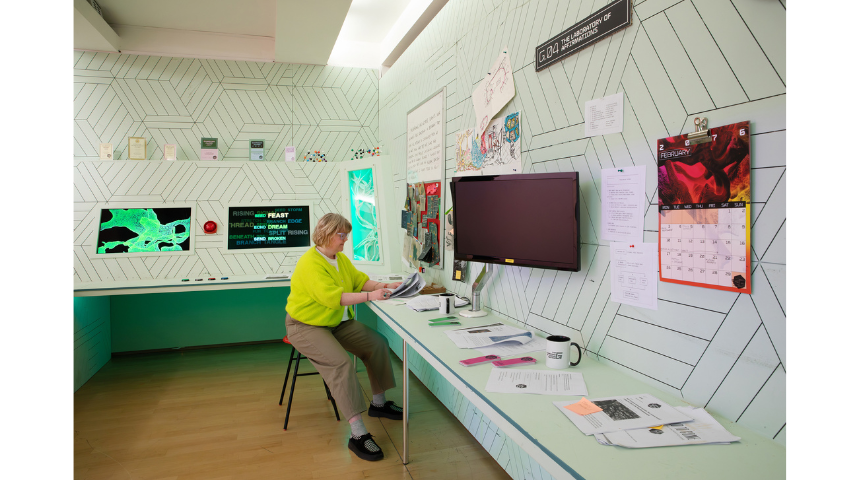
John-Paul Brown and Sophy King The Guardians of Living Matter (2026) photo Michael Pollard
SK: A lot of the AI people we’ve been talking to, the first thing we’ve said to them has been, we want to use a low carbon AI. What we’re finding is, there are people who are only a short way along the road to coming up with answers; there are people who are further along. It all centres around the idea that AI should be decentralised. Then you don’t have the need for huge data centres and huge water consumption.
As long as each AI is held by some conglomerate corporation, that’s their money-making machine. They own it, they keep it in one place, and that’s where you get these really massive data centres, massive power need and water needs; that’s the reason for it. It’s not AI itself that needs that, it’s just how it’s organised. As JP said, we haven’t used generative prompts, we’re not using Wi-Fi, our data is harvested from this time last year, so it’s not live. And this cuts down our energy usage massively. But we’re asking that question, why is it like that? How is it like that? And when you start talking to students and professionals in the field you realise that steps are moving along to change how that is organised.
J-PB: We’ve had a massively positive response from all of these people. “Oh great, someone’s talking about it”; “Oh it’s not just me!” Rich, interesting conversations. It’s not just companies, it’s global territory. Countries and continents are trying to safeguard it; that’s a real big block, that’s a huge barrier. We went to a lecture about the history of AI and he went right back to the Victorian times, he came out with this interesting statistic that in the Industrial revolution, 85% of the global market share was in Great Britain. That’s crazy. Compare that to Britain’s global market share in Artificial Intelligence, 2%. We used to have 85% of the leading industry and now we have 2% of the leading industry. They are desperate to build massive data centres to gain global market share, which means most of their decision-making is centred on this. That is not a good place for us to be, in terms of dealing with the climate crisis.
SK: It’s not a good place to be in any form of corporation, it’s like capitalism eating itself. All that matters is market share, we’re all consumers. It’s like this is all that matters, it’s really not the thing that matters; it was just there to make us all have a bit of an easier life. That’s what that whole world should be, and it doesn’t do that, it’s just spinning around eating its tail.

John-Paul Brown and Sophy King The Guardians of Living Matter (2026) photo Michael Pollard
SR: It’s become very evident to me that the amount of research, not only for this exhibition but in your entire careers as artists, has been dedicated to the ecological crisis. I really like that research is displayed like art itself in the form of The Laboratory of Affirmations. Was this a conscious curatorial decision?
SK: I think it was very much a conscious thing, when we were developing the show, we’d go blasting Zoe [Zoe Watson, Lowry Contemporary Curator] with all of this information. It evolved itself, but it seemed it was very clear that we needed a place where all these ideas within the work can be touched on.
J-PB: And I think the Laboratory space, when we have completed the install, won’t be too dissimilar from the state of our studios! When Zoe was doing her site visits, she highlighted it was something that should be shown. We’re using unseen forces; we’re showing our research behind that. It’s an onion layer. People experience art galleries in all kinds of different ways for all different lengths of time. There’s something here for everyone, from a fleeting visit to sitting here for hours reading books and research papers. So, I think maybe we were apprehensive to show some of the research, but by presenting it in this way – you just tap into it if you want to and its light-touch if you don’t want it. It’s meant to engage with people on different levels.
SK: This show is on for eight weeks, you have thousands of people coming through –there are layers to how deep you want to go into it.
J-PB: There is a secret reward in the show, for those who do want to sit down and read the research, there is a secret bookmark to take away from the show.
SR: Many of your materials, mycelium, rope, reclaimed paper, have their own lifecycles. Did you begin with a rigid concept first, or did the physical "behaviour" of the mushrooms and fibres guide the ideas as the work developed?
SK: That’s part of the process, this push and pull between your materials and your ideas. Some ideas you go “well that should be made out of this”, some ideas come from “I like this stuff let’s play with it” and that’s just the artist’s way of working with stuff. The same goes if you’re working with clay or paint or moss or anything. You set up conditions, you make a shape, you put it in a place – and how the material reacts whether it’s living or not is part of the process of making the art. Some people might work with the same material all the time, they know it so well that so that conversation becomes very short and they start to push the material to other places. We’re both people that work with different materials all the time, it’s just a conversation the whole way through between yourself and the material.
SR: There’s a saying: Never work with animals or children – do you think this applies to mushrooms and AI? How did it feel to work with such unpredictable non-human collaborators?
SK: They’re a complete nightmare! You say you’ll never do it again and almost always do it again.
J-PB: I think this question really highlights the importance of cross-disciplinary collaboration. We sought out scientists and digital technologists, we had an AI mentor from the School of Digital Arts called Dr David Jackson who has been great, talking to us constantly about the ethics of AI. We’ve learnt new skillsets and gained lots of knowledge to have a bit of an insight into how this may come around. Your question got me thinking about a line from a Bob Dylan song which is, “I’ll know my song well before I start singing”. For the past year, we’ve really sank our teeth into this, you learn your lines really well to the point when you can say 70% of this is like based on what we know and where we want to go with it, and we factor in maybe 30%, to allow for that autonomous creativity to come in with its unpredictability. Unseen problems, errors are factored in, we embrace that level of unpredictability.
SK: That’s kind of where beauty happens, it’s that tension between chaos and control. It’s where that meets that is really interesting: it could be more successful, less successful – but it’s that liminal space between.
This interview is supported by Lowry.