REVIEW Nov 2025 Curation in triplicate at texture, Manchester
Jo Manby
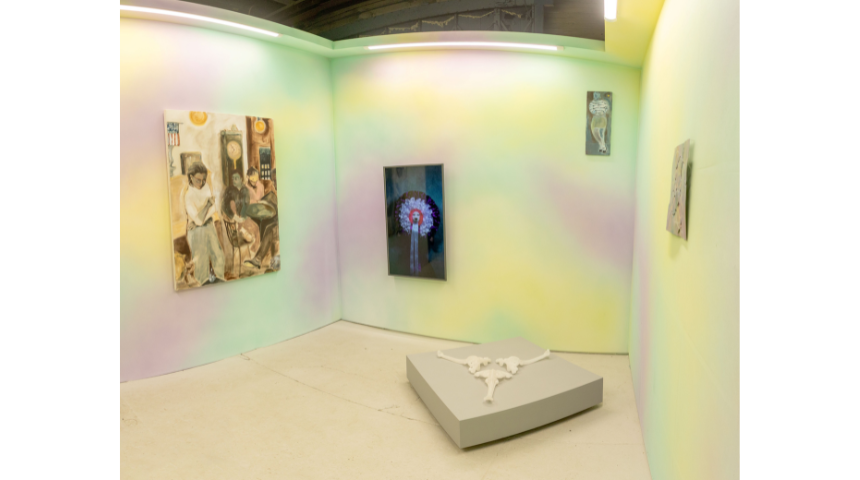
texture gallery ‘Three Readings: An Exhibition Curated Three Times’ installation shot photo Will Marshall
For the final show at texture, director Will Marshall stages ‘Three Readings: An Exhibition Curated Three Times’, exhibiting work by Tulani Hlalo, Jun Rui Lo and Mary Lou Lawless-Gill, and curated three times over by three different curators – Laura Biddle of Tate Liverpool, Bella Probyn of Tate Britain and curator and artist xhi ndubisi. the Fourdrinier editor Jo Manby went to see the exhibition/s and spoke to ndubisi and Marshall to find out more about how three curators can recontextualise the same show in three different ways.
‘Three Readings: An Exhibition Curated Three Times’ is on view at texture, Ardwick, Manchester until 23 November by appointment https://texturemcr.com/home
Entering the small gallery, soon to strike camp from its current location on a doomed industrial estate in Ardwick, through a blue velvet trimmed corridor, the visitor feels embraced by texture’s shifting mother-of-pearl emulsion walls hung with a selection of seductive artworks, and an enticing floor-based sculptural piece.
‘Three Readings: An Exhibition Curated Three Times’ presents work by Tulani Hlalo, Jun Rui Lo and Mary Lou Lawless-Gill. The same exhibition has been curated with its own title and accompanying text by:
· Laura Biddle, assistant curator at Tate Liverpool – ‘wait, I am here’
· curator and artist xhi ndubisi – ‘engram: i/iii’
· Bella Probyn, curator, artist and production and art installation coordinator, Tate Britain – ‘Last Looks!’.
The colour of the walls condenses the concept of the show as a coming together of creative thinkers, as if the efflorescence of the director’s, the curators’ and the artists’ minds was unwrapping, exposing and revealing itself in the form of rainbow hued mists and clouds that hover and drift across the gallery space.
Immediately to the left, Lawless-Gill’s roughly, thinly painted canvas, one of three presented here, is understated, her casual brushwork loosely referencing her subject matter, the Beatnik generation of artists, writers and poets of the 1950s. A brush held at arm’s length, scenes imagined at a distance, the distance of time and the distance of milieu – the artist acknowledges that due to her gender she would not have been given house room as a painter by her idols. But in this distance, there is an intimacy, rushed lives lived too fast in the glare of publicity, a drug-fuelled haze, poetic smoke and mirrors. The work verges on flippant, throwaway; but more sincere, more caught looking dreamy in the wings at a lost cohort on the move, through sliding doors, on the carousel of the public eye. Fluid, loose, brushy, breezy, flared trousers and skirts, stiff collars, sunglasses, masks. A slip here and there.
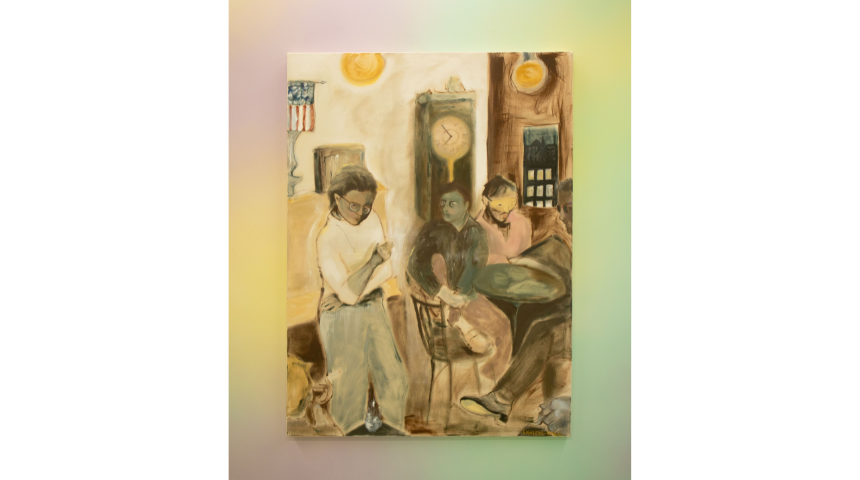
Mary Lou Lawless-Gill Poems in Praise of my Husband (2025) photo Will Marshall
Hlalo poses as a show dog, tiny twitches and eye movements caught in her video, wearing an outsize rosette and a dog mask, something dog-ego-deflating in the fact that the ears are not visible, but flattened underneath the massive rosette, wreath-like a huge memento-mori to its wild origins. Performance art that is about endurance – the rosette commanding the viewer to ‘look at me’, ‘pity me’, swamped in ribbon and overblown like a wedding decoration, overdetermined so it can no longer realistically support its own weight conceptually, but collapses into farce. There is a preposterous sense of the absurd but also of heartbreak for the way people, especially young people, are expected to parade themselves amid the spectacle of life lived online, like child actors dressed in hideously extravagant costumes.
A cast iron table leg is cast by Lo in wax three times. An inversion of the lost wax process in which wax is used to make a mould for a cast iron object. Here, the wax is the object, cast from an iron original. It has an ethereal quality, semi-opaque, softly gleaming. Makes you look again to check its material composition. Two square pieces of sheet steel with looping lines perforated into them by oxy-acetylene welding and painted with layers of thinned down acrylic to create a nebulous, swirling pastel-coloured haze. A step on from previous works by the artist that included drawings of similarly cursive, spiralling lines. A keen interest in the properties of materials and the capacity of transformation through manipulating media and surfaces to create layered surrealities.

Jun Rui Lo Untitled (Here) (2025) photo Will Marshall
Laura Biddle holds a lens of shifting identity to ‘Three Readings’ in her curation, ‘wait, I am here’, uniting the works in terms of their fluid, unstable, yet ultimately meaningful and personal examinations of selfhood. Hlalo’s work she positions as a commentary on the difficulty of negotiating between cultures. Lawless-Gill’s paintings are seen as an invitation to the viewer to transfer themselves onto the characters depicted in order to reimagine themselves. Lo, Biddle suggests, removes objects from context and renders them anew, mirroring the change and fluctuation inherent in gender fluidity and diasporic experience.
Bella Probyn, in ‘Last Looks!’ superimposes a film set onto ‘Three Readings’, not hard to visualise with the blue draped corridor and the ‘open’ ceiling of the gallery itself, with its exquisitely nacreous spray-painted walls. Probyn reads the artworks in terms of ‘performance, construction, and transformation,’ using the final call of a director immediately before the command of ‘Action’ as the title of her curation. She traces choreographies across Lo’s works; a cast of characters and props in Lawless-Gill’s paintings; and makes us, the viewers, into the camera operators in Hlalo’s video work.
xhi ndubisi, curator and writer, mind-bendingly unfolds human desire and the gaze in the text which accompanies her curatorial stance, ‘engram: i/iii’. This is incredibly insightful writing. ndubisi’s approach is to take an idea, at once diagram and concept, and build her version of the exhibition around it. Only she does much more than that: now to understand what curating is all about, via a debrief on dog-breeding. She constructs a deconstruction that is constantly de- and re-constructing itself, like a constantly repeating TikTok meme or a steel-bearing infinity puzzle, or an ouroboros. Once you’ve read her manifesto, you can’t misunderstand what she has told you. The meaning is crystal clear and at the same time iridescent with complexity.
I asked xhi ndubisi how she approached the curation. After seeing the work that Will had brought together, she ‘began by researching each of the artists and looking at the work they were making and thinking about what kind of conversation I’d like to have with the artists – and also what premise I would present, what kind of structure could there be to hang this dialogue on.’ That was where the idea of the engram came in. ‘Will was really supportive,’ ndubisi continued, ‘and we had a talk on the phone about what kind of shape of an idea I’d like to write. I also feel like this is something that could be replicated. It’s a wonderful invitation. I often go to exhibitions and really ask myself, what was the curator thinking, what was their frame? And why did they choose that frame? I’m also really interested in the act of curating and the curator as an artist or as a thinker. The curator as another contributor to the exhibition, not just shaping the way it is seen but adding something different to what is seen, adding a new context.’
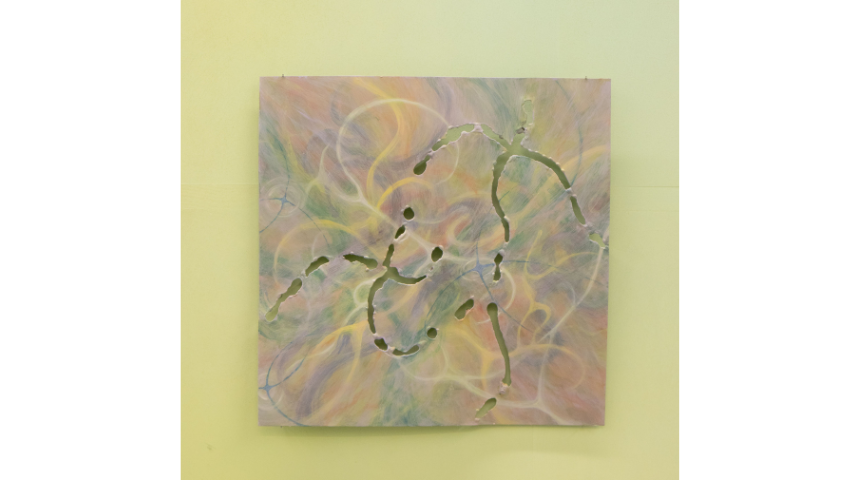
Jun Rui Lo Untitled (New Lights) (2025) photo Will Marshall
After visiting this captivating exhibition, I got the chance to ask Will Marshall, director of texture gallery, about the show and the future of the space.
Jo Manby: What inspired you to format the exhibition in this fascinating way, with three curators of the same show?
Will Marshall: I have treated the four exhibition programme in this space, in part, as an exploration and experimentation with the format and formalities of the exhibition as a concept. So, for this show, I thought it would be interesting to play with the idea of curatorial interpretation, and ideas of authority. Each brings their own version, and there isn't one definitive version of the exhibition. It becomes more fluid, open and democratic. The point being that anyone can bring their own narrative, and that at the end of the day, curatorial interpretation is not final.
JM: Will you be doing it again, as it seems a great concept?
WM: I doubt it, it was part of a specific four show programme, and belongs to that. I'm always interested in the next idea. A lot of the shows I do are about coming up with a new model for doing a show, which in theory could be redone but with new artists. But I don't really have much interest in doing them again (unless a big gallery wants to give me a nice fat budget to do one again).
JM: What is the remit of texture, and will it change or stay the same in its new home?
WM: It will move, this show will be the final one in its current location, but all being well we will move into a new space, and after a winter break will aim to open up again in spring. In that break I will figure out the form that the new programme will take.
JM: I heard you are moving to north Manchester, is that correct? Will the beautiful branding for the gallery stay the same, or change?
WM: Time will tell - nothing is certain yet. The brand will stay the same, the building will change, the shows will be different.
JM: Do you work on the basis of a 5 or 10 year plan? What are your future ambitions as a gallery director?
WM: To start off with, I just took this as a fixed term, four show programme. I haven't the energy to look beyond that yet. Once this show is behind me, I will start thinking more strategically about the future. But I want it to become sustainable financially, to be able to offer more artists opportunities, be able to pay artists and collaborators better, and keep being able to put on shows that I think are interesting.
JM: What kind of artist (and/or curator) are you most keen to promote / work with?
WM: Anyone who makes interesting work that makes me think, that grabs my attention, and has substance. I don’t really have many red lines.
JM: A specific detail, were the gallery walls spray painted for this show? What kind of paint/technique of application?
WM: Yeah, they were painted specifically for the show, the idea being there was a colour for each version of the show, and they blend and bleed into one another. It was done with a paint sprayer and an air compressor, only took a few hours.
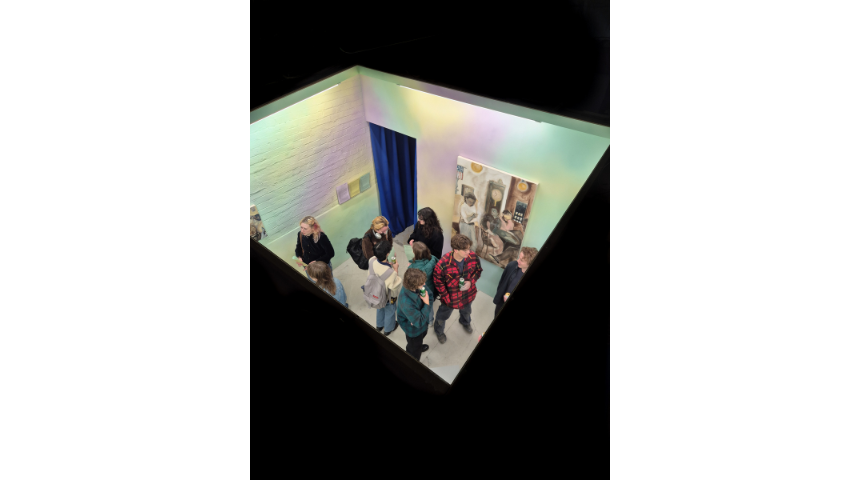
texture gallery view from above photo Will Marshall