FEATURE Jan 2026 ‘Roots in the Sky’ at HOME Manchester
Josephine Manby
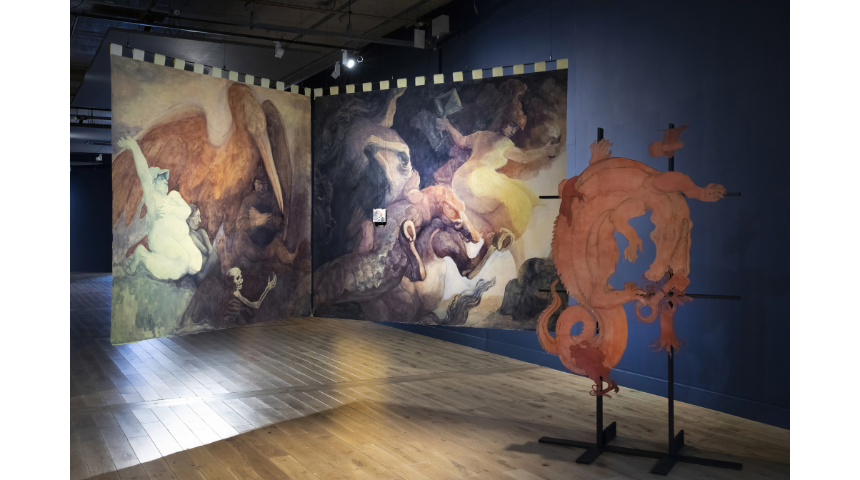
Elena Njoabuzia Onwochei-Garcia (left) Fight/Flight of the Birds (2025) Oil on washi; (right) Fall of the Crocodiles (2025) Oil on washi; (sculpture) Civility (2025) Tempera on washi; Allegory of the Third of May (2025) (from the triptych On Rebellion) Oil on marble. Installation shot. Photo: Michael Pollard
On Saturday 11 October 2025, a Panel Discussion was held at HOME, Manchester as part of ‘Roots in the Sky’, the first major curatorial project by artist Tunji Adeniyi-Jones, in order to talk through the themes and issues arising from the exhibition. Chaired by writer and art historian Aurella Yussuf, whose work explores ways Black artists create community and space outside art institutions as sites for producing critical thinking, the panel included artists Adeniyi-Jones, Jade de Montserrat, Elena Njoabuzia Onwochei-Garcia, Shaqúelle Whyte and Nengi Omuku. Also exhibiting in ‘Roots in the Sky’ are Alvaro Barrington, Ivy Kalungi, Joy Labinjo, Sahara Longe and Tschabalala Self. the Fourdrinier editor Josephine Manby attended the exhibition and panel discussion and shares her experience here. See ‘Roots in the Sky’, FREE entry at HOME, Manchester until Sunday 25 January 2026.
“This is precisely the time when artists go to work. There is no time for despair, no place for self-pity, no need for silence, no room for fear. We speak, we write, we do language. That is how civilizations heal”
- Toni Morrison
‘Roots in The Sky’ lead artist/curator Tunji Adeniyi-Jones opened the panel discussion held at HOME in October by speaking about the importance of curating a show like this now: ‘There’s an emergence of a community that has not always been available to Black artists in this country.’ Tunji referred to a letter written by Guyanese artist Donald Locke (1930-2010), father of Hew Locke, concerning his inclusion in Festac ’77, the Second World Black and African Festival, that ‘speaks to the limited opportunities that Black artists had in Britain’ at the time. It means that convening exhibitions and discussions like these that foreground Black artists’ work, in testing ideas within a community ‘are a vital part of the diasporic artist experience.’
Tunji referred to the strong sense of dialogue that comes over in ‘Roots in the Sky’, and lists recurrent themes of ‘interiority, memory shaping collective experience, mythology, the human form and the natural world.’ There can be a compulsion to present Black artists in a certain way, Tunji said, ‘that you don’t find here’ in the UK. Instead, this ‘curation of restraint’ avoids ‘a didactic framing.’
Tunji Adeniyi-Jones was born in London and is currently based in Brooklyn, New York. Inspired by his Nigerian Yoruba heritage, he processes his experience of diasporic identity through a fluidity of swirling, looping colour that proposes an alternative way through the hindrance of language barriers and an acceptance of corporeal plurality. Tunji exhibits two of his own paintings which depict an orange and yellow medium where protean figures are suspended in animated poses, swimming through an imbricated, kaleidoscopic, shallow plane of honey or amber, scattered with accents of leaf green and sky blue. The effect is pure positivity, brightness and optimism, bathing the viewer in a pictorial equivalent of sunshine.
Tunji’s approach to curating ‘Roots in the Sky’ began with as part of a regular strand in the programme at HOME, initiated by Creative Producer: Visual Art, Clarissa Corfe and undertaken by her in previous positions as well, of inviting artists to curate, as artists, rather than curators. Tunji brought together other artists whose work he admired and had supported for some time, forming close bonds. The result transforms HOME’s ground floor gallery space into a profusion of large-scale works, some glowing flat against the wall like Alvaro Barrington’s three oil paintings, Father Stretch My Arms (2025), others taking up the floor in three dimensions, like Elena Njoabuzia Onwochei-Garcia’s hybrid allegorical triptych collage, On Rebellion, comprising Fall of the Crocodiles, Civility and Allegory of the Third of May (all 2025) in rich, archaic earth colours.
Elena took up Tunji’s introductory discussion of history and identity as ‘an unstable concept’ and spoke of her own practice where she creates ‘a lot of drawings, then piece[s] them together’. Elena drew attention to the crocodile-like form in her work in ‘Roots in the Sky’, as exemplifying how her work concerns ‘changing, converting meanings, bringing in new elements.’ The crocodile is a freestanding element of her collage, presented like a stage-flat. Of Spanish, German and Nigerian heritage, Elena combines historical research with figurative drawing to create immersive works on Japanese washi paper.
Jade de Montserrat exhibits expansive watercolour drawings that include charcoal and earth colours – greens, browns, ochres and reds – and shapes and forms of seeds, leaves, the striped markings of animal pelts. Jade is an artist activist academic and research-led artist and writer who studied History of Art at the Courtauld Institute and Drawing at Norwich University, and is now based in Yorkshire. Through an often collaborative practice that embraces painting, writing, drawing, performance, live art, sculpture, print and text art, she challenges institutional structures at the intersection of gender, race, class and colonialism and explores the maintenance of histories, the nature of language and the vulnerability of the body.
Jade also spoke of questioning memory. ‘I’m grappling with unearthing histories pertaining to British culture and where my work and my peers’ work sits within this lineage.’ For de Montserrat, ‘the idea of memory and inheritance and fluidity is punctured by histories of trauma. The work I make works through that in an embodied way.’ Describing ‘Roots in the Sky’, de Montserrat finds a ‘generosity of approach and a confidence in audience. Each piece speaks on its own as well as part of a group, there’s a creation of an artistic ecosystem which allows for experimentation.’
Citing the ‘Kerry James Marshall: The Histories’ exhibition at the Royal Academy (until 18 January 2026), Tunji noted that it’s a show that points up how ‘We’re all finding our paths in real time.’ It ‘opens up what Black artists’ work can be.’ Asked about the themes that emerge of lineage, cultural memory and inheritance, Shaqúelle Whyte, a figurative painter born in Wolverhampton, UK, whose work positions real people in imaginary scenarios and delights in the materiality of paint, responded by summarizing how ‘the work becomes more than the initial idea.’ Memory becomes a device ‘through which your work can be read… memory can become an animate thing that exists within its own language.’ In ‘Roots in the Sky’, Shaqúelle exhibits two works, both of which depict men absorbed in peaceful activities, such as reading amidst a fictional interior landscape composed of books.
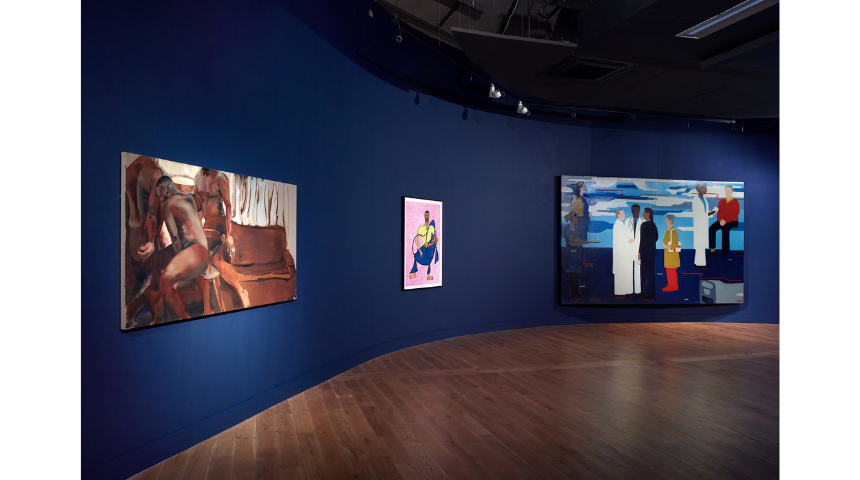
Shaqúelle Whyte Missing (2025) Oil on linen. Installation shot including work by Tschabalala Self and Sahara Longe. Photo: Michael Pollard
There was a discussion of the love for their work among the ‘Roots in the Sky’ artists and a desire to support future generations to make work, before the subject turned to corporeal presence: ‘How is the body visible in your work,’ chair Aurella Yussuf asked, ‘and what does it represent to the audience in terms of the different types of gaze that it can be subjected to?’ Shaqúelle described how in his paintings he aims to render the human figure in a non-sexualised way, and combining ‘telling stories and found imagery’. Shaqúelle went on to describe how the Black body was key to his work, along with the ‘telling of something about personal experience. There’s a feeling,’ he continued, ‘that Black artists are not allowed to fail.’ His own work has become a therapeutic process; it’s freeing, he says, and ‘the work is for me, first and foremost’.
Looking again to the Kerry James Marshall show, and listening to information ‘about his cultural life’, Shaqúelle was reminded of the need to assert that the Black body ‘is not something to be scared of.’ His question to Tunji was then to ask him to speak about ‘a strong sense of refusal to make things in a certain way’ among the ‘Roots in the Sky’ artists. Tunji feels there is ‘the power and freedom of fiction to be able to work in painting, collage, etc. – it doesn’t need specific indicators.’ He spoke about the experience of living and working in America for a decade. ‘You can give a work a label and a title – “Black Figurative Painting” – but it’s like a trend, there’s a shallow nature to the conversations around the art and practices of Black artists.’ Tunji critiqued the kinds of spurious connections and assumptions that emerge: ‘That’s why exhibitions like ‘Roots in The Sky’ are needed – Shaqúelle vs Alvaro? It’s not comparable.’
Tunji asked Jade about her use of silhouette as a means of dealing with how oversexualised the body can be. What did silhouette mean to Jade in her work? She discussed having thought about the persona of Josephine Baker, about androgynous figures and about ‘fielding speculation about our bodies’, and the way she feels compelled to ‘grapple with these very explicit concerns in everyday life’ and in history.
There followed a discussion of the painting surface as a body in itself. A substrate – paper, canvas, wood, textile – can absorb or repel paint, ink, or dye. For the artist, there’s a strong sense of connection; the surface is the site of experimentation, trial and error, perseverance, and joy.
Nengi Omuku originally trained as a horticulturalist and a florist, and creates dreamlike hybrid paintings on stitched together strips of sanyan fabric where people and other creatures are untethered from cultural hierarchies. Nengi describes her own approach as follows: ‘I deal with the shell of the body, with who we have to be in the world.’ In images emptied of representation, her work advances towards abstraction ‘to speak about the fluidity of the mind and also the general human experience. The resonance in the viewer is of shared experience’. Nengi explained that it took her a while to ‘figure out how to incorporate textile and painting. They were Yoruba women’s dresses. Panels that were wrapped around [the figure], not cut into a dress pattern.’ An interest in textiles led her to look into the Nigerian experience – the material directed her, as she puts it.
The panel began to discuss group crits and media of choice, topics such as how to manipulate the materials an artist is using, ‘control increasing as years pass,’ Tunji said: ‘you can use paint straight out of a tube. If you know what you want from it, you can use it. You can ask “What can I make the oil do?”’
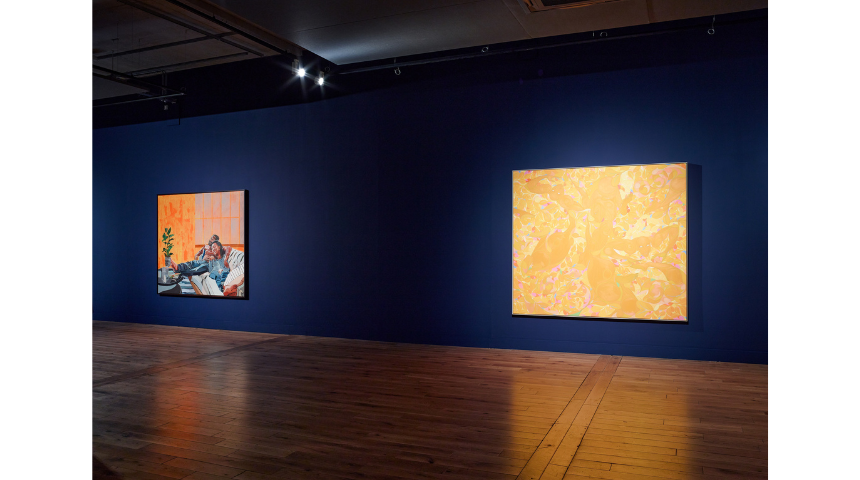
Left: Joy Labinjo Love him and let him love you (2023) Oil on Canvas. Right: Tunji Adeniyi-Jones Roots in the Sky (2025) Oil on canvas. Photo: Michael Pollard
Elena spoke about her love of oil paint and ‘the malleability of the paper I use.’ She had recently begun drawing on marble paper and loves ‘marble as a carrier of ideas… the oil just seeps over it. With canvas,’ she explained, ‘the thread is a bit too present. Canvas is too theatrical, so paper, washi paper – it’s like peeling the paper off the world.’ Elena’s transference of her process into words is so compellingly poetic: ‘As we move through the world we move through these walls of meaning.’ She adds that the element of stone ‘forces response to material.’ This description redoubled my interest in her work, and, going back into the gallery to see it again, I was struck by the sheer power it contains in terms of lighting fires of inspiration in the viewer – the work is simultaneously diaphanous, layered, shapeshifting; it is expressive of prehistory, the past seven centuries, and right now, all at the same time.
Shaqúelle described how he had recently begun to use gessoed Belgian linen to paint on, ‘so that before I even do anything – distemper, oil glazes, pigment – I have this ground.’ He talked engagingly about oil painting being ‘like having a tool kit – you can reach in and find new things, there’s the infinite nature of possibility, the way it goes wrong and the way it goes right.’ Alizarin crimson, he explains, ‘disappears during the painting process. There’s a constant process of figuring things out.’ His profound love of painting and the materials of painting, as well as its proponents, shines over: ‘Look at a lot of Rothko. They are like portals – work that you take note of and come back to.’ Shaqúelle states his aim: he wants his own work to be like a portal. ‘There’s always a reward in painting. Especially oil painting. Something that has been saving me for a long time.’
Jade described how ‘we are constantly students of the materials we use… we are in constant discourse with everything that inspires us on a daily basis.’ She talks about using materials to note take, and ‘thinking about how I might use them next time.’ She only half jokes ‘I want a massive studio and I want it now! Materials act differently each time you return to the studio. You’re trying to recreate but they behave in that other way.’ She talks about the accidental additions: how you can find staples in Frank Bowling’s canvases; how if you were in Nigeria, could you potentially work more quickly because the weather is dryer and/or hotter? Jade talks about recent use of Arches paper (‘on a roll’). ‘It’s a really heavy, expensive watercolour paper. Watercolour paints by the tube. Schminke. They are expensive but I can afford them and it makes financial sense and they can be preserved.’ Good quality materials that will stand the test of time.
Attention shifted to the artistic process. Tunji was asked about the shift from making paintings to curating a show. What was he setting out to achieve? Tunji had noticed ‘a few gaps that evolved and a need for art criticism that speaks to the way we are all able to learn from each other.’ Referring to curator, writer and broadcaster Ekow Eshun’s leading book, Soul of the Nation: Art in the Age of Black Power, a survey that restores to visibility long-ignored Black artists of the twentieth century, he voiced a concern that such groundbreaking and important work might get lost, and that there is a need for ‘more art criticism.’ His other point was that there needs to be more shows like Eshun’s ‘The Time is Always Now’, ‘In the Black Fantastic’ and indeed, Tunji’s ‘Roots in the Sky.’ ‘We [as Black artists] are expected to stand alone on a pedestal, but it’s nice to have something like this that’s more about a conversation – like the one we’re having today.’ As an artist invited to be a curator, Tunji explained, ‘this show has given me more ideas.’ He spoke of ‘Roots in the Sky’ as ‘an expansive concept, not just fixed inside these four walls.’
The question then arose, ‘What does the future of diasporic practice look like?’ In response, Nengi talked about the work she is showing in ‘Roots in the Sky’: ‘…the body is smaller. As human beings we are very loud (shouting, bombing) – now thinking of a new world building, something that’s not destructive’. She describes her figures living peacefully in a landscape. Tunji sensed a future space ‘where all we are doing here is able to eke out into the environment. Public art, schools – so concepts are not confined but are broadly understood. More direct engagement with the outside world, the broader culture, public art. We should be taught that this is something to aspire to.’ It’s an optimistic projection, and one which is so attractive as a set of ideas right now.
Elena agreed: ‘spreading the agency out as to who has power and when; as things become more radical and scary, it’s important that our world vision is more complex.’ Jade spoke of the way ‘Roots in the Sky’ allows a ‘resurgence of culture workers all aiming to make change within our sector, so that this has an impact structurally and therefore would impact on Black British histories.’ Speaking of being Black British, and what that means, she went on to praise the idea of collectivising ‘to make our voices louder’. She and Tunji discussed how it is not so clear in the UK as it is in the United States as to how ‘the role of imperialism affects us today – it’s all obfuscated. This makes it difficult in terms of collectivising.’ There was a general need for ‘conversations around class – who makes, who teaches. Art history and fine art are a rarified, devalued subject now.’
Jade referred to acclaimed American artist Simone Leigh who ‘convened the group BLACK WOMEN ARTISTS for BLACK LIVES MATTER in response to the continued inhumane institutionalized violence against Black lives’ (1), ‘joining forces to make the structural change that we want to see. It’s about a concerted effort.’ Regarding Kerry James Marshall, she called out the way the sector works, referencing his BBC Radio 4 This Cultural Life which revealed that he earns the highest income for a living Black artist. ‘When millions are at stake, how does this silence you – are you a kind of diplomat who keeps playing a game?’ Shaqúelle responded to this by pointing out the need for ‘further access for working class Black kids to do what we are doing – to have the freedom of being oneself.’
Shaqúelle recalled conversations during his time at the Slade School of Fine Art, where he graduated in 2022. There was access to Black tutorials with Michael Armitage, Alvaro Barrington. There was ‘a coming together for a set identity. How do we mobilise this thing that’s going on – Black British art – it’s within reach,’ he says – ‘what do we need to do?’ One of the things that’s needed, he continued, is ‘more freedom to fail. There is an idea that if you fail you are failing all Black people. We need to take up more space – a lot of what this show [‘Roots in the Sky’] does.’ Tunji was asked by the panel whether he would be doing more shows like this. Is there freedom to just be? Is there a pressure to express yourself? Nengi spoke about thoughts of collective experience and grief, in her case the socio-political scene in Nigeria. She felt she needed to look into what made her happy, to be at liberty ‘to paint flowers and plants, seascapes. To have rest and enjoyment.’
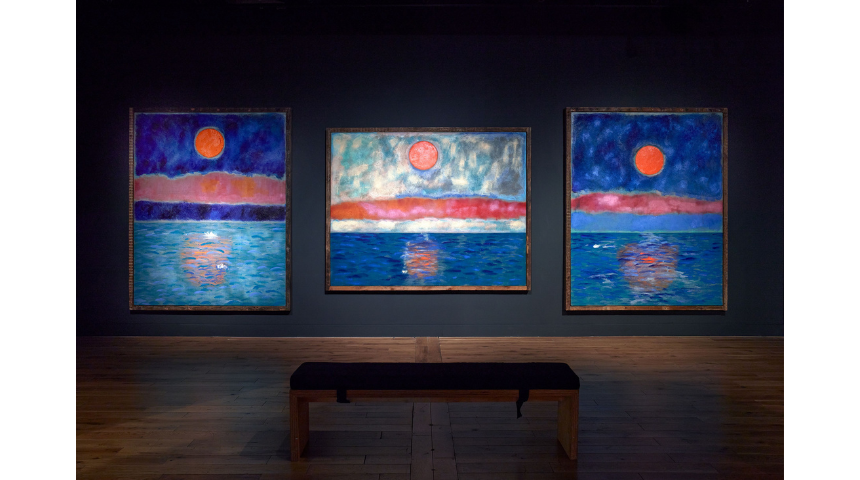
Alvaro Barrington (right, centre, left) Father Stretch My Arms (2025) All acrylic, oil, gouache ink, Flashe, sand on burlap in reclaimed wood frame. Photo: Michael Pollard
After the panel discussion, I went back down to the exhibition to have a good look around. Among the artists not present on the panel is Alvaro Barrington, born in Caracas to Grenadian and Haitian parents, and brought up between the Caribbean and New York. He now splits his time between New York and London. His work has explored aspects of the Caribbean diaspora in early 20th century London; the Harlem Renaissance; narratives of memory and identity among the female members of his family; identity; sexuality; and community. Recently commissioned by TATE to create the extensive multimedia installation ‘Grace’ for TATE’s Duveen Galleries, Alvaro exhibits impressionistic suns over luscious seas at HOME, which capture moments of beauty in timeless, evocative paintings that recall Monet’s sunsets and sunrises of the 1800s. Alvaro sets down the scenes with a fresh eye, unapologetically reminding us of the gorgeousness of the natural world, and simultaneously that spellbound time of day when the sun dips below the horizon.
Tschabalala Self, born in Harlem, New York and graduate of Yale School of Art and Bard College, exhibits a painting of a male figure inextricably merged with the chair he is sitting on. It is an assertive, fresh and independent image that invites the viewer to take time.
Born in Uganda and raised in Belfast, Northern Ireland, Ivy Kalungi lives and works in Liverpool. Using a range of media including metal, wood and audio-visual production, Ivy explores narratives of hybrid traditions and memory drawing on her Ugandan and Irish heritage to represent the complexity of cultural identity in her work. Ivy recently exhibited at Pipeline with a solo show and was the recipient of the 2019 HOPE + FACT Graduate Production Residency Award as a graduate of Liverpool Hope University with a two-month artist residency at FACT, Liverpool. Ivy exhibits an installation with an overhead neon framework which focuses the viewer’s gaze on the piece. A film of a dancer, a plastic crate, artificial brightly coloured grasses, rectangular frames combine to present a thought-provoking multimedia work.
Sahara Longe is a British figurative painter living and working in London, and has a classical art training from a Florentine atelier. Her work for ‘Roots in the Sky’ is a calm scene in a hospital setting, where flatly delineated figures are engaged in subtle dialogue with one another, offering advice, speaking on behalf of another, gently enquiring about someone’s health, with a background of blue sky and stylised clouds.
British-Nigerian artist Joy Labinjo’s work in ‘Roots in the Sky’ has an affinity with Tunji’s amber suspensions. Two people are bathed in a similarly warm orange glow, from lamplight in a painted room. Relaxed and at ease, they lie together on a sofa enjoying each other’s company – something simple and buoyant with happiness. Also as with Tunji’s work, and this is a theme running throughout ‘Roots in The Sky’, there is a note of private optimism and a sunny disposition that importantly counters some of the assumptions around Black artists’ work – that it can be full of conflict, or all about activism. ‘Roots in The Sky’ is a political act without the polemics, a place where Black artists and their subjects can sit in brilliance.
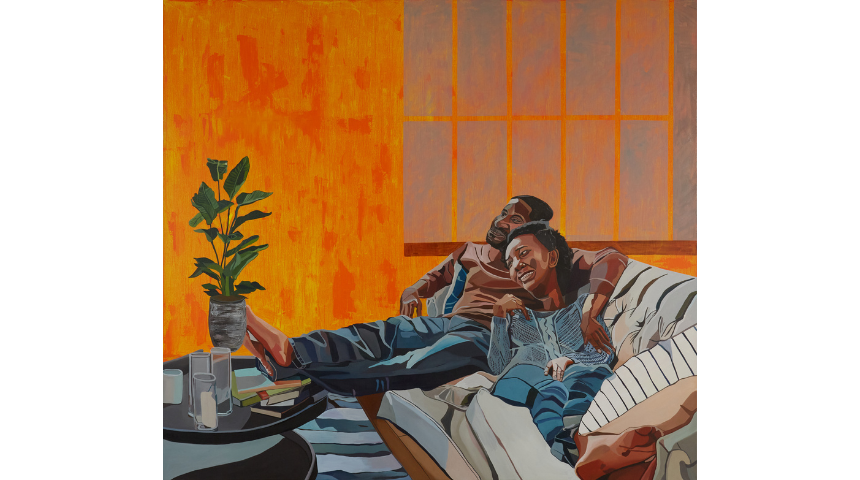
Joy Labinjo Love him and let him love you (2023) Oil on Canvas. Courtesy the artist
‘Roots in the Sky’ is curated by Tunji Adeniyi-Jones and developed with Clarissa Corfe, Creative Producer: Visual Art, HOME.
Footnote
(1) Simone Leigh, Artforum https://www.artforum.com/features/simone-leigh-231225/