FROM THE ARTIST’S MOUTH Feb 2026 Change Between the Lines – Jane Walker
North-west based painter Jane Walker studied at Sheffield Hallam University and the Royal Academy Schools before completing a Turps Correspondence course in 2021-24, and is drawn to composing with linear structures found in nature using a combination of traditional artists’ media and natural and recycled materials. Walker describes for FROM THE ARTIST’S MOUTH her current practice and concerns.
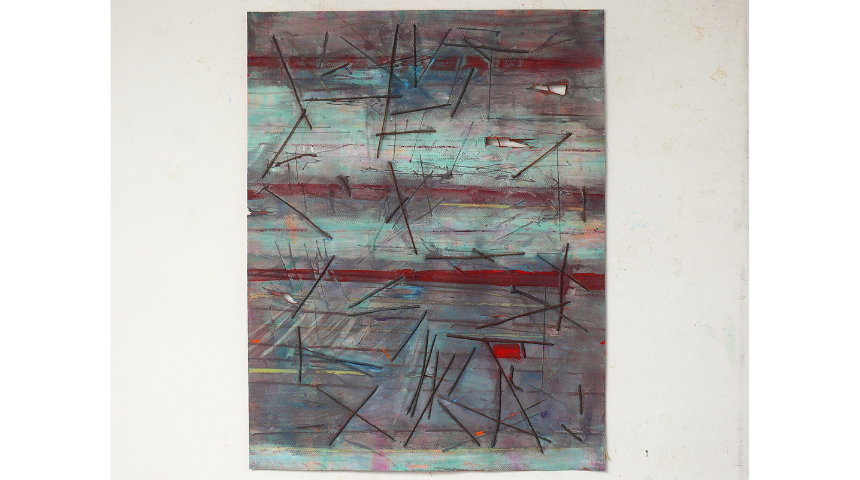
Jane Walker Composition 4 (2026) 65x50cm, watercolour ink and threads on paper © and courtesy the artist
My work is an investigation in landscape painting. The work I make is abstract and made with lines in 2-D. I always work on a portrait format, to suggest layers and depth. The current body of work started as mathematical and musical patterns, made with bright colours, arranged on a grid of horizontal and vertical lines. Alongside this studio practice I sketch outside. In some of these outdoor studies I noticed I had captured an immense power in natural things like tree roots and weather. I think the power is in the movement, nature constantly moves, grows and adapts; man made structures are static.
I start work in the studio with lines drawn in red, sanguine ink. The lines look like buildings; industrial and city structures, some of them are clusters of rectangular cells that look like a coral of human habitation. This is how I make work because for a long time I had been drawing fragile city lines. Buildings are static and certainly in painting terms, nature has a greater strength because it moves constantly. In bringing the outdoor work in to the studio I have gradually moved towards thinking about nature and how it relates to human habitation. I have sketched old trees in the city centre that have found ways of adapting and sometimes fighting back at tall buildings that take their space and light.

Jane Walker Composition 2 (2026) watercolour, ink, acrylic and threads on paper 65x50cm © and courtesy the artist
Another example is a Yorkshire dry stone wall, near my house that has been built to attach to a tree. The tree was there first, the roots and foot of the tree trunk are amazing structures. Not only has the tree grown in width so that it grips the ends of the stone wall on either side of its trunk but on one side of the wall there is a footpath and on the other there is a road that is about eight foot higher up. Things like this that have been constructed by nature have led me to think through so many aspects of the ‘landscape’ and to make more dramatic responses in painting.
In my work I change the order in which I do various processes, and increasingly mix materials. Sometimes I start by painting fluorescent colour on the reverse side of one of my sanguine ink drawings then start painting on both sides. I forget about the fluorescent colour until the work is hung on a wall then the colour glows from behind. Some pieces I start by damaging and destroying the paper cutting lines through the paper and scratching marks on the surface, I then mend these cuts by stitching over them. The sanguine ink lines are waterproof so reappear through a lot of these processes, they retain a presence.
Destruction is part of the way I work, I destroy previous ideas, patterns and drawings; erasing things makes space for development and change. If the deep textures on the surface of my work get in the way of new marks then I cut the stitches and threads and move them. The different ways of making lines and the individual character of the lines are made in a different order in each piece. Just wetting paper can almost reseal a cut and painting over it makes the cut disappear, but the work remains structurally fragile.
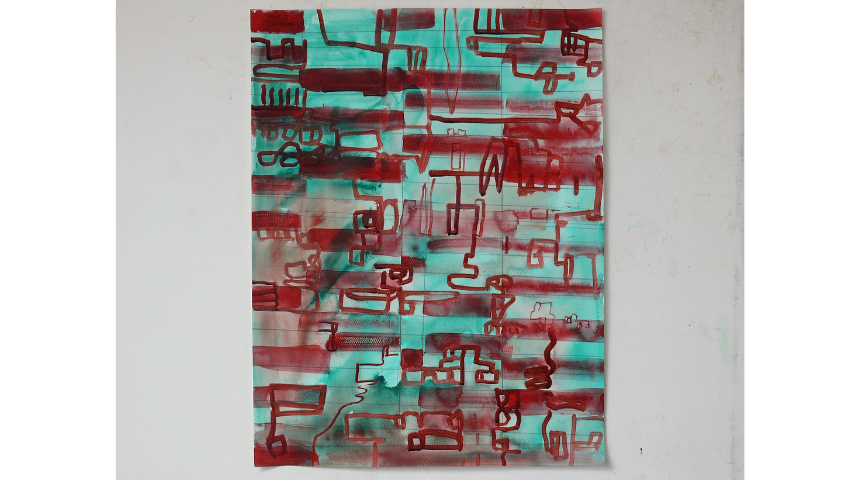
Jane Walker Lines (2026) Sanguine ink and watercolour on paper 65x50cm © and courtesy the artist
Other constants in my work are the straight ruled horizontal lines across the paper and that the touches of colour often play with, these lines they are a remnant of my musical patterns. While attending a talk at Huddersfield Contemporary Music Festival one of the speakers mentioned that new research had shown that tree roots grow towards the vibrations of water, not the water itself. This made me think of how important sound waves are and that they might have a bigger impact than we realise on all particles of matter. So in my work the threads and the way they hold particles of chalk, glitter or muddy pigments is my way of trying to think through this. On my palette I just add matter with colours, I work through a painting with colour, but I am often just looking for something heavy, light or dark. Paint is just stuff. I end up with subtle colour changes. Tone is more important than colour, in this respect I identify with the northern landscape painting tradition.
The paints I am currently using are Japanese watercolours they are luminous and delicate and completely contrast with the earth pigments of my western palette. The colours in Hiroshige prints that I saw at the British Museum last Summer were unforgettable and at the British Library previous to this there was an exhibition of Japanese ink drawings prepared for wood block printing but never turned in to prints. On these drawings it was possible to see all of the alterations, the blocking out and redrawing that you do not normally see making the lines far more alive than those on a finished print. So in my work I try to remember this, I work to somehow resolve things but each mark is part of this. The artist Amy Sillman records the dramatic changes that her work undergoes with photos. I can identify with this as well as the cartoon quality of her lines, my lines are often cartoon like. I sometimes lose work that is good in the working process, it is only when I look at the photographs of lost stages that I realise there were good paintings in between. I contrast working quickly with really slow deliberate marks.
The surface in my work can become quite convoluted almost turned inside out, once the stitches are covered in paint they can look like scars. The artist, Mike Kelly, whose exhibition I saw at Tate Modern last Spring, talked of reincarnation in the catalogue text and this is how I think of the scar like marks in my work, the skin is turned inside out. Also because the sanguine lines are always there the paint and washes of watercolour look thin, almost like a cloud passing. I chose landscape as a subject when I was a student partly because it seemed to have more scope for working at scale.
An exhibition of Helen Frankenthaler’s paintings that I saw last summer had a big impact on me, the gallery looked as if it has been built for her work it’s such a beautiful combination, and made me realise how important context is for showing work. Seeing Turner’s paintings in ‘Turner: Always Contemporary’, at the Walker Art Gallery made me aware of how good his work is particularly when it is shown next to other artists. It is his experimenting with the surface that has always been an inspiration for my endless experiments with the surface.
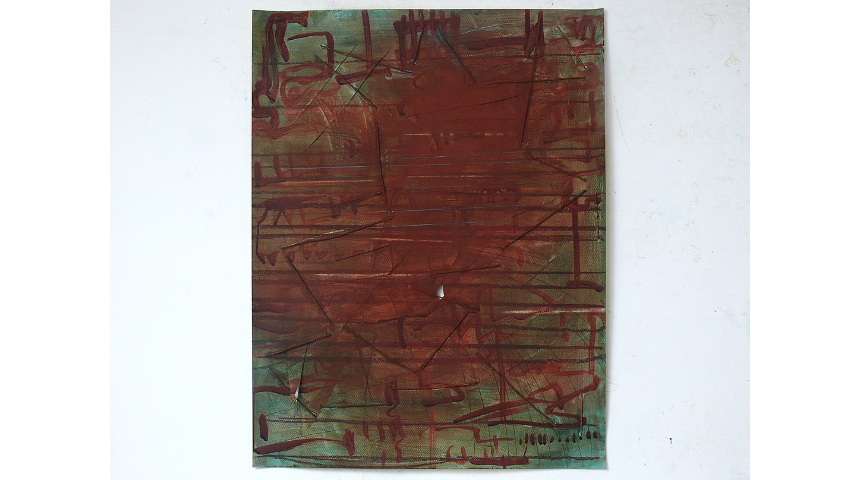
Jane Walker Composition 3 (2026) watercolour, pigments, threads on paper 65x50cm © and courtesy the artist
Janewalkerpainter