FEATURE Dec 2025 Into Unsafe Territory: The Pearls at The Manchester Contemporary
Josephine Manby
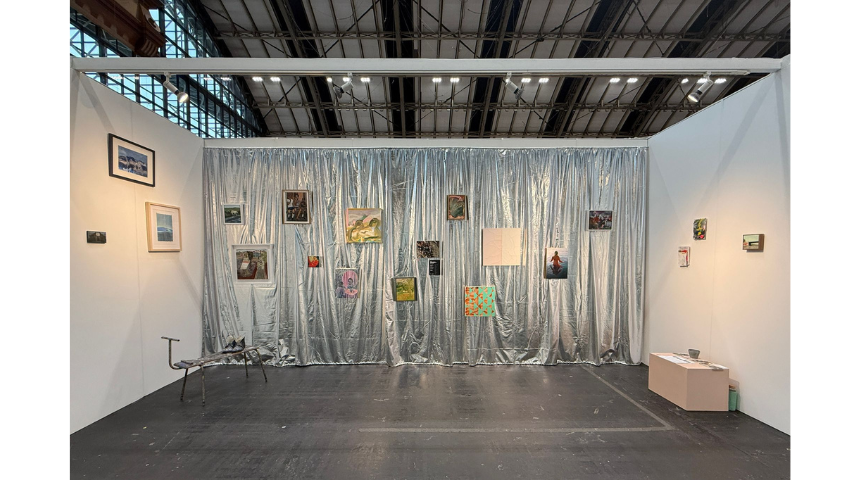
The Pearls Stand at The Manchester Contemporary, image credit Jen Orpin
The Pearls is a newly established collective of northern female painters who recently exhibited at the Manchester Contemporary (TMC), 21st to 23rd November 2025. Founded by artist Jayne Simpson with support from Birley Studios and Project Space in Preston, The Pearls are united in their commitment and interest in the critical discourse in contemporary painting.
Now a vibrant, intelligent and emotionally persuasive group of twenty, The Pearls are standard bearers for the cultural Renaissance of the contemporary north of England, each bringing their own dialectic of colour, form, line and value to bear on a collective conversation around lived experience as women painters, and on shared ‘connection, visibility, and endurance’. the Fourdrinier editor Josephine Manby caught up with some of the members of the group about the work they exhibited at TMC; how belonging to The Pearls allows them to nurture others, or to be nurtured themselves as artists; how their voices as artists have been amplified by association with the group; and their thoughts on the primary unifying elements that bind The Pearls together.
Visitors to The Manchester Contemporary who came to see The Pearls were greeted by a stunning disco curtain of silver fabric that dropped floor length from the top of their stand. The paintings hung on it had the perfect foil, but even those hung on the adjacent white walls flourished in the lee of the breathtaking draped background. Every single work stood out as evidence of a painter deeply involved in the materiality and the process of painting and speaking their own painterly idiom within a wider conversation of mutual respect and understanding.
The Pearls originated from a symposium organised at Birley Studios in Preston by Jayne Simpson in 2024, titled ‘Bananas are not the only paint’. Six female painters – Lindsey Bull, Nancy Collantine, Sarah Feinmann, Fiona Stirling, Katie Tomlinson and Joanna Whittle – from the North of England were welcomed to The Birley to deliver a short talk about their practice to a sold-out crowd. Invited painters shared their experiences of studio practice and what recognition meant to them.
The follow-up exhibition ‘The Pearls and the Oyster’ at the Birley Studios, was overwhelmingly well received with over 500 visitors. In addition to the 6 symposium speakers, Jayne also invited artists Julie Mayer, Abigail Hampsey and Mandy Payne. The second Pearls symposium in Spring 2025 set out to explore why and how women choose to paint and how painting practice explores and embodies lived experience for women in the current era.
Jayne Simpson’s painting at TMC, Golden, reveals linear tracings of drawing underpinning rich passages of colour, working and reworking, a visual conversation with its own language and dialect. She refers to recent ‘distinctive and celebratory conclusions of forgiveness, enlightenment and resolution’, implying that there is something akin to divination or sortilege involved in this fine-tuned dialogue that takes place in the mutable, liminal space of the picture plane.
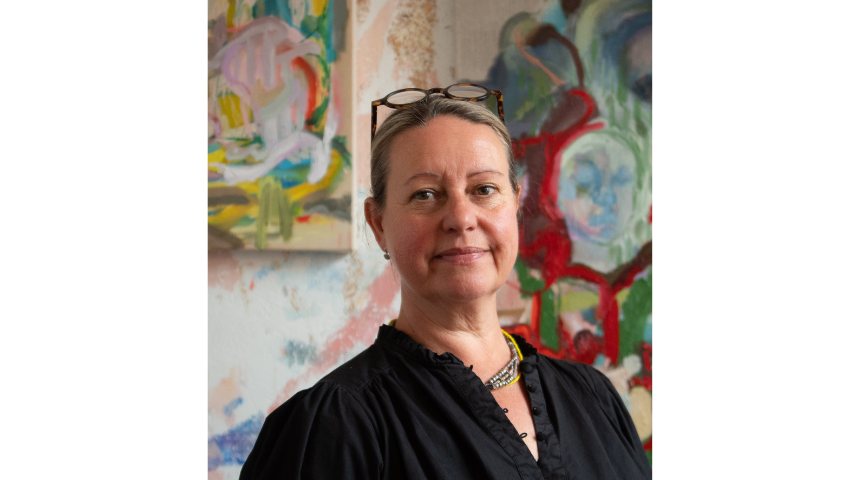
Jayne Simpson Studio August 2025 image credit Claire Griffiths
Nancy Collantine explains how Jayne Simpson ‘is an advocate for women who paint, and this affects confidence and visibility and instils in me the will to forge ahead and dig deeper into my painting practice.’ Discussing her TMC oil on panel painting Flight of the Infidel, Nancy describes a ‘sensation of painting’ from ‘a material process led enquiry’ – a process of allowing drawings and collages to fall away as the surface comes together and ‘it’s in this breaking of a painting I drop into unknown territory where I must risk getting myself into trouble…’ Many of The Pearls talk about this permission to take risks which the group seems to allow. Nancy says that as a result, ‘through our shared understanding and experience, being a part of this group builds faith in my own work and as a result, my painting has become more confident, free of conceptual restriction and much stronger as I trust my ideas and my process.’
Matilda Wainwright exhibited small holes in the silence at TMC, referencing a sense of lusciously hued vistas inspired by time spent in New Zealand. Wainwright professes to be interested in how the play of space and colour ‘interacts with memory and sense of place and the layers of how we perceive time.’ Long, languid, wide brushstrokes create satiny swathes of paint, showing a delight in the material qualities of the medium of oil on paper.
Susan Gunn showed Sakura | Divided Ground at TMC, a painting made of natural earth mineral pigment, wax and gesso on canvas and museum grade aluminium stretcher. In a ‘fusion of material, process and time’, she invites chaos in by allowing cracks formed from the setting of gesso made from minerals, gelatine and water to run whichever way they please over the pristine pink and white surface. Susan reflects that ‘The Pearls presentation at TMC has positioned my work within a broader dialogue about contemporary painting and the agency of women artists in the North of England.’
Sarah Grant, represented at TMC by The Cows Are Running, an image invested with vitality as if painted as a plein air sketch, makes works in series that form part of a larger narrative, using cropped details from Polaroids and other found visual material. Sarah sums up the overall ‘passion for paint and a genuine discourse around painting practice’ that characterises the group.
Kate Jacob describes her work BISH BASH BOSH, made of acrylic paint, oil bar, graphite, tissue paper, masking tape, thread, paint palette, card, cross-stitch card and PVA glue, as a response to sensory overload. It is exploratory, grasping at meaning by trying things out, putting them together and seeing what sticks: ‘The work felt as if it had formed itself, announcing itself as arrived’, hence the title. Kate says that in joining The Pearls, her practice ‘has become more experimental, and brave. The recognition, support and critical dialogue around my work have enabled me to move into more unsafe territory, making work that is uncomfortable or sits less easily within my own framework and understanding of painting.’
What’s striking is the breadth and variation by which The Pearls artists respond to the contemporary world we find ourselves in. A place and a time of unbridled climactic and political conflict. As Susan Gunn puts it, ‘I think our lives; including trauma, disruption, and experiences, feed into our work and, within The Pearls, this surfaces both consciously and subconsciously: through material choices, gesture, narrative, and emotional charge.’
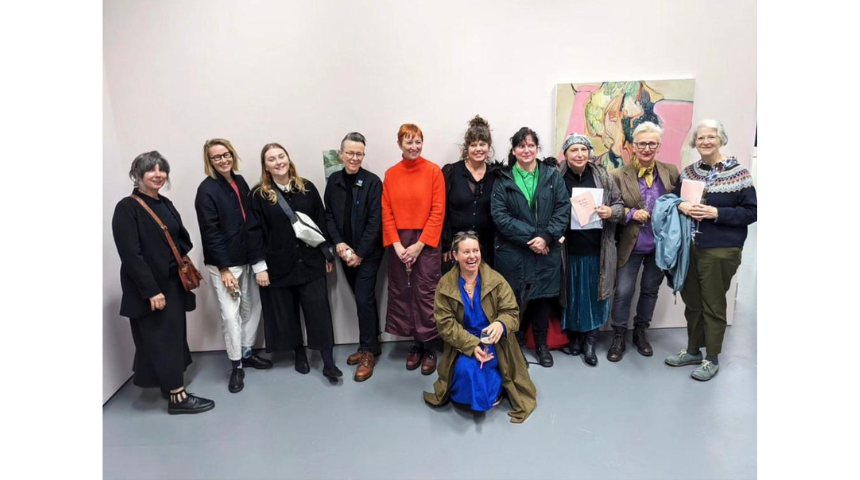
The Pearls and The Oyster Exhibition 2024 image credit Jayne Simpson
Ingrid Christie describes the consolation of mutual support generated by the group: ‘our members have all contributed in amplifying our voices by sharing one another’s work both individually and as a collective whole. Not only that, we decided to champion other artists that we admired too. Each of us sending one another outstanding work by other artists, both national and international via our Instagram page. This really does highlight an ethos of openness and a desire to go beyond our own collective and embrace the creative wellspring that is so important in today’s troubled times. As Tracy Emin said “Art for me, is such a beautiful thing because it comes from inside us. It doesn’t hurt anyone. It makes the world a better place and helps us understand it and ourselves better.’’’
Alison Critchlow recalls a recent conversation with a Pearl about the 'gap' that ‘can exist between new painting investigations and knowing how they sit with your work more broadly... the need to be ok with sitting in this gap sometimes and allowing time to take a hand in seeing the way forward. We talked about owning the unknown territory and accepting it as part of the creative process and the guts it takes to be open and honest about showing work so new that you're still getting to know it.’ Critchlow exhibited Night’s Swift Dragons at TMC, a small oil on board that takes its title from a quote from Shakespeare’s A Midsummer Night’s Dream. Critchlow spent the summer of 2025 recording her observations of summer light effects ‘against the constant backdrop of a world in violent turmoil’ and working on several paintings simultaneously. She describes the sense of excitement generated by membership of The Pearls as ‘creative rocket fuel’ – ‘I think my sense of what is possible has shifted exponentially.’
It’s a compulsion that can be traced in Helen Thomas’s work, bought by the Manchester Contemporary Art Fund for Manchester Art Gallery. Her focus on overlooked tangles of crisscrossing gone-to-seed plants feels like someone looking the other way. Common Whitlowgrass, close to Smyth Street invites us to consider the status of certain so-called weeds: how we assign value to some plants, while others we view as delinquent or unwanted. The desire to turn to what is traditionally seen as less important subject matter is interesting. What is going on in the background of the so-called epic, the elegiac?
Fiona Stirling’s Stacked relates to her experiences as a mother and an educator, and the balance of emotional and physical roles. Maintaining a responsive and resourceful approach, Stirling presents an ad hoc accumulation of torn, painted, taped and layered papers, underlining the sense that women can be adept at making work in the interstices of time and space around caring responsibilities and professional and domestic demands on their attention.
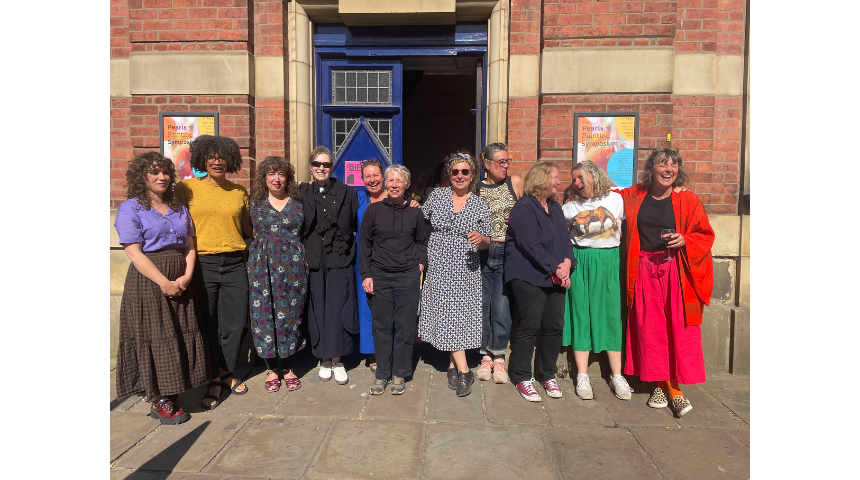
The Pearls Symposium 2025 image credit Jayne Simpson
One of the questions I put to the group pertained to how their voice as an artist has been amplified through association with The Pearls. ‘I feel seen, heard and taken seriously in my association with the Pearls’, Hannah Wooll said. ‘I feel like they get me, that I don't have to censor myself as a woman artist, a mother artist, a painter who's into colour and pattern and feminine tropes, and that that's ok and not considered trivial or undeserving of enquiry.’
Hannah’s Tulips at TMC is a work that typically conflates imagery of vintage fashion plates, homemaking craft manuals and Hollywood dressing room photos with a thinly applied layering of watered down acrylics and dreamlike colour palette. ‘I don't know if my practice has transformed or changed, but my confidence in my voice and what I make has grown. Imposter syndrome is lessening, my thinking being that if this group of intelligent, passionate, dynamic and critically engaged women see something in my practice, don't dismiss it, see it as trivial or a frippery, that I spoke sense and not gibberish when I presented at Pearls, then I must be doing something right! I think we are all used to knocks, rejections, negative comments or a feeling of being passed over, not quite right, not being got- but I do feel got and I do feel included and that is quite liberating for one's practice!’
I asked The Pearls how belonging to the group allows them to nurture others, or to be nurtured themselves as artists. Nancy Collantine describes The Pearls as ‘women who take painting seriously as a means of communicating lived experience - relevance, support and co-operation.’ Jayne Simpson realised that ‘what you put in you more than get back. Some artists are involved more than others and that’s fine, some leave and new artists are asked to join us - it’s totally fluid which fits with the busy lives of many women artists, often with caring responsibilities that have to take priority. It’s a different approach which was my ambition when I started organising us, I’ve worked with about 23 artists in the last 2 years for ‘The Pearls’.
‘Also speaking about the work/practice and exhibiting together feels less vulnerable because you know the collective is absolutely rooting for you and each artist can relate through their own ‘lived experience’ in being an artist,’ Jayne continues: ‘We’re all great artists, critically engaged, we read and share what is happening in contemporary painting and we share what we know or have experienced in our practice and professional experiences.’
Helen Thomas relates how ‘the nurturing ethos within the collective reflects our founder, Jayne Simpson. It takes strength, determination and commitment to be a painter and to do all the related work. We each bring skills, experience, and points of view that overlap, bridge and entwine. Support, encouragement, enthusiasm and generosity, amongst the group may be of practical, conversations in painting and or emotional. There will always be something that I need to learn, or need to talk through with someone. As individuals we have a range of experience and skills that we bring and there’s a readiness to share in response to and availability that we each bring to The Pearls.’
Matilda Wainwright echoes this: ‘I think Jayne has created a dynamic energy with Pearls that is feeding many painters, which many of us draw from but also give back to. Its reciprocal nature is self-perpetuating and generous, but of course this is also was a result of huge effort and time given by Jayne and many others.’
A further question concerned whether belonging to the group had led to an amplification of the artists’ voices, and had countered isolation. Roberta Cialfi exhibited Whispers of the Elements at TMC, a landscape occupying transitional territory between abstraction and figuration; colour values, tints, mists of colour, hues, sensory and sensual, evocative of a mood rather than a geographical place. An elusive, ephemeral quality of seasons passing through an orchard or a field. ‘I’m very glad to be part of the Pearls,’ Roberta says. ‘The collective has nurtured me in different ways, emotionally I feel less isolated, I appreciate very much the generous feedback of the members, the conversations in person around paintings and more personal aspects are invaluable and enriching.’
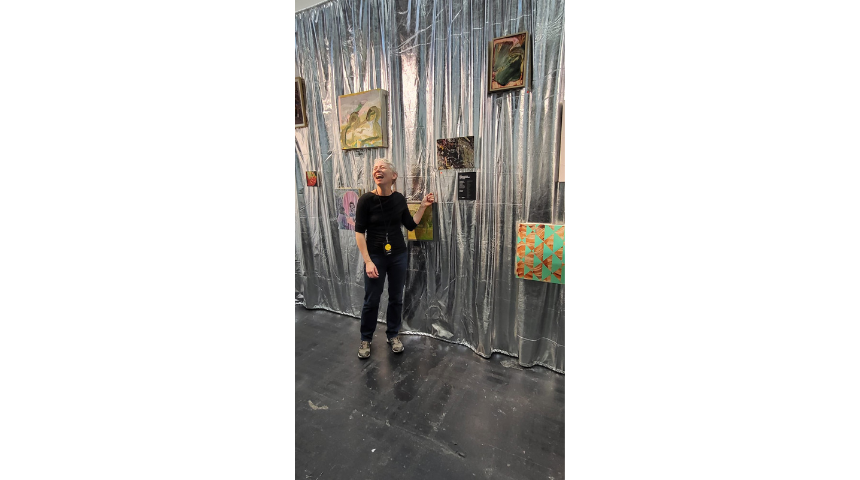
Helen Thomas image credit Alison Critchlow
Ingrid Christie lives on the north west coast and her work is informed by living close to rocks, sea and sky, modulated by weather, light and tides. At TMC, her elemental Without Shadow, No Light reveals blunt edged cold working its way round mountainous forms. Inspired by landscape around Heysham in the South Lakes, Christie has a daily practice that embraces spontaneity of response to a ‘meditative life of observation and connection to place’. Ingrid remarked how ‘painting is generally a solitary pursuit. The Pearls Symposium and subsequent show at The Manchester Contemporary have allowed me to feel part of something much bigger than myself. This feels life-changing and very much like a family, where everyone understands this drive to make work. I feel it’s a unique collective in this way. We’ve all felt a tangible magic in the air right from the start.’
Alison Critchlow explained how working ‘in a very rural location in north Cumbria’ could sometimes feel cut off. ‘The Pearls have given me a platform to talk about my work to a much broader audience.’ Sarah Feinnman focuses on elevated views from high up in multi-storey car parks, using painted and cut paper to combine into densely articulated compositions where unusual shapes and colours interlock. Sarah describes ‘a surprising sense of camaraderie [that] has grown amongst the women painters from the North of England, bringing us together in meaningful ways. It has opened opportunities to build connections with artists enriching my practice through shared exchange and learning. It has given me the opportunity to connect with artists of a variety of experiences, to exchange ideas, and to learn from one another.’
Lela Harris and Jen Orpin both explore memory, identity and place in their TMC works. Lela exhibits Newport Street, an oil pastel drawing in which she shares personal experiences of growing up in 1980s Rusholme in Manchester. The image is filled with sunlight; has a carefree, playful atmosphere and radiates a sense of belonging. ‘Being part of a collective for the first time has been amazing,’ says Harris. ‘It’s the first time I’ve had the opportunity to bounce ideas off other contemporary artists who are also navigating the art world as women. It’s even more special that everyone is Northern! I feel connected to something bigger than myself which has allowed me to feel much more confident about my own practice. It has also made me realise that although I am an emerging artist, my historical research-based approach combined with my career as a graphic designer means that I’m able to support other members of the group with my unique skill set.’
Jen Orpin, co-founder of Rogue Women in 2019, and founder of ‘a small space’, paints motorway bridges and other concrete and metal constructions onto which the viewer can project their own thoughts and memories. At TMC she presented The End is Someone’s Beginning, a technically skilled oil on birch plywood, atmospheric, specifically of the UK and tied to place. With no cars or people in evidence, you can project yourself easily into the scene and the viewer takes on the viewpoint of the driver in a meditation on nostalgia. ‘The life of an artist can be a solitary one,’ says Jen; ‘so when you have the opportunity to connect with others in a safe and nurturing space and there’s a shared goal of kindness, generosity with the feeling of being supported it can really dismantle the feeling of being alone and isolation. I think connection and supporting each other is a really important part of surviving and thriving as an artist and my most important and treasured moments as an artist have been when in this kind of environment and The Pearls has definitely been this for me.’
Fiona Stirling says that ‘most importantly, being part of an art collective has shown me that I don’t have to face challenges alone. The reassurance of community replaces the anxiety of going it alone. We uplift each other, celebrate achievements, and help each other navigate setbacks. The Pearls isn’t just a group it’s a source of friendship, inspiration, and support that has made me more confident, open, and brave!’
Kate Jacob sums up the primary unifier at the heart of The Pearls: ‘A sense of and desire for a community that enriches and lifts us all up. There is between us the common thread and unsaid understanding of the difficulties of being, and feeling marginalised, by an economic and cultural system that was designed by, and for centuries been led by a patriarchy. The spirit of The Pearls as well as an individual and group community, is a statement too on the importance of generosity, and the gift of soft power in shifting our approach to ownership, voice and access to the arts. The pooling of resources and skills, the willingness to share and have open conversations is the strength of The Pearls.’
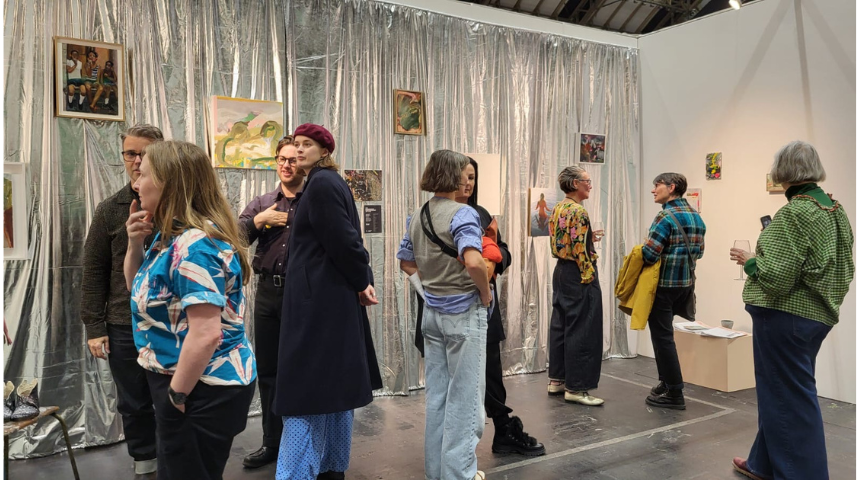
The Pearls Stand The Manchester Contemporary image credit Alison Critchlow