REVIEW Mar 2026 Jayne Simpson ‘LION’ at Grundy Art Gallery, Blackpool
David Hancock
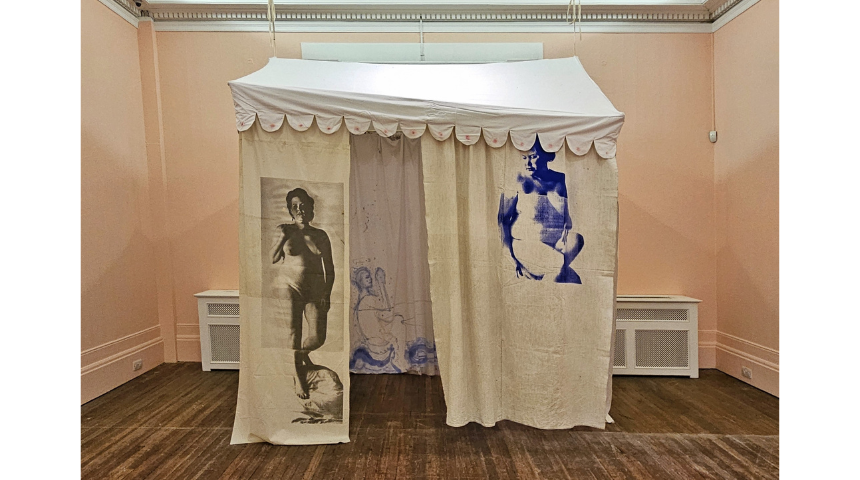
Jayne Simpson Cloth House (2025) repurposed bed sheet, screen print, inks, acrylic, emulsion and watercolour. Photo David Hancock
David Hancock, Director of the Fourdrinier, artist, lecturer, and curator, recently visited Jayne Simpson’s exhibition ‘LION’ at the Grundy Art Gallery in Blackpool. Presented as part of the Turning Point programme of solo exhibitions, the gallery provides opportunities for artists living and working in Blackpool and the Fylde Coast. Turning Point supports artists at a stage in their career where a solo exhibition can help take their practice to the next level. For Simpson, ‘LION’ has allowed her to create work on a large scale, expanding her painting practice beyond the canvas. The exhibition runs until 7 March 2026.
The title of Jayne Simpson’s exhibition ‘LION’ could not be more prescient. At a time when British identity is continually being questioned, symbols of nationalism have become increasingly visible and troubling. When I visit my father in North Manchester, flags of Saint George and Union Jacks are tied to lampposts along the route to his house. These displays are not expressions of pride in being British but acts of intimidation that alienate difference. They speak to a kind of jingoism shaped by a nostalgic and idealised vision of Britain that never truly existed. This is not my understanding of Britishness. My Britain is tolerant, diverse and inclusive. It is accepting and embraces multiculturalism.
In this exhibition, Simpson also reclaims another potent symbol of Britishness: the lion. By choosing the title ‘LION’, she invites us to reconsider the qualities traditionally associated with this magnificent creature, namely power, pride and leadership. Historically, these attributes have been aligned with masculinity and the brutality of colonialism. Simpson instead offers an alternative reading. She rejects a patriarchal interpretation by shifting the word lion from a noun to an adjective, reframing it as a way of being. In doing so, she proposes an understanding that centres on lion-like qualities such as bravery and determination.
For this body of work, developed over a two-year period, Turning Point provided Simpson with an opportunity to explore her own life story, particularly her experience as a woman, and as a mother and daughter. The exhibition depicts Simpson’s transformation and recovery through a series of ambitious works in which themes of love, loss and grief are discernible. There is an emotional rawness in the work, captured in gestural marks, but there are also passages of emptiness that signify those departed. In her work, the personal becomes universal, unfolding within a gauzy dreamscape that emerges from the linen supports.
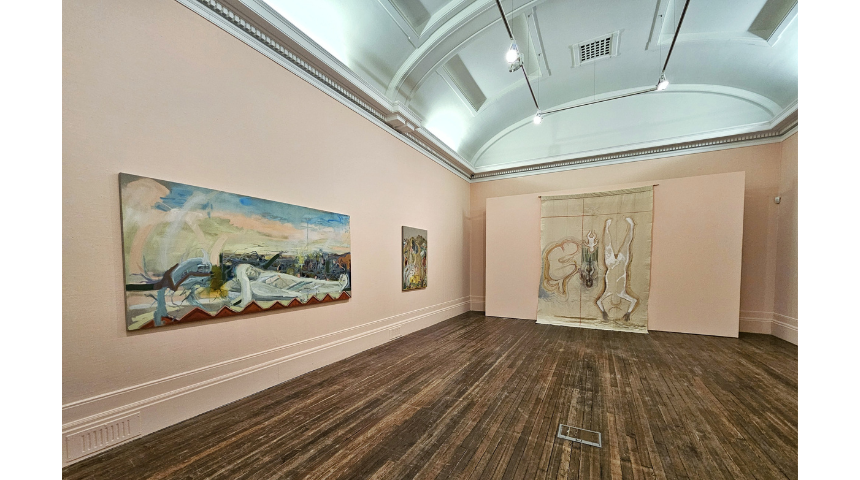
Jayne Simpson LION installation shot (2026) Photo David Hancock
In ‘LION’, Simpson explores painting in an expanded form, inviting viewers to encounter the works not simply as images but as immersive presences. A central concern of her practice is how lived experience can be embedded in both the body and the psyche, and expressed through the manipulation of paint. In Simpson’s confident handling, layers of colour, alternately translucent and opaque, function not only as devices for rendering form, but also as metaphors for what is revealed and what remains concealed in our lives. The work resonates with emotion. Having experienced a recent bereavement, I immediately sensed an unexpected feeling of loss emanating from the paintings. It was deeply affecting, and at times the cinematic scale of the works became overwhelming.
Marking the entrance and exit of the exhibition is the work Cloth House (2025). A vestibule constructed of cotton sheets, it provides a thin aperture through which fragments of the exhibition can be partially glimpsed. The ‘Wendy house’, as the artist refers to it, creates a threshold that must be crossed to enter the exhibition. Inside, the viewer pauses for reflection, picking out the various forms printed and sketched onto the surface. In one such image, a body appears to separate from its prone form. It sits in prayer, eyes closed, a halo affixed. Nearby, a gash in the fabric suggests a vulva. Two presences merge on one side, absence on the other. Yet it is not quite absence. Faintly, and loosely pencilled on the reverse, a figure reclines, partially emerging from the orifice. Elsewhere, a screen-printed figure, stands naked on a bed, her weight pressed into the soft base. A mother, post-partum, her pose, goddess-like, confronts the viewer, reversing the sexualising gaze. She is not the idealised form of Venus captured in marble but made of flesh and blood. Cloth House creates a transitional space, a non-place, a pause as the visitor readjusts from the ordered chaos of the open exhibition to enter the calm of Simpson’s ‘LION’.
From left to right, five paintings are spaced across the three walls: two on each of the long sides, with a large wall-hanging facing the entrance. The walls are painted pastel pink, a choice that lifts the work, complementing the grey tones of the exposed raw linen. The first, Departure (2025), presents a body laid out as if for death, turned slightly towards the viewer. A small group stands in attendance, their hands clutching at their clothes in gestures of mourning. To the right, a lion stands with its head cropped by the edge of the canvas, its gaze directed outwards towards the surrounding works. At the bottom of the scene, a faint suggestion of a stage lends the image a ceremonial quality. The central presence is given gravity, veiled in light, its pallor intensified by a restrained palette. The work speaks unmistakably of loss.
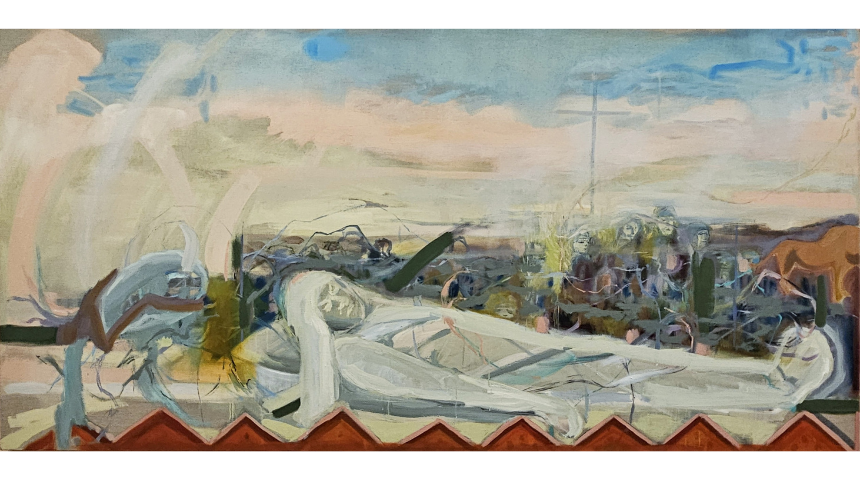
Jayne Simpson Departure (2025) Oil on linen. Photo David Hancock
The painting draws inspiration from The Funeral of Shelley (1889) by Louis Edouard Fournier, from the Walker Art Gallery’s collection in Liverpool. Simpson refers to this process as making work in the vibration of other artists. In resonance, paint seeps into the linen, barely perceptible at first, before asserting itself in thick, confident swathes. Simpson’s mark-making is assured, suggesting forms, figures, animals and movement without ever fully fixing them. Traces of life linger against the stillness of death. A child, almost lost within the scene, looks across the recumbent body from a low vantage point. Heavy eyes turn downwards. In just a few strokes, Simpson conveys an overwhelming sense of mourning.
Next along is Bigfoot (2025), in which the eponymous appendage dominates the composition. A reclining form emerges from the stump as light gathers where paint lifts from the visible linen. In the background, a procession of sorts moves towards the leg, as though approaching a sacred relic, the remains of a saint, the limb containing the spirit of a departed soul.
In The Map of Was / Is (2025), a beautifully monogrammed bedsheet, becomes the surface on which Simpson renders a family scene. A man, a woman and a child are positioned upside down. A fall. Biblical references are hard to ignore. The infant appears twice, literally coming into being on the sheet, gaining form as they descend. On the left, the female body, drawn in outline, is curled, foetal-like, and surrounded by a halo painted in a loose wash of ochre and pink. On the right, the male lies prone. White paint highlights his body, giving it form, yet he remains faceless, reduced to shape. His hands are black and outstretched as the body appears in free fall. Below, a mountain range is caught in the curl of the sheet as it spreads across the wooden floor. Above, a stitched red cross splits the fabric. A sacrifice. A descent.
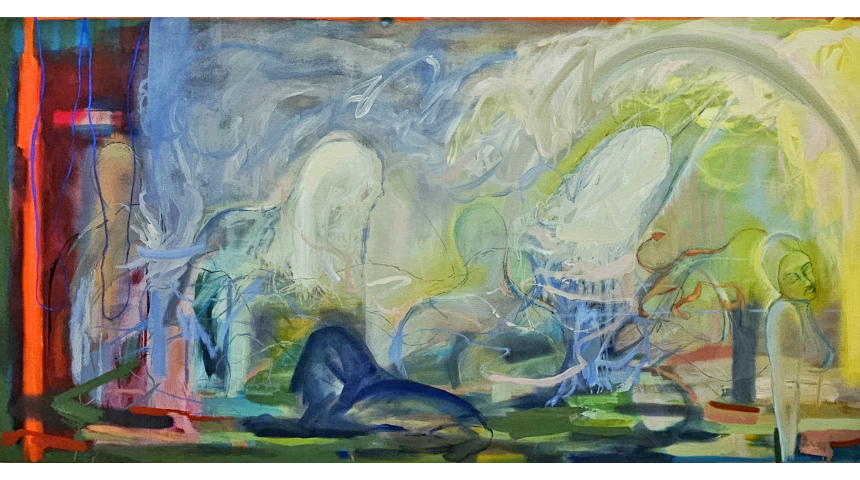
Jayne Simpson Arrival (2025) Oil on linen. Photo David Hancock
In Arrival (2025), a slash of orange ignites the canvas, lifted by the blue outline of legs drawn with an oil bar. In my head, the refrain of PJ Harvey’s Rid of Me, “Lick my legs, I’m on fire, lick my legs, of desire”, hums insistently as the eye moves across the surface. Lions populate the remainder of the painting, recalling Leonor Fini’s The Shepherdess of the Sphinx (1941). Simpson steers these wisps of resplendent creatures across the canvas. On the right, a female torso appears to exit the frame, an incomplete sphinx seemingly severed from its body, the ghost of which, headless, lingers over her shoulder. What was once whole now separates. It is a moment of rupture and departure. Meanwhile, a form of painted light rises from what resembles a pedestal, stretching upwards with the quiet, instinctive motion of a cat unfurling its body.
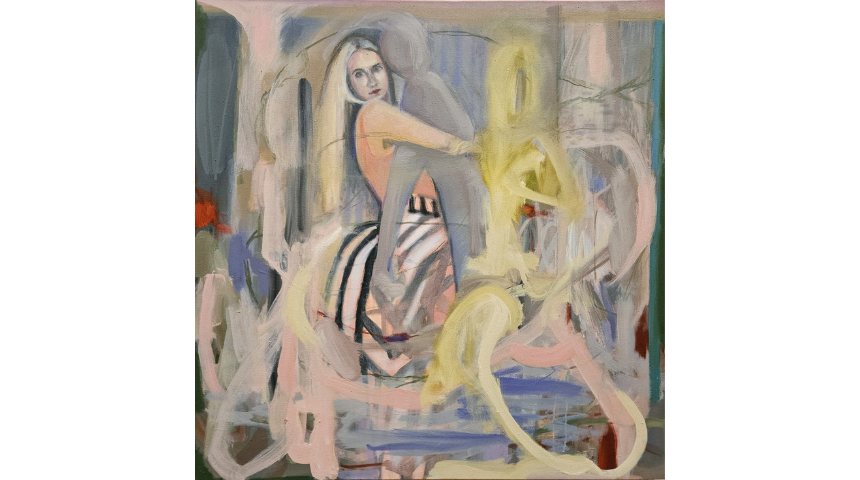
Jayne Simpson Bunny (2025) Oil on canvas. Photo David Hancock
Bunny (2025) is marked by the luminosity of the paint itself. At times, the swathes appear less applied than illuminated, as though painted in pure radiance. Ghostly forms rise around the central figure, reaching out to support her. She is Simpson’s daughter. These apparitions suggest presences from the past, friends, family and lovers, waiting to greet her, while she turns away from them, glancing beyond the viewer, suspended between connection and separation.
Exiting the exhibition as I entered, through the wafting sheets of Cloth House, I felt haunted by the images I had encountered. ‘LION’ offers a deeply introspective and emotionally charged exploration of personal and universal themes. Reflecting on my own loss, I felt the exhibition captured where I am emotionally. Through scale, colour, material and gesture, Simpson conveys feelings that cannot be put into words. A flick of a brush coated in oil is sufficient. ‘LION’ shifts traditional notions of identity, reclaiming powerful symbols to articulate a more nuanced understanding of strength and resilience. Both immersive and thought-provoking, the exhibition invites viewers to engage not merely as observers, but as participants in the emotional landscape Simpson creates. The raw vulnerability and intimate narratives embedded in these paintings resonate on a profound level, reminding us that paint remains both relevant and necessary.
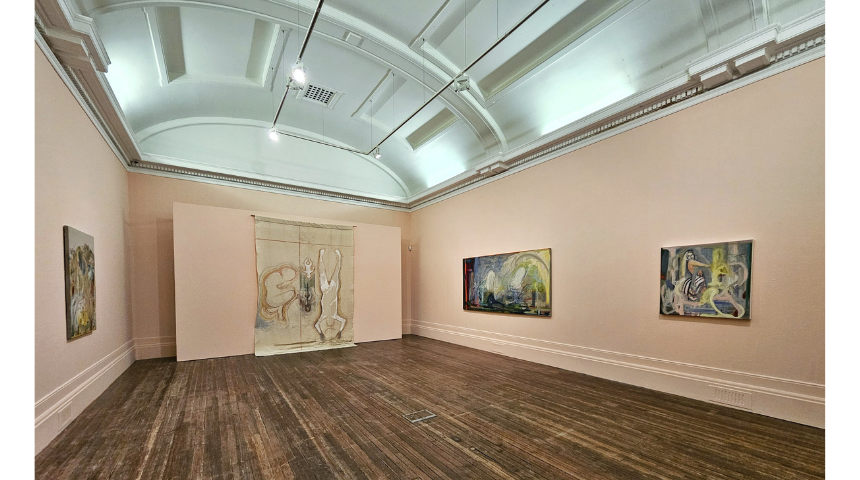
Jayne Simpson LION installation shot (2026) Photo David Hancock