INTERVIEW May 2026 Dawn Woolley at Salford Museum and Art Gallery – KITSCHY, TERRIBLE TRUTH BOMBS!
Charlie Currid
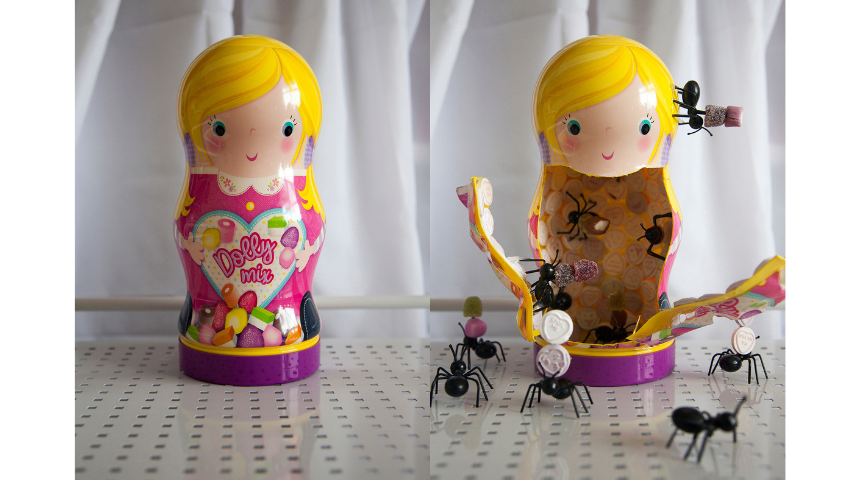
Dawn Woolley Host Figures [They Live] (4) (2019) Lenticular Print 30cm x 40cm
Dawn Woolley is a Leeds based artist dealing in interventions. Her practice is a Trojan horse, inviting but riddled with a viperous wit and deceptively kitschy gleam. Through a visual language of photography, sculpture, painting and performance, she dissects consumer identities and parses implied histories from found objects.
Her show ‘Relics: Objects of Devotion For Contemporary Life’, which opened at Salford Museum and Art Gallery, 2nd May 2026, brings together multiple collections of her work, and features a series of totems or Janus figures constructed from litter found between the gallery and Manchester Victoria. The exhibition also debuts new sculptural and painted works.
Ahead of the opening, Artist and Writer Charlie Currid had the chance to meet with her online for an interview, discussing consumer identities, kitschy aesthetics and seeing the world through the lens of truth.
‘Relics: Objects of Devotion for Contemporary Life’ is on display at Salford Museum & Art Gallery until Sunday 30 August 2026.
https://salfordmuseum.com/event/dawn-woolley/
In a world choking on detritus, it’s not hard to find objects that paint a picture of the world today without leaving your neighbourhood. In a speculative future, one cast into our minds by artists like Dawn Woolley, these objects have transcended their roles as fodder, as things to leave behind on festival grounds, and instead have been preserved with a lovingly scientific flair. They have become the features of an archive of what was popular fifteen minutes ago.
The best possible scenario is that an archive of our contemporary artefacts would serve as a warning to future generations. We become collectively aware overnight of our impossible way of living, and start keeping, mending and repurposing everything currently in our possession. The alternative is that, never managing to escape perpetual manufacturing, the act of archiving becomes obsolete anyway. The predetermined shelf-life of products means that we are archiving objects never made to last, objects that say nothing about our history or cultural timeline, but are impossible to ever truly dispose of.
So how does a visual artist deal with this? The tricky part is living with work once it’s created. How do we each personally reckon with the act of bringing something new into a world so crowded?
— — — —
Dawn: My name is Dawn Woolley, I’m an artist based in Leeds, and I’m currently in my studio, which is the basement of the house I share with my wife. It probably looks quite mad behind us. I’ve got a very old, broken-down shopping trolley which I retrieved from a field not far from here, with a papier mâché bird on it. I have some more birds that are perched on shopping baskets… The gallery are collecting the work on Tuesday, so I’m slightly up against it, but I think that’s part of my process – I use every minute I can.
I’ve become slightly obsessed with these flattened cans that you find everywhere… I’ve got a batch that I’m calling my Salford Relics, which I picked up between the gallery [Salford Museum and Art Gallery] and Manchester Victoria Station. It’s like a portrait of the way that that space is used. It’s also thinking about what our relics will be, what will we leave behind for future generations. How will we be remembered?
Charlie: Probably not very fondly.
D: Yeah! Definitely not.
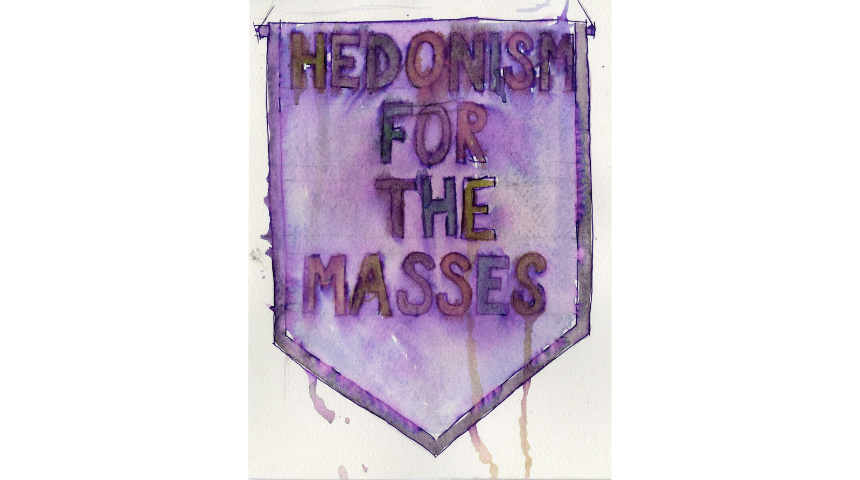
Dawn Woolley Waste Makers (Hedonism for the Masses) (2025-26) Watercolour painting on cartridge paper 15cm x 20cm
I’ve made these little hanging painting votives. Some of them will hang inside the bird’s baskets and trollies. That’s a very new development for this exhibition. I’ve not shown them before, so I’m excited to get those in the space and installed.
C: I saw the painted banners with the poetic mantras such as ‘Hedonism For The Masses’. Do you do much writing yourself? Does writing inform the work heavily or is this also a new development?
D: This is a new development, but it is not my writing. There’s a book called ‘The Wastemakers’, published in 1960 by this amazing writer called Vance Packard. He did a lot of early work unpacking the burgeoning advertising industry, and how it was affecting people. He talks about in-built obsolescence, how things were designed to break easily, or they stop being desirable. Advertisers were thinking about ‘How do I make this seem old in the mind of the consumer in six months' time?’. It’s all about the impact of this would-be waste: waste of resources, growing mountains of discarded commodities, waste of money, etc.
It’s written in quite a poetic way, I think academics in the 60s had a bit more free reign to be kind of fun in the way they write. It’s not very dry. I loved some of the phrases, like Hedonism For The Masses, so I’ve been making those plastic banners.
On New Year’s Eve, I had this motherload haul: I was walking with my wife and my dog, and noticed this massive mound of wrapped up plastic next to a wheelie bin. I ended up dragging this huge (and very heavy) pile of plastic back to the house, and now I have this incredible free resource to make the banners from. I’m trying to make them pseudo-religious but about consumerism, and I worked out that if you read Packard’s book not as a warning but as a handbook, it’s actually a pretty complete design for exploiting people and the environment. I decided to take them [the phrases] in that vein, and write them as though they’re commandments.
C: I liked the image of walking the dog, and instead of the dog picking up sticks and taking them home, you are carrying bundles of things collected on the walk.
D: I know, he’s always having to wait for me to grab cans and stuff. Those buzzball cocktails are like the holy grail for me at the moment. I love that they’re round.
C: With the idea of a predetermined shelf-life, I was interested in the speed at which you make the Janus relics. Considering people discard rubbish very easily and carelessly, how easy do you find it to let go of them once they’ve been made? Since developing a relationship to the materials and their histories, can you imagine getting rid of them to make space?
D: This work evolved from an earlier photographic series – ‘Relics’ – in which I looked at still life as a way to talk about consumer identities. I got to the end of my PHD and wanted to have a big clearout, but then felt quite bad; ‘I’m about to dump a lot of plastic waste into the world’. I made the first set of relics as a way to extend their life span a bit more.
Some of them are really cute. I got quite attached to them. I’ve still got a shelf in my office with them on. It’s going to be a problem if I keep making things that I find unbearably cute. We already have a pink mannequin in a costume in the hallway because I couldn’t find anywhere else for it. I’m encroaching, slowly.
C: Of all the figures going into the exhibition, are there any that you feel most closely resemble you, physically or characteristically? Do you at all try to make them portraits, or do they have more in common with psychogeographies?
D: I’d like to say more of a psychogeography of the area, but they certainly resemble the things I like. I’ve turned the buzzballs into snails - I love snails, and while I was making them, I was reminded that as a child, I used to- y’know those chocolate dip pots? I used to think that they made a great duplex-apartment for snails. I would collect snails and basically try and domesticate them. They invariably just crawled back out again.
Snails might also survive the climate catastrophe. If it gets too hot and dry for them, they seal themselves in their shells. If you see snails with a papery membrane over the opening, they’ve gone ‘yeah it’s not for me out there, gonna chill in my house for a bit’.
C: Jealous.
D: I know! I know, I thought I was making snails because it was interesting, and we could revere snails as a survival-species, but I realised also I do just love snails.
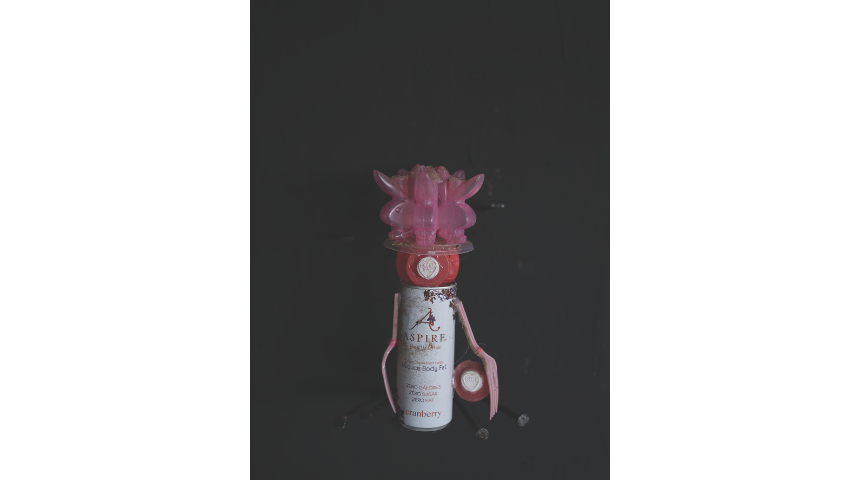
Dawn Woolley Relic (11) (2017) Photograph 30cm x 40cm
C: I find the sensibilities in the ‘Host Figures (They Live)’ (2019) series quite camp. The Dolly Mix container bursting open, full of spiders. You have noted, too, it’s building on the artistic language of John Carpenter’s film ‘They Live’ (1988). In what other ways do theatre and theatrics, and film inspire the way that you work?
D: I definitely have a camp, kitsch aesthetic in my work. I’ve always thought that this idea of glasses that show you the truth of things, the real image of advertising – I feel art should be those glasses. It should be there to reveal. The Host Figures (They Live) are these lenticular prints – super kitsch. I’ve always wanted to make something with them but could never look beyond the image of a dinosaur ruler or bookmark, but I wanted there to be a reveal that shows them open and closed. That was my opportunity to use a super kitsch method.
Literature has really informed my work. I’ve made series that strongly reference the play A Dolls House (1879) by Henrik Ibsen; I love JG Ballard, Philip K Dick, and other surrealist writers. I’m also becoming more interested in theatre in the sense that I am imagining characters or spaces in which people act…I am seeing the new work as something between a church and an anthropology museum, in which there will be these characters speaking and giving sermons. It is somewhere between character-making and installation.
C: The exhibition has work from numerous series. You’re pulling from at least four different collections of work, if I’m keeping track. From a curatorial standpoint, what do you think is gained from showing these specific collections together? As we were discussing shelf-life too, do you think there’s a point where collections will stop being exhibited, or do you see yourself continuing to pull from the past?
D: I often think of my work in discreet collections, but it’s great to have an opportunity to pull some things together. In the summer last year, I was part of the Yorkshire Sculpture International Network, which is a network of selected artists who go to meetings, different galleries, you have a mentor from one of the sculpture institutions in Yorkshire – that was when I started to think of sculpture as a finished piece, and not a stage or a part of an installation, rather making objects that speak for themselves.
Drawing them together and creating relationships between older work and newer work made me try to, in earnest, just use things I already had in my studio when making. I’m using leftover bits from series in newer work.
I don’t think I would ever fully retire anything, just go through phases. In the future, I’d really like to bring more parts of my practice together into exhibitions and see what they say to each other.
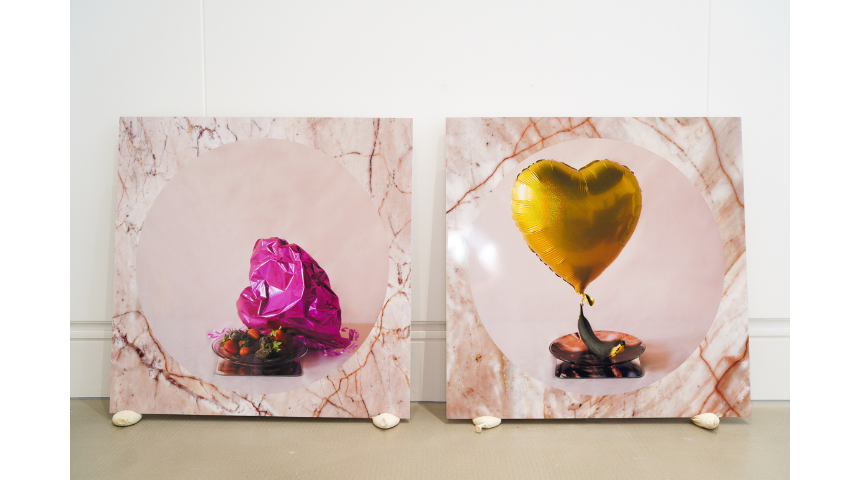
Dawn Woolley Memorial (Strawberry) & (Heart) (2016) Composite Photograph mounted on MDF standing on 2 deflated balloons 70cm x 70cm, installation at Blenheim Walk Gallery, Leeds Arts University, 2019. Hamish Irvine Photographer
C: I’ve seen your work at the Salford Museum and Art Gallery before. Two of the ‘Memorials’ images were included in David Hancock’s ‘The Omnipotence of Dream’. What is different about exhibiting there again this time around? Is there anything site-specific about this installation at all?
D: That’s a good question. I wouldn’t say it’s site specific. The Relics are, I guess, location-specific to Salford, but not really to the gallery. The gallery has a lot of character - the age that it is, the public institution that it is. I am actually showing ‘Memorials’ in full this time around. It will be interesting to see them in the gallery again, though in a slightly different location.
In that exhibition [‘The Omnipotence of Dream’], I was near the Marion Adnams painting [Variation on Red, (1949)]. I’m borrowing that one again, and one other by Derek Greenhalgh [Phenomenon 1, (1974)] from the Salford Museum and Art Gallery Collection for this exhibition. They both connote bodies through objects. I definitely do that through my photographs, and in some ways, still life always does that, but also I think it’s interesting to use cans in paintings. It’s not just a painting you’re looking at; you’re looking at an object that was bought by someone, sold and consumed. The thing itself has a whole life history before I got it, a history populated with people. I was interested in putting historical paintings in the exhibition to show there is a lineage in that kind of art, that uses familiar things in a really unfamiliar way.
C: I read about the folk tales that inspired the ‘Sirins’ and ‘Storm Birds’ sculptures; about these mythological bird-women that lure men to their deaths. Two questions came from that: When you’re discussing things like advertising and its effects on our perceptions of our own bodies, you tend to adopt a male point of view, advertising itself becomes a masculine endeavour - in what ways do you like to make work through other people’s eyes?
D: That’s a good question. Advertising is a very clever way of communicating. It’s designed to give us complex meanings in an accessible, universal way. They’ve done the hard work figuring that out, so we as artists might as well use those tricks and tropes, but I like the idea of subverting the language.
It’s interesting to think of advertising as a masculine position, because it is. Even in my self portrait work, some people have not seen them as such; in the past, some people have assumed I’m male, which completely changes the reception and reading of the work. I started doing still life and stopped doing portraiture because I came across The Substitute series on a blog, and the blogger had assumed that I was male, and had made a series about my ideal girlfriend – a girl made of paper, who didn’t speak back. I was like ‘Aw, shit.’ Once it’s kind of removed from you and it’s in the wild, your work can be de- and re-contextualised. Working with still life and objects gave me a chance to talk about objectification and sexualisation without showing a female body.
C: A lot of your work has a ‘veneer’ or a façade: The Dolly Mix full of spiders, The Substitute series replacing your body with a printed cut-out, a bird-woman luring a man to his death. How does your practice explore ideas of trust? I feel like your work lies.
D: It absolutely does, and I like that. Maybe it’s whether people should trust me or not.
I love veneers and surfaces. In the Pacifier series, I use vignettes, photos of usually a sex toy or a nail art practice with a piece of sweet jewellery. The surround is basically a type of paper, often very kitsch wallpaper made to look like velvet, or wrapping paper made to look like wooden veneer. Their appearance doesn’t match their substance, and I am really interested in that. In the Memorial series, the frame of the object is pink marble, which is actually just a shiny print stuck on a cheap piece of MDF.
C: Seeing that work in person, I should have looked closer. I had no idea it wasn’t marble!
D: No? I like that! It’s kind of giving that first impression that it never lives up to. When thinking about commodity culture, or representations in advertising, there’s that ‘too good to be true’ thing that I like to play with in my work. I definitely shouldn’t be trusted, my schtick is making things look better than they are.
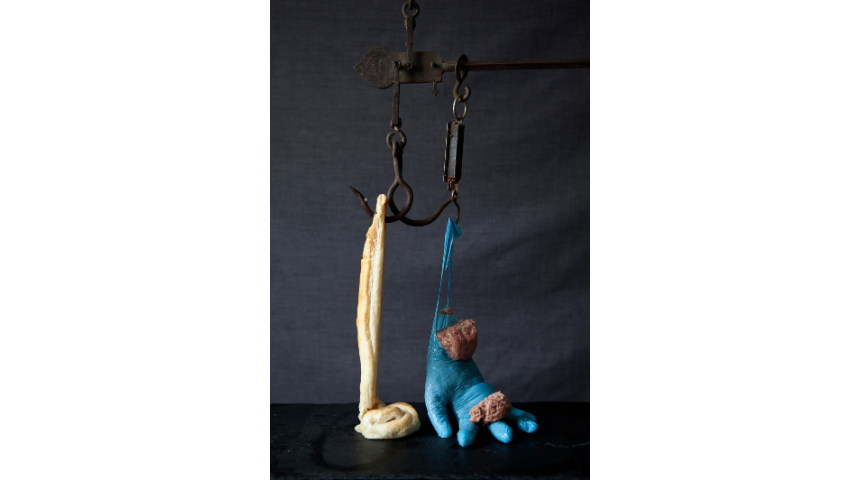
Dawn Woolley Celebrate (Scales 4) (2013) Photograph 40cm x 60cm
C: I was reading through the text accompanying the Celebrate series on your website. Coincidentally I was eating white chocolate while I read ‘White chocolate and blancmange’. I carried on reading and spat the chocolate out as I read ‘Sausage meat and surgical gloves’.
D: Sorry!
C: No, no. A lot of the work, particularly the older pieces in the exhibition, simulates taste. When I make work I pull very heavily from music. Is there one sense that you pull from particularly when making work?
D: I guess taste. In my PHD I looked specifically at food still life to talk about different forms of consumption, or how consumption impacts the body. You can open that up from literally what you eat to everything you consume. When you’re working with food, you can be quite visceral. I’ve worked with rotting meat quite a lot. The tongue (from the Memorials series) had been left in my studio for a while to start to go brown, and the smell while I was making it was incredible - in the worst possible way. Working with litter, too, it’s sticky, it smells, and you’re always slightly concerned that something is gonna drop out of a can. It’s quite sensorial to make, but I then go through a process of cleaning it up, reducing it all to visuals. On one hand, they’re ‘cleaned up’ for the audience, but on the other they still evoke those senses in people, and make them imagine the sensation.
Celebrate was one of the first things I made for my PHD, and it looks quite attractive from a distance, sophisticated in its colour palette, for example. Then you get closer, and you see sausage meat boiled into a surgical glove. The Weights series (a subseries of Celebrate) were made to be shown in January, when all of the party adverts come down and the gym membership adverts go up. They look nice from a distance and they draw you in, but there is something obviously abject about them.
While I was making the objects for those, I thought ‘if anyone came into this house now, they would just think I’m a serial killer.’ I had a blue glove bobbing around in boiling water, filled with a meat substance – doesn’t look good.
C: With that pink mannequin guarding the hallway, I don’t think anyone will get far enough into the house.
D: Yeah, I should maybe put some in the front window.
C: (In regards to the Salford-specific Relics) What was the most common piece of rubbish you found on your trips, and what was the most surprising?
D: I wouldn’t say there’s anything really surprising. I think things like coke cans and red bull cans - not just Salford, they are everywhere!. When I was younger it would be empty cig packets, but now disposable vape packages are kind of a sign of the times. I might have missed something though, so if you spot anything, send it over!
[She then shows me an experiment not featuring in the exhibition using a nitrous oxide gas canister as the body of a caterpillar].
I tried to make them into caterpillars, cause I hate caterpillars.
C: Really?
D: Moths, butterflies, caterpillars - not for me. I really think they will survive (the climate catastrophe).
C: I hear a lot about cockroaches as well having the same capabilities.
D: Yeah…the paintings that the crows and birds are guarding/collecting are called Survivors. They are pictures of species and creatures that probably will or indeed are already thriving because of climate change. It doesn’t fill you with joy. Mosquitoes, their natural habitat is increasing as the world gets wetter. Malaria, dengue fever, all the lovely things that they carry and transmit, will become more widespread.
These caterpillars are based on a boring kind of caterpillar thing which just eats decimates cereal crops.
C: Yay for them (?)
D: I know! I’ve been bitten by ticks twice while walking the dog, and that is a real body horror experience. Ticks are also on the increase thanks to climate change. If I wasn’t already concerned about climate change, this information would do it for me. ‘Stop climate change or there will be ticks everywhere!’ - everyone would be like ‘I’m in’.
C: Maybe that’s the next route of the advertising work…I’m gonna write this down.
D: I’m going to traumatise your readers! Terrible truth bombs!
Dawn Woolley will be giving a ‘Meet the Artist’ session in the gallery, where she will tour the show and answer questions. FREE, drop in, no booking required.
Sunday May 31st 2026
1:00 pm - 2:00 pm