REVIEW May 2026 ‘Joshua Donkor & Lela Harris: Familial Traces’ at Abbot Hall
Kirsty Jukes
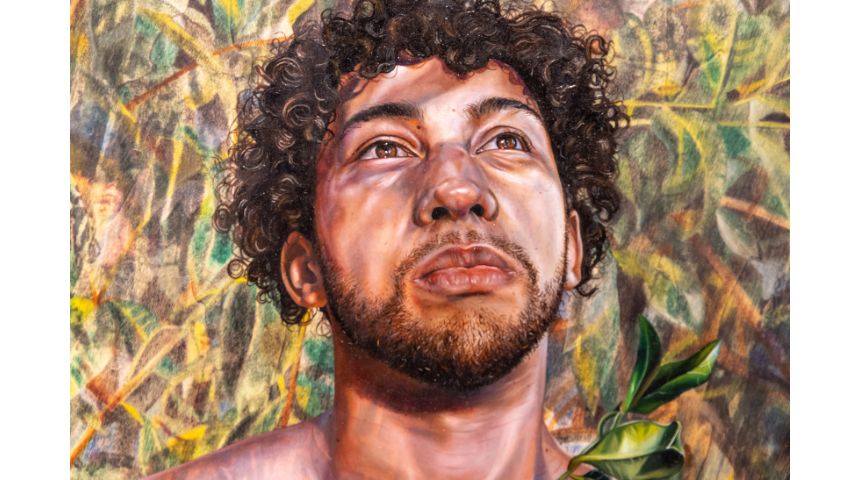
Joshua Donkor When the Moon Knows Where you are Wandering. Wanderer, part 1. (2025) Photo Credit George Carr Media.
Art historian and writer Kirsty Jukes reviews ‘Joshua Donkor & Lela Harris: Familial Traces’ at Abbot Hall, Kendal and interviews both artists. This joint exhibition brings together two emerging painters whose work challenges the narrative of traditional British portraiture. At the heart of the exhibition is a tension between documented lineage and the archival void. In each gallery space, Donkor and Harris challenge whose history is preserved and whose must be imagined. Through spaces such as the studio, the living room, the workplace, and the archive, Donkor and Harris draw out threads linking their practice, lived experiences and styles. It is a celebration of place, family, creativity and nostalgia. ‘Joshua Donkor & Lela Harris: Familial Traces’ is on view until Saturday, 3 October 2026.
‘The moon knows you're wandering,
even though the road thinks you're home’ (1)
These words appear in an open book on a table in Gallery 7 of ‘Familial Traces’ at Abbot Hall. This book of poems charts the writer Ruth Ellen Kocher's Odyssey across different places and landscapes, befitting the themes of this exhibition; the words repeat themselves in my mind as I walk around. This first room (although it is stated as being the final one in the wall text, I naturally turned left at the top of the stairs and headed straight into this exhibition upon arrival) is an amalgamated studio space with art supplies, exhibition posters, unfinished works, family photographs, study material, inspirational imagery, hand-quilted fabrics and a leather pouffe from Ghana. It is an imagined third space between Donkor and Harris’ studios, containing elements of their personalities and histories. It reminds me of a grown-up version of a teenage bedroom with identity signifiers all around. It feels warm and welcoming, inviting the viewer into a zone not usually seen by non-artists outside open studio visits.
On two of the walls are preparatory studies that give context to what goes into final artworks by each artist, a rare glimpse of their artistic process, unfinished and honest in their rawness. Next to them are groups of posters, featuring William Kentridge, Tamar Yoseloff’s poem Cadmium Lemon and the John Moores Painting Prize. This imagined studio creates space for an immediate pause to absorb the multitude of influences all around. Books sit alongside exhibition pamphlets, such as those for Kerry James Marshall’s ‘The Histories’, The Royal Academy’s ‘Entangled Pasts 1768-Now’, and Isaac Julien’s ‘What Freedom is to Me’. This paraphernalia provides clues as to the trajectory Donkor and Harris aspire to. Family photographs are framed on the wall next to a vitrine containing ‘Airmail’ by Donkor. This is a series of airmail letters written by his mother to her parents upon her arrival in Ghana, where she eventually met Donkor’s father. There are six letters in total, each overlayed with his signature image-transfer technique using each of the source photographs displayed above. This family archive captures Donkor’s mother’s firsthand experiences navigating new customs and language. The work's transcultural narrative materialises the artists' Ghanaian and British heritage through themes of migration, connection and memory. It is very moving to see those tentative beginnings next to pictures of Donkor and his family. Standing here really allows me to place myself in both artists’ shoes and therefore understand the work and its influences in the next two rooms that bit more keenly. It is a real gift and, personally, I feel it is an effective way to begin the exhibition.

‘Familial Traces’ studio installation, Abbot Hall. Photo Credit George Carr Media.
Moving into Gallery 8, the bulk of the work on display hangs along three walls. It is a beautiful day, and the sunlight plays across the wooden interior, illuminating everything in a warm glow. I am struck by the scale and detail in these works. It is also the first chance for me to take in Harris and Donkor’s unique styles next to each other, which are soft/expressive and realistic/detailed, respectively. In Harris’ Sounds of Home (2023), she tenderly depicts her daughter Georgie absorbed by playing the piano. Rendered in an almost entirely monochromatic palette, it is distinct from other works in the space that are awash with colour. This point of difference draws me towards it first. Knowing Harris’ humble beginnings and the adversity she has overcome to build the life she has for her family, this work stings me in such a poignant way. A reminder of the journey she has been on and what matters most. It is a quiet, gentle image full of joy and warmth that has stayed with me since.
Donkor’s Worlds Apart (2023) raises a similar feeling in me. It is a large work showing his grandmother and cousin in a living room, looking through a book of photographs that is a mirror image of the two of them. Grandmother looks engaged and strong, offering wisdom through a pointed finger. Her granddaughter meets my gaze directly, a look of precocious disbelief that is comical in its relatability. Throughout the work, ghostly apparitions of relatives and friends (more transfers from source images) appear on the wallpaper and furniture, a veil of welcoming faces peering out of the picture plane in unexpected places. It is rendered like a history painting, each figure given gravitas even in a recognisable domestic setting. The tension between them is finely executed, and I stand looking at this piece for a long time, drinking in all of the details. It speaks of generational difference, of trying to understand our elders, of the naivety of youth, togetherness and separation.
Other pieces in this room that strike me, although there are many more than I can write about here, include Harris's Birdsong (2024), a stunning bust-view portrait of a young woman in a yellow headscarf and gold earrings. Her pose turns her slightly towards the viewer, where she eyes the viewer confidently. There is something in her eyes that keeps me stuck, a compelling shimmer, deep and thoughtful. I wonder about her life and inner world. It is an affecting portrait full of Harris’ emotionally intelligent mark-making. In Donkor’s two paintings, Sankofa (2024) and Reap What You Sow (2023), his father is on his family’s farmland in Ghana, proudly showing the viewer this meaningful place. They are both reflections on the connection to ancestral land. In Sankofa, he stands on a rock looking back (the painting's title literally means ‘go back and get it’) symbolising a need to learn from the past. I can’t see what it is he looks at, but I can see that he is comfortably alone in this space he commands, aside from the repeated motif of transferred figures appearing through the layers of paint. In Reap What You Sow, Donkor’s father walks towards the viewer holding seed pods containing images of his own parents. Like the artist’s use of photography to connect with his past, these seeds are a kind of ancestral magic that helps further visualise the family line.
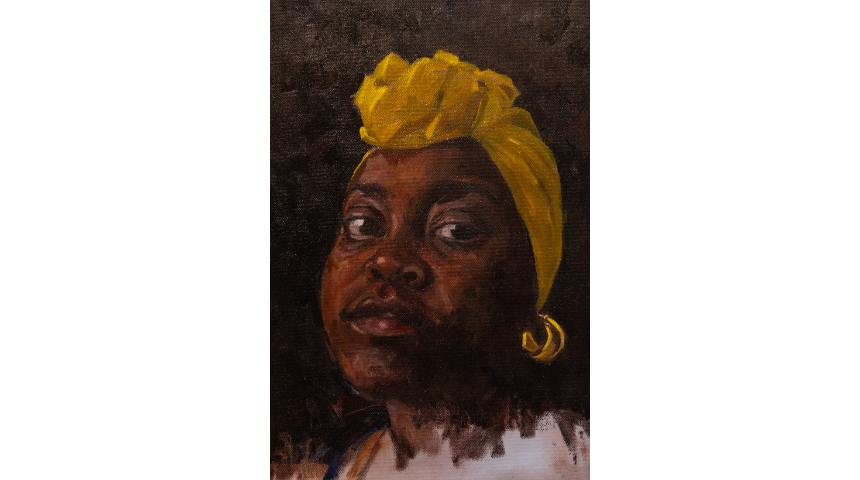
Lela Harris Birdsong (2024) Photo Credit George Carr Media.
In the final space, during my wrong way around ‘Familial Connections’ is a collection consisting mainly of Harris’ historical and literary commissions and Donkor’s character studies. The variety of skills on display is excellent, and it is great to see some works I know well paired with newer pieces. For example, Harris’ sensitive Portrait of Thomas Anson (2021) commissioned for ‘Facing The Past: Black Lancastrians’ at the Judges’ Lodgings Museum, Lancaster, sits on the same wall as her most recent work, mixed-media work Dr. Martin Luther King Jr. (2026), which follows the same intricate process as her Folio Society illustrations for Alice Walker’s The Color Purple (also on display in a vitrine complete with source painting). They show Harris’ versatility and skill in capturing the likeness of such important figures, whose appearances are both known and envisioned. She so effortlessly combines a careful way of looking at the archive with creatively summoning a person’s spirit in paint, whether or not a source image is present.
Opposite are Donkor’s hyper-realist portraits of young sitters. My personal favourites are Layers of History, Tash (2025) and When the Moon Knows You Are Wandering. Wanderer, part 1 (2025). Each of the subjects is bathed in light and sensitive in feature and demeanour. Being able to see so much of their personalities through each setting and clothing (or lack of) is a pleasure to behold. I genuinely stand in front of the latter while moving from side to side, as the eyes follow me, and the beautifully rendered face seems as though it is coming out of the picture plane. Many of the works have me fixated on both artists' ability to render so much emotion in people’s hands. It is mesmerising to see hints of the inner world of each sitter in the way their hands are formed. Some are playing the piano and holding an ice lolly. Others are offering, pointing, or their hands are draped over their face. When they are included in an artwork, I always look at the details of the hands. They are a great indicator of artistic ability and can tell me so much more about the intended emotions of the subject outside of facial expressions. I was not disappointed here. Throughout this entire exhibition, the tension between an archive of documented lineages and reconstructed possibilities where certainty cannot be found reveals the many complexities of migrant heritage.
—
I was lucky enough to catch up with both Donkor and Harris to discuss their work together on ‘Familial Traces’ and to find out more about both of their practices.
Kirsty Jukes: Were you aware of each other before working on this exhibition together?
Joshua Donkor: The art world is so small that everyone knows each other in some capacity, but probably not personally. I've followed Lela's work for quite a long time, actually being friends on Instagram and that sort of thing. Just following each other's trajectories, I guess. So, I've been aware of Lela's work for a very long time, and just absolutely loved what she was doing. I love Lela’s work with Folio Society. I just think the portraits or the drawings that she creates for those projects are absolutely stunning. And I remember sort of thinking, “Okay, I want to copy every single thing Lela does with Folio Society”. And then as soon as her name came up, saying that it could be a joint show with her, then immediately, I was very, very excited.
Lela Harris: I was aware of Joshua's work for the exhibition because I saw ‘Worlds Apart’. Which is in the exhibition with the grandmother and his cousin. And I was just immediately grabbed by the storytelling.. I didn't realise how big it was until I'd seen it in real life, but it just packs a punch even when it's reproduced, small or big. It was really fascinating to find out more about the background and the story behind the painting. I've just been really taken with how approachable a person he is. He really is a kind, gentle soul. Although I'm older, he's got like heaps more experience and is really generous in terms of sharing his knowledge or answering questions or asking me questions about my work. He’s really supportive, and we'll message each other now. I really love his approach to sharing his knowledge and also his commitment to making art accessible for people, ensuring that it's a collaborative approach. So we've done everything together, including all of the decision-making.
JD: I think that the lovely thing is we found loads of perfect entry points for this exhibition. Then it all entwines and then comes together whilst also working with very different perspectives. So it's been really fun working that all out together.
LH: it's been it's been really nice, and I've really enjoyed getting to know him. I love the studio space at the start, it was just really nice just to be in there, just standing for a while, taking it all in. We really wanted it to demystify the whole of being an artist. It’s an invitation into the studio space to let people know that we’re the same as everybody else. We might be seen as two artists who have an exhibition in this very fancy gallery, but we're just sitting at home making paintings, being interested in people, just like everybody else.
KJ: What did you learn about each other's practices during this project?
LH: I was speaking to him when he arrived, and we'd set where all the paintings were going for the show. And I said, “It's kind of funny, really, how our work is a reflection of our personalities”. Mine are louder in terms of paint application and colour palette, and he's a much more reserved and quiet in a gentle, thoughtful way. Some of my work is thoughtful like that, but I really like the way we approach quite similar themes but totally differently, so it was like seeing ourselves on the wall. He agreed. I thought it was kind of interesting, but I was also worried they wouldn't work together until I saw it all in conversation with each other. It's like having two people and two families in the same space, which I think is very nice.
JD: I remember this discussion when we were installing. Lela's is very sort of out there and gestural in different ways. And I feel like that is quite a good description. Like she's got so much passion, energy, and personality that all goes into the painting process. So you're creating these paintings that have traditional elements, but then are full of energy and very contemporary. And I just think, yeah. Oh, it's just brilliant. Maybe my work, maybe a little bit quieter and more introverted.
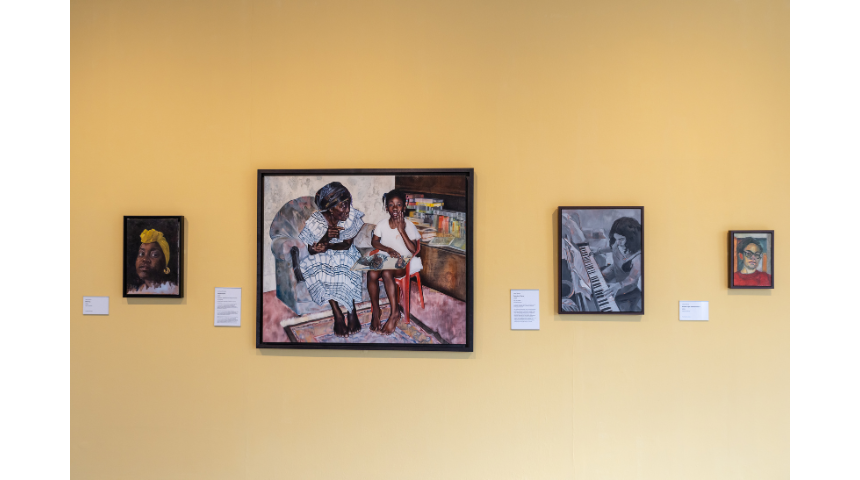
‘Familial Traces’ at Abbot Hall installation shot. Photo Credit George Carr Media.
KJ: Throughout your body of work, you often explore the human psyche through portraiture, sometimes by personal connections and other times featuring strangers. How do your approaches differ when dealing with each?
LH: The different approach depends on the subject. With people I know, or I have a personal connection to, it's more about trying to make their personality or effervescence shine, that kind of spirit. I find that when I'm working on somebody that there's a personal connection to, there's a tension between resemblance and letting the drawing or the painting do what it wants to do. So I often find myself slightly more tense when I'm working on somebody I know because there's an expectation, or a perceived expectation on my part, that the resemblance is important to them. Previously, I thought it would be easier to do portraits of people I know, but I actually find it the opposite. I find it easier to create portraits where I can get really absorbed in historical research or daydreaming about what's potentially going on in their lives. So for the historical portraits, it's speaking to academics, members of the community, church leaders, digging through the archives, and, when it's available, I work from a reference photo that's been given to me. So I don't know them, but there is a small connection I like thinking of. It's like writing a piece of creative writing, like what's happening on that day, what's happening, you know, in their lives and kind of dreaming up a story, but also connecting it back to me. I think my work is so eclectic because people are so different, and I'm trying to match the two rather than worrying about what the expectations are like, sticking only to oil paintings or inks. I try to match the medium to the person's personality.
KJ: Works in ‘Familial Traces’ trace your family history in Ghana. How do you translate the personal archive into the final work?
JD: I think that it almost works the opposite way around. I think you start from a personal place, and you just think about it from that. It's just thinking about honesty within the work. And then that should inevitably translate. Or I found that that has inevitably translated, I think, when you're thinking about making work for people or how people are going to perceive it might not always be the best thing. I think it always creates the work that feels right for me, that expresses my personal perspective, my story, my family's story. And then, you know, you kind of hold your hands up, and it is left to other people to interpret [the way that you] hope they do. So it's quite a scary thing, I think sometimes. But so far, a lot of the response has been lovely, and a lot of the way people connect with the work has been even better, and also sometimes quite unexpected. Which I guess fills you with a renewed energy to keep making, which is really nice.
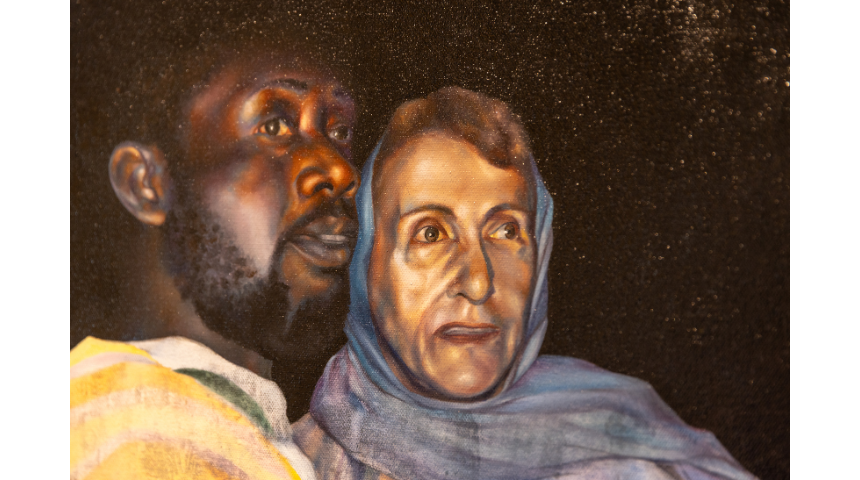
Joshua Donkor Nightfall in Cyrene (2025) Photo Credit George Carr Media.
KJ: Who are some of your main creative influences?
LH: I am hugely inspired by painters, sculptors and documentary photographers. I've always been a fan of Joan Eardley's work. My work ‘Newport Street’ in this exhibition is in response to Eardley’s work Street Kids (c.1949) in the National Galleries of Scotland. I think when I was learning to draw and paint, I discovered her work and found it to be infused with curiosity and a non-judgmental appreciation for humanity. Especially her portraits. I love how she includes all her workouts in the drawings. So when I discovered her work, it made me feel more confident about my own work because I thought, to be a professional artist, you couldn't show any of that scaffolding or the creative process. Whenever I've seen her pieces, I've always wondered what the people in that particular portrait were doing that day because she spent so much time in the working-class neighbourhoods of Glasgow, really observing and talking to [people] and trying to integrate as much as possible into their lives. She just really captured this timeless magic of innocence, adversity at the same time, without being judgmental, which I thought is really powerful. Other artists I admire are John Singer Sargent, Käthe Kollwitz, Rembrandt, Johannes Vermeer, Barbara Walker, Catherine Kehoe, William Kentridge, Kouta Sasai, Lynette Yiadom-Boakye, Jennifer Packer, Nicolas Uribe, Édouard Vuillard, Vivian Maier, Hurvin Anderson, Dorothea Lange and Gordon Parks.
JD: I love painting, and I love painters. So Michael Armitage is probably one that I absolutely adore. Then you have other artists like Njideka Akunyili Crosby, who's been a really influential artist for me personally, especially with her approach to painting and layering of images. And then another artist, Lynette Yiadom-Boakye, is just phenomenal. I think, I don't know if you ever saw a show with the I think it was Tate Britain, that show, especially being a retrospective, was just absolutely incredible, seeing as the breadth of research and ideas unfold across years and decades. And that was very special. Another one I love is an artist called Firelei Báez. And I think she's particularly inspirational, especially when you hear her speak. Because the breadth of research and knowledge she has that inspires a lot of her work is really kind of, you know, she really sets the standard, I think. And then, I also love film. I love documentaries, so I'm constantly watching films of anything that's coming out. So yeah, I think try and draw inspiration from all forms of kind of creativity, I guess. But the main thing is, is storytelling that encapsulates a culturally traditional perspective. That's what my work is all about. What I am fascinated by. One film that really stuck with me and that I thought was particularly beautiful is Moonlight (2016). It really captures this idea of an internal space. It's a very quiet film. I think that was something I really admired, the way they captured that, but then also the visualisation of that is just one of the most stunning visual films you will ever see. The colour palette, it's like every scene is a piece of artwork.
—
Getting the connecting train home from Oxenholme, I jump on a service from Glasgow. After finding my seat, I am surrounded by Glaswegian accents that remind me of my Grandad. I think about my own layered family history dislocated from its roots on both grandparents' sides. It is a warm feeling to find that sense of belonging in a multigenerational crowd of people whose voices remind you of relatives past. Of Entangled Pasts. Family photographs and precious moments with my Grandad flash through my mind as I listen to the warm conversation going on all around. That sense of connection tinged with longing and loss that I always feel when I am reminded of him triggers a similar feeling of nostalgia that Harris and Donkor both describe when speaking to me about their work. That is just one reason why ‘Familial Traces’ works so well. Everyone has some form of family, whether given or chosen, and with that comes both joy and sadness. These themes are extremely relatable, meaning any visitor to this exhibition should be able to find a story that resonates with them, even after they have left. I know I certainly did and cannot wait to be back.
‘Joshua Donkor & Lela Harris: Familial Traces’ runs until Saturday 3 October 2026 at Abbot Hall.
Entry included with gallery admission. Lakeland Arts members and Annual Pass holders go free. Pre-book tickets online here.
Thank you to Lela and Joshua for their time and generosity.
This interview is supported by Lakeland Arts
Notes -
(1) Ruth Ellen Kocher, ‘When the Moon Knows You’re Wandering’, New Issues Press (August 2001)