REVIEW Apr 2026 Delaine Le Bas ‘Un-Fair-Ground’ at the Whitworth
Josephine Manby
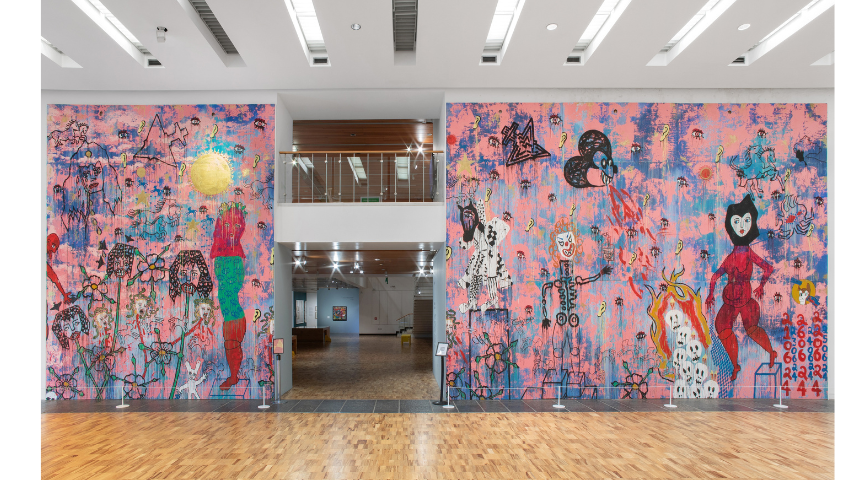
Delaine Le Bas, Un-Fair-Ground installation (2026) © the Whitworth, The University of Manchester. Photographs: Michael Pollard.
‘Un-Fair-Ground’, an immersive exhibition by acclaimed multimedia artist Delaine Le Bas, is on show at the Whitworth Art Gallery Manchester until 31 May 2026, and is accompanied by a wealth of special events (see foot of article). the Fourdrinier editor Josephine Manby went to experience it and had the opportunity to ask Delaine about her work.
https://www.whitworth.manchester.ac.uk/whats-on/exhibitions/delainelebas/
Depending from which entrance the visitor approaches ‘Un-Fair-Ground’, they may first encounter Delaine Le Bas’s vast gritty pink mural, originally commissioned for the 2024 Glastonbury Festival. Or they might chance upon the central performance space, with a found map by Delaine’s late husband Damian Le Bas, works on cotton by Leslie Thompson and Sarah Lee of Venture Arts, and a large ‘NO’ slogan inscribed on the floor in red paint.
Or else they will come upon phantom-like drops of white organdie and calico bearing Running Figures (2025) in calligraphic black brushstrokes before setting eyes on the reverse of the performance space – a row of costumes in bright primary colours beneath a carnivalesque painted frieze, two costumes from Diaghilev’s Ballets Russes, and a sample of wallpaper by the exuberant French feminist sculptor Nikki de Saint Phalle.
A range of approaches is apposite for this stunning, radical cross-collaborative presentation curated by Delaine Le Bas with Valentin Diakonov, Curator (Modern and Contemporary Art) and Hannah Vollam, Assistant Curator (Art) at the Whitworth, with scenography and installations developed with Le Bas’s partner Lincoln Cato. The exhibition retains an elegant, refined aesthetic and curatorial structure, informed by current thinking on remediation of traditional museum collections, which is then hung with an expansive, immersive collaging of works that upturns received art history to embrace experimentalism, myth, folklore, witchcraft, identity politics, punk, activism, neurodiversity and ethics.
It’s an exhibition which works on numerous levels but which works cohesively as a unified collection of like-minded narratives. Visually, aesthetically, it is hugely engaging. Each of the galleries is filled with textures and varied saturations of colour, from the palest pastel and mists of white and grey to bold primary and tertiary that together encourage contemplation, thinking and dreaming. There are inversions and oppositions of scale, whereby a work such as Help Help (2021-2015), a small piece of inscribed brown wrapping paper held down with pink paper tape, contrasts with the outsize titular mural Un-Fair-Ground (2024) tumbling and flaring across the wall of the Project Space at the Whitworth, with its disembodied eyes, Medusa heads, bolting horses and dazzling suns.
The title itself, ‘Un-Fair-Ground’, holds a double meaning. In Romani, it refers to a good stopping place. However, in the context of general English language usage, it conjures notions of disputed territory and the exclusionary practices of landowners in a country where the state and its local bodies have an entrenched history of denying nomadic people rights of temporary occupation.
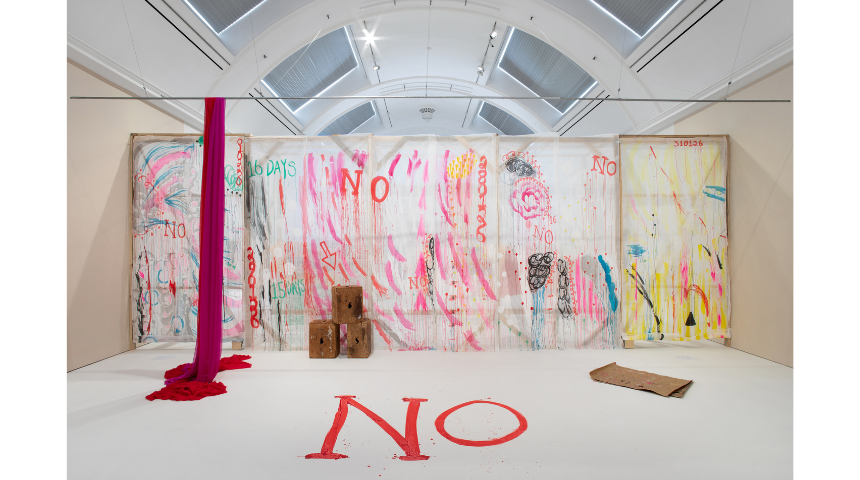
Delaine Le Bas, Un-Fair-Ground installation (2026) © the Whitworth, The University of Manchester. Photographs: Michael Pollard.
Delaine Le Bas (b1965), a member of the Romany community, studied St Martin’s School of Art and has been a practicing artist since 1988. Exhibiting widely, her work has appeared at Prague Biennial (2005, 2007), Venice Biennale (2007, 2017, 2023), Gwangju Biennial (2012) and ANTI Athens Biennial (2018). She has undertaken innumerable residencies and commissions. In 2024 she was shortlisted for the Turner Prize, for which she created Incipit Vita Nova (Here Begins The New Life/A New Life is Beginning) exhibited at Tate Britain. ‘Un-Fair-Ground’ is a survey of her practice encompassing painting, textiles, embroidery, film, performance, collaborations with other artists and dialogue with works from the Whitworth’s collection.
Because the exhibition is complex in both concept and content, I was interested to find out about Delaine’s preparation for the Whitworth show. Did she have a period of time to spend exploring the collections? How did she structure the time and what did this feel like for her as an artist? ‘I spent time initially online with some random word searches, as I am always interested in what appears in these.’ Some items are listed without images, she says, providing a further element of chance.
‘I had two site visits to see items, and once I got to the Whitworth to see the items I had found online, Valentin Diakonov then took me into the store where they are held. In the process of this, other items were also discovered.’ Delaine chose to incorporate works from the Whitworth’s Musgrave Kinley Outsider Trust which comprises over 1153 pieces by over 129 artists, amassed by curator Monika Kinley and gallerist and curator Victor Musgrave over the period 1979 to 2010, and gifted to the Whitworth in 2010. This collection includes work by artists who are self-taught or in some way marginalised from the mainstream artworld. ‘I do a lot of research for myself,’ Delaine said. ‘It's part of my complete artistic process, and being able to access the collection is an extension of this research process.’
Section One
Flanking the entrance of Gallery 7 are two large scale banners, Rinkeni Pani (2022) in pale pink fabric marked with orange, green and black lettering and symbols, possibly referring to topographical features: ‘LEY’, ‘ORD’, ‘RINGS’ and ‘ANCIENT’ are spelled out, along with glyphic mountain ranges. The title is English Romani for ‘beautiful water’, recalling Delaine’s great grandmother’s exhortation to be careful not to waste water, at the same time as asserting the lack of water for certain populations across the world.
Imperium Romanum Romani (2016) is a work created by Delaine’s late husband Damian Le Bas (1963-2017) from found maps using markers and other media. Damian was interested in the potential of using maps to explore the flow of people across borders in a transnationalism that dates back to the Roman Empire.
Facing this detailed, richly inscribed work is Delaine’s Performance Space (2026) constructed from a wooden framework and draped with painted organdie. Delaine states that the central painting was inspired by her recent residency at the Celle Ligure in Italy. ‘Percy Shelley was once staying not far from there, on the other side of Genova, and wrote the Masque of Anarchy as a response to Manchester’s Peterloo Massacre’ in which the poet refers to walking in ‘the vision of Poesy’. ‘My painting is a portal to those visions,’ says Delaine.
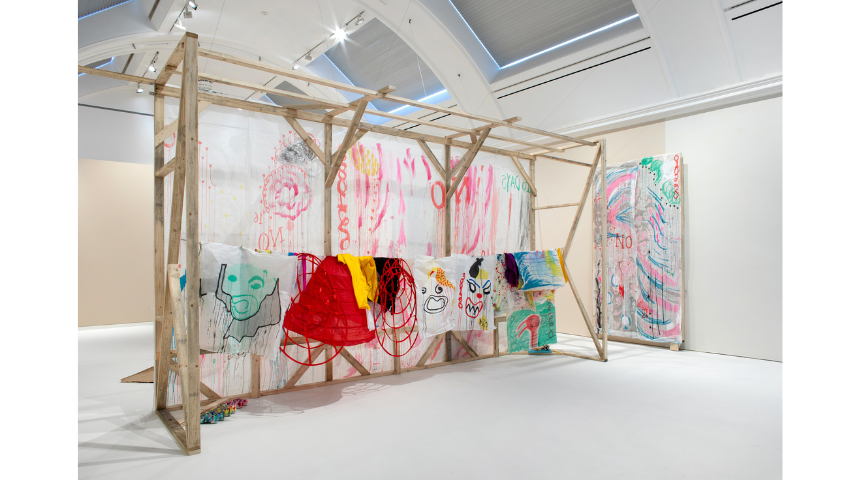
Delaine Le Bas, Un-Fair-Ground installation (2026) © the Whitworth, The University of Manchester. Photographs: Michael Pollard.
To the left and right of the open space between Imperium Romanum Romani and Performance Space, Delaine shares the gallery with Sarah Lee, who exhibits All is Confused by a Horse’s Head (2026), in hand embroidery on cotton with yarn, ribbons and bells; and Leslie Thompson who shows four works in acrylic ink and fabric pen on cotton. Leslie uses an outline to draft his burgeoning, expansive, cartoonish impressions of fantastical figures, from Masters of the Universe and He-man and Two Muscle Women Together to Body Building Gym of the Fantastic Four and all the Superheroes (all 2026). He then applies washes of subtle, sophisticated ink that turn away from the vividness usually associated with cartoons; these are the hues of a classical watercolour painter rather than a graphic artist.
Venture Arts, based in Manchester, is an award-winning visual arts organisation working with learning disabled artists. Via studio programmes, exhibitions and collaborative projects, they champion neurodiversity and provide pathways for each individual to develop a creative identity. I asked Delaine how she set about forming a collaborative relationship with the two Venture Arts artists.
‘The Whitworth has a long-standing relationship with Venture Arts, which is really important to me as I will only be there for the duration of the installation and I will come back a few times. I am interested in how relationships can be sustained over a period of time, so that care can be taken over time to establish long-lasting relationships so that everyone involved really benefits.’ Delaine explains how she is not interested in a box-ticking exercise.
‘Leslie and Sarah are both great artists. It was so good when we were all working in the space together; both Leslie and Sarah will also continue to work in the space over the duration of the show. I like how this keeps the space active and continues our sharing of the space together.’
Section Two
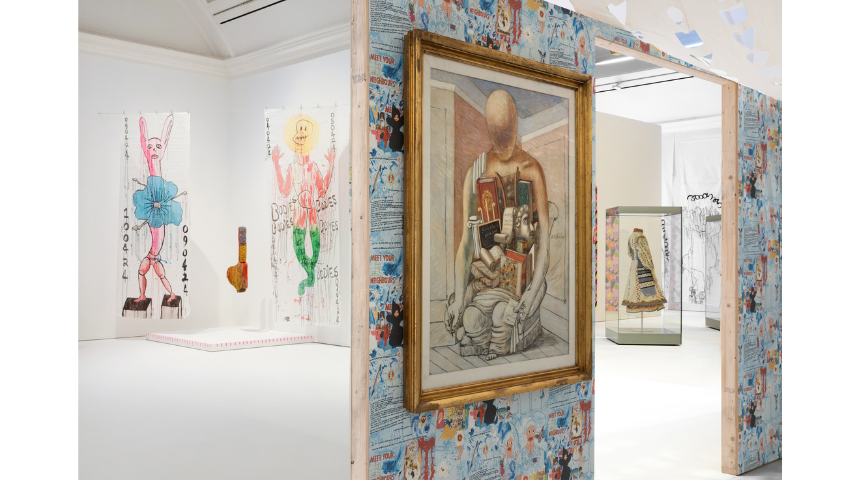
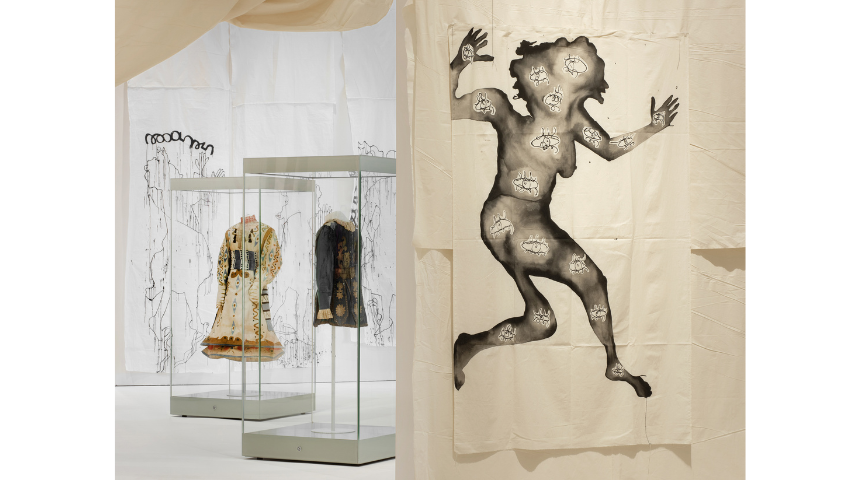
Behind the Performance Space in Gallery 7 is a backstage style dressing area containing exquisite ballet costumes dated 1907-1929, from the Whitworth collection, on loan from Granada Television since 1974. These were created for the famous Ballets Russes, the dance company founded by Serge Pavlovich Diaghilev (1872-1929), one time lover of dancer Vaslav Nijinsky (1889-1950), which was renowned for dazzling and revolutionary innovation in music, choreography, costume and art.
To the left is Alexander Golovin’s design for a Knight’s costume, L’Oiseau de Feu (The Firebird music by Igor Stravinsky 1882-1971), in hand-painted cotton with metal trimmings. To the right Alexandre Benois’s doublet for Le Pavillon d’Armide (Armide’s Pavillion music by Nicholas Tcherepnin), in cotton, metallic fibre, silk, silk velvet and bobbin lace with handsewn embroidery and appliqué.
Between the two outfits is a panel of textile design by the pioneering French American sculptor, filmmaker, painter and illustrator Nikki de Saint Phalle, sometimes considered an Outsider artist as she had no formal art education. Her work often consists of monumental, joyful assemblage pieces and she collaborated with Jasper Johns, Robert Rauschenberg and Jean Tinguely. Here, an expression of feminine joy or French feminist jouissance unfurls across the surface pattern design.
Delaine Le Bas, Un-Fair-Ground installation (2026) © the Whitworth, The University of Manchester. Photographs: Michael Pollard.
Section Three
Gallery 6 contains sculpture, large scale textile works, film and an installation, Witch House, including several works from the Whitworth permanent collection. For me, it is in this space that the exhibition reveals its superlative curatorial properties. Instead of layering what’s on view with additional text in the form of labels and panels of supporting, explanatory information, the visitor is left to mingle with the works, entering an enchanted realm where the imagination can wander at will. ‘That was a deliberate decision by the artist,’ explained Valentin Diakonov: ‘[the artist] feels that a unified artistic field inspires surprising connections and expands our understanding of art beyond names and brands.’
Works from the collection include the cryptic, becalmed left section of a triptych, The Philosopher (1925) by Italian painter Giorgio de Chirico (1888-1978), presiding over the Witch House. The amassed pile of objects the spectral figure is composed of, and the strangely placid, eerie space the figure occupies, are so indivisibly connected to the atmosphere of the Witch House that to hang the painting anywhere else now is almost unthinkable.
Through the installation of Pearl Alcock (1934-2006)’s wax crayon on paper Floating Mermaids (1987) alongside Paula Rego (1935-2022)’s etching and aquatint Baa Baa Black Sheep (1989) and William Blake (1757-1827)’s ‘Europe’ Plate i: Frontispiece, ‘The Ancient of Days’ (c1817-27), chain reactions are galvanised into action, each work sparking with redoubled meaning and import.
The etching and aquatint Los Caprichos, Plate 49: Hobgoblins (nd) by Francisco José de Goya y Lucientes (1746-1828) positioned next to Mercedes Jamison (1933-97)’s drawing The Scarecrow from Oz (nd) play off each other in democratised counterpoint. Joan Miró (1893-1983)’s aquatint, Le Chien Bleu (nd) accompanies John Hamilton Mortimer (1741-79)’s lightning-fast pen and ink sketch A Witch with a Brand (nd). Connections and interpretations are not announced in a gallery label or text in some well-intentioned but heavy-handed manner, they are just left open to the visitor to pick up on in whichever way they wish.
‘Un-Fair-Ground’ as an exhibition is billed as being shaped by The Metabolic Museum, a book by Clémentine Deliss that ‘calls for the disruption of reductive, patriarchal classifications within museum collections and displays.’ Deliss, reflecting on her own career as Director of Weltkulturen Museum (Museum of World Cultures) Frankfurt, is concerned to explore the way European ethnographic collections have recently been compelled to address issues of colonial appropriation, the basis of their very existence. The concept of metabolic museum (indicating a well-regulated body) is ‘an interventionist laboratory for remediating ethnographic collections for future generations.’
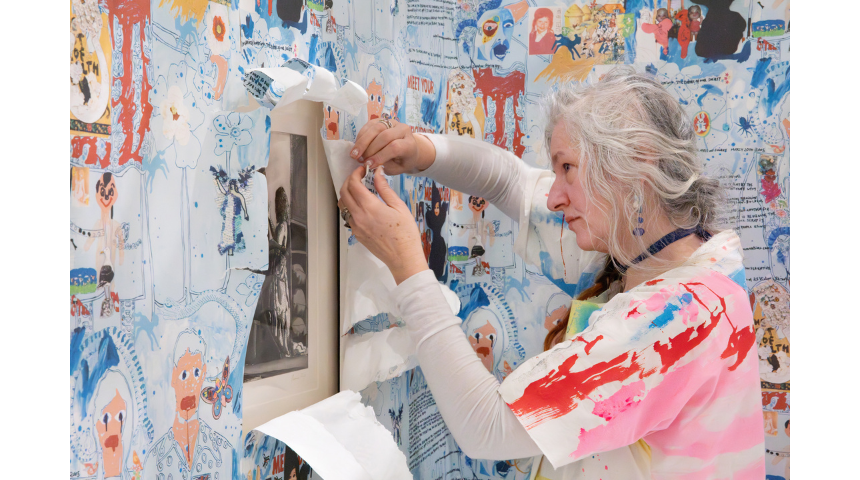
Delaine uses her own radical, subversive painting as the motif for a new wallpaper. Breaking up customary display conventions by placing valuable, world famous works of art from the European canon (Miró, Blake, Goya) alongside pieces from the Musgave-Kinley Outsider Art Collection is innovative and bold. Taking the interrogation of standard presentation a step further, these precious works are mounted behind the layer of wallpaper, which in turn is ripped apart to reveal the artworks.
I absolutely loved this ethos and outlook, and asked Delaine if she intended the exhibition, particularly the Witch House, to have an empowering effect on the visitor, almost acting as a portal to other levels of creativity and freedom. ‘My partner Lincoln Cato,’ she says, ‘who helps me with the scenography, and I are always talking about how we allow the audience to experience artwork differently. Framing is also an issue with works. I have only recently started using frames even for my paperworks as I was always looking for a different way of 'framing' the work.’
‘The Whitworth has a history of making wallpaper with artists, and so, between us, we came up with the idea that the works would be almost exploding out of the walls. It is fitting, especially as the wallpaper is made from my painting "Meet Your Neighbours", it introduces the artworks in a different way and also allows no hierarchies to be in place in terms of whose work is whose in the artistic canon. It's a house of a different kind…’
In ‘Un-Fair-Ground’, the work of outsider artists is welcomed into the space and treated with the respect it deserves. It is particularly moving to witness these works, such as Judith Scott (1943-2005)’s two untitled pieces from 1990. An American artist known for binding objects with strips of cloth and lengths of thread and yarn, Judith was a second-born twin who had Down’s Syndrome and became deaf following childhood scarlet fever. She was separated from her loving family aged 7 by social services and only 35 years later, her twin Joyce was able to undertake legal guardianship of Judith from the State, bringing her home. Exhibited internationally, her work has played a significant role in the advancement and appreciation of work by artists with developmental disabilities.
I wondered whether all of Delaine’s work comprised a call to activism, or is it more an appeal for personal freedom and a life of joy and creativity. ‘Activism can be in the everyday. The smallest thing can have an impact, like what you share with others directly, especially when you can share. Personal freedom, joy, creativity.’ Delaine points me to UDHR Article 27: ‘Everyone has the right to freely participate in the cultural life of the community, to enjoy the arts and to share in scientific advancement and its benefits.’
I asked Delaine how she rationalises and deals with the fact that there is so much division and hatred in the world, or whether she attempts to find a way to live apart from all that and not pay it too much mind. ‘It's all there in the work. Working across all media enables this to happen,’ she says. ‘I'm not in a bubble. I am acutely aware of all the bad that is happening. I am working to create works that address that, but also, as I am always saying, "No, we must not let them steal our joy".’ As Valentin Diakonov pointed out, ‘Delaine’s mural in Gallery 3 deals quite straightforwardly with the divisions and catastrophes that a reliance on one dominant politics, in our case American imperialism, brings to the world. The cult of military power that supports national interests and borders creates monsters, and Delaine’s ethos is anti-restrictions, freedom of movement, collaboration and inclusion. All very much needed now, as ever.’
Delaine Le Bas, Un-Fair-Ground installation (2026) © the Whitworth, The University of Manchester. Photographs: Michael Pollard.
Section Four
Gallery 8 has a slightly sinister feel. A large table laden with books takes centre stage. The whole room is draped in calico. Drawings by Madge Gill are also executed on calico; Delaine saw then at Monika Kinley’s house several decades ago. Painted mirrors created by Damian Le Bas, each representing a feminine face and head in thick black brushy outlines, both command and deny one’s own reflection. One of the Whitworth’s most ambiguous but menacing works, by the Brazilian artist Ana Maria Pacheco who came to Britain in 1973, The Endeavours of a Certain Poet (1985), looms out of the dimly lit atmosphere at the back of the room. Next to the two figures, the skull of an antelope is bound to a black table with red cord. Coercion and trepidation are in the air, but nothing is clarified. When you turn to leave (possibly not wanting to linger too long), an iconic, baleful image of a running female figure covered in eyes runs in the opposite direction of the doorway, through which can be seen the two Ballets Russes costumes standing back-to-back in their glass cases like sentinels from the turn of the last century.
~
I was fascinated to ask Delaine whether punk came into her sphere when she was growing up in the late 1970s and 1980s. Did she wear punk clothes and make up as a teenager? ‘I was too young for Punk but was inspired by Polystyrene of X-Ray Spex, the first time I heard the song ‘Identity’, it was the first time I felt someone was speaking to me about how I felt to own the world. She also wore great clothes, a mixture of vintage and things she had made. It was because of music and clothing that I went to art school.’ Textiles are indeed an essential component of her work. She recalls her parents having clothes made for her and her siblings: ’so we never looked like anyone else, even including my school uniform, it was its own thing. I also went to Jumble sales and second-hand shops with my Uncle Eddie and my Nan, finding great old bits of clothing.’
What was Delaine’s formative experience like, in terms of preparing her for the life of an artist? ‘Lots of things prepared me for being an artist: resilience, patience, how to work in compressed time zones, making the most of every single opportunity, and learning to live with not being part of the status quo.’ I wondered whether and when she found a confluence between the anarchism of punk and the nomadic lifestyle of her Romany (British Gypsy, Romani, Roma and Traveller) heritage, in terms of social and cultural positioning. ‘I would say for me personally, it's about not conforming’, Delaine said, ‘and living on the outside of the status quo.’
I had heard Delaine describe the way her life and her art are indivisible. Should everyone live like this, in an ideal world? ‘It works for me; it would not work for everyone. As I am always doing what I love to do, it's a full life in the complete meaning of that.’
Visiting ‘Un-Fair-Ground’ was for me a transformative experience. In the Witch House, I was reminded of the proximity of Kurt Schwitters’ Merz Barn (1947-48) a magical artistic installation in a small building originally located in Elterwater, about 15 miles from where I spent many holidays when I was growing up. In the presence of the Ballets Russes costumes, the fleeting memory of my own grandmother telling us about the incredible experience of seeing Anna Pavlova (1881-1931) dance. The night after seeing ‘Un-Fair-Ground’, I dreamed of a gathering of people in an enclosed, dimly lit space, their faces painted in the colours of portraits from members of the European Modernist painters of Die Brücke, Der Blaue Reiter and the Fauves.
Thinking of the importance of kith and kin, I asked Delaine how important the language and lore of the people she grew up with is. ‘The language has probably encouraged my use of language and my wanting to work with language within my work. Certain ways of being and superstitions, I think, made me investigate areas around this. My Great Great Grandmother was called and known as a Witch – more to do with knowledge than actual Witchcraft, so this opened up my research into Witches, Witchcraft and Witch Hunts, it all comes full circle in some ways. With Witch Hunts being tied to capitalism, which leads to scapegoating, exploitation, suppression, enclosures, land grabs... I could go on...‘
I recently listened to an archive footage interview with an elderly woman on the subject of witchcraft: ‘if you believe you are bewitched, you will be bewitched. If you do not believe, you will not be.’ There was something spellbinding about standing inside Delaine’s Witch House, as if doors of possibility were opening up all around. However, irrespective of bewitching, I would encourage everyone to visit ‘Un-Fair-Ground’ and see if this groundbreaking exhibition has an effect on them. Walking away from it, something shifted in my experience of the world.
Delaine Le Bas, Un-Fair-Ground installation (2026) © the Whitworth, The University of Manchester. Photographs: Michael Pollard.
This review is supported by The Whitworth
Events
Radical Collections: Delaine Le Bas and Clémentine Deliss in conversation. Thursday, Apr 23 from 6:30 pm to 8 pm. £5 - £15, booking required.
Student Upcycling Workshop with Delaine Le Bas and Wendy Roby. Saturday 24 April 1pm-3pm. Free, booking required.
Upcycling Workshop with Delaine Le Bas and Wendy Roby. Saturday, Apr 25 from 1 pm to 3 pm. £10, booking required.
Live working sessions with Sarah Lee and Sally Hirst from Venture Arts. Everyone is welcome to come say hello and find out more about Sarah and Sally's work. They will be working in the Performance Space of Delaine Le Bas: Un-Fair-Ground, where Sarah's work is exhibited throughout the run of the show. Thursday 7 May, 10am-2pm. Free, drop-in
Romani Resistance Day with Delaine Le Bas, Juice Vamosi and Gemma Lees. Saturday, May 16 from 1 pm to 4 pm. £0 - £10, booking required.
Curator Tour. Join Hannah Vollam, Assistant Curator (Art), for a more in-depth look at Delaine Le Bas: Un-Fair-Ground. Thursday 28 May, 6pm-7pm. Free, booking required. Booking link coming soon.