FEATURE May 2026 Multiplied Thresholds – ‘Curtain Up’ At Lowry
Josephine Manby
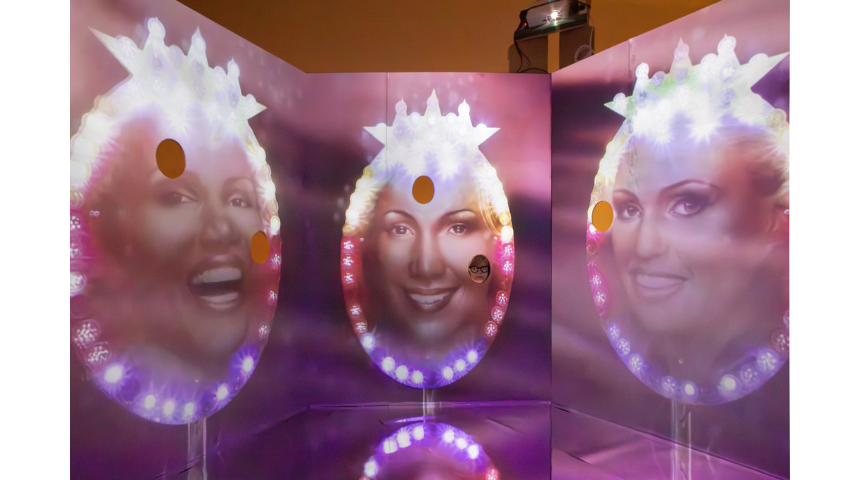
Rowland Hill Relic (2026) Photo Michael Pollard
From curtain-concealing-ordinary-man in The Wizard of Oz (1939), to Alfred Hitchcock’s flimsy shower curtains in Psycho (1960) and Wes Anderson’s theatre curtains bracketing the acts of Rushmore (1998), the curtain is a culturally loaded divider between fabrication and reality, and forms the curatorial concept for Lowry’s newest exhibition, ‘Curtain Up’. Free to visit until 21 June 2026, the show features artists Simeon Barclay, Chris Paul Daniels, Denzil Forrester, Rowland Hill, Joy Labinjo, Ryan Mosley, Abigail Reynolds, Bridget Smith, and Ulla von Brandenburg. Contemporary Curator Zoe Watson presents new commissions by Ulla von Brandenburg and Manchester-based artists Chris Paul Daniels and Rowland Hill, alongside a selection of works on loan. Supported by Arts Council England and Salford City Council, Lowry presents a regularly changing programme of contemporary exhibitions alongside the permanent LS Lowry Collection.
‘The adoption of self-reflexive scenographic conventions – including the proscenium frame, scaenae frons (arcade screen), rideau de scène (stage curtain) and back curtains, narrow forestage with side entrances, viewing boxes, orchestra pit, stage flats, footlights, prompters box, and on- and/or offstage viewers – allowed the artist to present both images and sets in the guise of metafictions. They appear as pictures of an imaginary or dreamlike world whose dramatic effect is intensified through multiplied thresholds that trace (and sometimes subvert) distinctions between zones of illusion and reality...’
POGGI, CHRISTINE. “Stage at the Edge of the Sea: Picasso’s Scenographic Imagination.” The Art Bulletin 101, no. 1 (2019): 90–118. http://www.jstor.org/stable/45175002.
The curtain, in cinematic or theatrical terms, signifies suspension of disbelief. When the curtain is down, you know it’s going to rise on a different world, a dimension in which time contracts to the span of ten minutes, or two hours, possibly with an interval, in which case the curtain can fall again, normality restored for a short while.
If you are invited to walk through a curtain, it is often with a degree of trepidation as you pass through the fourth wall to mingle with the enchanted realm on the other side, where people are not who they seem and objects are suspended in alluring duplicity.
Here, Lowry presents three brand new commissions, Spirits Are Matter (2026) from Paris-based German artist, Ulla von Brandenburg, and Relic (2026) and Give Yourself A Round of Applause (2026) by Manchester-based Rowland Hill and Chris Paul Daniels respectively. Before having a closer look at how the works by Rowland and Chris were devised, constructed and produced, I will explore the accompanying paintings, photographic prints and installations, loaned from private, corporate and artist collections, that sit alongside Rowland Hill’s and Chris Paul Daniel’s exciting, innovative works, beginning with a sense of how the show was put together.
For ‘Curtain Up’, Contemporary Curator at Lowry Zoe Watson started with the ‘dynamic of congregating and witnessing something collectively’ as ‘a powerful stimulant that enriches any creative experience’. This was the guiding tenet for the whole exhibition, determining which loans were arranged and which new works were commissioned. The show, she says, was ‘very much inspired by Lowry as an organization. I’ve been working in the galleries here for the last four years, and I love working in a venue that hosts art and performance under one roof. It’s amazing to witness the number of theatrical productions that happen on our stages and in our studios every year.’
At the entrance to the exhibition, the visitor comes across a work by Simeon Barclay (b 1975), the acrylic, aluminium and vinyl diptych A Track With No Name (2018), where navy blue and black Perspex are pitted together across a photographic image of a Helmut Lang fashion show, with a glossy, Vogue-like aesthetic. Just visible are a model and a view of the front row around the catwalk. The epitome of glossy, the choice of materials and the reflective surface give nothing away, dark and inscrutable as Anna Wintour’s shades.
Towards the back of the gallery is Look No Hands (2018), also by Simeon Barclay, one of a series that looks at the London jazz scene and the performance of technical dance styles. Virtuoso dancing feet appear in footage at the back of the installation, which is flanked by neon signs , yellow ‘LOOK’ to the left, green ‘NO’ above, white ‘HANDS’ to lower right. Born in Huddersfield, Barclay worked in a factory in the 1990s, absorbing club culture, music and fashion, later attending night school, graduating in 2014 with an MFA from Goldsmiths College. On 23 April 2026, he was shortlisted for the 2026 Turner Prize for a performance, The Ruin (2025), created in partnership with the Institute for Contemporary Arts and commissioned by The Roberts Institute of Art in London.
In the next space, works by Bridget Smith and Abigail Reynolds are marked by contrasting scale. Bridget Smith’s two large theatrical cyanotype print works are based on an Odeon in London where she once worked as a cinema usherette. Blueprint for a Curtain (2015) occupies an entire wall, twenty individual cyanotypes depicting a closed, ruched cinema curtain. Adjacent is the smaller Blueprint for a Sea (rising) (2015), a cyanotype on aluminium showing the scalloped wave formation of empty rows of cinema seats seen from an angle and raked by light. Known for captivating, becalmed photographs of cinema curtains, Bridget Smith was born in Southend-on-Sea, Essex, and trained at Central School of Art in the mid-1980s and Goldsmiths College 1985-88, winning a GLA Women’s Photography Award in 1991.
Abigail Reynolds exhibits small works from a series The Universal Now. These employ guidebooks and similar ephemera showing images of the same place, here, the Minack Theatre in Cornwall, collaged together and forming a new surface with three-dimensional qualities. In this way, two time periods and two times of day, two views of the same place are spliced together to mimic the way a film or play can be cut and edited, playing with chronology and narrative structure. Individual and group experiences of the same performance can be expressed in this expanded form of collage Reynolds calls ‘three-dimensional time ruffles’. Abigail Reynolds is based in Cornwall and studied English Literature at St Catherine’s College Oxford followed by an MA Fine Art at Goldsmiths College.
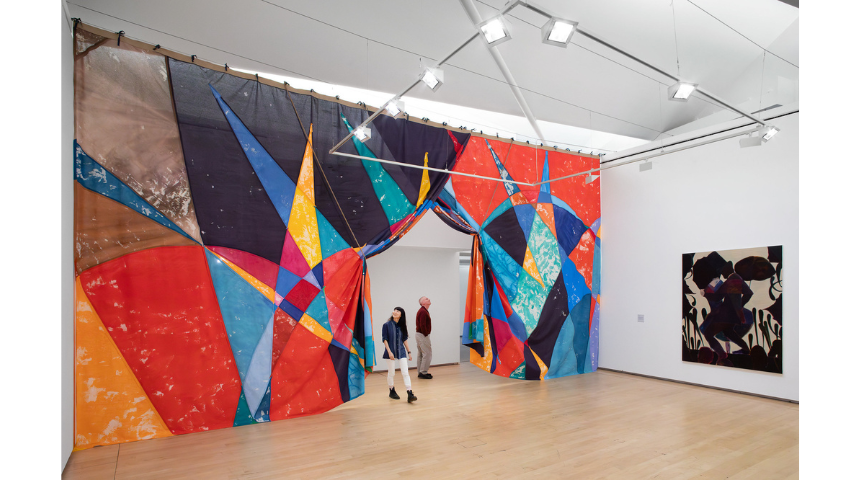
Ulla von Brandenburg Spirits Are Matter (2026) Photo Michael Pollard
Ulla von Brandenburg’s Spirits Are Matter (2026) is an expansive, site-specific hand-painted cloth curtain divided into geometric sections based on a freehand drawing and coloured with the hues of a Sonia Delaunay painting – brick reds and pinks, purple, blue and sunflower yellow. It is draped across a gallery threshold, so that here the visitor steps through from one space to another. Once on the other side, further works can be seen and the back of the curtain reveals its handmade fabrication, with pale patches where the ink has not saturated all the way through to the reverse, and neat handsewn seams. Ulla von Brandenburg, born in 1974 in Karlsruhe, Germany, initially studied scenography before studying at the Academy of Fine Arts Hamburg. She was a nominee for the Prix Marcel Duchamp in 2016. Working in a plurality of disciplines, Brandenburg brings theatrical and performative approaches to explorations of ritual and symbolic underpinnings of society and culture.
Through the curtain is a gallery of loaned works by Ryan Mosely, Denzil Forrester and Joy Labinjo. Ryan Mosely’s two paintings, Cave Inn (2011) and Dance of the Nobleman (2011) hung opposite each other employ the figurative blended with the surreal and absurd, combine the familiar and the off-beat. Focus is on the performing figure, theatrical props such as skulls and the puppet-like movement of an over-directed actor. Animated, almost comical, there is something dark and inexplicable in these scenes, only half-revealed to the viewer. Ryan Mosely, born in Chesterfield, lives and works in Sheffield. He studied drawing and painting at Huddersfield University before completing MFA Painting at the Royal College of Art, London.
As an art student, Denzil Forrester began drawing in clubs in the 1970s and 1980s, making vivid, gestural sketches in an A1 sketchbook, almost a parallel performance or creative act to the DJ. He would then take these vibrant drafted scenes home and develop them into paintings the next day. DJ Mix (1998) retains his original palette and signature streaks of light; the later Revival (2025) contains the mauves and yellows of his new colour range, which changed when he moved to Cornwall in 2016, inspired by the Peninsula light of the area. Born in Grenada in 1956, Forrester, who is an MBE, came to the UK in 1967 and studied painting at Central School of Art and the Royal College of Art, London.
Joy Labinjo paints a solo performance with an audience sharing a small space in Enjoyment (2023). Often using family and archive photographs as reference material, Joy Labinjo articulates the picture with figures gathered round a musician in an elegantly cohesive restricted palette where a flash of yellow emphasises a jumping child’s excitement and the mood is one of communality and companionship. A British-Nigerian artist based in London, Labinjo is known for her large-scale figure paintings. She studied Fine Arts at Newcastle University and undertook research into the Black British Art movement of the 1980s.
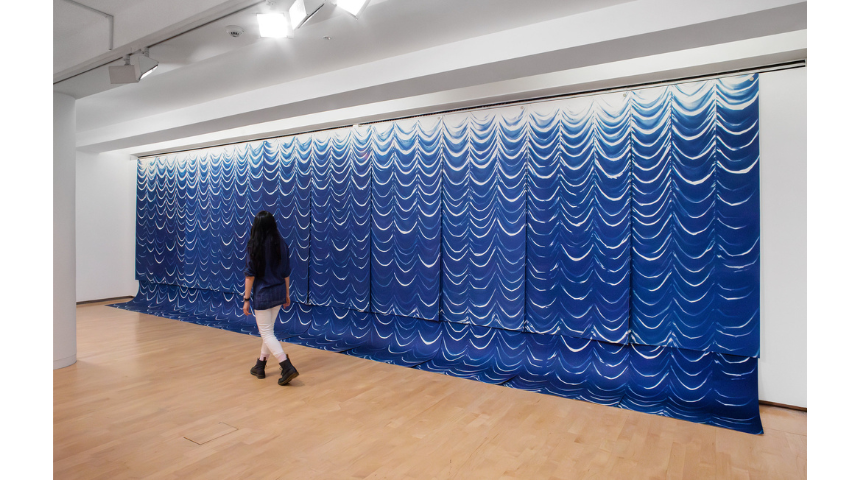
Bridget Smith Blueprint for a Curtain (2015) Photo Michael Pollard
When it came to commissioning the new works, Zoe was delighted to invite Chris Paul Daniels and Rowland Hill to make work on a larger and more significant scale. She had worked with them previously, but now, ‘because I have followed them and their work avidly over the years, I knew that the theme of this exhibition aligned with their interests, and that their work would resonate with our audiences.’
Both commissions started with an invitation followed by studio visits, coffee catch-ups, site visits and zoom calls, ‘regularly penciled in over 18 months or so. In that time the show had shape shifted a lot, and so had their proposed work, so I try and keep the process fluid and accommodating where we can be.’ Zoe is keen to pull the whole gallery team together when working on a show, ‘so I make introductions and loop colleagues in to give support and help realise the work. And I try and be as transparent as possible with the artists about curatorial decision making across the whole show so they are part of the conversation.’
Chris Paul Daniels
Experiencing Chris Paul Daniel’s Give Yourself a Round of Applause, which draws on footage from the North West Film Archive at Manchester Metropolitan University, the viewer is taken on a journey, which though it may differ for people as individuals, retains an element of shared communal experience. I wondered whether it was intentional that the narrative appears to comprise a stream of consciousness that an audience member might experience while attending a performance. I couldn’t help but identify with the sense of the narrative voice being a little lost at the beginning (lines such as ‘the fabric of reality is coming apart at the seams’). The music is slow, tenebrous, as if pondering the depths of the darkened stages that are parading before us for clues as to what is going on.
There was a hint of negative apprehensions and doubt at the beginning, moving to a more positive upbeat finale where the narrator appears to have undergone a transformation via the magic of theatre. ‘I was a cinema usher at the old Cornerhouse cinema in Manchester for five years, and have also worked in some theatres,’ Chris says. ‘So, I think my ideas of audience reactions are informed by those experiences; how a shared experience can be transformative on a personal level, but also how many wildly different interpretations and reactions there can be to the same film, play or exhibition.’
He describes cinema as ‘a kind of church; or at least a space I allow myself to contemplate and reflect on my own experiences, or just step away from reality for ninety minutes or so.’ It was good to hear that he also, as an audience member, allows his mind to ‘wonder into all kinds of territory’ before becoming captivated by a particular narrative. ‘So, I’m happy if my approach to writing and editing also triggers some of the stream of consciousness you might yourself have experienced.’
I also wanted to know if it was Chris’s intention to represent and articulate an intimate perspective on behalf of ‘everyman’. Whose voice/s is he channeling? ‘The rants and observations are all my own; I’m often channeling my own feelings about the world in my scripts, but in this film I’m definitely trying to address the performative elements I see within society, but also within myself.’ For Chris, the creative process here is partly autobiographical: ‘The end of the film is very directly trying to find an authentic voice, or at least in trying to resolve some of the complexities I’ve encountered in myself at different times in my life. I think every gay man or queer person, has probably had to confront an element of themselves that has been masked or unmasked – and that has informed a lot of the lines in the script towards the end here.’ So although there is an element of universality, he maintains that this is his most personal work so far.
In terms of writing process, I wondered if Chris starts with the images or with the text, or runs both together in parallel. The latter is the case, he says: ‘It’s very long winded… I watch the films in the archive, then write to specific memories of them whilst requesting the permissions from rightsholders and donors. Once I’m able to access the files, there are often different versions of the films I’ve imagined, so I like that unreliable memory of an unfixed image.’ Editing is the best bit, after the initial excitement of letting himself explore innumerable tangents. Then, ‘I can edit with a caption track to the actual films, which then helps structure both the script and the edit. I love editing, it is where a film comes together and gets out of my head… also a huge relief.’
I wondered if Chris writes the text in a similar way to the video edit, presumably amassing fragments and then arranging them into a narrative arc. Also whether he writes longhand or types. ‘I have a studio at Paradise Works in Salford where the walls are covered in handwritten post-it notes of one-liners, idioms, and phrases connected to the theatrical theme.’ He describes a flood of phone messages that he sends himself, or sometimes sends to friends instead by mistake. ‘Zoe Watson has a picture of me showing her reams and reams of pages that are a compilation of different texts compiled into themes and colour coded. These are long nonsense edits, that are finally brought together into a loose structure that then gets brutally cut down.’
Working with Afrodeutsche on the voiceover was an enthralling collaboration, says Chris. ‘Afrodeutsche has such a rich voice and is an incredible artist in her own right, it really was amazing to hear her read my complicated lines out loud for the first time, but she was also very open to direction at the times I asked her to try out different emphasis on certain words or phrases. She’s such a professional, and her performance adds so much to the piece.’
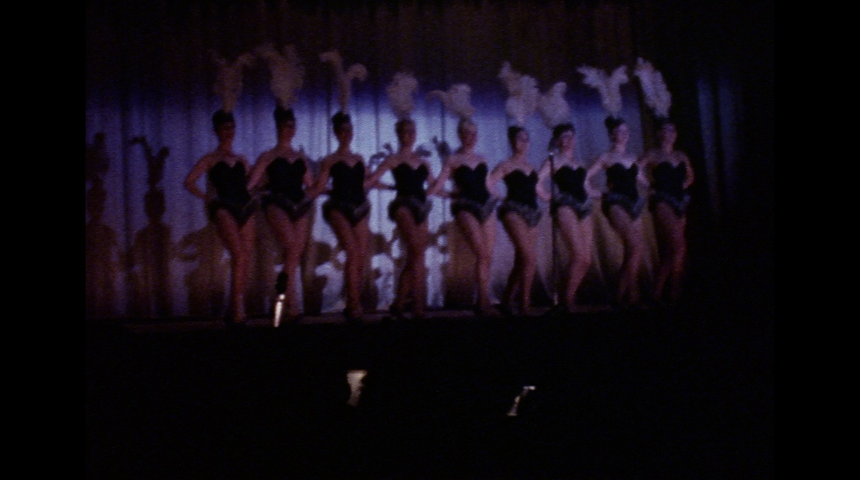
Chris Paul Daniels Give Yourself A Round Of Applause (2026) courtesy the artist
For sound design and score, Chris worked closely with Raz Ullah on formulating an emotional arc. ‘We discussed a three act structure… He’s had to put up with my very abstract way of planning out the work, but those close conversations have led to something so in tandem with the emotional arc I wanted to communicate. His music and sound design add so much to the film, and his approach towards the end was to perform elements in the recording as a kind of live score.’
Doubling back to the narrative arc, I was interested to hear if this was a way of coming to terms with the multiplicity of the material, a way of being able to process and accommodate and allocate this multiplicity. ‘I’ve littered the script with many references to the present day,’ Chris says; ‘but using the tropes of theatre as a structure for a narrative device. Multiplicity, and being overwhelmed is probably a mode of process for how I experience the world at this current point in history.’
Rowland Hill
As the viewer approaches Rowland Hill’s Relic, it’s like coming across a fairground attraction from behind – all bare wooden boards and blank panels. But the darkened room is already swirling with light and when you look through one of the face holes cut into the boards, you can fully see the work, or at least experience its fragmentary, hallucinatory projections which crystalise and come apart again like a kaleidoscope. There are a reflected vortex of mirrors and lights and darkness, the potential of infinity seething at the edges, blown up faces of people on waltzers, streaking amethyst and pale blue light, a rearing carousel like a Baroque fantasy, lit up with hundreds of golden bulbs that shunts away, lights merging and falling, shapes pirouetting and fluorescing.
I asked Rowland to describe to me the gap (or proximity) between what she projected the final installation would look like, and what she imagined it would look like when she first conceived of it. ‘I made several drawings, and If you compare these to the final thing they are very similar. I knew the film would be about the fair in some way, and projected in 360, but I didn’t have much idea beyond this until I began editing it.’ Rowland was permitted to build the structure in the basement to test the projections.
The film was commissioned by Rowland from a filmmaker and a sound recordist. It was edited as a single image on a screen but projected in the round. ‘The audience can only ever view the film partially, obliquely,’ she says, ‘and in a strangely physical way, so the end result is a very different viewing experience to what I edited at my computer. Max Thompson, who helped me with the projection mapping, made a digital 3D rendering of the installation for me so that I could visualise what I was doing better which was extremely helpful – once I saw this I made some big changes.’
Rowland points out that in a way it is the audience who complete the work and therefore collapses the distance. ‘I’m interested in how an audience feels in an embodied sense and in producing certain atmospheres… Things remain impossible to control and I enjoy that - it gives the work a proximity to live performance.’
I wondered what steps Rowland takes as an artist from the spark that sets the idea for a work in motion, through planning, to final delivery, and whether this changes depending on the specific artwork. Rowland starts out by thinking about who she wants to work with on a project. ‘Once I have a team in place the process is largely to do with good communication between us. It is enormously helpful to have a producer. My partner, the filmmaker Scout Stuart, produced the film shoot at Loughborough fair in November 2025, which was the first big part of the project, so that I could concentrate on directing the shots… I collect together lots of reference images which I draw on whilst I’m in the initial stages, and if I’m making a film, I also take a lot of screen shots of experiments I do in the edit. I’m just trying things out and seeing what works, and keeping a visual record of anything that might be helpful.’ Then comes a point when the research can be put aside.
When I ask about what conceptual place the artwork occupies in terms of what it draws on for its subject matter (the fair) and in terms of the distance she have taken the work from that source material, and whether she defines Relic as an installation, or an AV presentation, or other, Rowland talks about wanting the audience to forget they are in a gallery. ‘I’m increasingly interested in forms of art that perhaps were not intentionally made as “art”, that serves decorative, ceremonial or magical functions. Fairground signage falls into this category, as does a lot of folk art and religious art I’m interested in and looked at a lot when I was making Relic.’
Describing the portholes in the structure, Rowland is referencing peep boards, the ‘painted structures you see at fairgrounds and the seaside which allow you to become embodied in an image. My research led me to discover that some forms of ancient Christian relics - the tomb of a saint for example - were accessed via small holes made in a structure that housed them, through which pilgrims would insert their heads in order to be physically closer to the relic’s divine presence.’
Along the lines of how a fairground ride works, how important is it to Rowland that the work can be dismantled and set up elsewhere? Is this part of the work? ‘I always want my work to have a life beyond where it’s initially presented, and I would love for Relic to travel elsewhere. However, the piece as it exists for Curtain Up was made site-specifically for the space at the Lowry and I don’t think it’s necessarily important for it to be realised again in the exact same dimensions or pieces of MDF… I probably have to accept the practical limitations of storing and transporting large scale work like this, as much as I love the idea of it resembling the travelling fairground that is dismantled and re-built in each new location.’
I wondered how it felt to look through the portholes for the first time and see that the work had been realised. ‘The first time I looked through… I think I felt a mixture of delight that the effect seemed to “work”, and anxiety about whether I had chosen to cut them out at the right height and placement. Creating stuff is mainly a long process of making innumerable small decisions for a sustained time, and your mind is so full of them that even when you have these breakthrough moments, you’re distracted by attending to small technical issues or scrutinising how rough the grain of wood is around the portholes. The first time I experienced the work properly with no technical issue was the afternoon before the preview (!) and I think I just felt pure relief.’
Promoted as an exhibition that ‘explores how visual artists have sought to capture the shared anticipation, heightened emotions, and communal energy of being in an audience’, ‘Curtain Up’ is certainly the product of much collaboration, camaraderie and collective fabrication. As Zoe Watson puts it: ‘I really understand what our perimeters are in the galleries, and what resources and support we can offer, so I think it’s important to have open dialogue as the work is being shaped. Ultimately I see my role has enabling artists to realise their vision.’ She adds: ‘Curtain Up is really a tribute to our dedicated visitors who share that love of performance and make our work possible.’
This feature is supported by Lowry
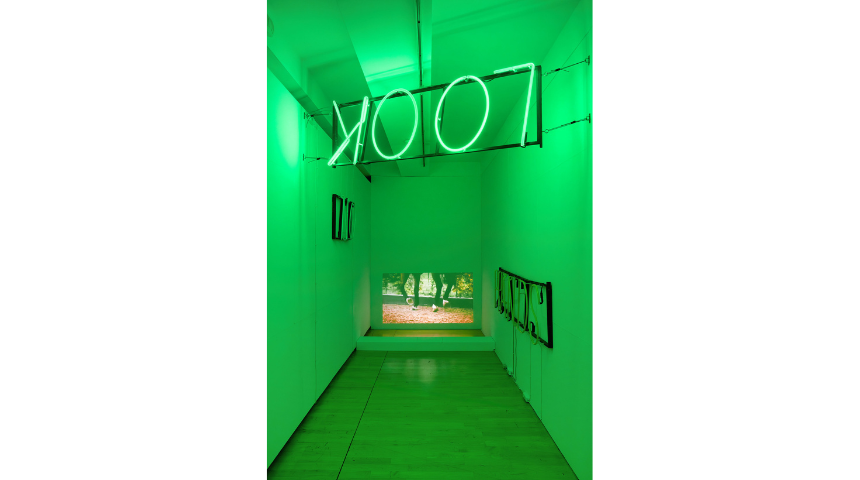
Simeon Barclay Look No Hands (2011) Photo Michael Pollard
Artists In Conversation: Curtain Up Thursday 21 May 2026 18:00 Andrew Law Galleries Gallery Entry
https://thelowry.com/whats-on/artists-in-conversation-curtain-up-rrd7
BSL exhibition tour of Curtain Up Saturday 13 June 2026 11:00 Andrew Law Galleries General Admission
https://thelowry.com/whats-on/bsl-exhibition-tour-of-curtain-up-ccy1