FEATURE Mar 2026 Held in the Quiet Light – an artists’ painted bower
Josephine Manby
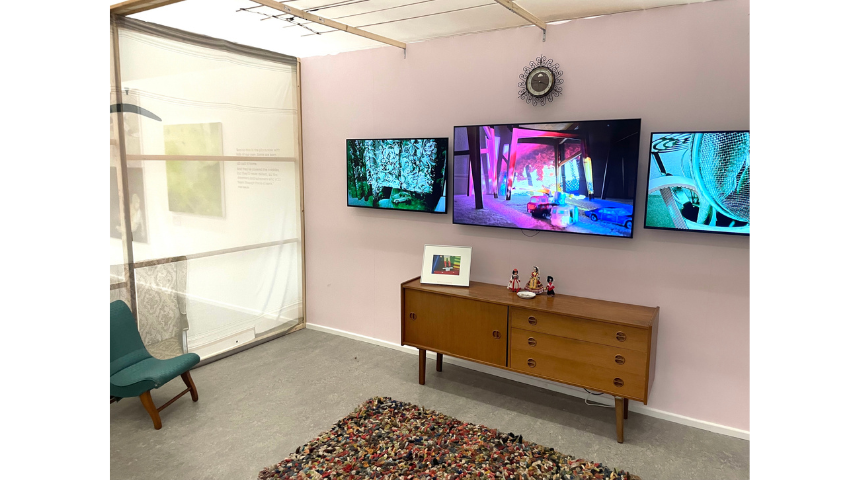
Held in the Quiet Light Mike Thorpe: Held in the Quiet Light – triptych video installation / Printed fabric
‘Held in the Quiet Light’ is on show at Salford Museum & Art Gallery until Sunday 19 April 2026, a group show from ‘The Three of Us’ – Briony Jenkins, Stephen Milner and Mike Thorpe. the Fourdrinier editor Josephine Manby went to see the exhibition and was given a tour by the artists leading to the following piece, which features in a book published by the group. There will be an opportunity to ask questions of the artists (12-1pm) in the gallery followed by a book launch and exclusive artists’ talk on Saturday 21 March 2026 (1-2pm), led by artist and co-director of Rogue Artists’ Studios in Manchester, David Gledhill. The event and the exhibition are both FREE entry.
https://salfordmuseum.com/event/quiet-light/
https://salfordmuseum.com/event/quiet-light-artist/
Before my appointment in Salford Museum and Art Gallery to meet the artists from ‘Held in the Quiet Light’ (HITQL), I have time to meet a friend for coffee. By the window, face to face in winter sunshine and the glow of the café’s electric light, whisps of steam curling from hot drinks, my friend happens to tell me a story.
It’s about going to a spiral, she says. It’s where a group of people, who may or may not know each other, get together in a welcoming space where a labyrinth is created on the floor by unfurling long strips of fabric and circling them around.
Day-to-day domestic objects and ornaments have been placed around the room in little baskets and bowls. Participants are invited to walk around the room and pick up random items and place them anew, in different positions, somewhere around the spiral, as they see fit.
I’m immediately attuned, anticipating how this anecdote might colour my view of HITQL, which I know is a multi-disciplinary group show of work by three artists. Originally strangers, they became friends on the recommendation of a mutual course leader at Newlyn School of Art in Cornwall.
So, when I get to HITQL, I’m primed for the sense of spiritual calm and welcoming tenderness emanating from every piece of work on show. Also, for the way in which seemingly disparate, independent works are bonded not only by a common theme but a unity of reciprocal understanding and an exchange of emotions, sensations and ideas.
I’m welcomed into the North Gallery and the heart of the exhibition by two of the exhibitors, Sale-based Stephen Milner and Macclesfield-based Mike Thorpe, who later connects me with the third artist, Briony Jenkins, who lives near Aberdeen, on Facetime.
Alternatively known as The Three of Us, this triumvirate of artists, all born and brought up in Manchester, first exhibited together at Rogue Artists’ Studios in January 2024. ‘The Paths We Cross’ took as its motif the idea of beginning at different times and places to come together in a chance meeting on common ground, sharing perspectives illuminated by compassion and hope.
Later the same year all three undertook a summer residency at Nan Collantine’s small-but-perfect Marple gallery, Mura Ma, to create, exhibit and sell new works. For HITQL, the concept was of a metaphor for shedding light on memory.
For the HITQL opening, invitees were asked to bring along a favourite object from their childhood to the preview. ‘We used an inexpensive children’s thermal instant camera,’ says Mike. ‘It doesn’t need developing, just prints thermally onto a small roll of paper, similar to a printed receipt.’ The results formed a curtain of iconic images of growing up in the 1960s – at once an ice breaker and a scene-setter, putting everyone at ease.
Inside the exhibition is a microcosm of Mike’s late mother’s sitting room, where a triptych 6-minute looped video work plays. ‘There’s no particular narrative,’ Mike says, but fleeting glimpses of the furniture, ornaments and toys seen from floor level. One internal wall is papered in a specially designed and printed pattern of nine childhood playthings (a Matryoshka doll, a model of a footballer) on microdot low adhesive output.
I was interested to hear about Mike’s use of media and techniques as an interdisciplinary artist. Does his creative process always begin with an idea, and then he finds the media to best express it? ‘In general, yes… I will make decisions around media, based upon what I think would be the most appropriate ways of communicating the concept. It may involve me projecting images onto a particular setting to create a dialogue with the subject matter – that could then lead on to photography or even paintings of what I observe from the intervention.’
This led to an elaborate game of scale manipulation, reflecting what could fit into a child’s tiny hands, coming back to seeing things through a child’s perspective. Mike recalled the whole world opening up as he gazed at the postage stamps he collected as a child. The tightly packed images, full of colour and precise detail, windows onto vistas spanning the globe.
I wondered about this with the idea of the microcosm of the home within the exhibition, and whether because this entailed textiles and objects, it was the idea of, say, wallpaper as an output first, for which he found images for the motifs?
‘The idea of the ‘room’ came from our original concept of the gallery resembling some kind of deconstructed living room. However, as I thought about how to present my film, I realized that I wanted to create a cocoon-like space for the audience to feel held in the moment. The translucent printed material that reproduced the walls of my late Mum’s living room was a relatively late decision.’ After the installation had been constructed, Mike realised that ‘the material moved from opaque to translucent, depending on the angle you look at it. This speaks about the shifting nature of memory, where we move in and out of focus in time.’
Briony’s painting Night Walk (2023) also hangs in the room-within-a-room. Typical of the curation, where works by all three artists are integrated together, the sombre tonal register of the work stands as testament to the emotional charge of the whole installation as an analogy of grief, a kind of vanitas amidst the gentle pinkish light of the interior.
Adjacent to the room with the video work and the wallpaper is Mike’s toybox work, Held Within (2025), which is fabricated from corrugated cardboard and painted and drawn on with intentionally childlike use of materials. Several small windows permit a view inside the box: a magical scene of miniature figures and vehicles upon a reflective surface onto which footage pans across tiny details of bygone toys, from a small projector.

Held in the Quiet Light (Foreground) Mike Thorpe: Held Within Installation; (On wall L-R) Stephen Milner: This is me/It’s for life; Briony Jenkins: Night Walks 2
It reminds me of my best Christmas present, a homemade felt rabbit stitched together by my Mum, accompanied by a tiny shop-bought pink onesie and wicker cradle. A balance of mass-produced and handmade. Mike’s toybox work has the same effect and allows the visitor to the exhibition to see through their own childhood eyes again.
Facing the toybox is a portrait commissioned by Geoff Sparks, whom Stephen met 20 years ago. He painted the portrait whilst involved in an exhibition at Lowry as part of the International Clubfoot Conference. It is accompanied by printed text detailing Geoff’s experience of living with osteomyelitis, but despite these challenges, he worked tirelessly for Salford Social Services for many years, giving back in commitment to childcare. Stephen was born with a club foot and was compelled to undergo years of painful interventions and surgery which had a physical and mental toll into adolescence and beyond.
Stephen graduated from Sheffield in 1982 and was runner up in a Manchester Academy of Fine Art competition with a work entitled Waltzers (1982). He kept his hand in while working in corporate management with Apple as a UK Territory Manager, and took early retirement, always intending to come back to art.
The sudden passing of his father made him decide, and he ‘almost immediately enrolled at Newlyn.’ Artist Anthony Garrett had ‘invited loads of artists to converge on the coast of Penzance,’ Stephen recalls, ‘repairing the coastal path between Land’s End and Sennen Cove as part of an art project with the National Trust (Mike was also there but we didn’t know each other at that time).’ He remembers the day, 1 September 2019, as it was also his wedding anniversary.
Mike had already studied at Newlyn, in 2016, and Briony and Stephen in 2022. Their mutual lead tutor was artist Jesse Leroy Smith who heads up Newlyn’s Mentoring Programme and ran group crits with other artists. Studying at Newlyn was ‘full-on while you were there,’ the artists recall, with intensive two-day sessions interspersed with home or studio-based practice.
Stephen talks me through Rebirth (2023), the final piece for his Newlyn mentoring course. More recent work over the past 12 months has comprised personal narrative reflections from adolescence to adulthood. Big School (2025) recalls the trauma of moving from primary to secondary school, difficult for someone with Stephen’s condition. He describes leaving the comforting, tolerant surroundings of the primary school for the wild west of secondary, the traumas of PE and what his impeded participation in it meant for his sense of masculinity.
Art became a form of self-expression and a refuge. During ‘A’ Levels, he began independently to attend life drawing. While he attended Sale Grammar School for Boys, his extra lessons were at South Trafford College. Mike, meanwhile, attended Marple Grammar and studied life drawing at Stockport College.
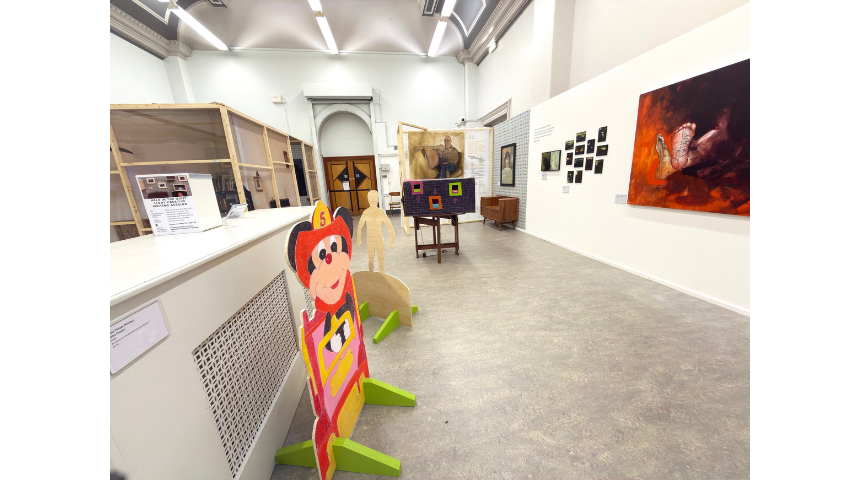
Held in the Quiet Light Exhibition in the North Gallery, Salford Museum & Art Gallery
She Didn’t Judge (2025) uses distortion to express deep feelings of awkwardness. Stephen met his wife Susan in 1980, ‘at Sheffield while I was studying Fine Art and she was studying Media and Communication Studies’, and tenderly celebrates her compassion.
She Loves Me (2025) is a homage by Stephen to Susan. He talks tenderly about the crossing of the feet in many of his works. ‘It’s a coy gesture,’ he says, ‘expressive of shyness.’ The painting has a precursor in the Newlyn Rebirth, but there the crossed feet convey a sense of injustice and discomfort. Stephen reflects on these hardships but then explains how much has changed in his later life, with in depth discussions with specialists in the medical field giving insight into recent research and innovation into club foot and its treatment. Talking about the subject, initially difficult, led to opening up and healing some of the psychological scars of what he underwent as a child.
Along with acknowledging childhood trauma in his work, I wondered if Stephen recalled spending time confined to hospital in daydreaming and in his imagination, and if so, was that what led him to an artistic life? ‘I do have some very specific memories of my time in hospital,’ he says, ‘some very uncomfortable and distressing, which I frequently reflect on, but its impact on my art only came laterally during my time at Newlyn as I searched for a subject matter that had significance, energy and longevity for myself.’
I asked Stephen if he makes a lot of preliminary sketches, or tends to begin a large-scale work by diving straight in? ‘I like to jump straight into the canvas and see how the image evolves through my process, but have sometimes referred back to unrelated sketches to refine my thoughts. ‘Does he find once he has completed one work, the next one is a logical succession? ‘I will work on multiple canvases at the same time, so they will often create a narrative between themselves, and further extend the topic and its journey.’
Stephen primarily works in acrylic ink, Derwent Inktense pencils, using water rather than medium with the acrylic. In works such as This is Who I Am and It’s For Life (2025) he is proud and forthright in making a statement about his life and his identity, citing among his artistic influences Egon Schiele, Käthe Kollwitz, Francis Bacon and Tracey Emin.
Briony speaks to me on Mike’s phone. Briony’s work traces a train of thought over forty years, and these small works are a culmination, she says. Self Portrait (1985) at the entrance of the show is a starting point: she indicates three distinct sections to her work here, and the portrait is the first, formally and figuratively delineated and evocative of Amedeo Modigliani (1884-1920)’s portraits. The next is Sodium Dreams (2025) which gives a view of street lights from a window at her parents’ home, a strong memory of her parents’ bedroom window. ‘Like a target when you were walking home, something to aim for,’ Mike suggests – a beacon of safety.
The third key work of Briony’s is Green Glass Memory (2025), a painting hung behind the subject itself. ‘The green glass sphere – the fishing float – has always been in the family home – on a shelf, in a cupboard or sideboard or on the floor when we played with it as children. It is beautiful and heavy and tactile and was a persistent thread throughout my life in Manchester and in the forty years since when I have returned home to visit.’
The green fishing float ‘now sits in my own house where it may become a memory for my own family, or not. I love the fact that it had a history before me – I didn’t ask where it came from when I could have and now it’s too late. It will have a history beyond me. Alan Garner (the author) would call it a "Beauty Thing.”’

Held in the Quiet Light (L-R) Stephen Milner: Group of four – Three Legged Race, A Mothers Love 1, A Mothers Love 2, Time is a Healer; Briony Jenkins: Green Glass Memory
The painting behind it seems to reveal a sense of childhood daydreaming or reverie; does this also relate to Briony’s state of mind while painting it? ‘The painting behind the glass ball is my endeavour to link ‘then’ and ‘now,’ where the painting is of the refection seen in the green glass ball outside my home in Scotland. This ties into the theme of our show ‘Held in the Quiet Light.’ Handling the ball again, moving it back into my field of vision in my studio for a few months triggered an unexpected cascade of reflection on what was.’
I asked how Briony came to abstraction. Referring to the gaps between earlier figuration and now, ‘in between came life, children,’ she explains. ‘But the biggest jump for me was from city to rural setting. I went from finding people to finding atmosphere and landscape.’ Travelling between Wales, London and Scotland and now living near Aberdeen, she has discovered a more open sky. ‘Massive skies and stars at night. I hadn’t painted a landscape or a still life five years ago. Newlyn helped change that, although the palette has stayed the same – city colours.’
Attending Newlyn, Briony says, ‘clarified things and forced you to work more cohesively. You were encouraged not to turn up empty handed’, but to have worked hard in between the Newlyn mentored weekends. What she realised exhibiting work alongside local Newlyn artists was the contrast in palettes. With the famous Cornwall ‘peninsula light’, colours tended to be lighter, softer, more inclined to blue. Briony paints in a distinctly darker range of hues and tones.
What are the origins of this distinctive colour palette, tending towards black, white and lime/lemon yellow? How does Briony create her misty, layered effects? ‘My palette is something I have reflected on over the last few years, now that I have what is essentially an archive of my work to look back over. The first colour on my surface may be vivid with the intent of a different outcome, but over the progression of a painting I migrate back to my home palette in the final layers – a painterly homecoming in effect.’
She is keen to explain how within the visibly dark palette ‘there are always layers of colour and thoughts which are not visible, but which are hinted at through the lighter brush strokes. At the last I am always drawn back to those few sombre hues which I think invite reflection and closer scrutiny in a way that more vivid colours do not.’
Her surfaces tend to be matte, absorbing rather than reflecting the ambient light, so her works have an affinity with the industrial smog, citrine-sour street lights and carbon-blackened buildings of the twentieth century Northern School: Adolphe Valette (1876-1942), L S Lowry (1887-1976) and Theodore Major (1908-1999). Their coal-dust texture draws the viewer in, eyes roaming across the picture in search of points of light or washes of colour as if scanning the darkness of night itself.
I asked Briony whether she felt part of a long line of painters, or indeed northern painters, part of a human artistic chain. ‘It is only now, as my experience is coming to fruition that I have begun to explore my place in a wider context. I am really just beginning to understand my connections and influences and to look again at those early artists I was exposed to.’
I wondered what Briony’s process is when it comes to painting landscape. Does she walk or drive in the landscape, or take photos or make sketches? Also, does she tend to work on several paintings simultaneously? ‘I live just outside Aberdeen and so the rural landscape is a part of my everyday journeying – driving or walking. The three-mile journey into the city encompasses views of distant mountains, woodland and crossing the river. The journey down the hill from home affords a wonderful overview of a city nestled within a valley.’
Briony described how when she looks at landscape around her, she tries to commit it to memory, ‘and I paint what I remember, and the sense of it and how I have felt about it. I don’t sketch – my finished works are the entire train of thought and my initial ideas have been developed and resolved within the process of painting them.’
Does she spend time outside in the landscape at night? What is it about the fading daylight and dusk that appeals to her? ‘For some paintings I have walked at night specifically for them. I love nighttime sensations and the heightened awareness that comes with low light. There is a sense of peace that I only feel at those times. Faint light and deepened shadows push me to question what I am seeing (and hearing) and what is held there, just out of sight.’
I asked Briony whether, with the falling of dusk such a recurring subject in her work, is there a sense her paintings bring a notion to the group of coming back together (to family/friends) at the end of the day, to commune, rest and reflect? ‘For me personally there is a deep sense of coming home in the exhibition and I have been touched to be able to exhibit where I began and also very affected by the sense of people not there, who won’t see my work returning. The conversations between the three of us as we have worked towards this have been hugely moving for me and there have been unexpected trains of thought and memories revisited.’
I also wondered whether the group The Three of Us had become almost a second family. Stephen told me how working with Briony and Mike ‘has been quite natural despite only knowing each other for two years. While working in isolation as we do, the support, encouragement and humour that we share has been instrumental in our success, and critical in ensuring the momentum we have achieved over the last two years.’
My last few questions were for Mike. In creating such a welcoming, inclusive and empathetic space for visitors – an exhibition where anyone can feel ‘at home’, I wondered if all three of the artists felt that they had achieved in this show what they set out to do at the outset?
‘I’m glad you mentioned empathetic,’ said Mike, ‘because that has been the word I have continued to come back throughout the project. It’s a rare commodity in much of public life and discourse and we wanted to create something that is relatable to the audience.’ Rather than provide a set of answers or solutions, the show ‘offers up our individual takes on the nature of memory. Hopefully this enables people to consider their own memories in the context of the art.’
Finally, what was the initial spark of an idea that set it off? ‘The original working title was ‘Where were we’, because we wanted to explore our own upbringings in and around Manchester,’ explains Mike. ‘The title became ‘Held in the Quiet Light’ to refer to the fragile nature of memory. I’m not quite sure what ‘the quiet light’ is, but it somehow speaks of us all being held and carried through our lives by our memories.’
Perhaps being ‘Held in the Quiet Light’ is what happens when dusk comes down and evening begins, when lights are switched on in houses and flats and cafés and places of nightwork, abating daylight’s business and glare. When people come together and a soft pink or orange glow that, bathing everything in its compass with the warm tints cast by candles or fairy lights, lulls and pacifies, heals injury or quarrel, imparts comfort and rest.
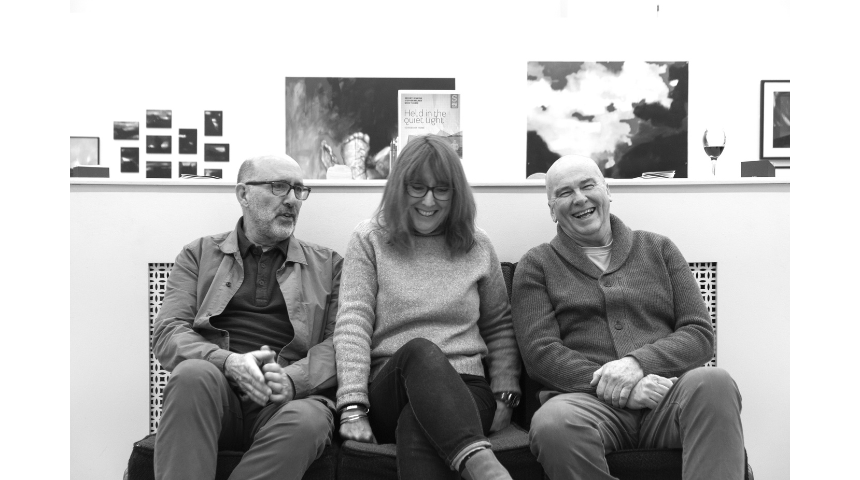
Held in the Quiet Light Artists: Mike Thorpe, Briony Jenkins, Stephen Milner
February 2026