REVIEW May 2026 Louise Giovanelli ‘From Here to Here to Here’ & Apollo Painting School in Blackpool
David Hancock
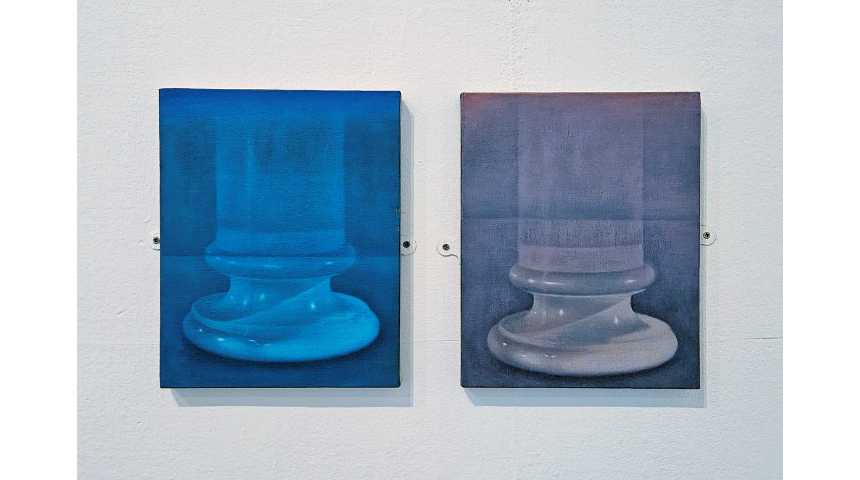
Louise Giovanelli Socle III & Socle IV (2017) Oil on Canvas. Warrington Museum & Art Gallery Collection. Photo: David Hancock
In the decade since Grundy Art Gallery Blackpool last presented a solo exhibition of the work of Louise Giovanelli, she has gone on to become one of the most celebrated painters of her generation. ‘From Here to Here’ to Here considers how Giovanelli has evolved artistically and professionally to become the artist that she is today. The exhibition also includes a selection of painters from Apollo Painting School that Giovanelli founded with Dr Ian Hartshorne and curator, Alice Amati. David Hancock visited the exhibition in Blackpool on the opening weekend. FREE entry until 28 June 2026.
https://www.thegrundy.org/whats-on/single/louise-giovanelli-from-here-to-here-to-here/
Centre Stage
As I enter Louise Giovanelli’s exhibition, I am immediately drawn to the works in Gallery 2, bypassing Gallery 1 for now. The paintings unfold in swathes of colour that seem to leap directly from the walls. Lux (2025), the first work I encounter, is a highly saturated portrait of Christina Ricci from the film Buffalo 66 (1998). A fiery orange ground rises through a chromatic transition, from red to yellow, then green that culminates in a cool blue shadow encircling her eyes. Light is delicately picked out on the full lips, while speckles of green sit within the nostrils. The hair, shaped tightly around the face, that comes across almost inscrutable. A fat curl rendered in red-on-red, with only the slightest tonal shift, its ridges of a deeper red, is caught along the canvas edge. Opposite, a sharp line of scarlet dissects the surface, interrupted by flecks of green yellow that catch the light. The cheeks and nose are built through a pointillist application, pale lime green layered over orange, the underpainting visible through small gaps. Taking a step back, these marks resolve into a unified whole, a face that feels alive, animated by the paint itself. It is a sumptuous work, shifting technically between a blended photorealism and a tactile exploration of an impressionistic surface.
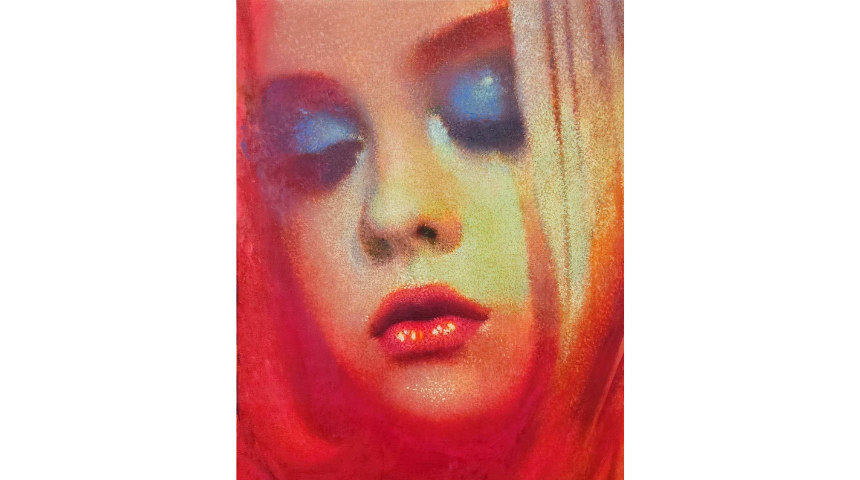
Louise Giovanelli Lux (2025) Oil on Linen. Soho House Art Collection. Photo: David Hancock
In Offer (2022), hands grasp a glass of wine, obscured by row upon row of scratchy diagonal lines. These marks, ranging from pale yellow to deep crimson, are dragged across the surface. They feel raw, disrupting the image almost aggressively. Giovanelli appears to revel in the paint, breaking the polish of her technical assuredness to leave these clumsy marks exposed on a surface that refers to the handmade nature of the paintings. The lines form a veil across the surface, partially concealing the painted image underneath. The glass, clutched tightly, takes on an almost devotional quality, as though held in prayer. The wine transformed into blood through the sacrament, the paint into human frailty. Revelation in these works is always partial and always staged.
Orbiter (2021) is a painting of movement and spectacle. A sequined dress wraps around a cavorting figure, its shimmer of light rendered through thick, doubled halos of yellow and orange. Across the surface, scratched, staccato marks in pale blue and green, flick like dust on a film reel. In the bottom corner, a vivid blue daub pushes forward, disrupting the surrounding browns and golds, causing them to recede. A fleeting glimpse of flesh suggests motion, shimmying and shifting before the eyes, it imbues the painting with restless energy.
By contrast, Prairie (2022) is still: a closed golden curtain. A mist of viridian hovers at the upper edge, dissipating like theatrical vapour. Painted across two large canvases, the split is intentional, and on each half a vertical band of pale pink interrupts the flow of the curtain further, creating a break in the image’s continuity. A few inches from the left-line, there is an attempt at a third. Though partially erased, the line lingers, ghostlike. These interruptions fracture the illusion. What we are looking at may resemble a curtain, but it is insistently constructed from paint. The paint is the reality, not the artifice of the image. Material presence asserts itself over pictorial illusion, producing a rupture that destabilises the staged scene. The subject itself seems to allude to this dynamic: the emerald glow emerging from behind the curtain, suggesting Giovanelli as a kind of Wizard of Oz, the concealed operator of this alluring fabrication.
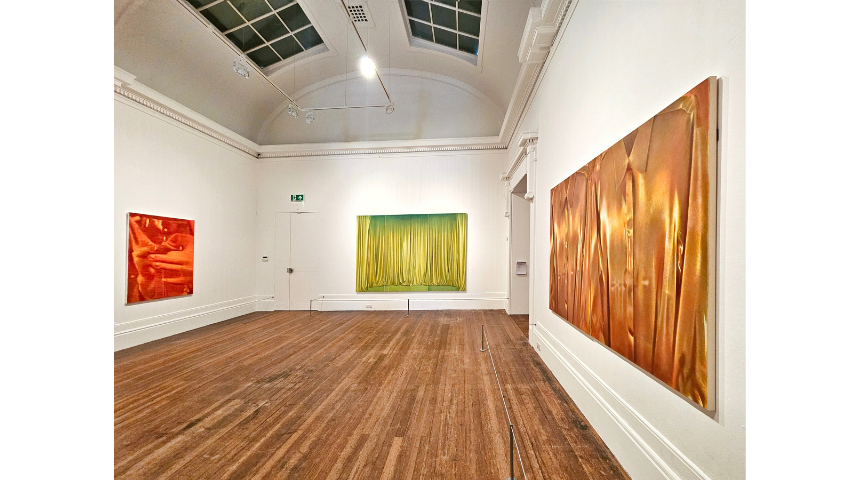
Louise Giovanelli ‘From Here to Here to Here’ @ Grundy Art Gallery Photo: David Hancock
Nearby, in Wager (2021), two gold lamé shirts hang side by side, mirroring one another in their reflection of light. Across these works, a sense of nostalgia emerges. I am transported back to the working men’s clubs I frequented as a child with my mum and her partner, a vocal comedian. Both Prairie and Wager bring this to mind: the lights and artifice of small spotlit stages, the sweat and sparkle, and the rapt attention of the entire audience. Off to the side, I would sit sipping a Coke and quietly munching on a bag of crisps, listening to Neil Diamond covers and the patter of off-colour jokes, absorbed in the spectacle.
Though I have encountered several of these works before at venues such as the Hepworth, Hayward Gallery, and White Cube, their presentation in Blackpool, within the Edwardian setting of the Grundy Art Gallery, is a shift from the pristine, clinical nature of these spaces. Here at Grundy Art Gallery, a certain tawdriness surfaces that seems to chime with the seaside location, the North Pier and its theatre mere yards away. In this Northern context, their coolness and slickness appear to fall away slightly, and their underlying grit is revealed. It is not something I expected in Giovanelli’s work, but is welcome nevertheless.
Across these works, Giovanelli repeatedly stages acts of concealment and transformation so that curtains close over their scenes, painted surfaces veil what they reveal, and gestures of offering take on a devotional charge. Again and again, the image seems to hover between spectacle and sincerity, between theatrical illusion and something more fragile and human.
Setting the Scene
Returning to Gallery 1, we are presented with a collection of early work by Giovanelli that focuses specifically on responses to works from Northwest collections, including work from the Grundy, Touchstones in Rochdale, and Warrington Museum & Art Gallery. The scale of these significantly smaller works creates a sense of intimacy that pulls the viewer into their orbit. At Warrington, Giovanelli was drawn to the marble sculptures in the collection. In Socle III & IV (2017), two columns, one blue, one purple, are presented standing side by side. Each fade as they rise, the lower sections more solid, tangible. Horizontal bands cut across both forms, positioned just above and below the midpoint. These interruptions introduce a subtle tension, carefully calibrated within the composition.
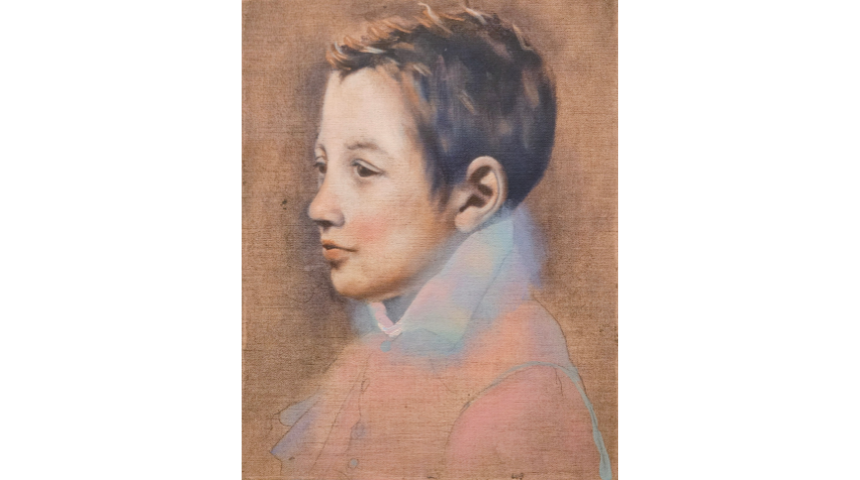
Louise Giovanelli The Dress Rehearsal II (2016) Oil on Linen. Private Collection. Photo: David Hancock
The Dress Rehearsal II (2016) offers a quieter moment: a portrait of a boy in a pink shirt that fades into cyan. His collar dissolves into a blur of light and colour, with a small highlight beneath the chin. His downcast eyes suggest melancholy; whether real or imagined, the figure feels imbued with life.
These smaller works, presented together in a slim band around the walls, offer an antidote to the larger works in Gallery 2. They are much more muted, yet, derived as they are from classical sources, there is a timeless quality to the work. The contrast works well, not only as it offers two distinct periods of Giovanelli’s practice, but an entirely different sensibility.
Sharing the Stage
A final suite of paintings extends into Gallery 3, which opens to a selection of painters from the Apollo Painting School, a summer school that Giovanelli established with gallerist and curator Alice Amati and Dr Ian Hartshorne in 2024 that takes place between Manchester and Latina in Italy. The final room features nine graduates from the programme: Ally Fallon, Deborah Lerner, Isobel Shore, Hannah-Sophia Guerriero, Isaac Jordan, Catherine Ko Chen, Nora Hreb, Jamie Kirk, and Mahrokh Mofidnakhaei.
Isobel Shore’s paintings possess a luminous glow, where reflections and refractions create oneiric, almost yonic forms. Her handling of paint is rich and assured, producing works that hover between abstraction and figuration. Isaac Jordan presents surreal compositions in a coppery verdigris palette of greens and browns. Bottle-like forms stack precariously on and beneath tables, their shadows loom large, creating a sense of unease, a menacing, almost human presence that is drawn from the surrounding background.
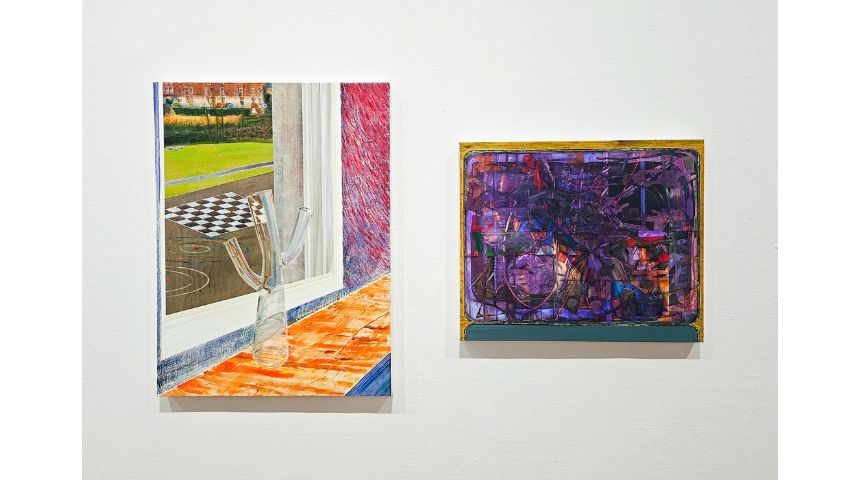
Jamie Kirk Co-workers at a Nuclear Facility (2025) & Nothing to Declare (2025) Oil & Acrylic on Canvas. Photo: David Hancock
In Jamie Kirk’s painting, Co-workers at a Nuclear Facility (2025), a vase rests on a windowsill. Outside, a playground stretches across a concrete ground marked with lines. These markings are meticulously rendered, masked, their ridges raised from the washes of colour. However, through the vase, they become distorted, translated into looser, more fluid strokes. The vase refracts and transforms its surroundings, picking out the blue and red interior wall, the checkerboard in the playground, and the orange sill. Beyond lies a quieter, almost bucolic scene of what might be a barge parked beside a modern building. The work recalls Peter Doig’s paintings of Le Corbusier’s Unité d’Habitation in Briey-en-Forêt, hinting at distant structures lost to nature, which may even allude to the nuclear facility referenced in its title.
Finally, Nora Hreb’s miniature paintings are quietly enthralling. At roughly 3cm square, their scale lures in the viewer, demanding close attention. Within such small apertures, an extraordinary intensity is achieved, each painting holding its own presence on the wall, disproportionate to its size.
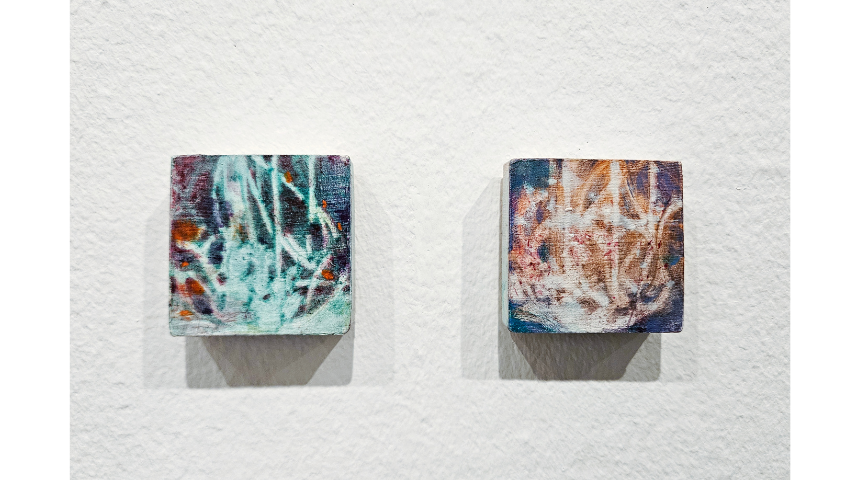
Nora Hreb Key to the City (2025) & Furthest Star (2025) Oil on Wooden Panel. Photo: David Hancock
Taken together, From Here to Here to Here and Apollo Painting School highlight the strength of painting in Manchester. Giovanelli’s position within contemporary British painting is assured; however, in a wider context, the exhibition also points to the depth of emerging talent within a city where a dense network of studios, artist-led initiatives, and teaching contexts has supported a vital painting culture for decades. Rather than marking a revival, the exhibition acknowledges the persistence of a regional tradition that continues to revitalise itself from within. These two exhibitions suggest a renewed focus on painting as a practice grounded in attention to materiality, surface, and image, as well as in the deliberate cultivation of the communities that surround it. The exhibition quietly insists that painting is not a solitary pursuit but a shared language, sustained through teaching, dialogue, and collective experimentation. In this sense, it does more than survey a decade of Giovanelli’s work; it situates her practice within a wider moment in which painting, particularly in Manchester, continues to operate as a live and generative field still being tested, extended, and collectively re-authored.
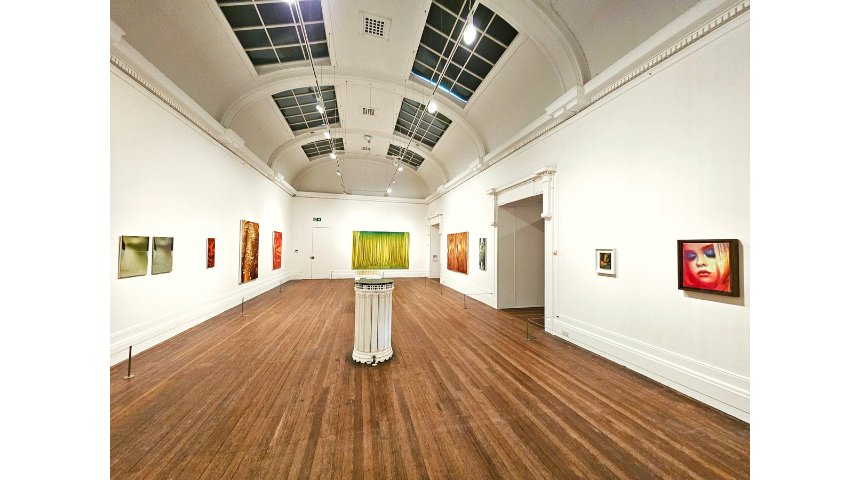
Louise Giovanelli ‘From Here to Here to Here’ @ Grundy Art Gallery Photo: David Hancock