FROM THE ARTIST’S MOUTH Mar 2026 Jeffrey Knopf: The Bunker
Known for his brand of digital archaeology, often to be found scrutinising, scanning and 3D printing museum artefacts, artist Jeffrey Knopf reflects on a haunting journey to Ardennes, France where he comes across a talismanic reminder of the Holocaust. Using his practice of employing 3D scanning he is able to gain some insight into the significance of the bunker that he and fellow artist Alan Ward stumble across in a once war-ravaged stretch of woodland. For April’s FROM THE ARTIST’S MOUTH, he endeavours to disentangle the enigma.
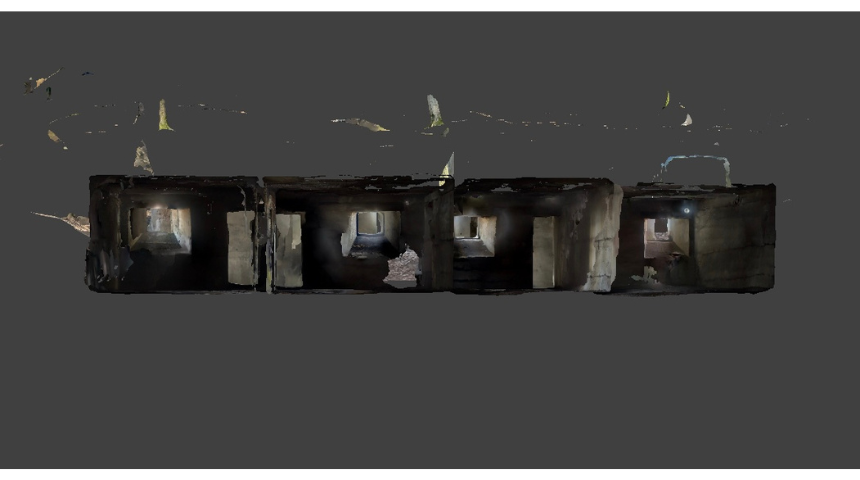
Jeffrey Knopf The four rooms that make up the bunker 3D scan
It all began in late 2023 with a message of introduction from my friend, the photographer Peter Fraser. He suggested I contact his friend, Alan Ward about a project he was developing. The request immediately caught my attention, not least because I had recently noticed that Alan had started following me on Instagram.
And so it began – first with a conversation, which soon led to a visit to Alan’s house, where an expanding archive of material for the project was steadily accumulating. My initial impression was simple: there was an extraordinary amount here to become interested in, and potentially to contribute to.
In essence, the project was triggered by a small set of negatives that Alan had acquired. They came with only a sparse label: “Taken by German medical officer, WW1.” One of the negatives depicted an unknown German soldier looking out across a town somewhere in France. With time on his hands, Alan embarked on a forensic search to locate the exact place. Working methodically, he traced possible locations on maps, cross-referencing them with photographs found online, studying skylines and architectural details until he finally identified the village.

Looking at the left hand side entrance with Alan Ward in the distance. Photo Jeffrey Knopf
That village was Grandpré situated in the French Ardennes near the Belgian and Luxembourg borders.
By the time I became involved, Alan had already spent considerable time in Grandpré. He had visited repeatedly, photographing the area, speaking with local residents, and gathering stories and histories connected to the village. Through socially engaged projects and the creation of a Facebook page, he developed a deeper understanding of both the events that unfolded there during the First World War and their enduring impact – not only historically, but into the present day.
During the First World War, Grandpré was invaded and occupied by the German army. Administratively, the village was absorbed into the German Empire. This shift manifested both symbolically and materially: street signs and buildings were renamed in German, and the village became a place of convalescence for wounded soldiers, as well as a site of rest and recuperation. Here, troops could wash, eat properly, and temporarily step away from the frontline while on rotation.
Up until March 2025, my understanding of Grandpré came entirely through Alan’s research and archive. This material directly informed the sculptures I produced for the exhibition. Among the archive was a substantial collection of black-and-white postcards dating from the war years.
These postcards had been produced by travelling photographers who capitalised on the presence of soldiers during their periods of rest. The images were printed as postcards and sent home to family members in Germany via the Feldpost (field post), an impressively efficient military postal system that often delivered mail within a single day.

Scanning the site. Photo taken of Jeffrey Knopf by Alan Ward
Over time, these postcards came to represent something more than personal correspondence. For the residents of Grandpré, they inadvertently formed one of the most detailed photographic surveys of the village and its surrounding landscape. Images of soldiers standing outside buildings and landmarks now function as visual records of what the village looked like before the American offensive, which resulted in widespread destruction during the liberation of the region.
After months of preparation and a long car journey, Alan and I finally arrived in Grandpré. This trip was part research, part fieldwork – an opportunity to explore the area ahead of an exhibition that would culminate in the publication Nothing Remained Unchanged but the Clouds, bringing together Alan’s extensive investigations. Having become deeply familiar with the terrain, Alan guided me to sites of particular historical significance.
What struck me immediately was the atmosphere of the place. This part of France felt like a threshold – neither fully anchored in the present nor entirely of the past. It possessed a bleakness that resisted easy description. My perception continually shifted between what I could see and what I tried to imagine: fields once churned by artillery, landscapes carrying the physical and psychological residue of conflict and death. My experience of the terrain was shaped as much by archival imagery and historical accounts as by the landscape itself.
Has the land truly healed? Nature has certainly reclaimed it. Grass grows, trees have returned, and life has resumed, yet the scars remain visible. Some are literal: rusted fragments of weaponry unearthed during the “Iron Harvest,” or the so-called Red Zones – areas still too contaminated by unexploded ordnance and toxic materials to be safely inhabited or cultivated. The land remembers, even when it appears at rest.
During our visit, Alan took me to numerous sites of conflict across the region – places where thousands lost their lives attempting to capture and recapture territory. Loss was a constant presence. We visited cemeteries hidden within residential areas, cemeteries deep within forests – some unexpectedly beautiful – and cemeteries that were no longer burial grounds, their bodies exhumed and reinterred in mass ossuaries. These spaces exist as sites of remembrance, yet many now lie largely forgotten, overshadowed by more recent conflicts.
What surprised me most was the presence of Jewish graves within German military cemeteries. Rounded headstones bearing the Star of David stood alongside crosses marking their fallen comrades. It was a stark reminder that the German army consisted of conscripts from diverse religious and ethnic backgrounds. Jewish soldiers fought and died alongside their fellow countrymen.
This was echoed at the Meuse-Argonne American Cemetery, where thousands of American soldiers are buried. At first glance, the cemetery presents ordered rows of white crosses stretching across the landscape. Yet interspersed among them are Stars of David, marking Jewish soldiers. One in particular stood out, bearing the inscription: “Here rests in honoured glory, an American soldier known but to God.” These markers quietly assert the individuality and diversity of those who died.

Headstone of unknown Jewish Soldier in the Meuse-Argonne American Cemetery. Photo Jeffrey Knopf
One of the most affecting sites we visited lay just off a country road in the Ardennes, between the villages of Moncheutin and Séchault. From a distance, it appeared to be an ordinary forest. But as we approached, subtle irregularities in the terrain began to emerge. During the First World War, this woodland had served as a German encampment, offering shelter and concealment.
As we entered the forest, traces of the past revealed themselves: fragments of brick wall, depressions in the earth, craters softened by decades of natural growth. The silence was profound. It was difficult to reconcile this stillness with the intensity of what had once occurred there.
Eventually, we reached a ridge. As I stepped down the incline, the entrance to a concrete bunker emerged ahead of me, rising from the earth itself. I hesitated before entering. Alan, accustomed to such exploration, had already gone inside.
Crossing the threshold, I found myself within a small network of concrete chambers, partially submerged beneath decades of accumulated forest debris. The air was cool and motionless. Despite its age, the structure remained remarkably intact. Rusted reinforcements marked the walls, and cracks traced the slow process of decay. Its original function was unclear – perhaps storage, perhaps accommodation. Its purpose had been erased by time.
I photographed the bunker and captured it using LiDAR scanning technology. This act of recording became more than documentation; it became a means of understanding. The space possessed an uncanny quality, resisting passive observation.
After returning to the UK, I found myself repeatedly revisiting the scan. The bunker had unsettled me in ways I struggled to articulate.
It took time to understand why.
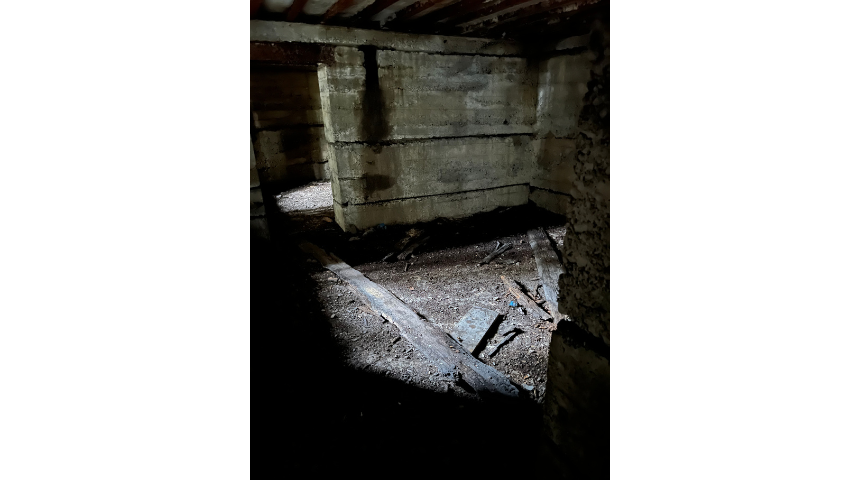
Room inside the bunker. Photo Jeffrey Knopf
Its concrete construction, enclosed atmosphere, and absence of light triggered a memory of another place I had visited two decades earlier: Auschwitz concentration camp.
Like many, I had grown up aware of its history. But nothing prepares you for the physical experience of being there. At Auschwitz I, the gas chamber and crematorium remain as reconstructed spaces. Originally built as a morgue, the chamber was converted into an instrument of systematic killing before later being repurposed as an air-raid shelter. The structure that exists today is a reconstruction assembled after the war from surviving materials (United States Holocaust Memorial Museum, n.d.).
The space is stark: bare concrete, low ceilings, and an overwhelming sense of absence.
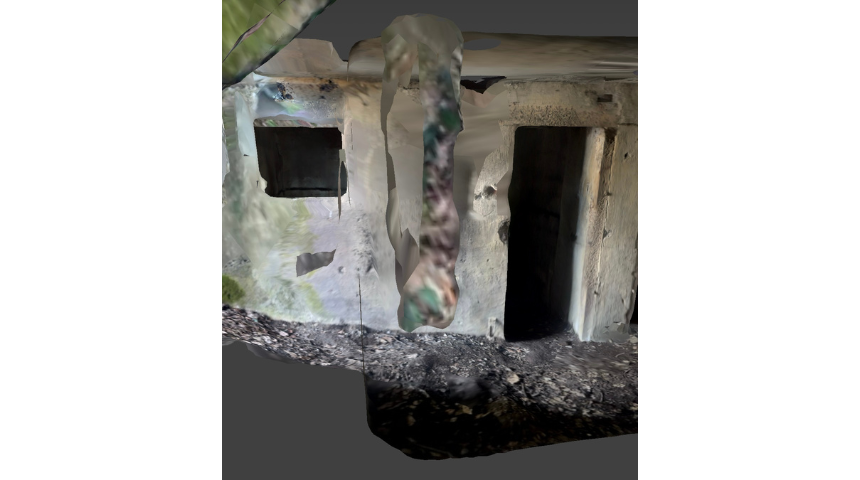
Jeffrey Knopf 3D scan – window and door from the bunker
Standing in the bunker in France, I was involuntarily transported back to Auschwitz. Although separated by decades and constructed for different purposes, the spaces resonated with one another. Both were architectures of containment. Both embodied the material presence of historical violence.
It is difficult to articulate why one space evokes another. The connection was not logical, but sensory and emotional. The bunker became more than a military structure; it became a vessel of memory. Dormant emotions resurfaced. I remembered the shock I had experienced after visiting Auschwitz – the difficulty of reconciling the scale of what had occurred there.
I experienced a similar emotional disorientation upon returning from France. Until you physically encounter such places, it is impossible to fully grasp their impact. Both sites were marked by an absence that was also a presence – a void shaped by industrialised death. What remains is not simply architecture, but the persistence of memory embedded in the material fabric of the landscape.
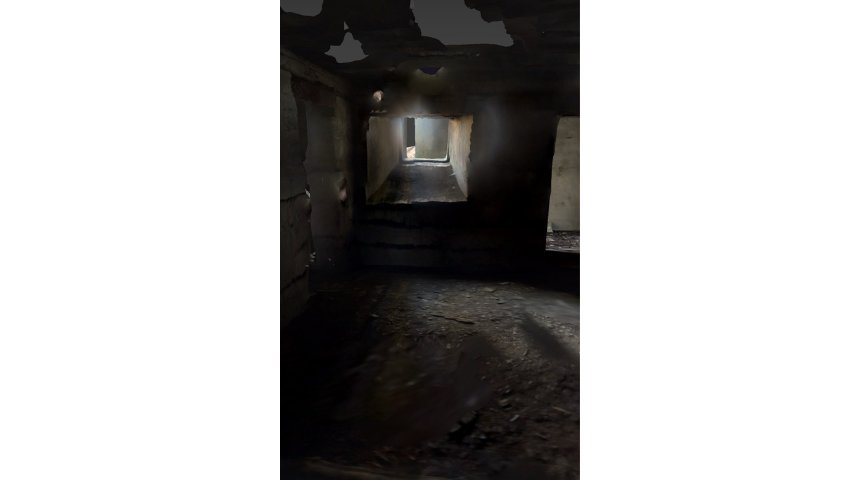
Jeffrey Knopf Looking out from a window from inside the bunker, 3D scan
Notes
For more about the Grandpre collaboration between Alan Ward and Jeffrey Knopf, there is a book published by Alan Ward titled “Nothing Remained Unchanged but the Clouds”. Purchase directly from
Alan Ward @alanjward.co.uk
United States Holocaust Memorial Museum (n.d.) Former gas chamber in the Auschwitz main camp. Available at: https://encyclopedia.ushmm.org/content/en/photo/former-gas-chamber-in-the-auschwitz-main-camp (Accessed: 26 February 2026).