REVIEW Apr 2026 ‘Plant Dreaming’ at Leeds Art Gallery
Charlie Currid
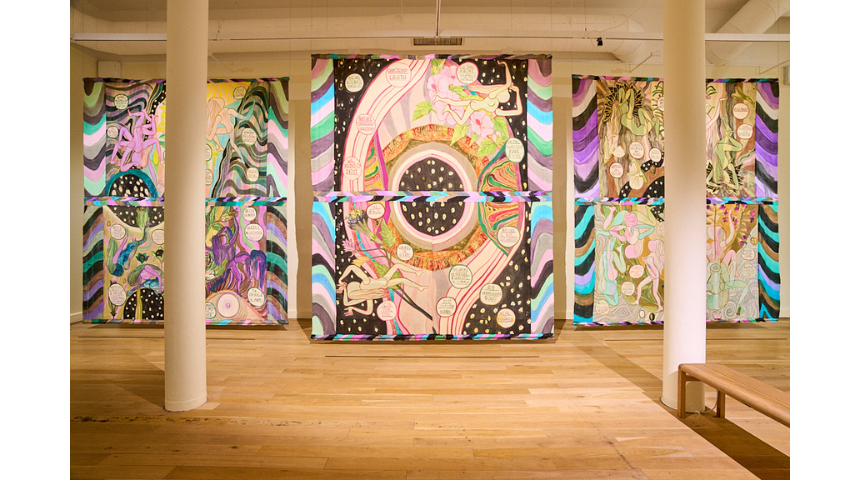
Emma Talbot 21st Century Herbal (2022) (all three) ©Rob Battersby
‘Plant Dreaming’ is a group show at Leeds Art Gallery, curated by Liza Bukatova-Grimshaw. The exhibition hosts works by Noemie Goudal, Aliyah Hussain, Jane Lawson, Yan Wang Preston, SHARP, Emma Talbot and Charmaine Watkiss. Artist and writer Charlie Currid reviews the exhibition here.
Plant Dreaming is on view at Leeds Art Gallery until 19th April 2026.
https://museumsandgalleries.leeds.gov.uk/plant-dreaming-mspx
I am reading a bubble of text featured in one of Emma Talbot’s paintings. I am grinding my teeth while trying not to flatten my tongue against my palate after my dentist told me he could see a line forming along the inside of my cheeks.
It reads: ‘Do you imagine yourself outside?’ I stand there for a minute longer, enough time to feel my jaw aching and to be suddenly beset by guilt. I guess I don’t think of myself outside. I have understood the necessity of reenchanting the natural world, written about the impact green spaces have on our mental health, photographed the environment, posted it online – but I practically sprinted from the train station to the gallery without looking up from my laces.
Why don’t we imagine ourselves outside? Well, outside isn’t always where I’d like to be, anyway, and only recently has there been any glimmer of hope of ecopolitics being appropriately addressed in Parliament. Collectively, we have for far too long seen nature as a means to an end. In the era of climate collapse, we have adopted the lens of the male surrealists, prioritising the scientific, sometimes psychoanalytic potential of plants over their inherent queerness and storytelling capability.
The artists in Plant Dreaming encourage us to re-examine this antiquated understanding of nature’s role in our lives. Indeed, ‘role’ here indicates profession, job description, and our first misunderstanding. If we are to engage with the work at all, we are to abandon utilitarianism, be reminded not to impose our restrictive ideology on a world upheld by mutualism, fluidity and stewardship.
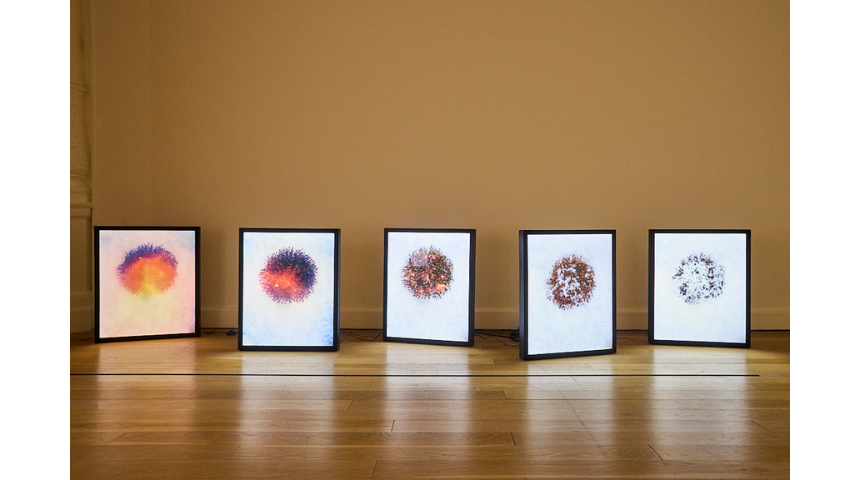
Yan Wang Preston Winter I: Seed Capsules (2020-23) (floor) ©Rob Battersby
Rewinding momentarily, standing in the hallway of the gallery, Yan Wang Preston’s work nicely illuminates our entrance. Winter I: Seed Capsules (2020-23) is a photographic documentation of a burning bush, constructed from seed pods outside the artist’s studio on the snowed ground. The cluster appears like the strange colloidal liquid ferrofluid, or a meteor, burning up as it enters the overcast skydome of Leeds.
Preston uses the seed pods of a Rhododendron Ponticum shrub as a vehicle to discuss the colonial history of the UK and its relationship to China, as the plant is regarded inversely in these respective areas; invasive species in the UK, native species in Eastern China. Themes of immigration, displacement and dispersal are paradoxically pulled into sharp focus as we see the seeds ‘rounded up’ by the artist. A succession of images documents the burning of the seeds, set alight by Preston. As the series progresses, the pods are lost to the flames, leaving us with the image of punctured snow where Preston had placed each seed, and where the fire quenched them. In showing almost the underbelly of the cluster, the staged, deliberate construction of the work is made visible.
The brilliant flame is complimented by SHARP’s spritely The Dancing Daffodils (1988-2024), another photographic print mounted nearby. The lifespan of the piece is 38 years, originally existing as a film negative, since adorned by time with scratches and bruises, which SHARP has embraced as gestures towards the suffering LGBTQIA+ people experience(d) under Section 28, a UK law banning the ‘promotion’ of homosexuality (repealed in 2003). In reviving an image from 1988, the work has effectively waited for a chance to bloom, presenting an opportunity to think about the relationship between activism/visibility and privacy, and the parallels existent in the plant world.
Blowing the image up to 33 x 22’’ is confronting, enhancing the imperfections and distorting the daffodils. What we’re left with is a spectral character, swaying joyously upon the surface, bearing the scars of maltreatment: A reclamation of the term ‘daffodil’. I am reminded of Paul Harfleet, who since 2005 has been operating ‘The Pansy Project’, which similarly reclaims a slur often used against effeminate men, through the planting of pansies at sites of homophobic abuse. SHARP’s responses to the solitude and escapism afforded by the natural world are encoded with eco-queerness. They highlight the mental benefits we are denied without green spaces, and the disproportionate effect this lack has on working class, LGBTQIA+ people.
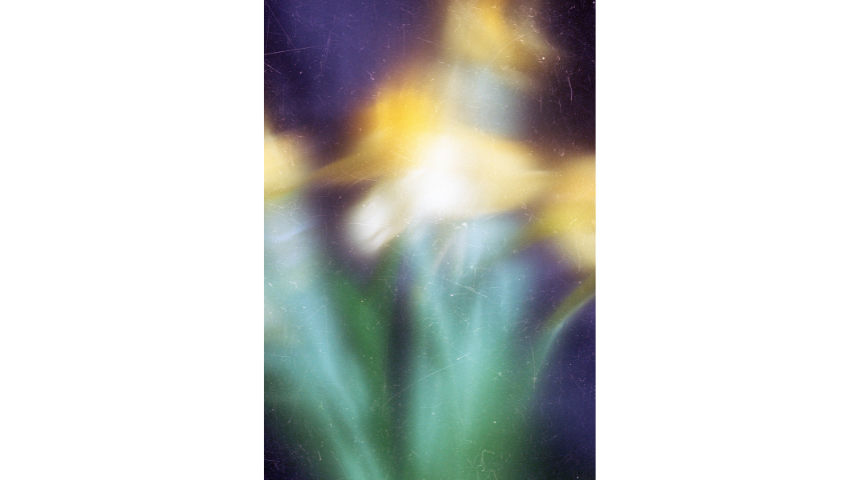
The Dancing Daffodils (1988-2024), SHARP Courtesy the artist
On the same wall, almost hidden in shadow, is a drawing by Charmaine Watkiss The Matriarch I (2021). It is unfortunately her only piece in the show, though it has strong thematic ties to the rest of the works, and possesses a beautifully understated nature. Drawing from tales passed down through generations, Watkiss asserts that, in a group show that so often looks to the future to reconnect with the natural world, we must instead look back, so as not to retread ground.
The plants featured in the drawing act as signifiers of the repression and resilience of Black women throughout history, and the work is not simply a list of medicines, but an examination of the role plants play in our heritage.
The materiality and stylistic elements of the piece bring to mind the drawings of Rachel Goodyear, an artist who similarly uses paper as a portal to exploring folk tales and the suffering women within them. The history covered in The Matriarch I sheds light on the potential plant life has in enabling a deeper understanding of more intersectional histories. The manchineel apple is contained underneath a glass jar, with an almost theatrical “no touching” sign, a hint or clue for those of us unfamiliar with the roles plants have played in the liberation of enslaved peoples. Reading the statement supplied with the work, we learn about the peacock flower, about how slaves would ingest its seeds to prevent children being born into slavery. This fact, among others detailed in the statement, transforms the image from a family portrait into a haunting and brilliant memento mori, one that bakes the Black experience into its depiction of both life and death. In drawing the women in pencil, and decorating them with fragmented brushwork, The Matriarch I feels intentionally sparse, a visual encapsulation of the scant attention given to the act of ‘looking back’ in an age so determined to conceptualise a radical future.
Watkiss’ work sits in the threshold into the second, larger space of the exhibition, next to an archive of botanical specimens from the Leeds Museum and Gallery’s Natural Science collection. The plants contained in the display case, though thoughtfully preserved, echo the pallid browns and blacks of Aliyah Hussain’s Jal Tarang / Waves in Water (2025), the installation facing it.
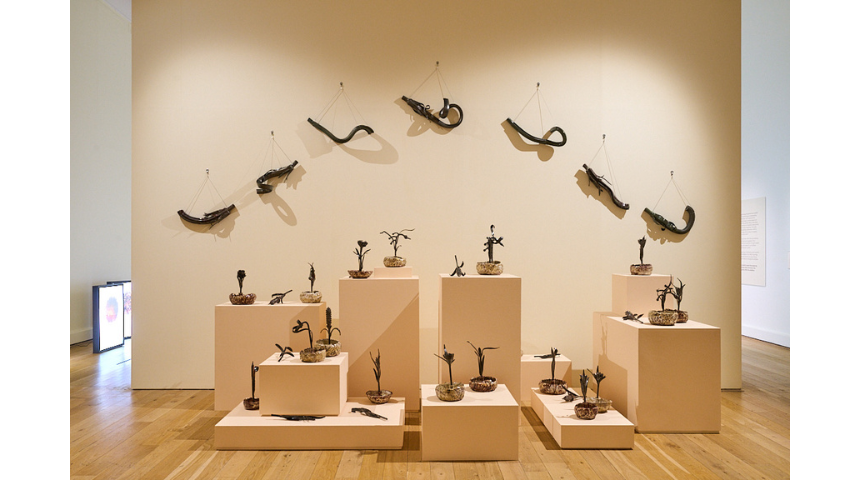
Aliyah Hussain Jal Tarang Waves in Water (2025) (whole work) ©Rob Battersby
The text accompanying the piece highlights a cruel irony faced by Hussain’s family: We learn that following flooding and consequent displacement, the family emigrated from Pakistan to the North West of England, a region now experiencing its own flooding. In one sense, there is nowhere at present one can go to be beyond the collapse’s grasp, yet in the same way, this could be an opportunity for transcontinental empathy, an international exchange of knowledge and proactive thinking.
Having seen Hussain’s work at Lowry (in ‘Local/National/International’, 23 November 2024 - 16 February 2025), I was intrigued by her inventive installation sensibilities, and was now anxious that a group show would pose a threat to the sense of immersion or cohesion evident in her previous work.Jal Tarang / Waves in Water is an installation composed of plentiful ceramic sculptures littered across a series of staggered plinths, giving us the sense of rising/draining waters. Headphones supplied play a building score, mimicking too the enveloping nature of a flood, as the rain droplets and flood sirens assume the space between my ears. The whole package is done with such finesse and ease, it’s impossible not to invest wholly in the work.
The success of the work lies in its toying with our sense of scale, both literally and figuratively. It connects seemingly disparate areas in ways that excite me. Seventeen bowl-forms scattered across the installation echo the titular jal tarang, a percussive instrument from the Indian subcontinent made of a series of bowls filled with varying levels of water. Hussain imagines a waterlogged Upper Calder Valley, a dish, filling with water. We are cast as the gorgeous ceramic plants, glazed in an ill black, some standing tall, some lying defeated, resembling banana skins or corn husks. Our determination and fragility in the event of emergency, mirrored in the intentional and delicate physicality of the plants.
Similarly to Watkiss, Emma Talbot turns our attention to the sources from which we pull our cultural understandings of plants. Her contribution consists of three large paintings on silk, 21st Century Herbal (2022), that take on the qualities of a pharmacognosy textbook, or a herbal. The paintings are sprinkled with bubbles of text, detailing the medicinal effects of various plants, effects both scientific - ‘Antidepressant, helps PMS’ - and metaphysical - ‘Imbued with magical powers’, creating a herbal that pulls from folkloric history, not exclusively medical discovery.
The command Talbot has of paint gives the work a delectable quality. Knowing, too, the unforgiving bite silk has on paint, the beauty of the pitcher plants and foxgloves among the paintings is undeniable. Embracing interconnectedness in Spaceship Earth (2022), Talbot’s brush marks are reminiscent of muscle tendons, eye balls, or, as pointed out on the artist statement, one of Buckminster Fuller’s geodesic domes, itself a web of interconnected triangles. Ambiguity afforded by her faceless figures and bubbles of text like ‘Prevents crying’ (in that it is potentially a benefit and/or deficit), in ‘St John’s Wort/Belladonna’, encourage viewers to look beyond the binary-ed ways of thinking that are often part and parcel of anthropocentrism.
My eye is once again caught by a bright yellow, this time in the top right corner of Talbot’s leftmost work, a spot historically reserved in the Western canon for heavenly bodies. Surrounded by bubbles reading ‘Helps mood disorders’ and ‘Helps lung ailments, breathing’, the narrative being told here seems to centre the human. It designates the top right corner for the ‘good’ qualities, the bottom panel of the painting for the ‘bad’, decided by how they impact human life. This composition seems to upset the non-hierarchical approach taken by her thus-far inclusive herbal, though at the same time it is intriguing to question if/how religion influences our cultural understanding of plant-life.
It is here I read ‘Do you imagine yourself outside?’, and here I stood for that very isolating minute. The very next thing I did was return to the case of plants supplied by the Leeds Museum and Gallery’s Natural Science collection, and to the various books shelved in Plant Dreaming’s own little library (which, I’m told by an invigilator seated nearby, was another contribution of Aliyah Hussain). I jotted down the names of those I found most interesting. My notebook slowly turned into its own kind of herbal, born from a mixture of guilt and curiosity.
Hanging high on the wall begins Jane Lawson’s Cthulucene Domestic Heating Prototypes 2 (2025), tumbling onto the ground and extending into the floor space of the central room of the exhibition. Lawson deals in speculative fiction, and in possibly the most conceptually misty work in the exhibition, she imagines a future from which these works have been pulled, where humans have survived the climate crisis, and are now regenerating the Earth through renewable energies, foresting, and so on; though the work itself is a kind of decorated insulation, a machine knit made of wool and cotton, used domestically in this hypothetical future.
Reading the text from top to bottom feels like a Star Wars opening, similarly dramatic and inscrutable. Segments read like fragmented poetry, and ignite new streams of thinking. I am particularly drawn to what seems like a documentation of an important conversation between ‘a man’ and ‘a woman’, a portion of which reads as follows:
‘And a man said
Our job is not to decide the future;
our job is to leave the future
as many good options
as possible’
There are moments of profundity scattered throughout the text, which in itself holds up well alongside Talbot’s work. The spore prints recreated in the knit are a little confusing (but then again, what about this work isn’t?), in that they don’t seem to retain any of the magic, the intricacy, of an actual spore print. By reproducing them in wool, we are given a taste of what happens when images or sentiments erode and morph, having been passed down through generations, an idea very important to understand in regards to ecology and conservation. It somewhat resembles the radioactive symbol, which was created in efforts to visually (rather than literally) warn people of radioactivity long into the future. Before a group of researchers headed by Nels Garden designed the symbol, scientists and semioticians pitched many different solutions, the zaniest of which included colour-changing cats and spikes protruding from the terrain surrounding the radioactive material. It can be fun to imagine a world in which we decided these were preferable to a series of signs. In the same manner, it’s not hard to have fun with Lawson’s pieces, which cast similar ‘what ifs’ into our minds.
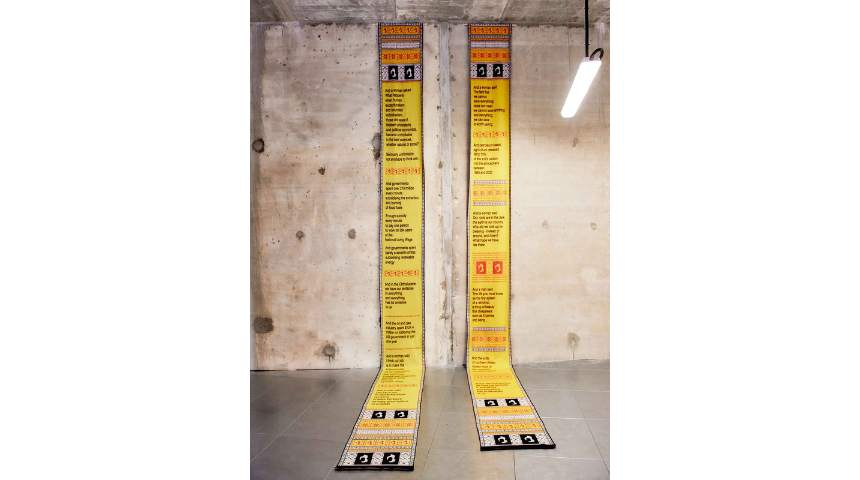
Chthulucene Domestic Heating Prototypes (2025), Jane Lawson © Jane Lawson
The back space of the gallery is reserved for Noemie Goudal’s work Below the Deep South (2021), a video piece that plays out like a serene nightmare: Bird calls and cricket hums soundtrack the slow burning of photographic prints of rainforests. Each photograph, painted with combustible fuels, is devoured by a golden fire, simultaneously wild and methodical in the way it consumes the prints one by one. Its licking flames seduce us, and we linger in the space, teased by the promise of the final sheet burning away.
The most tantalising parts occur when the seams of images begin to show. There is something simply delicious about their straight lines slowly revealing themselves as the images begin to decompose. In one dramatic instance, a layer of the forest sways gently backwards and forwards, before splitting horizontally to reveal a ghastly fire by which it is swiftly swallowed. Something primal happens when we watch the fire, and there is no other option than to watch.
The climate crisis as a visual feast alludes to the Hyperobject, a term coined by Timothy Morton: essentially something incomprehensible through anthropocentric thinking. Our understanding, largely, is digesting the crisis as a series of images, small happenings here and there. This compartmentalised processing prevents us from ever wholly becoming familiar with the reaches (or, more accurately, the omnipresence) of the collapse.
This idea - the collapse as freeze frames - is flipped on its head as we watch still images themselves burn away. Like a piece of surreal theatre, Goudal’s work has a meta, self-referential quality which helps to highlight the profound absurdity of the climate crisis, and further still our passivity in its presence.
And then the film ends. The final sheet is burnt away, revealing a bare room with wooden panelling, and I’m left gazing from one room into another. What follows is especially weird, as, in order to leave ‘Plant Dreaming’, I have to walk past every other work. That seems obvious in writing, given that Below The Deep South is situated at the back of the exhibition space, but having watched an almost episodic burning of images, I suddenly feel I’ve been transported back in time, seeing drawings, paintings and sculptures standing proud in the gallery. A bizarre kind of credits sequence. It’s funny to realise, too, that the exhibition is bookended by flames: Goudal’s Below the Deep South’ and Preston’s burning rhododendron seeds Winter I: Seed Capsules. Realising I have developed a sympathy for the works in the central space, who are separated from the fires on either side, I take note of the curation. The placement of Goudal’s work has an impact on how visitors leave, not just how they enter. And that is the most important aspect of ‘re-enchanting’ – a sustained change, not a passing moment of fun and whimsy. ‘Plant Dreaming’ encourages us to imagine personal connections with nature, but speckles our conjured worlds with images of despair. We are reminded to wake up from the dream, or indeed the nightmare, and turn our faces to the rising sun.
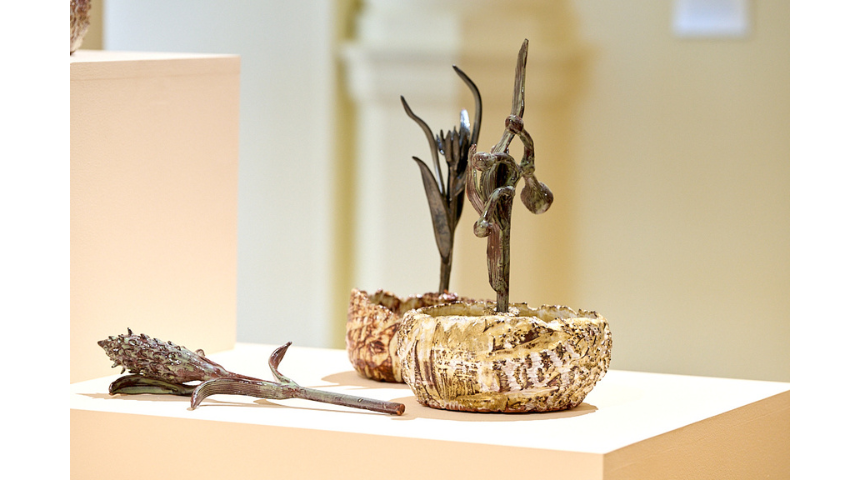
Aliyah Hussain Jal Tarang (2025) (detail) ©Rob Battersby