FEATURE May 2026 150th Anniversary at The Atkinson – Southport, A Town For All Seasons
Josephine Manby

Now and Then Julia Fullerton Batten, 2026. Adapted from: Southport for a Holiday in Wintertime, Fortunino Matania (1881–1963). Atkinson Art Gallery Collection.
Southport 2026 is a year-long programme of celebrations for the town filled with the theatrical, artistic and other creative spectaculars that the town has long been known for, and The Atkinson plays a central role in the drive towards cultural and economic transformation. the Fourdrinier editor Josephine Manby met with staff at The Atkinson to get a sense of their plans for 2026 and beyond, and spent time in the Museum thinking about the inspiring potential of the town’s collection.
So much of what drives my writing is a desire to know and connect with other humans—to locate myself within a vast, prismatic web involving art and culture, history and economics, ecology and technology. Museums are places that facilitate that sort of investigation, having already curated a narrative through objects. They’re full of stories, ideas, and information that provide the often-obscured context for understanding people and nature. They’re crucibles that make meaning out of the raw stuff of life.
Jenny Xie, author of Holding Pattern (Riverhead Books / Penguin Random House), quoted in Writers on How Museums Fuel Their Creative Work by Corinne Segal 3 May 2023 (BrooklynMuseum.org) (1)
The museum at The Atkinson is a resource for reminiscence, memoir, poetry – a fiction writer’s paradise. Here, you can immerse yourself in another era. Travel in time as far back as the Mesolithic epoch, tracing a woman’s footsteps across the Formby shore 7000 years ago; move through a world of faience and hieroglyphs amongst Mrs Goodison’s Egyptology Collection.
Stop off in 1926 to witness the land speed record being broken by Henry Segrave in his Sunbeam V12. Check out Eclipse Mania the following year. Get the lowdown on the famous racehorse Red Rum. Hear all about ex-Gaiety Girl Mirabel Topham building a brand-new steeplechase which hosted The British Grand Prix five times, won in 1953 by Stirling Moss. Cheer the 1984 Grand National winner on the same track, Neale Doughty on Hello Dandy, beating 1983 winner Corbiere into third place.
Dress in Roaring Twenties gear and find yourself absorbed by the retouched photographs and paintings of Southport in the heyday of flappers and Venetian water carnivals. Send a digital postcard to share your experiences and arrive back in the twenty-first century to mingle with visitors, among whom you might spot the modern day versions of the people from the past, sitting in The Atkinson’s café, A Great Little Place, enjoying tea and a slice of plum crumble cake.
2026 is an important year for Southport. The catchphrase is ‘Elegantly Eccentric’ and the whole town is on board to make Southport the year-round destination for thrill seekers and holiday makers alike This initiative is symbolised by a brand new photographic recreation by award winning fine art photographer Julia Fullerton-Batten, of a historic painting, Southport for a Holiday in Wintertime (1936) by Italian artist and illustrator Fortunino Matania (1881-1963), from The Atkinson’s own collection, has been commissioned. Now both versions, the original in oil on canvas, used in the 1930s to promote Southport as a winter resort, and the new restaging hang side by side in the Museum foyer, with a wealth of information about how the commission came about and how the restaging was put into effect.
To create her photograph, which captures the glitter of Southport past while embracing the town’s ambitions for the future, Julia Fullerton-Batten chose to feature local business owners from the creative and entertainment sectors, from B&B owners and interior designers to creative directors and personal trainers. The modern day cast were dressed and made up to breathe new life into the original scenario, and photographed alongside carefully replicated props and motifs outside the original Garrick Theatre to make an image as stylish and iconic as the Matania it hangs alongside.
Julia Fullerton Batten’s work features in permanent collections at the National Portrait Gallery, London, Musée de l’Elysée, Lausanne and the Parliamentary Art Collection, Houses of Parliament. Julia said; “I loved the glamour and intrigue of the original image and it was so exciting to get the chance to reimagine it on behalf of modern Southport. Our cast are a wonderful celebration of the warmth and creativity of the town and I hope the image helps capture the majesty of the art deco architecture which is all around you” (2)
The other Matania works in The Atkinson collection are The Venetian Bridge, Shopping on Lord Street and The Water Festival. Joanne Chamberlain, Heritage & Participation Officer at The Atkinson, described the original Matania Holiday in Wintertime scene as ‘revellers coming out of the Garrick Theatre on Lord Street. Central is a man with a monocle (said to be the artist Fortunia Matania himself), next to him is allegedly his wife and to one side is a young women on her own – rumoured to be his mistress!’
I asked Joanne about The Atkinson’s take on the current situation with the Garrick and whether it should be preserved or not. ‘Absolutely! It’s a huge piece of Southport history,’ she said. ‘And there are so few Art Deco buildings in Southport. Even when the trend turned to this more contemporary style, the buildings on Lord Street continued to be built in the Classical style. As Lord Street is so wide and grand – this style worked well here.’ Joanne also pointed out that the ground floor of The Garrick still has all its original Art Deco features.
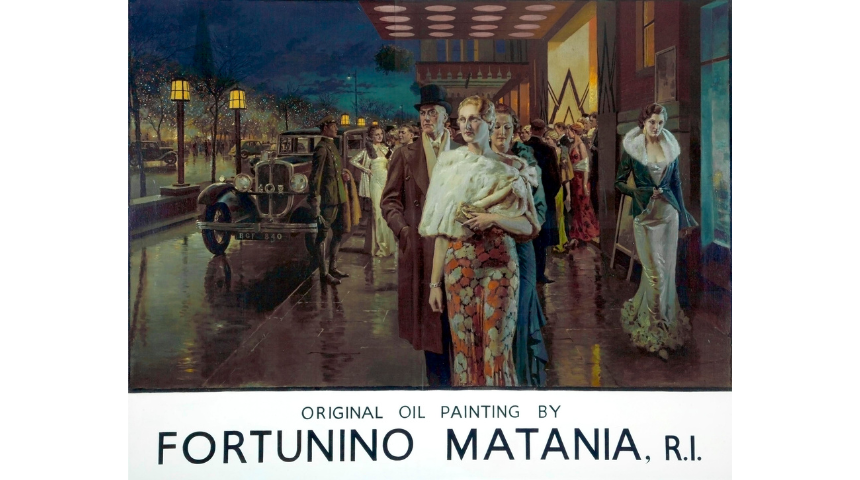
Southport for a Holiday in Wintertime Fortunino Matania (1881–1963). Atkinson Art Gallery Collection. © The Board of Trustees of the Science Museum
This is one of the ways The Atkinson is celebrating its 150th year in 2026. It is the year of the 100th Annual Sefton Open Exhibition organised by Southport Palette Club. Also, as part of The Atkinson’s Museum Forward Plan 2025-2029, an oral history project is planned, for which a new position of Heritage Officer, a 2-year appointment, has been made. There will be a culminating legacy exhibition relating to this project in 2027 in one of the galleries. In 2028, objects newly acquired via the oral history project will be accessioned into the permanent collection at The Atkinson.
Each layer of Southport’s fascinating history is represented in the Museum. Southport began as a small fishing village, although archaeology has uncovered evidence of people living around Lunt Meadows almost 8000 years ago. Churchtown had a seawall as early as 1100. In 1692, an Act of Parliament permitted the draining and subsequent reclamation of dangerous marshlands along the Sefton Coast. Sea bathing at Bootle grew in popularity from the 1700s together with boating, tennis and golf, and by 1801, around 100 people lived nearby William Sutton’s South Port Hotel (later known as Duke’s Folly).
In the 1800s, landowners and railway companies competed to create first-class golf courses across Southport’s sand dune system, which has helped preserve rare flora and fauna. The Atkinson displays two watercolours by Mrs Fairfield, the earliest known views of Southport, painted in 1833 when Lord Street was no more than two rows of simple houses on the dunes. It later became a resort as people with disposable income began to arrive; industrialists, for example, seeking healing waters and fresh air. Initially, high tides presented a problem, reaching as far inland as Lord Street. In 1835, a new seawall and promenade mitigated the floods. In the 1840s, leading local landowner Charles Scarisbrick championed residential development for a social elite, ensuring a minimum value for houses, creating what came to be known as the Seaside Garden City, even going so far as to stipulate the number of trees per garden.
Napoleon Bonaparte III is said to have temporarily resided on Lord Street, which allegedly inspired Parisian boulevard design. “Historians have found documents stretching back over a century supporting the story – one even claims Louis-Napoléon Bonaparte rented a property on Lord Street itself, while other records confirm the eventual Emperor of France visited Lancashire and was friends with the Gerard family who were well known in Southport,” Sefton Council’s Heritage Officer reported on MySefton.co.uk in 2023. “While we continue to look for more evidence, there is one undeniable truth – Southport’s splendour is up there with the world’s best.”
By 1860 Southport had a pier – still the second longest in Britain and the oldest to be made of iron. The visitors who came to bathe and promenade needed entertainment. In 1974 Cambridge Hall and Southport Winter Gardens opened, the former to stage concerts, lectures and dances; the latter to present balls and roller skating. In 1889, Birkdale Golf Club was established, graced by 1935 with an Art Deco club house and the title Royal Birkdale Golf Club in 1951. With the 1932 Garrick Theatre in stylish Art Deco manner, Southport entered its most fashionable era.
In the 1920s, a tram service was inaugurated. Southport as a resort developed contemporaneously with Blackpool; however, Blackpool retained its working class roots whereas Southport attracted a wealthier clientele. There was a vibrant social scene, hotels, dinner parties. Lord Street was a continuation of existing neoclassical architecture in the town, and echoed continental boulevards. The Art Deco of the Garrick Theatre (featured in the Fortunino Matania painting and the restaged photograph) was a notable exception. When the Venetian theme was brough to Southport, with the Venetian Bridge and the gondolas, the Venetian Nights Spectacular events, held from 1932 until the outbreak of war in 1939 were so popular that a special train called the Venetian Express was put on to bring visitors from Manchester. The bridge and the islands would be lit with coloured fairy lights, while gondolas and flotillas of other boats sailed amongst lake lanterns carrying people in fancy dress playing music and singing.
Founded in 1924 by the Council, The Southport Flower Show is the largest independent show in the UK and is still held in Victoria Park in Southport, bounded by the historic Rotten Row, the longest herbaceous border outside London. This was a major attraction to pre-war Southport and was restored by Friends of Rotten Row in 2011.
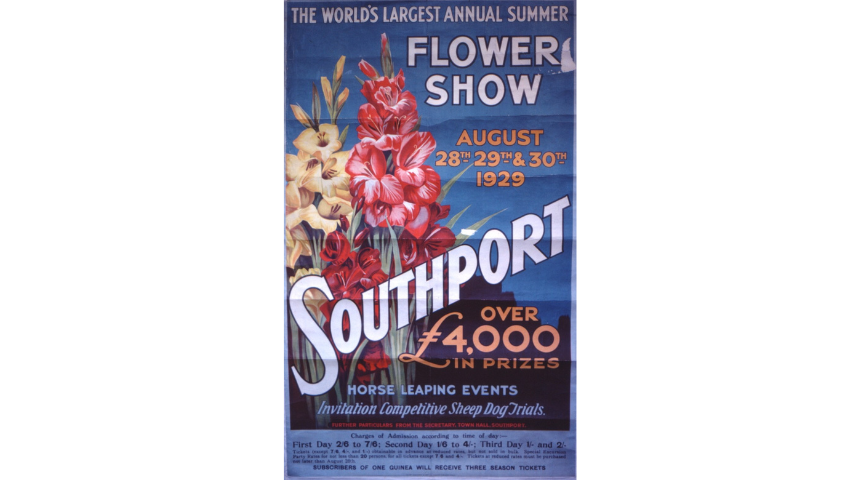
Southport Flower Show. 1929 Show Poster. Atkinson Art Gallery Collection.
Famous people were drawn to Southport. Stars such as Fred Astaire, Judy Garland, Frank Sinatra, Clark Gable and Charlie Chaplin. Nineteenth century showman Phineas Taylor Barnum visited regularly, particularly in 1850 and 1870, and later married Southport’s own Nancy Fish, a local socialite and daughter of Barnum’s friend, John Fish, a local cotton mill owner. Barnum acted as an advisor on the construction of Southport’s Botanical Gardens Museum. He donated his hat to The Atkinson and it remains in the collection today. Other visitors have included the authors Oscar Wilde, Rudyard Kipling and Arthur Conan Doyle.
‘Lightport’ was a spectacular, free immersive light and sound experience that transformed Southport’s iconic Lord Street into a breathtaking walk‑through rainbow of colour, creativity and joy. Produced by leading international artists Lucid Creates, the event marked a hugely successful moment for the town and a standout start to Southport’s 2026: Elegantly Eccentric cultural programme. It ran between the 14-16 February 2026. (3) ‘Lightport’ was a multi-sensory adventure designed to lift spirits and chase away the winter blues. The event marked the opening moment of Southport 2026, the year-long celebration.
Mermaid Gardens was transformed by mirrored LED lights to create a field of colour, the Mermaid Pond a rippling rainbow, the sundial casting multicoloured rays over the scene. Monument Square flowed with shifting gradients of colour and light, while Christ Church Gardens became immersed in colourful neon and the Town Hall Gardens presented the ten metre high finale installation of a dreamlike rainbow archway made of 7000 luminous pixels surrounded by mists that visitors could stand underneath to see it rising up from the ground.
The Atkinson programme for April to June 2026 includes a range of exciting exhibitions. The Sefton Open, running until 30 May 2026, invites local artists annually to celebrate the creative talent of the borough. Works are selected by the Southport Palette Club, longstanding partner of The Atkinson, who celebrate their 100th exhibition this year.
‘Taking Centre Stage: Female Artists in The Atkinson’s Collection’ opens on 13 June and runs until 27 February 2027 and will feature a breadth of artistic styles and perspectives. ‘Zahed Taj-Eddin: ANTIQUITA’, from 13 June to 10 October 2026 will showcase the clay and bronze sculptures of the Syrian artist and archaeologist as he explores riches of history, myth and his own experience to develop works forged from personal memories of the ancient city of Aleppo, encompassing both its past as a culturally diverse, fortified municipality at the crossroads of trade routes, and the impact of more recent conflict during the Syrian Civil War.
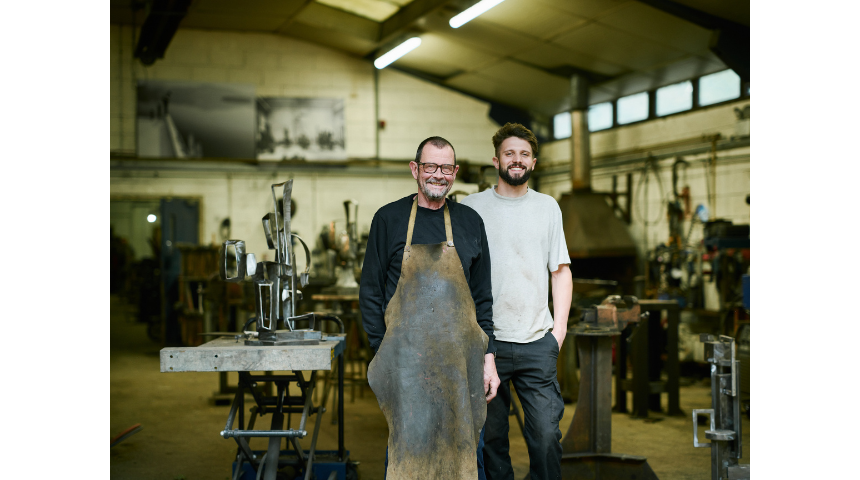
Brian and George Fell. Photo Adrian Lambert.
Father and son metal workers Brian and George Fell present ‘Always Something New’, from 13 June to 17 October 2026 as the two share a love of their chosen materials but very distinct approaches.
‘The Legend of the Angel of Mons’ from 27 June to 17 October 2026 is curated in partnership with Mons Memorial Museum. Legends of the Great War describe soldiers assisted by heavenly beings and this exhibition recounts the most famous, the Angel of Mons which circulated after reports in 1914 which claimed that St George and a squadron of ghostly archers protected British troops. The story of the Angels of Mons was originally published by war correspondent Arthur Machen which gave the story some credibility. This also became a perfect tool for moral and propaganda as clearly God was on the side of the British. As time moved on the image of the angel shifted to the nurses who looked after the injured.
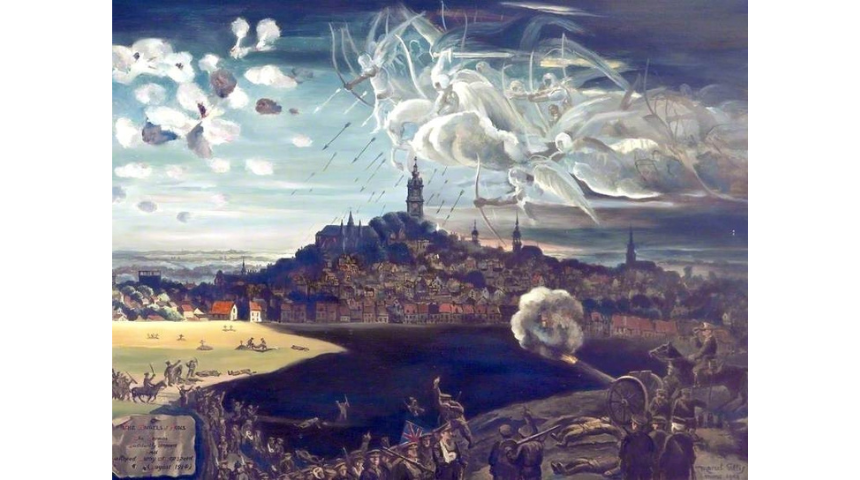
The Angels of Mons Marcel Gillis (1897–1972). Atkinson Art Gallery Collection. © 2026 DACS
‘I had been writing about many of the pictures that artists made representing the Angel of Mons during the years of the First World War,’ says Joanne Chamberlain. ‘Two were the covers of sheet music. The rest were illustrations that appeared as posters, post cards, and in books. The final one I will discuss is by Mons artist M. Marcel Gillis. The painting was done in 1922, four years after the war. It has appeared many times illustrating articles about the Angel of Mons. It holds a place of honor in the new Mons Memorial Museum.’
An exhibition, titled 'The Angels of Mons: Beliefs and Appearances in 14-18' ran at The Mons Museum until 11 May 2025. It focuses on examining faith and institutional propaganda during warfare and commemorates the 110th anniversary of the Battle of Mons in the First World War. Central to this is the legend of the 'Angels of Mons.’
“The goal is to question the need to believe in times of conflict, examining why angels played such a significant role in the collective imagination of the period,” the Mons Museum explained in a press release. This research, a blend of artefacts and imagery, has been curated by French historian Annette Becker, Belgian historian Laurence Van Ypersele, and Corentin Rousman, the Mons Memorial Museum’s curator. Joanne Chamberlain of The Atkinson visited the exhibition and met with the Mons Memorial Museum’s curator, Corentin Rousman with a view to bringing elements of the exhibition to The Atkinson 2026.
With so much to see and experience, The Atkinson is a key destination for Southport visitors. Come and spend some time absorbing the enticing fragments of history, meet the people from the distant and the near past, and join a community of like-minded individuals in seeking out stories. You might even be inspired to write it all down. (4)
Footnotes
1) Jenny Xie, author of Holding Pattern (Riverhead Books / Penguin Random House), quoted in Writers on How Museums Fuel Their Creative Work by Corinne Segal 3 May 2023 (BrooklynMuseum.org)
https://www.brooklynmuseum.org/en-GB/stories/national-book-foundation-5-under-35-writers
2) ‘A famous 1930’s image of Southport has been recreated to launch Southport 2026’ (VisitLiverpool.com News 9 November 2025)
3) Lightport https://www.visitsouthport.com/whats-on/top-events/lightport/
4) The Arts Society Southport are longstanding partners of The Atkinson and support the annual Young Artist of the Year competition and Poetry & Creative Writing competition. The Arts Society network brings arts education and culture to over 64,000 members, bringing people together through a shared curiosity for the arts. Their members contribute to and preserve our artistic heritage through volunteering and grants.
If you are interested in becoming a member please visit their website: theartssocietysouthport.org.uk
This feature is supported by The Atkinson