INTERVIEW Apr 2026 My Hat and My Other Hat with Caz Egelie and Katy Morrison at PINK
Sadie Rogerson
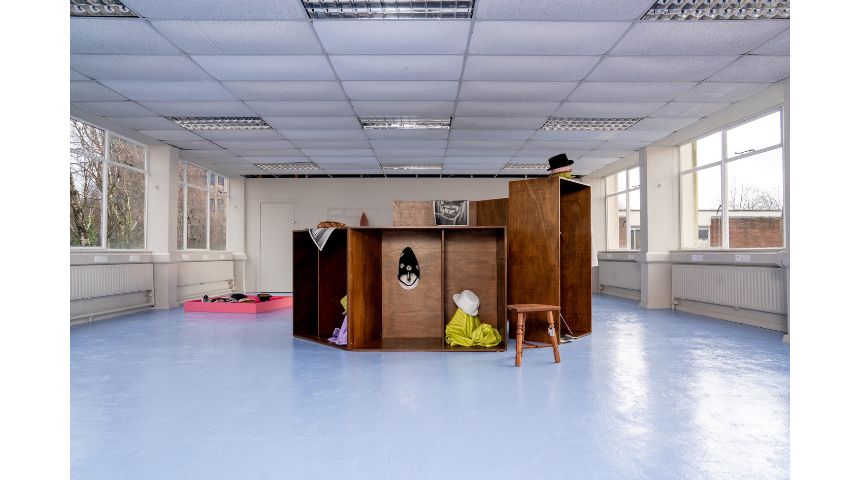
Caz Egelie My Hat and My Other Hat (2026) Mixed Media Installation. Photo Credit: James Measom (2026)
‘My Hat and My Other Hat’ is a world‑building installation oscillating between set design, medieval fantasy and institutional archive by Dutch artist Caz Egelie, made with the support of Katy Morrison, director of PINK, as part of their international artist-in-residence programme. The installation explores Stockport’s hat-making heritage through archival and material research. Caz engages with the concept of role-play, as the hat becomes a performative device to explore social functions, re-fashioning of ideas and the embodiment of the self through play. On show at PINK, Stockport, until Sunday 19 April 2026.
https://www.pink-mcr.com/my-hat-and-my-other-hat
Caz Egelie is best known for their multidisciplinary body of work including installations, performances, two-dimensional works and videos. In Caz’s work, the lines blur between fact and fiction, defying canonical categorisations of art history through ‘institutional jest’. Caz’s installation was made possible through their two-part residency at PINK in Stockport. Katy wears many hats (excuse the pun): curatorial thinker, PhD candidate, entrepreneur and director of PINK, she leads a curatorial programme that fosters interdisciplinary research and engages diverse audiences to challenge the boundaries of curatorial practice. I was fortunate to meet Caz through my work with PINK, as their residency coincided with my involvement in the KNIP programme. Katy devised KNIP as a work/learn curatorial programme, in which my cohort have been exploring exhibition management, outreach and programming within artist led spaces.
Situated in Hilton House, PINK resides in a sixties-built modernist office block, complete with harsh office lighting, prefab walls and a carpeted lift. Behind the façade of nostalgic banality, you’ll find a gallery, artist studios and events space dedicated to advancing interdisciplinary research, experimental artistic practice and collaborative exchange. Though not the typical setting for an ambitious installation exploring the interchange of industrial production, craft, identity and performance, this unassuming setting contributes to a further sense of uncanniness.
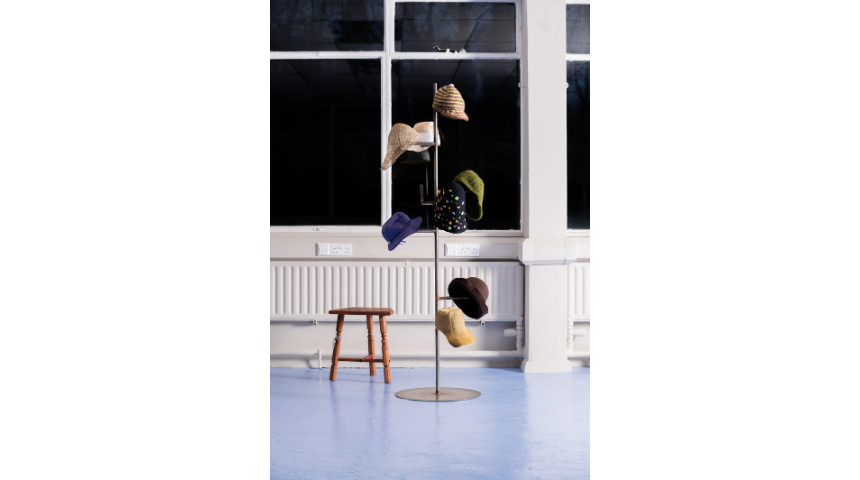
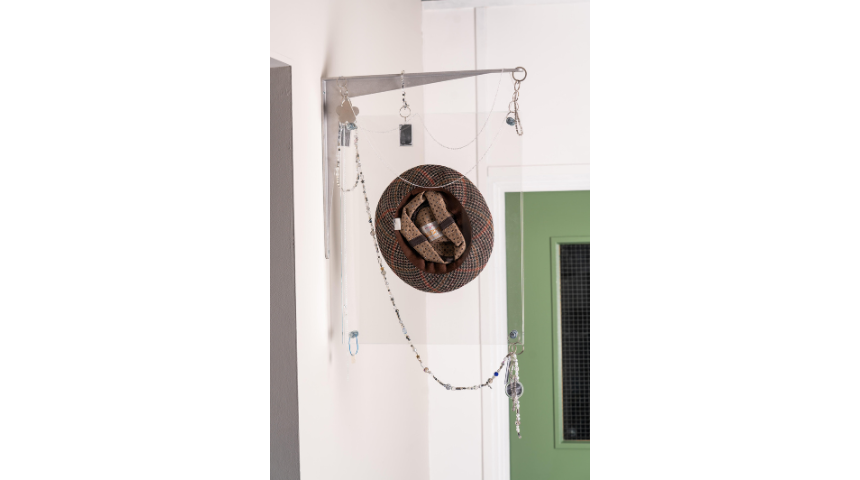
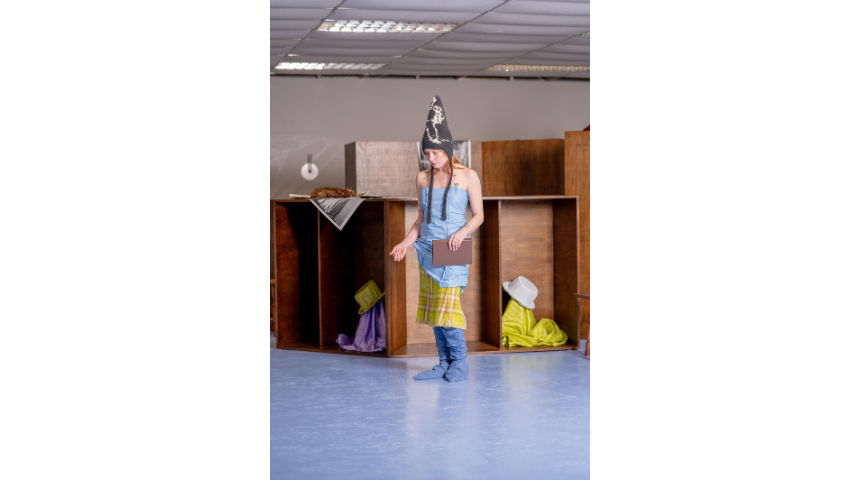
At the opening of My Hat and My Other Hat, I found myself stepping into a hybrid, heterotopic environment that folded together the aesthetics of a medieval tavern, an archival workshop and a theatre set. The space, complete with charming blue floors, rich wooden counters and sourdough bread, was filled with hats hand-crafted by Caz worn by both performers and visitors. Performance activated the space, as each distinct character rehearsed rituals such as playing the bass flute, counting coins and whispering to each other. Ornamented with historical hats in plush boxes and black and white faux-archival photographs of the performers wearing Caz’s works, the space becomes more reflective in the absence of performers. The interplay between performance, archive and constructed history invites closer examination of how the work was developed and realised. In conversation with Caz Egelie and Katy Morrison, we discussed their collaborative process, their engagement with Stockport and the evolution of My Hat and My Other Hat.
Sadie Rogerson: How did the project and partnership with PINK come about?
Katy Morrison: So this particular project came about through the fact that we got funding firstly! I always have a list of artists that I want to work with. Not in the typical curator sense where it’s studio visits or picking a body of work, for me it’s actually about picking a person that I am intrigued to see how they might answer some questions I’m dealing with or someone who does something that fascinates me. That could be how they make, how they think, how they tackle something.
In 2021-2022 me and Caz were involved in a large-scale production called Grey Area with Kevin Hunt, when we were in the old 86 Princess Street in town. We’ve always maintained relationships; we caught up when I brought your work back to the Netherlands and we’ve just been constantly touching base. We’ve talked about this in KNIP, but friendship is a strong starting point and then falling into someone’s practice, really falling into a kind of fascination with what that person does.
I’ve retained this absolute desire to bring Caz back, especially when we moved to Stockport in 2023. You can’t ignore the fact that every time I go to PINK I go past the Hat Works Museum, so that history of textiles, industry and the strange redevelopment of Stockport moving further away from its industrial past. I just felt that this needed to happen, I needed a project about hats from Caz.
So, when we got the UK Shared Prosperity Funding from Stockport Council, that felt like the correct time to do something very hyper-Stockport. I needed to go to somebody who could produce a phenomenally high level production but could also make something that was deeply research embedded, so then we could go back to Stockport Council and really show what we are capable of.
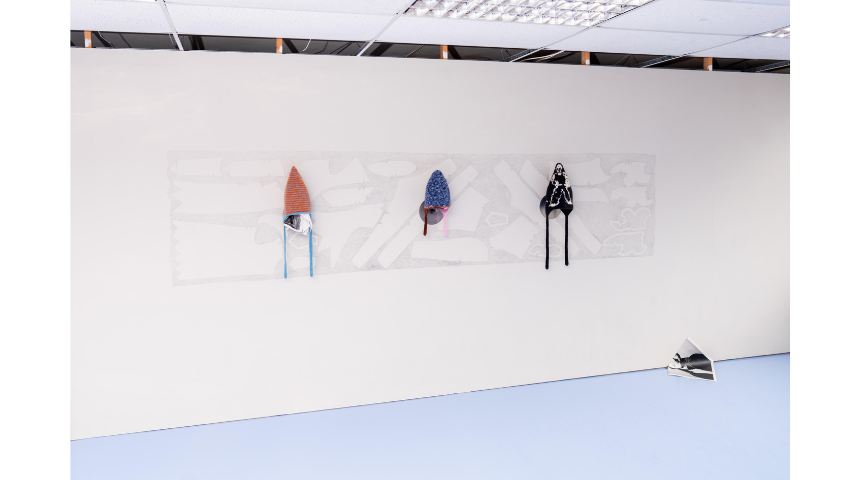
Caz Egelie My Hat and My Other Hat (2026) Mixed Media Installation. Photo Credit: James Measom (2026)
Internationality is a really important method for me because it represents a lot of the stuff that I couldn’t find in Manchester – paid or research led opportunities. Internationally, there’s a strong curatorial research focus and I just couldn’t find that in Manchester and that’s one of the reasons why I built PINK. But there’s one thing building somewhere, and another thing needing to find inspiration that nurtures and feeds into that. I get a lot of enrichment from international work. I’ve always worked towards this idea where I can bring international work to me rather than having to constantly travel away, don’t get me wrong, it’s lovely! In this post-Brexit, post-Covid world movement has been minimised, and I think now more than ever it’s really important to learn from different cultures.
The international activity we’ve had so far, we’ve had an Irish artist Elaine Grainger in collaboration with Moa Gustafsson Söndergaard who’s Swedish, we have the Norwegians coming on Friday and Caz is from the Netherlands, so we’ve had this very central European focus so far. But that’s mostly due to proximity of networks and funding, a huge dream would be to work with people from further afield, to work with the global majority, that would be wonderful but it’s all very funding based. I just wanted to work with Caz again, it had to happen, it was always going to happen, it was just a case of when we could afford it.
Caz Egelie: Ever since I worked with Katy and PINK on the Grey Area show, that was the moment for me where I really saw Katy’s curatorial perspective. You can tell that, for her, the basis of making an exhibition or project is trust, trusting the artist and trusting their practice. Seeing Kevin Hunt being able to realise the project that he really wanted to make. Seeing Katy stepping back and being like, I trust you making this and I’ll do everything you need to make this a good show.
I think that’s a really refreshing curatorial practice in which you just start off with having the trust instead of having to prove yourself to a curator during the process. I feel like when you start off with this trust, I feel as an artist I can make any kind of work, the most ambitious work I want to make. That stimulated me to think, what do I want to make at this moment of my practice? Instead of constantly having to think about the expectations of the institute or the curator.
SR: How did the project develop over this two-part residency?
CE: For the first part of the residency, it was really focused on getting to know Stockport and Greater Manchester. Getting to know the different museums and art galleries here which are dealing with Stockport’s hatting legacy or collections that relate to this history as well.
We got a tour of the collections at Stockport’s Hat Works Museum with one of the curators, where we were shown lots of documents and newspaper clippings from Stockport’s history. The same goes for Stockroom, they have a huge document archive full of newspapers, photos and books.
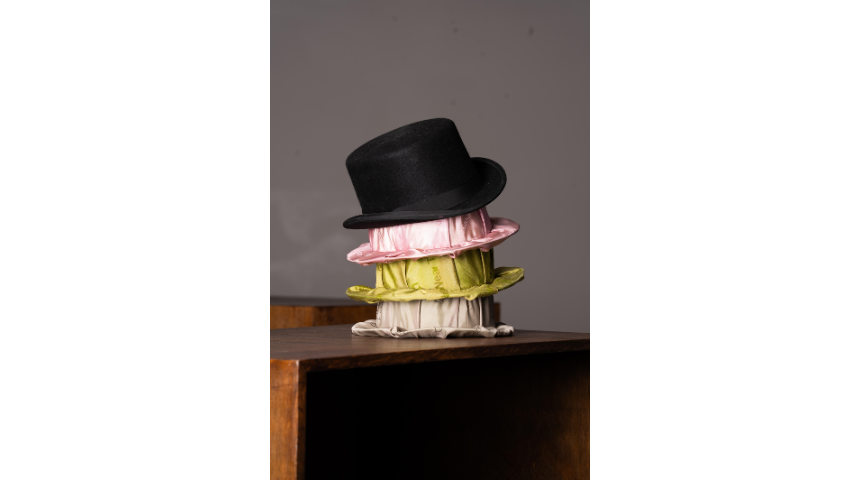
Caz Egelie My Hat and My Other Hat (2026) Mixed Media Installation. Photo Credit: James Measom (2026)
So that was more Stockport focused, but also going around town and finding things connected to what Katy mentioned about Manchester as a textiles hub. Exploring how those industries changed over time and now seeing the problematic aspects of this history.
Getting to know that whole context before the second half of the residency, which was when I actually began to produce work. It’s very important for me to understand the context which I am embedding in, before I start to produce work. You want to avoid repeating the same narrative over and over, you want to get a broader perspective before you get into making the actual work.
KM: My PhD has been trying to grapple with the philosophy of the artist residency for years, I use that term “residency” quite tactically. It’s the artist in residence, who resides for a period of time.
But I’m really interested in this curatorial activity, or curatorial thinking with artists. Not thinking for artists, thinking for artists completely puts me off, I never want to work in that way. But thinking with artists, where I basically go “here’s a load of money, do what you want”.
That not yet knowing, is not very palatable to the arts system that the UK works in. A “residency” is usually a dedicated desk, or studio space in a little village, but I use it as a term to pass my practice through the system. Systems that would usually question what do you mean you don’t know what this exhibition will look like? Or what do you mean you don’t have a proposal with an output, or measurable data?
That structure is embedded within PINK’s institutional critique.
I think what I’ve always struggled with in institutional systems is the expectation that you already know the outcome before you’ve begun. In a lot of funding structures, you have to write a proposal where everything is already decided: what the exhibition will look like, what the audience numbers will be, what the outputs will be. But for me that removes the point of working with an artist in the first place.
If I already know exactly what the exhibition will be, then I don’t need an artist, I just need someone to execute the plan. What interests me about working with artists is precisely the opposite of that. It’s about entering a process where neither of us fully knows what the result will be. That uncertainty is actually where the interesting work happens.
Of course, that’s very difficult to translate into the language of funding applications or institutional reporting. They want measurable outcomes; they want to know what the deliverables are. But the reality of artistic practice is that the most meaningful things often emerge from time spent researching, experimenting, or simply being present in a place.
That’s why the residency format is so important to me. It creates a framework where artists are allowed to spend time thinking, observing and responding before producing something. The final installation then becomes the result of that process rather than something that was predetermined from the beginning.
For me the term “exhibition” is very loaded. In the copy for the show I’ve tried to use the word “installation” instead because “exhibition” is very coded. If you say it’s an exhibition, people enter into that space going “Is this a good exhibition?” because it hasn’t given me a painting on the wall. I try and call it an installation because it’s a world building exercise. It’s the language you choose, for me the word residency opens up possibility, it means come and think. Whereas exhibition means, come and produce in a rigid way which has a set outcome. Everything we do is very critical, it questions the systems of institutional art.
SR: Where does the title My Hat and My Other Hat come from?
CE: When I was going through newspaper articles in Stockroom that were related to hat-making, one of the articles that I found was written by someone, I still don’t know if it was a fictional article or a description of his day, where he was talking about always owning two hats, his hat and his other hat.
As soon as his friends would tell him that his current hat was out of style, or ruined, or tarnished, they would force him to buy another hat from this specific shop. It’s a sort of an advert for this shop, this hat-making company, although in the article he is very adamant that it is not an advertisement!
He kind of talks about when he buys the new hat, he becomes his other hat. There’s the hat that he wears around the house, or the hat that he wears shopping. His other hat is then thrown in the bin.
This title is quite a funny title, I like plain, descriptive titles, and it kind of sounds like a punchline to a joke! It’s a bit absurd, but it was important for the title to make clear that this is a show about hats and about hat history. The title was also influenced by the show’s ideas about identity and taking on a different identity through costume, in this case through hats.
KM: I remember we were walking down the Underbanks when you told me. And it clicked, it’s like the saying “wearing many different hats”.
Titling for me is very important, again, I’m not in control of the show. Unless a title was offensive or could be misinterpreted or misunderstood –especially with international work it could be a language slip – that’s the only time where I would intervene. But ultimately, I would never ever tell someone their title is wrong or tell them to change it.
SR: Stockport’s hatting heritage is a central theme within the installation. Would you describe this work as site specific?
CE: I think the process felt very site-specific, the making of the project felt specific. But I don’t think this installation could only be shown in this space.
The way I like to work in general, is where you get inspiration from information from a specific space or moment in time and I like to translate it into something else completely.
Caz Egelie My Hat and My Other Hat (2026) Mixed Media Installation. Photo Credit: James Measom (2026)
Of course, people from Stockport who have engaged with this history before or have been to the Hat Works Museum or to a hat factory, will have a different understanding of the show than someone who doesn’t have any prior knowledge. But then I try to work in a way that still makes it accessible for people who don’t have that experience.
KM: All of the projects I try and do are really multi-faceted and multi-layered, they create multiple entry and exit points, conceptually and sometimes physically. Someone could come and initially go “I’m going to see a show about Stockport’s hat-making history”: that’s the departure point. But whilst you’re in there it leads to bigger questions and coded queer identity. You might not have a critical contemporary research background, but you can come and play and try on the hats.
SR: Can you talk about your approach to building this world and what it was like to realise such an ambitious vision with PINK’s support?
KM: I feel like we should firstly thank Johnny [Billinge] and Robin [Broadley] [who provided technical construction] because none of the build would have been possible without their help. PINK’s curatorial method is one that I’ve rehearsed over and over again, making it better and learning from it each time. One thing that has really stuck has been working really closely with Johnny, he runs Sawn [a Tameside based workshop for joinery, exhibitions and fabrication] and has a lot of help from Robin. And together, they just say yes to all of our crazy ideas! You just need to come up with whatever you want to build and Johnny will say if it’s possible. Johnny almost becomes an artistic collaborator in that sense, it’s very unique to have a tech team who are there not only to install but also to collaborate creatively. Johnny hand built those stools, he hand-whittled them.
Your use of the word support is lovely, because my job over the years has been to create a team of people that I trust to deliver an artist’s vision. In terms of transforming the place, that for me is really good, it’s curatorially ambitious. This is not to say that a white-walled gallery is wrong, but I just find it very sedate and I like things that are performative – not just performance based – but things that invite this sense of curiosity. Painting the floor, granted it was hard work, but it was important because it means that Caz’s ideas were realised in full, there’s no limitations. Everything is possible until it isn’t!
I like things that can be reused too, so the bar structure is going to be a living archival structure downstairs in our bar. We’ve spent money on it so we may as well make it fucking work for us! Conceptually it’s very important to give the work the environment that it wants, because ultimately the environment is the work, and it’s how the work will be read.
Caz Egelie My Hat and My Other Hat (2026) Mixed Media Installation. Photo Credit: James Measom (2026)
SR: Visitors are invited to wear hats and even make their own through knitting and felting instructions in the catalogue. How important was this participatory element?
CE: I think that this happened in the first weeks of the research, I’d carry around the first hat that I made to show it to everyone. And everyone would put it on and start behaving like a goblin, they’d go crazy for this hat! It became inevitable that it became part of the show. The more fragile ones can’t be tried on but there is a hat rack full of hats which you can wear whilst you visit the show.
KM: You don’t get to play like that anymore! When we wear hats its usually for a special occasion, it’s a change of identity, a change of status even.
CE: In sharing the knitting pattern that I’ve developed, I would love for someone to go home and make it themselves. If I was to sell the hats that took me hours and hours to make they would be incredibly expensive for someone to buy as an art piece or a sculpture. I would love to see someone wearing one of the hats out. I’m not the owner of this hat, I want to share the pattern with others.
SR: The installation also functions as a performance and social environment. How did live activations extend the work?
KM: For me, with performers it was phenomenal and there was always going to be a performative element, because that’s just Caz’s artistic method. It’s kind of like people are your material. Everything you’ve ever done has some human or performative element. We did record the footage of the performers, so we will have film footage in there of the performers, to show how the space has been activated.
CE: The performance is something I think of as a proposal, it’s how I would see people inhabiting or living in this space. Sometimes that’s more pointed so I write music for them to perform, or I want them to behave in a very specific way. For this performance, it was that they had a series of tasks that they could improvise off.
SR: What was specific about the bass flute quality that you were drawn to?
CE: We were looking for an instrument that could play airy sounds of steaming, like the steam machines used in the production of the hats. So I asked some of my friends who are composers for advice, and they suggested that the bass or contrabass flute would be the best.
SR: During your time in Stockport, did you notice any cultural or social nuances about the town? Would you like to come back?
CE: Something I’ve really seen here and something we’ve talked about is that there’s such an attitude here of people willing to invest all their time and all the energy they have into making things happen. There’s such a scarcity of funding that people need to have jobs to support their art practice. But I just feel like people here are so dedicated to making things happen and making things work for themselves.
KM: I agree [about] the Northern working-class grit, where you just get stuff done. You have no other option to do it and do it yourself. On the handout we had twenty-three collaborators in some form on this project. It takes a village to raise a child and it takes twenty-three people to make a project happen.
CE: I’m the child!! Meeting everyone here, slowly being introduced and cracking into the surface of what Stockport is, to answer your question I would love to be back. It feels like such a warm community of people and artists.
Caz Egelie My Hat and My Other Hat (2026) Mixed Media Installation. Photo Credit: James Measom (2026)