
INTERVIEW Jun 2026 esea contemporary Director Xiaowen Zhu
Nicole Slyu
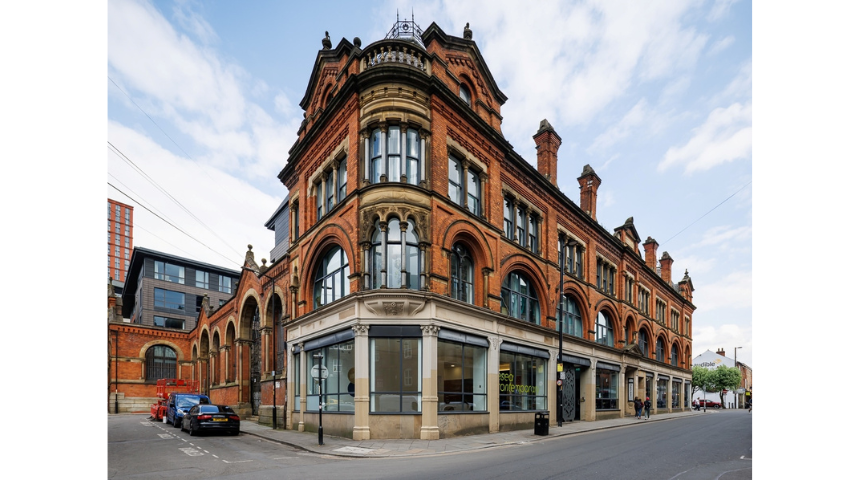
esea contemporary, 13 Thomas Street, Manchester. Photography by Joe Smith.
esea contemporary began life in 1986 as the Chinese View ’86 arts festival, organised by Manchester-based Hong Kong-born artist Amy Lai. Originally a grassroots festival generated from the energy of Manchester's Chinese community, the institution was reborn in 2023 as esea contemporary, a name that reflects the organisation’s desire to represent artists of the wider East and Southeast Asian (ESEA) community in Manchester and across the UK.
Since 2003, the institution has been housed in a wing of the historic Smithfield Market in Manchester’s Northern Quarter, one of the most culturally visible postcodes in the North of England. The renovation of the Grade II listed building was designed by OMI Architects and awarded the RIBA prize for architecture in 2004.
Over the course of 40 years, esea contemporary (and its various iterations) has launched the career of numerous ESEA artists, and has co-commissioned international exhibitions with partners spanning the globe, becoming a unique institution both in the UK and Europe in terms of its scope and focus.
Nicole Slyu sits down with esea contemporary’s Director, Xiaowen Zhu, to discuss the organisation’s role in the global contemporary art ecosystem, and why esea contemporary is the destination for contemporary ESEA art.
Nicole Slyu: Turning 40 is a watershed moment when an institution gets to define its own terms, reflecting on its past achievements and the transformation it has undergone. What does this milestone mean to you in terms of how esea contemporary wants to be seen – not just within the ESEA community, but within the broader landscape of contemporary art in the UK?
Xiaowen Zhu: Turning 40 feels less like arriving at certainty and more like standing at a threshold. esea contemporary has never been a fixed thing. It has shape-shifted constantly through different moments, generations, migrations and aspirations. What began as a grassroots response to cultural invisibility has become something far more fluid: a space where contemporary art can hold contradiction, intimacy, estrangement and solidarity all at once.
I think this milestone allows us to reframe how we are seen. Not as a ‘minority institution’ orbiting the edges of contemporary art in the UK and Europe, but as a site actively reshaping its language and imagination. Some of the most urgent conversations in contemporary art right now revolve around diaspora, multiplicity, fractured identities, technological anxieties, decolonial futures, ecological realities and the unstable feeling of living between worlds. These are not peripheral conversations for us, they are embedded within our foundations.
What excites me most is that esea contemporary increasingly refuses neat categorisation. We are not interested in becoming a museum of fixed cultural identity. We are interested in movement, contamination, emotional residue, unfinished histories. A place where artists can speculate, rupture inherited narratives and create new emotional and political vocabularies for living together.
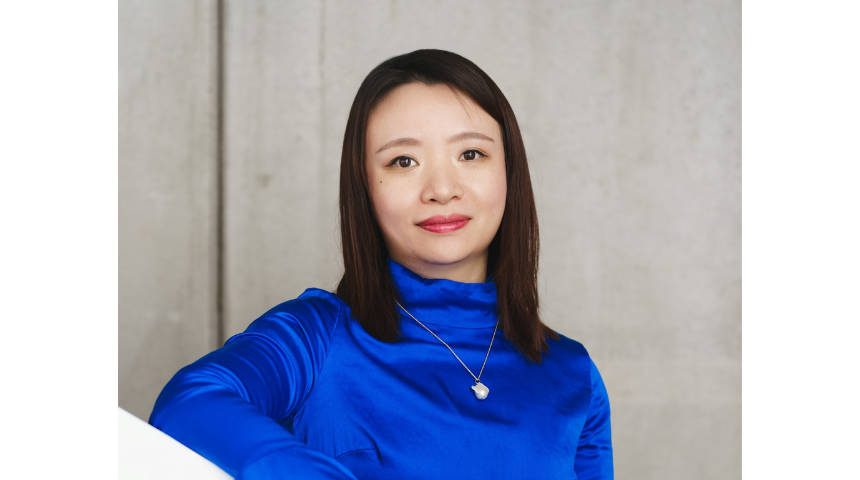
Xiaowen Zhu. Photography by Haishu Chen. Courtesy of Xiaowen Zhu.
NS: Over the years, how would you say Manchester itself has transformed as an audience for the institution, and do you believe it has fully understood the significance of what it has on its doorstep?
XZ: Manchester has changed enormously, but perhaps what has changed most is its appetite for complexity. There is a greater willingness now to sit with work that doesn’t immediately resolve itself, work that asks audiences to inhabit ambiguity rather than consume certainty.
Manchester has always been a city haunted by movement: industrial expansion, migration, music, protest, reinvention. There is a rawness to the city that makes it fertile ground for artistic experimentation. I think audiences here increasingly recognise that esea contemporary is not simply ‘about’ East and Southeast Asia, but about the unstable conditions of contemporary life itself.
I felt this very strongly during the finissage programme for our 40th anniversary exhibition, ‘Thresholds of Becoming’, when we hosted Yin Aiwen’s live role-playing work ‘Liquid Dependencies: What does a decentralised, caring society look like?’. Over five and a half hours, a group of complete strangers from Manchester, London and Birmingham collectively inhabited a speculative society built around mutual care and interdependence. What moved me was the intensity and intentionality of connection that emerged through it. By the end, nobody wanted to leave our Communal Project Space.
Only afterwards did people begin revealing who they ‘really’ were outside the fiction. The pharmacist in the game turned out to be a rapper who had attended almost every exhibition we’d staged and became fascinated by the work because he wanted to understand how systems of care might actually function. Another participant, a creative producer who had recently returned to the UK after living in Australia for a decade, spoke about the shock of returning to a country that felt increasingly fragmented and her desire to imagine more meaningful collective futures. An artist and workshop facilitator reflected on the disappearance of third spaces and how the experience had briefly restored his belief in the possibility of communal life. A carer playing a journalist was deeply affected by how instinctively others understood the emotional and political stakes of care work.
For me, that experience captured something essential about Manchester audiences today. There is a hunger for forms of participation that rupture existing social bubbles and allow collective imagining to become real. People want spaces where they can rehearse different ways of being together, however temporary or fragile those moments may be.
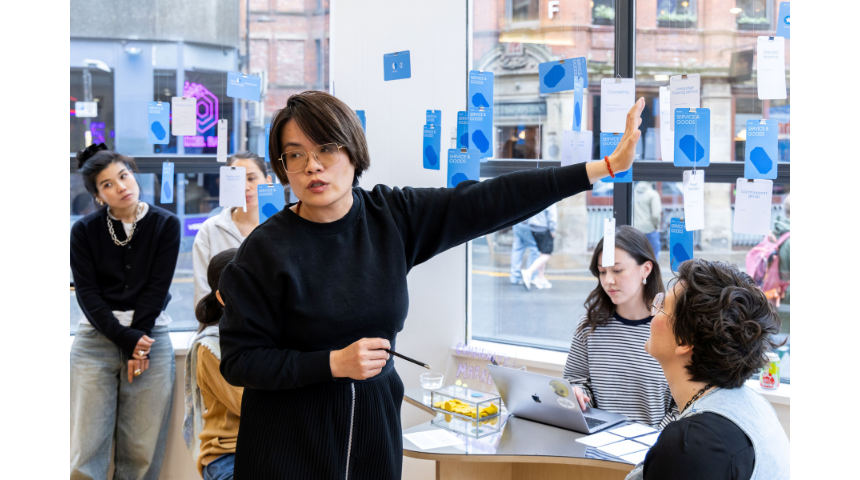
Liquid Dependencies: what does a decentralised caring society look like?, Yin Aiwen (2021–ongoing). Developed with Zoe Zhao and Yiren Zhao; UK iteration assisted by Lauren Rees and Yee Ting Lau. Live role playing game, 16 May 2026, esea contemporary, Manchester. Pictured: Yin Aiwen (centre). Photography by Jules Lister. Courtesy of esea contemporary.
NS: The 40 Years, 40 Voices project, currently unfolding on your Instagram, is gathering testimonies that reflect on esea contemporary’s role for artists and creatives that have been engaged with the institution throughout its history, and will help shape the organisation's self-understanding at this milestone. What memories do you think will resurface, and how do you hope this will reshape the way the organisation and its audiences view esea contemporary after the conclusion of the project?
XZ: I imagine the project will surface memories that feel almost magical. Stories half-remembered, encounters that quietly altered someone’s trajectory without anyone fully realising it at the time. First exhibitions. Long conversations after openings. Temporary communities formed around shared urgency, experimentation or survival.
What interests me is not nostalgia so much as accumulation. The way institutions gather emotional sediment over decades: invisible histories of care, improvisation, exhaustion, risk and belief.
Looking back through the organisation’s history, it becomes striking how many artists had formative moments here before the wider art world fully caught up with them. Xu Bing and Cao Fei both had their first UK institutional solo exhibitions with the organisation in its earlier forms as the Chinese Arts Centre and later CFCCA. aaajiao also had his first UK solo exhibition with us and is now one of our trustees, which feels beautifully cyclical. Artists such as Yuen Fong Ling and Gayle Chong Kwan emerged alongside the organisation at a time when there were very few spaces in the UK for British Chinese artistic voices. Back then, the organisation was far more grassroots and artist-led, with a certain scrappiness and immediacy people still speak about very affectionately.
The project also reminds me how deeply artists, curators and cultural workers shaped the organisation collectively. Figures like Ying Tan and Ying Kwok both held early institutional roles here before becoming important voices within international contemporary art.
More recently, artists like Pio Abad, now one of our trustees and chair of our Artistic Development Committee, or Sinta Tantra, whose practice we hope to continue collaborating with, reflect the increasingly expansive communities orbiting the organisation. Younger artists connected to esea contemporary such as Isaac Chong Wai, Charmaine Poh and Xin Liu have gone on to major biennials, museum collections and international recognition.
What becomes visible through all these stories is that esea contemporary has never simply been a venue or programme. It has functioned more like an evolving ecosystem: a place where artists, curators, writers and audiences encounter one another at crucial moments before dispersing back out into the world.
I hope the project reshapes how audiences understand the organisation, not as a static institution but as something living and relational. Ideally, what remains after ‘40 Years, 40 Voices’ is not a polished anniversary portrait, but something more polyphonic and alive: a chorus rather than a monument.
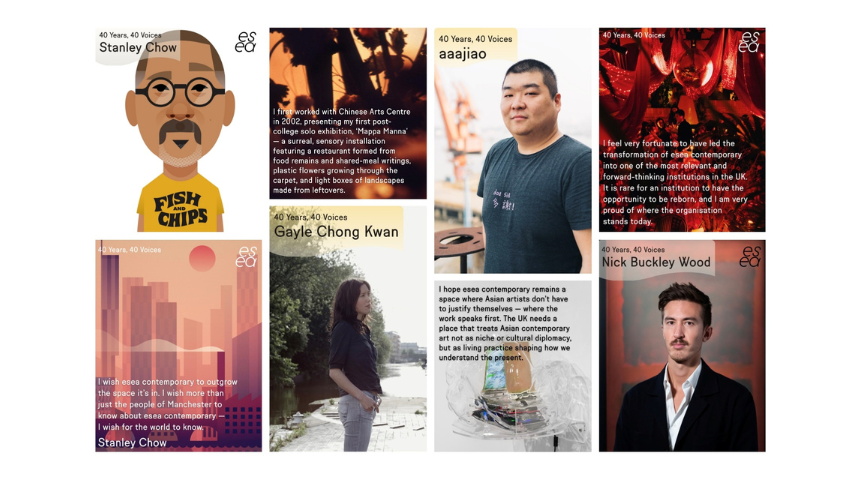
40 Years, 40 Voices project graphic, esea contemporary (2026–ongoing). Featuring Stanley Chow, Gayle Chong Kwan, aaajiao, and Nick Buckley Wood.
NS: As the ESEA diaspora in the UK encompasses communities with vastly different migration histories, languages, relationships to the UK, and relationships to each other, how does esea contemporary’s programming reflect this diversity without defaulting to the kind of pan-Asian generalisation that flattens exactly the specificity you are trying to celebrate?
XZ: The term ‘ESEA’ is useful precisely because it is unstable. It contains enormous internal differences, tensions and incompatibilities. We never approach programming as though we are attempting to represent a singular community or cultural essence because no such thing exists.
What interests us instead are the frictions between histories, geographies and subjectivities. One artist might approach transformation through speculative ecosystems, technological entropy and ecological futures, while another moves through queer embodiment, ritual and intertidal forms of care shaped by diasporic urban life. Other practices explore protest, vulnerability and collective memory through participatory encounters and performance.
These practices should not collapse into a flattening pan-Asian aesthetic simply because institutions desire coherence. I think this is also why artists and collectives like Slavs and Tatars have been so important within our programme ecology. Their practice moves across languages, belief systems, geographies and political humour in ways that resist fixed identity categories altogether. They remind us that cultural complexity is not something to smooth over but something productive to remain inside.
What matters to us is precisely difference: the tensions, overlaps and unexpected resonances that emerge when radically distinct artistic vocabularies are allowed to coexist without being forced into sameness.
I think audiences are increasingly hungry for specificity anyway. The most compelling contemporary art emerges from deeply situated experiences while somehow remaining emotionally porous. The more situated a work becomes, the more unexpectedly expansive it can feel.
For us, diversity is not a branding exercise. It is about allowing incompatible realities to coexist without forcing resolution.
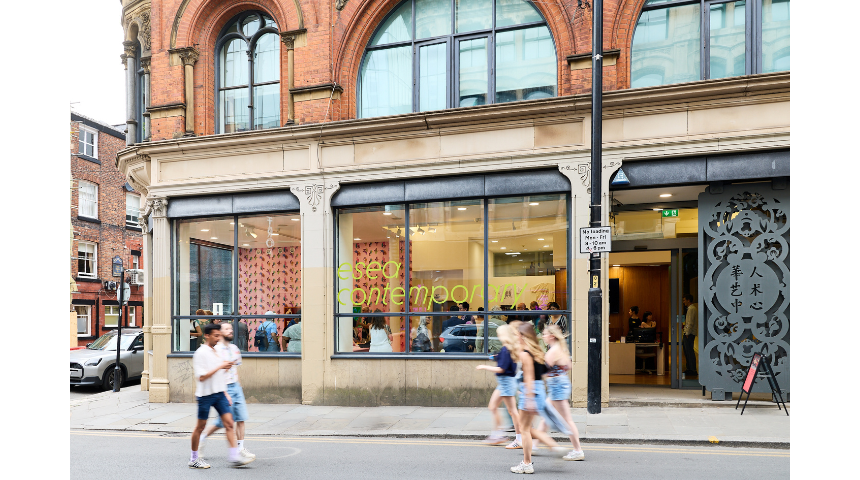
esea contemporary, 13 Thomas Street, Manchester, during Slavs and Tatars: The Contest of the Fruits, 14 June–14 September 2025. Photography by David Lindsay. Courtesy of esea contemporary.
NS: esea contemporary has just been awarded a grant by the Creative Foundations Fund, to help renovate essential services within its Grade II listed building, an intrinsic aspect of the organisation’s identity and physical presence in the city. Thinking about the future and imagining the organisation’s 50th anniversary in 2036, what would be the single thing esea contemporary needs to do in the next decade that it has never done before, that would make the anniversary feel like a genuine celebration rather than an act of endurance?
XZ: If the 50th anniversary is to feel alive, esea contemporary needs to become not only a site for exhibition-making but a lasting ecology for artistic life.
The art world is very good at producing moments and very bad at sustaining people. Too many artists survive through exhaustion, precarity and endless self-translation. I think the next decade is about asking how institutions can operate differently: slower, more reciprocal, more porous.
I would love esea contemporary to become a place where artists do not simply pass through but return to repeatedly across different stages of their lives. A place for long-duration thinking, difficult experimentation, collective dreaming. Less production line, more compost heap. Somewhere ideas can grow, mutate and regenerate over time.
The building itself carries a strange emotional weight. Sitting in Manchester’s Northern Quarter, it holds decades of accumulated ghosts, stories, transformations and possibilities. Upgrading this listed building is not simply an act of preservation, but of preparing a vessel for futures we cannot fully imagine yet.
NS: esea contemporary has been the launchpad for the careers of many contemporary artists who showed early or pivotal work at this institution; figures like Dinu Li, Jane Jin Kaisen, Steph Huang have gone on to significant international careers. Is there a particular artist whose trajectory you think best illustrates what esea contemporary can do for an emerging practice, and have the increased competition and changing priorities within the art-world impacted the way esea contemporary considers formatting the presentations of artists for whom it hopes to be a career launchpad?
XZ: What esea contemporary often offers artists is permission. Permission to become stranger, more ambitious, less easily legible.
Artists like Chris Zhongtian Yuan, Marcos Kueh or Steph Huang all embody very different trajectories, but what connects them is a refusal to simplify themselves for institutional readability. Their practices move through migration, materiality, memory and intimacy without reducing those things into digestible identity narratives.
I often think about Jane Jin Kaisen in this regard as well. Her exhibition Halmang [2024] with us was deeply rooted in highly specific histories of displacement, memory, ritual and Korean diasporic experience, yet it became one of the most emotionally resonant exhibitions we’ve presented and was shortlisted for Manchester’s best exhibition that year. It proved that audiences are far more open to complexity and specificity than institutions sometimes assume.
I think esea contemporary has historically been important because it allowed artists to exist before the market or larger institutions knew how to frame them. There is something powerful about encountering artists at that volatile stage where a practice is still mutating in public.
Sometimes what an institution can offer is simply the space for uncertainty before a practice hardens into definition. That uncertainty is often where new artistic languages emerge.
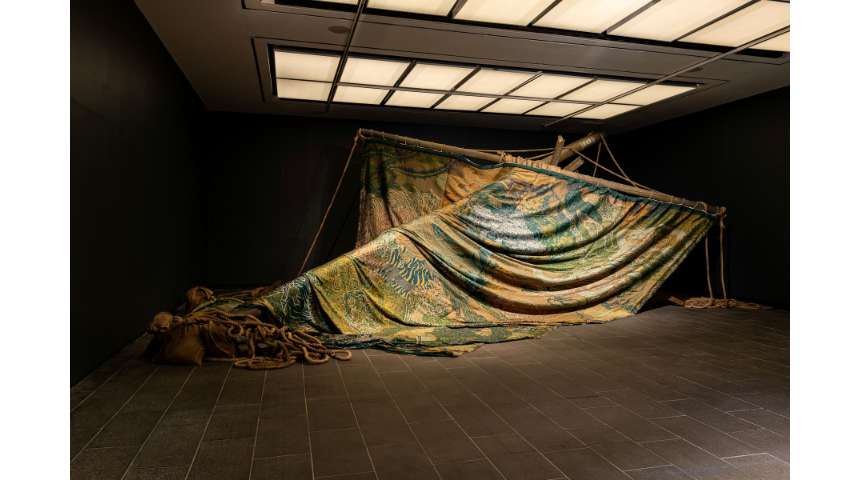
Marcos Kueh, 'Abandonment' (2025) industrial weaving with recycled polyethylene terephthalate threads, wood, rope, sandbags, dimensions variable. Co-commissioned by esea contemporary, Manchester Metropolitan University, and the Centre for Heritage, Arts and Textile (CHAT), Hong Kong SAR. Photography by Jules Lister. Courtesy of esea contemporary.
NS: As esea contemporary's reputation and reach grows, so does the number of institutions wanting to work with you. How conscious is esea contemporary of itself as a node in a global network, and how do you decide which collaborations are genuinely right for the organisation, and which ones (however well-resourced or prestigious) wouldn’t serve what esea is trying to do? And what would an ideal partnership make possible that you cannot currently do alone?
XZ: We think a lot about networks, but less in the sense of prestige and more in terms of energy exchange. The most exciting cultural relationships today are not hierarchical. They operate more like constellations: different organisations, artists and communities briefly aligning around shared urgencies before dispersing again.
We are careful about collaboration because scale alone means very little to us. The question is always: does this relationship deepen the work? Does it create new conditions for artists, new forms of encounter, new audiences, new imaginaries?
The ideal partnership expands possibility rather than visibility alone. It allows for experimentation, exchange and genuine reciprocity. It should produce something neither institution could have imagined independently.
I think audiences can feel when collaborations emerge from curiosity rather than strategy. The energy is completely different.
NS: esea contemporary is now inviting curators to shape the organisation from the inside, and the first voice brought in is Milia Xin Bi, a Glossop-based curator whose practice moves between Manchester, Shanghai, AI, decentralised technology and subculture. What does having an external curatorial voice in the building do for the institution, and what does it do for the curator?
XZ: Inviting external curatorial voices into the organisation introduces a productive instability. Institutions can very easily become self-referential ecosystems. Bringing in someone like Milia Xin Bi interrupts that rhythm.
Her practice moves across AI, decentralised technologies, subculture, online mythologies and diasporic experience in ways that feel deeply contemporary but also emotionally slippery. That friction is important. It expands the imaginative architecture of the institution.
For the curator, I think it creates a rare condition: the ability to experiment inside an organisation without being fully absorbed into institutional sameness. Ideally, it becomes a space of mutual contamination. The organisation changes through the curator’s presence, and the curator’s practice changes through the organisation.
NS: What does the foreseeable future hold for esea contemporary, in terms of programming, projects or any other developments that audiences, collaborators and the broader art world can look forward to?
XZ: We are living through an incredibly complex moment where political, technological, economic and emotional realities are shifting constantly. It makes navigating cultural work more difficult, but also far more necessary. Ten years ago, the contemporary art audience in Manchester would have been much whiter, more homogeneous and more middle class. That landscape has changed profoundly.
What excites me now is the range of people who move through esea contemporary. We have working-class and marginalised community members attending alongside collectors, patrons and academics. We have audiences who may not come from artistic or intellectual backgrounds at all but are deeply curious about what artists are trying to articulate about the world. That porousness matters to me.
Internally, we are also developing as an organisation. We have an exciting capital project ahead and several ambitious programmes currently in development, but equally important is the growth of the people within the institution itself. Our team is small but incredibly diverse: mostly young people from mixed Asian backgrounds, migrant workers like myself, former international students, first-generation university graduates. Not everyone comes from the same educational, economic or national background, and I think that complexity genuinely shapes how the organisation thinks and behaves.
At the same time, there are always well-meaning pressures. I’ve had patrons asking why we don’t show more ‘famous’ artists, while community stakeholders want us to remain more grassroots and locally embedded. We have curators interested in highly experimental digital practices, while other audiences are searching for intimacy, slowness or familiarity. It’s impossible to satisfy every expectation simultaneously.
But I think cultural institutions fail when they stop listening. Increasingly, people feel overwhelmed by external pressure and retreat into closed positions, only focusing on their own perspective or immediate community. For cultural work, that is not enough. The challenge is to remain open without becoming diluted. To hold contradiction without collapsing into fragmentation.
That, for me, is what the future of esea contemporary looks like: not certainty or consensus, but the ongoing negotiation of difference, contradiction and collective possibility.
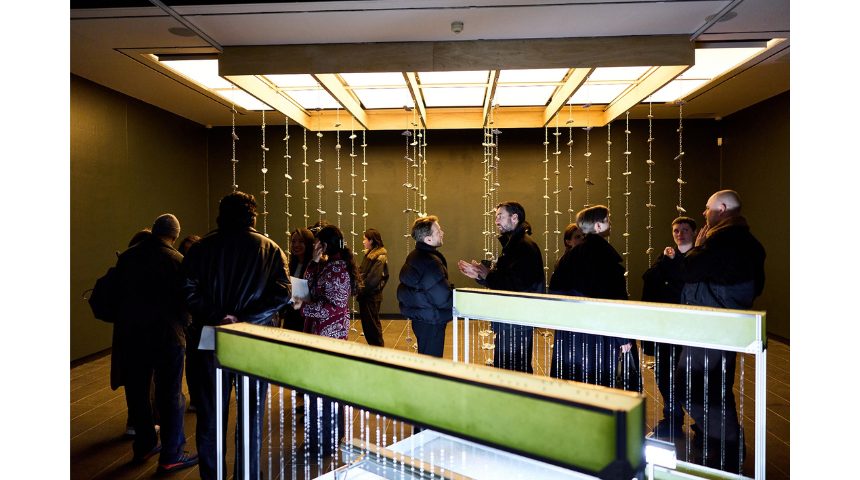
Opening event, Thresholds of Becoming, esea contemporary, Manchester, 20 February 2026. Photography by David Lindsay. Courtesy of esea contemporary.
esea contemporary’s next exhibition, ‘Two Improvisations’, welcomes Wuhan-born and London-based artist Chris Zhongtian Yuan in his first UK institutional solo exhibition, opening on 12th June 2026. ‘Two Improvisations’ will be accompanied by a varied public programmed throughout the summer, including a live performance by Wuhan-based band Hardcore Raver in Tears, led by musician Lu Yan, who features in Yuan’s film as part of exhibition installation on 13th June, at Soup in Stevenson Square. Later this year, Umi Ishihara's solo exhibition ‘Nocturnal Melody’ will tour to esea contemporary from Gasworks in London.