REVIEW Jun 2026 Unspeak the Chorus – Kira Freije at Modern Art Oxford
David Hancock
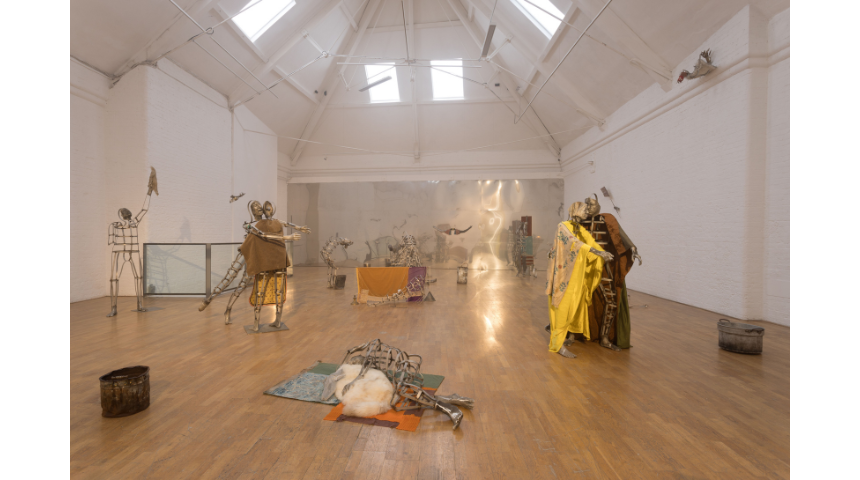
Installation image of Kira Freije: Unspeak the Chorus, Modern Art Oxford, May 2026. Photo: Rob Harris
Modern Art Oxford presents a new body of work by the Turner Prize nominated artist, Kira Freije, co-commissioned by The Hepworth Wakefield. The exhibition, previously shown at The Hepworth, is Freije’s first major solo presentation in the UK. The exhibition comprises around twenty life size sculptural forms scattered across the Upper Gallery of Modern Art. David Hancock visited the exhibition and is moved by his encounter with Freije’s uncanny sculptural forms.
Entering the gallery feels like stepping into a room of shadows where figures quietly emerge and dissolve. Bodies appear mid gesture: a couple greet one another and embrace; one figure leans in to whisper affectionately into another’s ear; elsewhere, a figure offers assistance, pulling someone gently upright. These small acts of care are balanced by moments of grief and exhaustion. One figure wails with hands obscuring the face, while another curls up beside a dog for warmth. It is an intense spectacle in which the viewer seems to encroach.
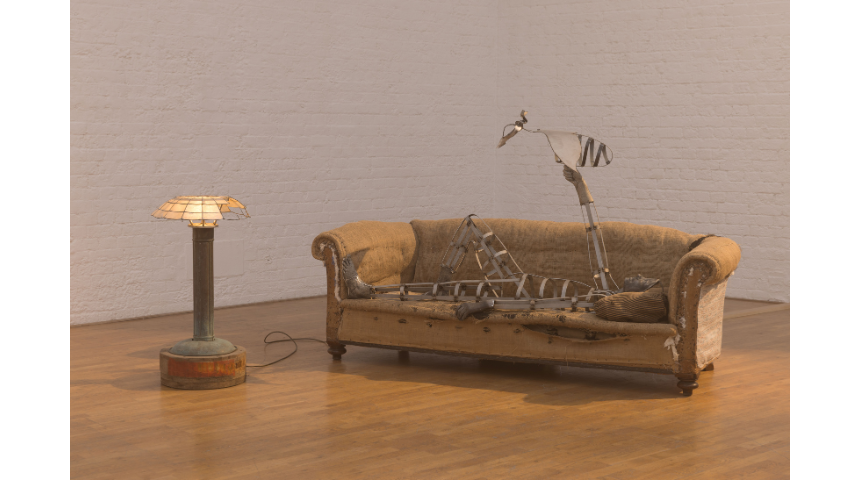
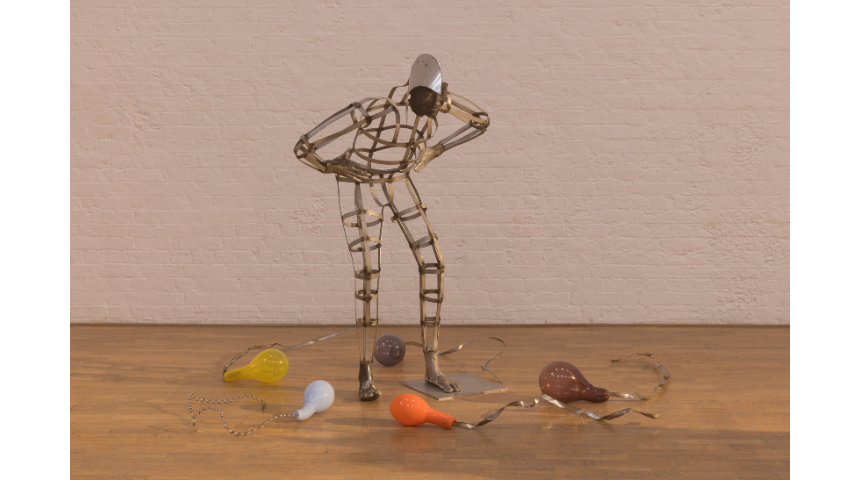
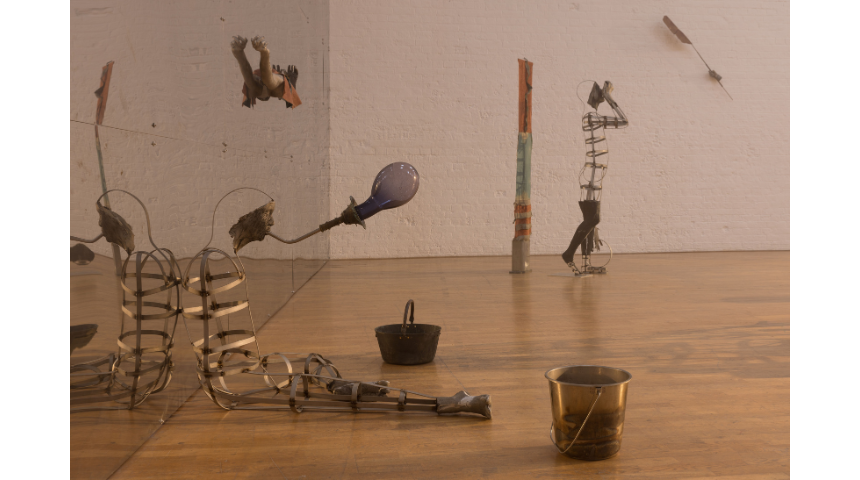
Across the space, fragments of lived experience unfold. Rodents scuttle among scattered buckets in a yard-like setting, filled with clear molten glass that suggests cooling water offering succour. A leashed dog stretches behind a curtain. A man pauses after carrying a filled pail, wiping sweat from his brow beneath a lace cap, while another collapses onto a sackcloth sofa, reaching out towards a bird hovering above. These figures, all constructed in a shorthand of welded steel and cast aluminium, appear from the light and haze, together in the large open gallery. They interact with each other and with the smattering of visitors.
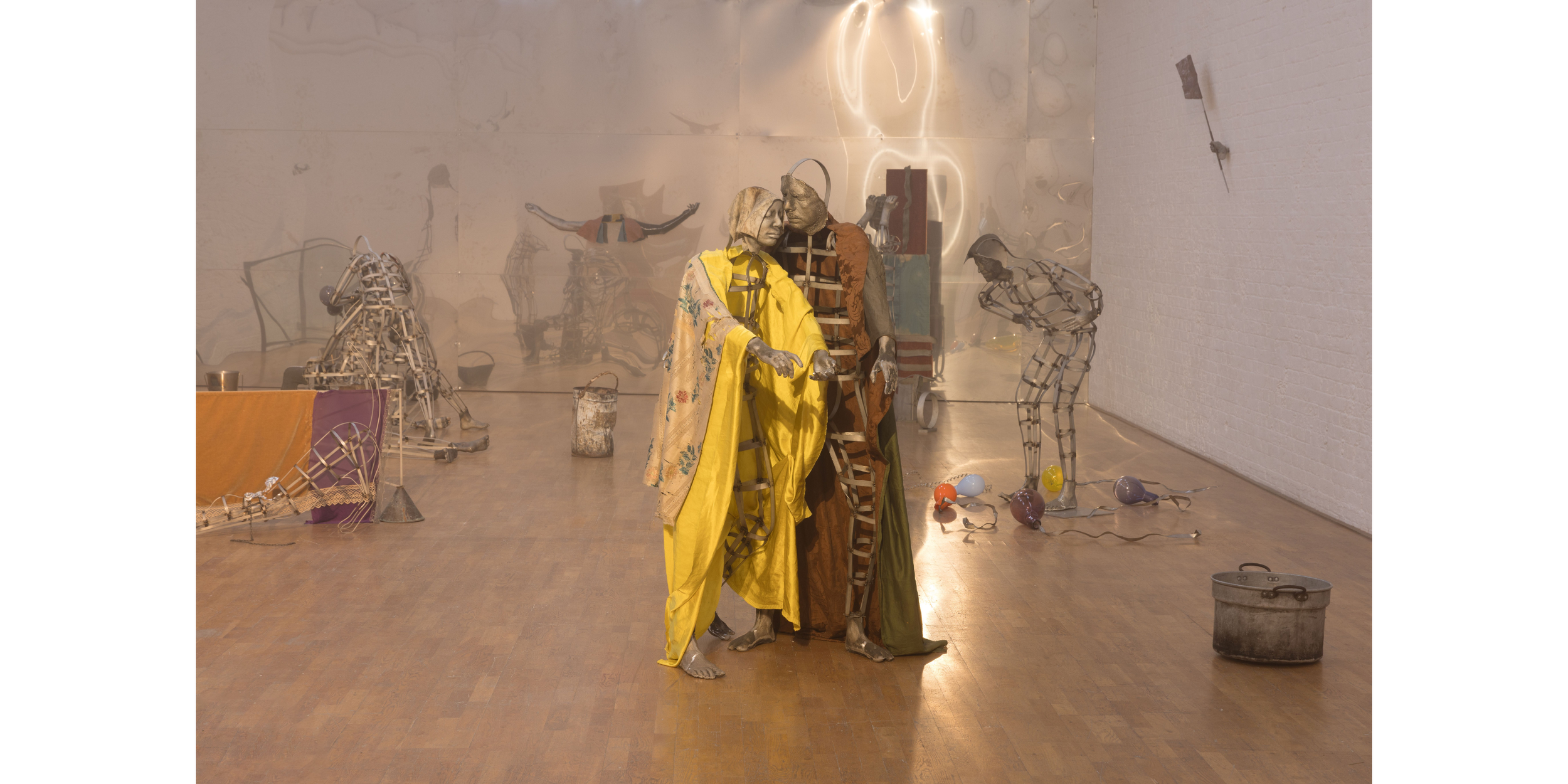
Installation image of Kira Freije: Unspeak the Chorus, Modern Art Oxford, May 2026. Photo: Rob Harris
In A Modest Path (2025), a male figure whispers in the cowled ear of a female figure as he gently leads her forward. Interviewed by Laura Smith, artistic director of the Hepworth, Freije refers to an etching by William Blake, The Soul Hovering over the Body, Reluctantly Parting with Life (1813), situated on her studio wall. Blake’s print offers a possible interpretation of this work as one figure guiding the other into the afterlife. However, Freije is never so specific. She refers to a “kind of interiority that comes into the sculptures”, one that “allows them to never stage one particular scene. It is more to do with the sentiment of the gesture.” Freije leaves interpretation open to the viewer.
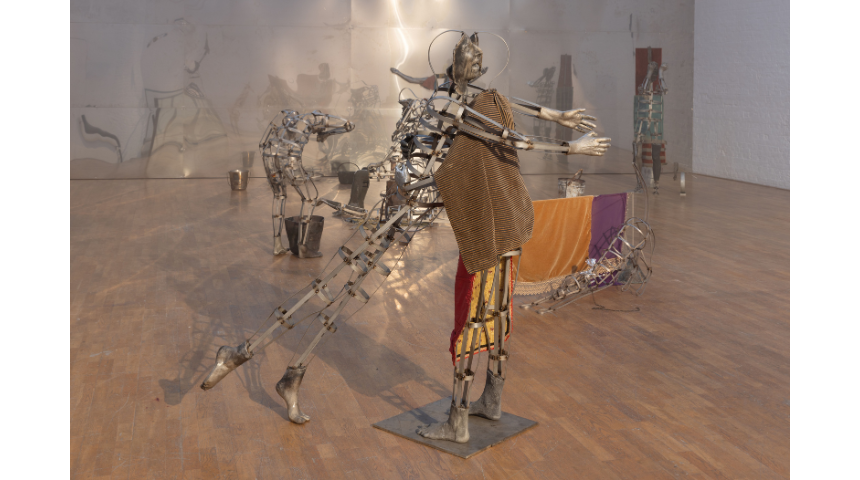
Installation image of Kira Freije: Unspeak the Chorus, Modern Art Oxford, May 2026. Photo: Rob Harris
The entire room is veiled in a light mist, and the moisture in the air lends a fluidity to the installation as we move through the space. Housing all the works in a single gallery is effective, especially as visitors walking amongst the installation are similarly obscured in the fog. They take on a comparable presence to the artworks, becoming interwoven with the sculptures themselves. At times it is difficult to tell sculpture and viewer apart. Light abounds in the space with the mirrored back wall. The skylight windows of the gallery are uncovered letting light flood in and this is accentuated with studio lights, picking out the miasma in the air. Freije worked closely with lighting designer Matt Daw, who responded directly to the distinctive architecture of Modern Art Oxford’s Upper Gallery, and the staged effect brings warmth to the steel sculptures. The space feels hot and humid, creating a potent atmosphere that firmly locates the sculptures beyond the Modern Art and its surrounds.
Installation image of Kira Freije: Unspeak the Chorus, Modern Art Oxford, May 2026. Photo: Rob Harris
Freije’s materials of fabric, steel, blown glass and fur create figures rendered in linear form: hollowed out, partially complete and not fully formed. Worn textiles shape the suggestion of lived bodies, while welded structures support draped fabric that animates creatures with unexpected vitality. Paradoxically, the sparser the figures become, the more lifelike they feel, inviting viewers to complete them imaginatively. An arm cut off abruptly is sufficient; a frame of sheep’s wool suggests bulbous thighs severed at the waist. The torso may be absent, yet it is also somehow present, held in the viewer’s perception as much as in the material itself. Freije states that her sculptures “start with a very fleeting idea and a desire to communicate a feeling of something that can’t be held.” She begins each sculpture from the feet, working upwards. There is a sense of this dynamic running through the sculptures, but also a sense of ascension. In all her works, the eyes of the figures are closed. The practical reason lies partly in the casting process, but it also gives the figures a sense of enrapture, caught in a moment of spiritual illumination.
Freije describes her sculptural figures as a community, with one figure forming an anchor around which the others are developed. Each figure relies upon the next, forming a sense of companionship. The way Freije charges these sculptures with a sense of life is profound. There is a real sense of humanity in this commune of forms. A narrative thread runs across the whole ensemble, but nothing definitive. We are instead presented with brief snapshots of joy and suffering. The figures themselves are created from steel strips, which Freije welds as though drawing lines. The hands and feet are cast from her own body, and the faces are both her own and those close to her. Added to these frames is an assortment of other materials and fabrics.
Installation image of Kira Freije: Unspeak the Chorus, Modern Art Oxford, May 2026. Photo: Rob Harris
What emerges most powerfully from Unspeak the Chorus is a sense of community, one that the viewer is made to feel part of and share in these fleeting intimate moments. Freije’s figures, gathered in states of care, fatigue, devotion, and uncertainty, are suspended somewhere between the everyday and the symbolic. Their closed eyes and incomplete bodies resist resolution, asking the viewer not to decode them but to dwell amongst them. In this mist filled environment, the sculptures feel less like objects to observe than companions to encounter, forming a quiet collective presence that lingers well beyond the gallery itself.
Kira Freije: Unspeak the Chorus runs until 16 August 2026 in Upper Gallery 1 at Modern Art Oxford. A solo exhibition by Olivia Plender: Little Fennel’s Complaint, will also be on view in Upper Galleries 2 and 3.
Installation image of Kira Freije: Unspeak the Chorus, Modern Art Oxford, May 2026. Photo: Rob Harris