INTERVIEW Jul 2026 Brian and George Fell ‘Always Something New’ at The Atkinson
Josephine Manby
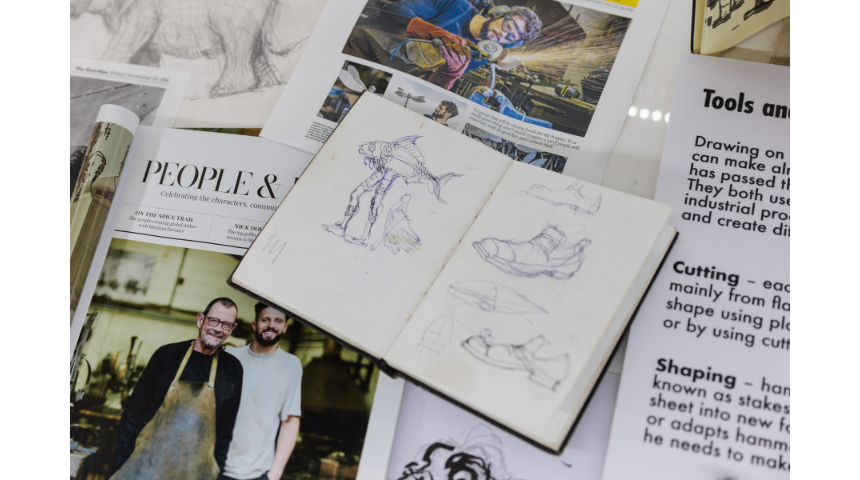
Brian and George Fell Sketchbook The Atkinson 2026 Photo Credit Dave Jones
Renowned public sculptor Brian Fell and his son, sculptor and musician George Fell, who have worked as a team for fifteen years and have a studio at Yorkshire Sculpture Park, present a wide-ranging exhibition, ‘Always Something New’ at The Atkinson in Southport, running until Saturday 17 October 2026. This comprehensive showcase encompasses both two and three-dimensions, with maquettes, full-size wall-mounted and freestanding work along with visual documentation of public commissions and a selection of Brian’s rhythmic, lively collages. The art works are accompanied by an acoustic guitar soundtrack of George’s latest music.
From the floor-to-ceiling impact of their animal-based works in polished and burnished steel, to the solid, industrial presence of Ajax Bow (1986), to the way a collage suite like Fragments Series (2025) bounces and pings with dots and loops like a lively visual conversation or a piece of jazz sheet music, there is something to suit all tastes in this survey show.
https://theatkinson.co.uk/exhibition/brian-george-fell/
Josephine Manby How do you divide your time between artistic creation and business? How much time do you devote to generating opportunities, how much to admin, and how much to pure experimental play?
Brian Fell I don’t think we really consider ourselves to be a business; it’s not how we think.
George Fell It’s more of a hustle, really – I don’t think we could hold our own in a conversation with real business people! But in a way I suppose, everything is a business when you are making a living creatively. In some ways you’re free from that and in some ways there’s no escape. There’s a bit in that question about how much time is devoted to pure play. I don’t feel I’ve had any time for pure play since I was a kid really! Creativity has to have an endgame, otherwise I lose motivation.
BF You’ve got your music though, your guitar playing. Very much pure play.
GF Yes, but again; any direction I’ll go in musically it’s be for the sake of – I’ll have an idea of something that’ll work for this event that’s coming up – so it’s never, oh, that’d be fun, it’s always ‘I think that would work well.’
BF I’ve always considered your music to be the equivalent of my abstract stuff. You’re playing.
GF Music sounds very joyful, sounds like the freedom of the soul, so you assume that it’s created in a kind of exhilarated state, but you achieve that by following certain rules and it’s more confined than it appears. The joy is an illusion that’s created by the execution of it. If it’s delivered well, then it sounds like it’s come from a place of freedom. Musical ability comes from very repetitive practice. There’s a bit of a paradox there.
BF That’s the craft of it though.
GF Craft’s what sets you free, but then to get there – like when I was first working for you [Brian], it took me a few years to feel I could be creative in that field; you have to get past the technique and the confines of what you are doing before you can start having fun. You have to unlock your abilities.
BF Another point to make is that our work is so intermittent. Sometimes we’re snowed under, but our main income comes from commissions. And sometimes they run back-to-back. For the past 15 years we’ve been partners, we’ve made a living out of commissions with gaps in between; a lot is word of mouth. There’s always something coming in.
GF If there is any time for play, it’s in quite particular circumstances. Where you’ve just completed a commission and you have enough money to not worry about looking for another one yet, there’s a few weeks you can have a bit of fun, but that’s quite a rare thing. Especially these days, when the cost of living is raised, you can’t rest on your laurels in the way you used to. I’m constantly looking at the next job. It’s more about, it’s going somewhere and it’s going to be a real, finished thing that people are going to see, that’s just as exciting, even if it’s not something that has come from the deepest areas of my imagination. I’ll work to a brief if I know it’s going to have an impact. And you can persuade yourself to get excited about things if you think about it in the right way.
JM Definitely.
It sounds like you’ve got a really good working relationship and that you’re producing work all the time. So – have you found a balance between hard work and enjoying the work?
GF I think where it can feel like drudgery is when it’s fabrication work that we have to do sometimes to keep things running, like making railings, or a base, that can feel a bit like drudgery. As long as it’s got an artistic element, I’m happy. And it’s a privilege to be an artist. It’s not a torment. If you can make money off making your own stuff then you should be happy with that. Even if you’re not always interested in what you’re making. You’ve got to count your blessings.
JM When you are going about day-to-day business, travelling through land or cityscape, in and out of buildings, places of work, are you always keeping an eye out for visual inspiration?
BF You just catch glimpses of it somehow, you often see something, could be a shadow or a reflection, and you think, that’s interesting-looking. Or a fragment of a building or of a machine. Something you’ve not seen before. A new experience. When I’m at home in the evenings, I have a load of sketchbooks beside me, and I just work with a brush pen and make interpretations, and then use that as a starting point for an abstract sculpture.
JM George, who are your main influences (apart from Brian!)?
GF He’s obviously the biggest one; it would be strange if not. I’ve thought about that recently, wondering about why I’m drawn to certain imagery. Although Brian has been a huge influence on all the stuff I make, I’m not particularly into making abstract art. I think one of the main visual influences on me is playing video games when I was a kid. Certain games on PlayStation 1. Like a fighting game called Tekken 3, [set] in Chinese temples, and all the characters look like alpha-human beings. Some games on PS1 were so beautifully designed. Also, I had as a kid a How to Draw book from Marvel Comics. How to structure a face but it was a Marvel hero. I remember studying that hard and I’ve never really got over it. I do try and create images that are romantic and come from bits of cinema and video games.
In terms of sculptors, I like Jacob Epstein. I love the drama and I love people who can get the emotional narrative into a face like that. In terms of contemporary artists l like Daniel Arsham. I’m really into Studio Ghibli recently, and the depictions of nature. A lot of my work depicts animals and I like having a surrealist undertone to things. So, the depiction of nature and ghosts in Studio Ghibli I find really interesting. And people haven’t tried to go in that direction before in sculpture necessarily, so that’s something I’m trying to do at the moment.
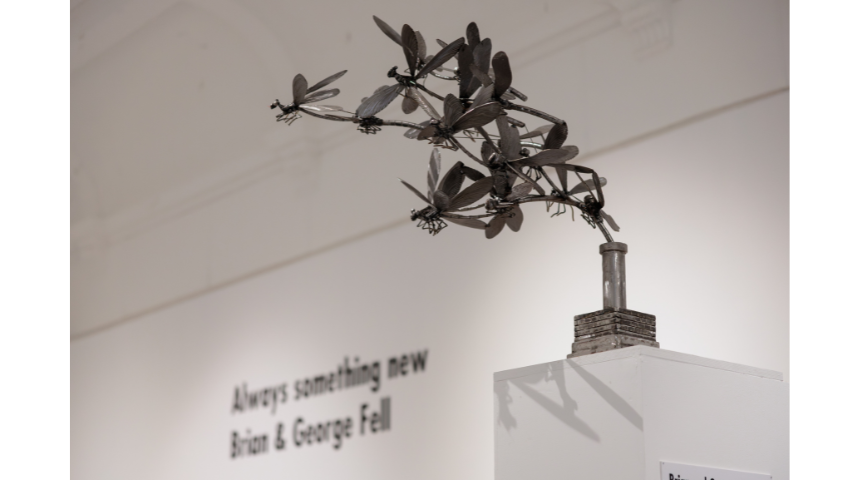
Brian and George Fell Damsels and Dragons (Infinity Pipe) The Atkinson, 2026 Photo credit Dave Jones
JM Like those wall-based sculptures at The Atkinson that are high up?
GF There’s a little girl riding on a bird [Zia and the Egret]. So that’s a Studio Ghibli image, definitely. Also, the dragonflies and damselflies flying out of the pipe [Damsels and Dragons (Infinity Pipe)] they were both things you could imagine as stills from a cartoon. I like the subversion of reality where you can depict something realistically but there is something there that makes it other worldly. I try and find the magic in things to keep myself amused. You kind of want to reflect the things that excite you. I do find nature quite magical and mystical. I want to show that side of it as opposed to the biological side. I’m not a naturalist – not a seriously scientific ornithologist, even though I love birds. I love them for their ethereal qualities.
JM So the damselflies in a cloud – is that working to commission?
GF No, it was drawn from a commission I’m working on now. I’ve got to make 500 dragonflies for a charity appeal for Barnsley Hospice, they’re all going to be installed in the grounds in a big swarm. Which again is very Japanese Studio Ghibli. I had the idea of doing damsels and dragons, I thought it was a snappy title, and, because they said no, we just want dragonflies, so I thought, I’ll have my way in the end, and I did it for the exhibition [at The Atkinson]. I realised dragonflies actually eat damselflies so if you look a bit closer you can see they are actually predating them. It’s a bit darker than it seems at first.
JM Looking at Overlock (2025) and King & Queen (2020) in cut, welded and painted steel, what is the compulsion to include multi-level ledges and plinths? Is it the idea of incorporating the concept of display into the work, or is it more an industrial influence (thinking of pillar drills, freestanding milling machines etc.)?
BF It is about display. I’ve been involved in the sculpture park for nearly fifty years, since its inception. I used to work on the installation of work. That’s all about how you display it, the plinths, the siting of it. Where it should be, how it’s presented – a very important element. So, that is very relevant. The Overlock one, actually, that sculpture, the base is a table. And there’s one on the other side of the room, a three-level table. I have quite a few where tables are sculptures. I’ve always liked the idea of a sculpture having a function. And I’ve also made a few kind of abstract lights as well, table lamps and wall lamps, which similarly, do have a function.
In the sculpture park, there’s a massive Anthony Caro. And it’s cordoned off now. It’s such a shame because when George was a young lad, there’s little places to sit in and places to hide, and George used to spend a lot of time with it, and I love that idea of a sculpture that you could play on.
JM Yes, interact with.
I wondered what drives you to work not with found objects but more to be inspired by found objects (in works such as Ajax Bow) and to make sculpture from scratch? Is this something inherited from School of Art days, something about how you were taught?
BF I’ve always admired Caro’s work, and [David] Smith’s. I tried it, when I was a young artist, but it never felt right to me. I felt I had to own it in some way, make it from scratch.
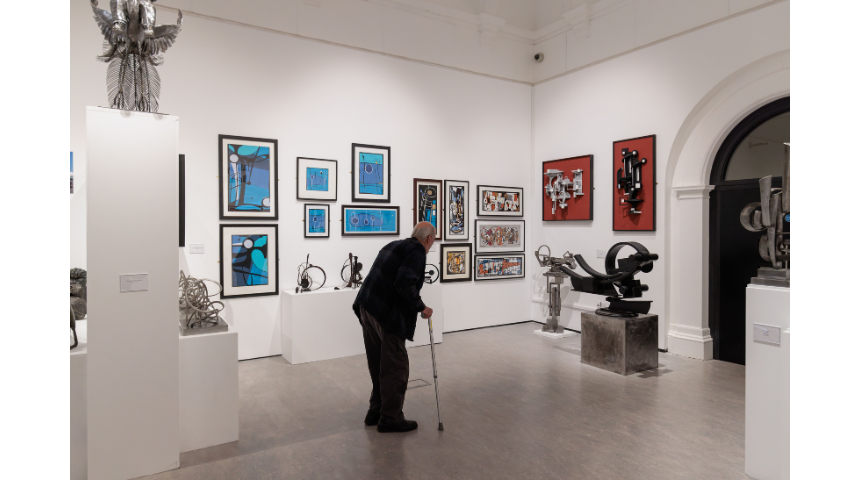
Brian and George Fell, The Atkinson 2026. Photo Dave Jones
JM Can you tell me a bit about Ajax Bow (1982)? I just find it a really interesting form.
BF It’s a very old sculpture, Ajax Bow. I was quite fascinated by trying to capture the idea of movement. I’m still very enamoured by a sculpture by [Raymond] Duchamp-Villon, The Horse [(Le Cheval) (1914)]. Do you know that one? It’s an abstract sculpture – there’s no horse represented at all, it’s… I love that idea of how to capture movement in a sculpture. And that was based on staring at an Ajax bow, a hacksaw, called an Ajax, and it’s that backwards/forwards movement.
JM When I went to see the show, someone said to me, ‘but what is it?’ As if it was half-functional, half-sculpture, as if they were confounded visually by it.
BF I quite like confounding myself in some ways. I like the idea of not knowing where I’m going, really. Especially, it’s like doing a cryptic crossword without the answers.
JM Is the stage you are both at now in your careers anything like the trajectory you imagined for yourself when, say, you were a student?
BF I’ve never really thought of it that way, I just carry on making stuff and finding a way of enabling you to make stuff, that really is all I was ever interested in. The making’s really important, just making stuff. Manipulating materials. That’s all I’m interested in.
JM What about you, George?
GF I try and think the next thing I make will be the most exciting thing I’ve done. That’s the only state I’m really comfortable with. Even if you have just done something brilliant, it’s like if you think you’ve done the last thing perfectly, you can stop then. The whole idea is a sense of dissatisfaction: I could do something more; my best is yet to come. Like the hustle thing. Every time I secure a commission, I can’t believe I’ve got away with it. That I’ve persuaded people to give me money to make this daft idea I’ve got. Every time I have to work I feel delighted, because it’s a privilege to be able to make a living off the ideas in your head.
I didn’t think I’d be a sculptor in the first place, I just fell into it. I thought I’d be a musician but that’s not really enough to sustain a life. I’d always been working for my dad, doing labouring, but it was when I started to realise I could make things myself… I think the problem is you will never have enough time to make all the things you want to make. There’s a massive list in my phone notes – one or two are ticked off, the rest is this huge list. Not having enough time to fulfil all those ideas, is the biggest torment. But that’s not a bad place to be. You should be in a state of excited unrest all the time. That’s the fun of it. It’s about which ones will Fate allow me to complete.
JM Do you install your public art yourselves or do you work with technicians to do this?
BF Knowing how to do that is part of the design procedure. Knowing how to install, which parts are going to bolt onto other parts. But also, you get involved with structural engineers. Some can be really good, some can be dreadful. Sometimes you can get really lazy ones. I’ve just got some who over specify because they can’t be bothered to do all the calculations themselves.
JM That’s really interesting.
GF It creates loads more work for us – it’s like you get some generating their own necessity, really. But then you suffer for it because you’ve got to carry out their wishes.
BF Obviously, for the Southport beach works you’re involving cranes and so on. Procedural installing. I actually love that part. I’m passionate about cranes so if cranes are involved, I am very happy.
JM Do you get a lot of bureaucratic stuff with people going mad about Health & Safety, risk assessments, or is that really key to get right anyway so you go with it?
GF It’s pretty soul-destroying stuff. But there’s always boring parts to life. You can’t get away with stuff. If you’re installing in a public space, it is like putting in any kind of infrastructure. These are the hoops you’ve got to jump through.
BF An installation in Hull, they wanted a method statement of how I was going to do it, and I’m not very good with words, so I did it in pictures. I did them a sort of storyboard like for a film.
JM It will be a precious document in your archive, that.
Did you teach George to weld? Where did you learn to weld, was it at Art College?
BF There was the welder available at art college, but I wasn’t taught to weld. It was autodidactic in some ways, I made such messes of doing things and burning holes, and breaking things up. In those days they just let you loose in the metal workshop and often the technicians weren’t there and they didn’t explain the machines, you just played with the machines [till you got it] – it was ridiculous, you couldn’t do it these days.
JM So did you teach George to weld?
BF Yes, and he’s really good at it. A lot of textural stuff that he does, it’s quite a skill, that.
JM Everything, the finish, the interlocking pieces, is amazing from a welding point of view.
GF It’s probably more labour intensive than you see. Steel’s a cheap material but you can make it look amazing if you put in the labour. It’s much noisier and dirtier as a process. You can make something out of wax that you’re going to get cast in bronze, I’ve seen classes of people doing that and I can’t believe how quiet and calm it is. I associate making art with heavy machinery! There’s something very satisfying about polishing surfaces and adding textures to surfaces, I think that’s wonderful. That’s the part of it where I’m most at peace, where you’re doing these processes that end up being beautiful. Welding’s an underused tool for artists really because it’s both an adhesive and it’s a material in itself. I’m still exploring all the possibilities today.
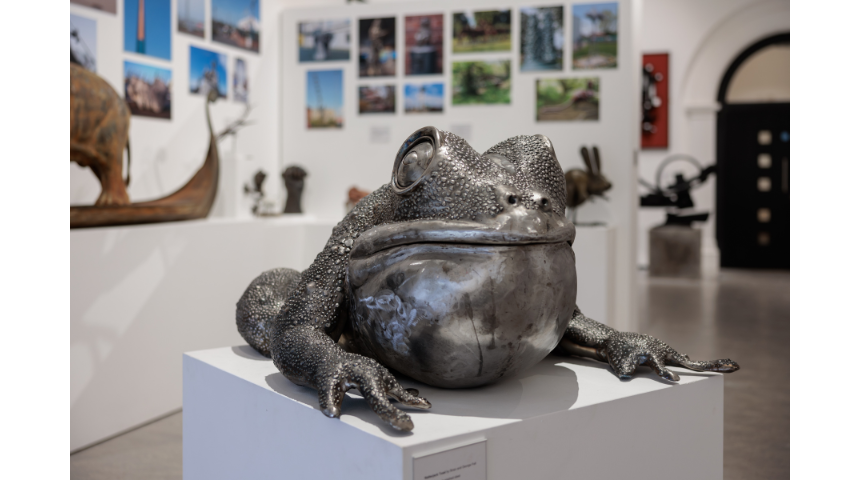
George Fell Natterjack Toad The Atkinson 2026 Photo credit Dave Jones
JM With the large toad sculpture, is that weld, all the little bumps?
GF Yes, it’s all applied by hand. It’s all little blobs of weld, one after the other. It’s an interesting thing to do because you’re in a kind of black box while you’re doing it [the welding mask]. So you’re in a bit of a trance then you have to lift your head out from the dark every once in a while to check that everything is alright. It’s easy to start doing it really badly and not notice.
JM It must be constantly exciting and inspiring to have a studio at Yorkshire Sculpture Park. Do you take regular walks around the park to soak up the latest acquisitions and old favourites?
BF It’s a lovely place to work. The landscape is fantastic. Also, the sculpture that’s coming in and out. Some of them you think, I can’t get my head round, and some of them – it’s just nice to see new things coming in all the time. The [technicians] are really nice lads as well. The title of the exhibition, ‘There’s Always Something New’ – that came about because one of the bus drivers who used to service the gallery there, as he used to walk through our studio, he used to sing that Cat Stevens song, ‘Brian and son, the work’s never done, there’s always something new…’ So that’s what we called the exhibition.
JM That’s really nice.
What has influenced your colour palette in the collages? Are the collages your way of processing visual information? Some look like landscapes, or more specifically, look as if they are fleeting visual notes of landscapes seen out of a speeding car or with the distance of memory in mind.
BF You’ve got it about right there. But they do stem from those sketches, the black and white ones, they take on their own life really. That’s the way I make them – I have big sheets of black card and I tend to cut things out and insert paper behind, so the light comes through. And the thing about working with card is that they’re constructed drawings, you can change things, move colours around, cut bits and replace them. It’s like making a sculpture really, in two dimensions. I used to just work in very simple colours, like the colours of primer paint for steel – red oxide, zinc primer and black. But I’ve discovered Canford papers, lovely papers in a range of colours, some of it almost luminous.
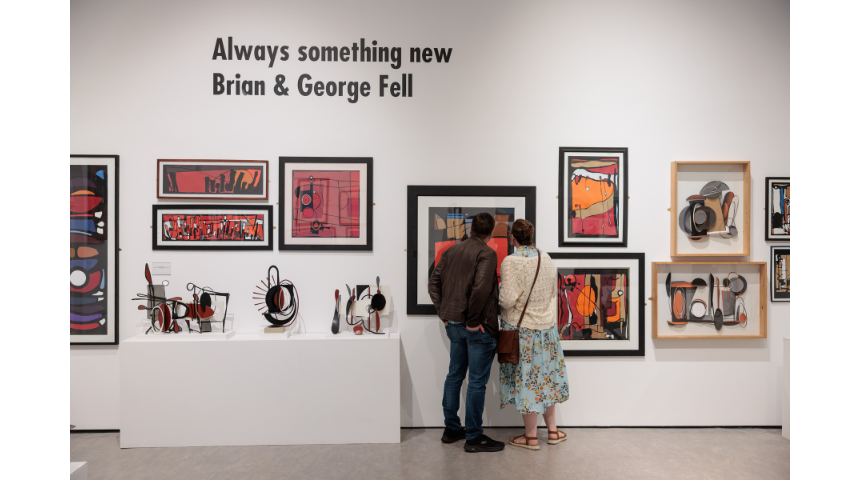
Brian Fell Collages The Atkinson 2026 Photo credit Dave Jones
JM Thinking of that idea of landscape going past, I was wondering, when you are making work, have you got the sketch with you, or is it that once you have done the sketch, it’s in your head and you can just make the work?
BF I use a sketch as a starting point. It tells me what to do. I go into a zone where I don’t really know how it’s going to turn out. Which is what I love really, and then I like to think it’s spontaneous. But sometimes I tend to make things and think, yes, that’s spontaneous, and put it in a frame, and I look at it days later and I think, oh no, and I end up taking something out.
JM I was thinking of the three-dimensional work as well there, whether once you’ve done a sketch for a work, do you then put the sketch aside, that’s in your head and you can articulate it in three-dimensions?
BF Again, the abstract 3D stuff, it takes on a life of its own and it tells you what to do. But the sketch is the starting point and often it doesn’t end up looking like the sketch at all. It’s got its own complete identity.
JM So, I suppose both of you but thinking of the collages, is it a matter of working quickly, and is it improvisatory, or is it quite slow and a matter of blocking things out?
BF Some of them come together very quickly and others I’m struggling with them in terms of when they are finished, and so on. If I get really confused by collages, I’ll go away and make an animal or something. Start at the front and end at the back and if at the end it looks a bit like an animal then I know [it’s ok]. Making animals is a bit like therapy for me.
JM For George, really, but both of you – thinking of Sky Hooks (1995) installed near Old Trafford. We were all really impressed by the ambition and scale of the piece, as well as the neat one-liner aspect, like the Ha-Ha (2002) bridge at Yorkshire Sculpture Park. You must be very proud of your dad and of continuing this line of work. How does it feel to know that between you, you are leaving a mark for posterity?
GF That’s kind of what you’re doing with public art really. You’re leaving a breadcrumb trail of your abilities. That’s the greatest privilege of it – you get to put things there that become part of people’s everyday lives so you’re getting into their heads. And yeah, Sky Hooks is great. Because I live in the centre of Manchester, that’s the easiest reference I can use. People ask, what do you do? and I can say my dad made Sky Hooks. It lands instantly.
All the little bits I’ve managed to get out there, I’m very proud of. I don’t necessarily want to go and look at them, but I am proud of the fact that they’re there. And that’s etched into people’s consciousnesses because they go past it on their commute, and they don’t have a choice about whether they see it or not, it’s just there. I’m really proud of [Brian’s] Merchant Seaman’s Memorial (1996) in Cardiff as well. I think that’s a masterpiece. They both capture a bit of a surrealist element.
And Sky Hooks – I like playfulness, and you can see that it’s come from quite a good-natured person, it does pay homage, it’s got a whimsical quality; I think all my dad’s work has a kind of respect for the viewer. It doesn’t feel egotistical, it feels like it’s there to enhance the beauty of the place it’s in. That should be our intention. It shouldn’t be about megalomania. Which relates to creative freedom as well; in work for the public you are confined to doing something that will be appropriate there, you can’t just do what you want, if it’s unpopular there’s no point in it being there. It’s supposed to be there for people to like, but it’s not that important that we did it.
BF You put the sculpture there but you don’t like to go back and see them, because when you do go back you think, I could have done that slightly differently, I could have… but once it’s there, you’ve made that statement. I think you’re always moving forward. The future, the next one’s the important one.
GF The next one’s always going to be the best one.
This interview is supported by The Atkinson