FEATURE Aug 2026 Sepideh Shahgholi – ‘Every blade of grass that grows by a stream’
Josephine Manby
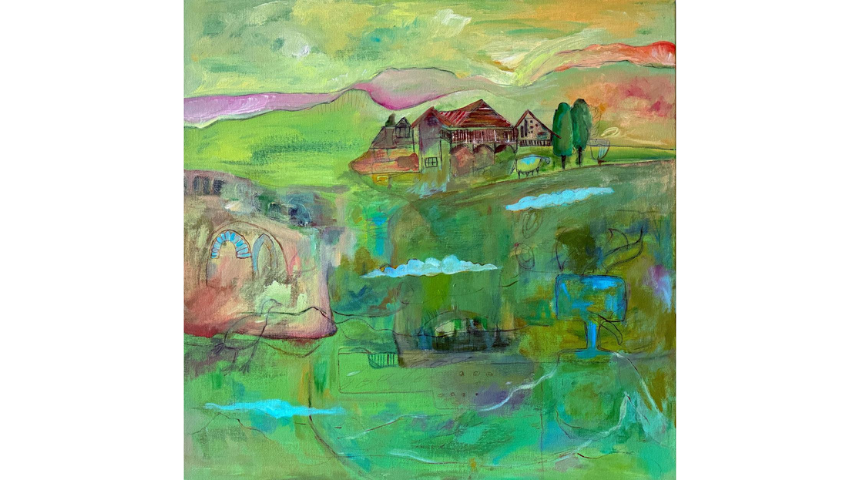
Sepideh Shahgholi Seasons of Self (2025) acrylic on board. Courtesy the artist
Painter, sculptor and graphic artist, Sepideh Shahgholi graduated with a Master’s Degree in Design and Visual Communications from The University of Salford in 2024, following a BA in Design and Visual Communications from Yazd University. In summer 2026, her work Drifting Self (2026) was selected for the Didsbury Arts Festival and shortlisted for the Cecile Elstein Studio Art Prize. Other works were also exhibited in Stockport War Memorial Art Gallery and the Open Eye, Liverpool. The Fourdrinier editor Josephine Manby met Shahgholi in July and wrote the following critical feature about her work.
At first, I thought Sepideh Shahgholi’s paintings were inspired by European art works. Sitting with Shahgholi in a quiet room in a café during the third of this summer’s UK heatwaves to hear her talk about her work, Drifting Self (2026) is the painting that hangs next to my left shoulder, and I am constantly drawn to turn and look at it.
This complex, mysterious image at the time had been shortlisted for the Cecile Elstein Studio Art Prize at Didsbury Arts Festival. Predominantly in Post-Impressionist hues of green and blue, there are traces of a bridge, a suspended oval form, compelling signs and symbols that for now I find hard to apprehend.
Across Shahgholi’s current body of work I track the Europeans, or think I do. In Home (2024), an off-white board is streaked and smudged with loose brushstrokes, passages of crosshatching, blush pink smoky blotches, a half-obliterated, ochre bank of foreground. The feeling is of a terrain marked with topographic occurrences, like a hand-drawn map. It recalls the work of Marc Chagall (1887-1985), his scuffled paint, fragments of villages and outposts adrift in dreamlike landscapes.
A hut or yurt, a tower, a wall with an open door in it. A fish, a bird, a moon and a sailboat. A paved path that leads skywards; bubbles rising like miniature planets.
All is untethered, scale and depth of field collapsing against the worked background that is as animate as an archaic vellum or parchment manuscript. It wells with immanence, with meaning, but the meaning is concealed – or it is everywhere. These are symbols that anyone, from anywhere in the world, can identify; that they have seen in their childhood, their dreams, their half-remembered other lives.
I notice that the flock of birds on the upper left, in pitch black, mimics drones or an air force formation, and bookmark that thought for later.
The base of Between Now and Then (2025) is a white background distressed with paint, delicate fumes, veils of turquoise, petrol blue, lavender, olive green. Ink black, burnt cream. Stages of a journey – a lake seen from above, a tree turned inside out, field systems or a children’s game of hopscotch, birds or planes – taken apart and re-conflated across these three panels. Three stations, dominated by a blue lake on the left, a pair of central indigo-black towers, and geographic incidents slung between two mountain ranges on the right.
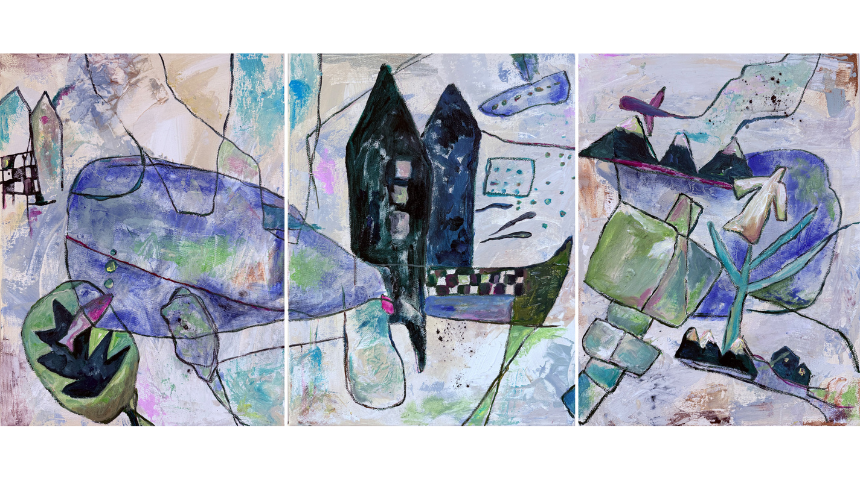
Sepideh Shahgholi Between Now and Then (2025) mixed media. Courtesy the artist
The painting treads a steady line between the recognizable and the cryptic. It contains its own pictorial logic, and every part of it is at once straining to break free from the confines of the picture plane while at the same time being tied exclusively to it. It is a calculated but effortless balancing act, and the artist holds everything in thrall to her brush.
My Amazing Gift (2025) bestows on the viewer a bouquet that recalls the chalky, resonant bunches of flowers painted by French graphic artist and painter, Odilon Redon (1840-1916). Like Redon’s blooms, Shahgholi’s erupt from a vase. They cascade drops of dark green loops and twisting blue segments on a suffused powdery ground. Flowers with deep centres, petals becoming incrementally abstracted towards the top of the painting until at the furthest top right is a skeletal linear upturned cup, a diagrammatic star-telescope.
The flowers express their own animist vibrant existence. Their leftward surging bias is only tied down by the two perfect green spheres of apples in a bowl, apples that behave like apples drawn and painted by Paul Cézanne (1839-1906), the French Post-Impressionist, sets of weighted pictorial units that can be arranged and rearranged to balance out a composition.
Further evidence of European influence becomes apparent during our conversation. Shahgholi cites Gaston Bachelard’s book The Poetics of Space (La Poétique de l’Espace) (1958) as ‘an important reference’ that helped her ‘think about the idea of home not just as a physical space, but as a psychological and emotional space shaped by memory, imagination and lived experience.’ Talking about Between Now and Then, Shahgholi recalls that Bachelard’s perspective ‘had a strong influence on the way I approached this painting.’
It helped her to express her personal idea of home. ‘It is not simply a representation of one specific memory or one particular house. For me, home exists somewhere between what I see in the present and the traces of the past that suddenly appear in that moment.’
Before finding out more about its imagery and handling, I hear about how Shahgholi came to be here, and what led her to painting and the other visual arts disciplines that she is proficient in.
Shahgholi has lived in Manchester for three years and came with her husband, who she says is very supportive. She found it hard to find a way in the artworld to begin with, having the know-how to connect was difficult. Looking for somewhere to work as a volunteer, to access the art world, she became involved with Castlefield Associates, helping install exhibitions, ‘a very positive experience’.
Following a period when her artistic practice became less active, Shahgholi recalls that:
‘During Covid, I started making stuff again. It was something my soul needed. I came here to study a Master’s in Visual Communications and to find a new, more professional path for bringing my ideas to life. To express my voice and my feelings, and to understand how I could grow as an artist on an international level.’
‘It wasn’t easy,’ she continues. ‘Before Covid, there had been several years when I was less active professionally, but I was never completely disconnected from art. I continued developing myself through different courses and workshops, and looking back, I see that period as an important time of personal growth, even if it wasn’t part of my professional practice. Most of my fine art experience before then had been self-taught. In Iran, I had studied Visual Communications with a specialism in Graphic Design.’
‘When Covid arrived, something inside me told me that I needed to return to art in a more serious and professional way. I started creating sculptures using wood and papier-mâché in our personal workspace. I also planned online workshops with a friend, although this was challenging during that period. Finding a new path during Covid was difficult, but it helped me realise how deeply I needed art and that I wanted to return to my practice more seriously.’
Now, having graduated in 2024, following challenges and hard work, Shahgholi feels she is in ‘a very good place’, fortunate to receive support from many people and organisations. Her Master’s project, Crafting Focus in the Digital World, which explored the attention economy through wearable sculpture, was shortlisted for the One to Watch Award at Castlefield Gallery in October 2024. She was also highly commended at CCA Galleries in Surrey. ‘These opportunities have given me confidence that I’m moving in the right direction,’ says Shahgholi, ‘and have encouraged me to continue developing my practice.’
I asked her how her time at Salford School of Art had impacted on her painting and her career as a painter. ‘As a visual artist, I became much stronger in terms of theory, and I was able to expand and develop my ideas in a more structured and conscious way. It really helped me understand how to move from an idea to its execution, and how to refine and develop a concept through making. One of the most important things I learned was how to bring ideas into real life, how to translate thinking and research into a tangible artistic process.’
Once again I turn my head to look at Drifting Self. I’m full of questions. Shahgholi begins to tell me about the Iranian iconography in her work and I begin to grasp previously hidden layers in the painting. ‘I started with a background and used the map of my country – originally it was the idea of ocean and forests together to make the map of Iran, but then I decided on the bridge, forest, boats. Then there was war in Iran, and here there is a bad feeling about that. I want to show the anxiety, worry about my country and my family.’
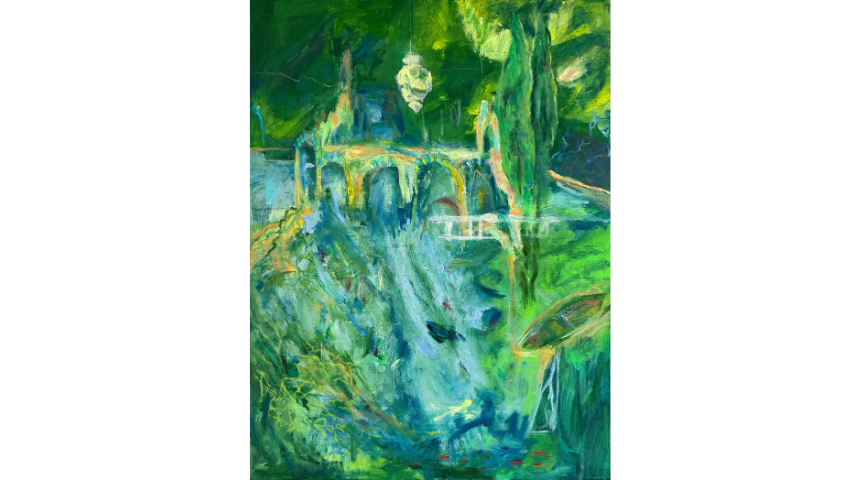
Sepideh Shahgholi Drifting Self (2026) acrylic on canvas. Courtesy the artist
Those signs and symbols. ‘I use the patterns of the roots of trees, as in bote jeghe (paisley), like script. I use free association, in that a touch of the brush takes me to my past memories.’ Shahgholi talks about the iconography of Iran and how she references it in her work. ‘The process is similar to what emerges in a dream. Sometimes a curve reminds me of something – but it’s not totally the same. Where the boundaries blur between place and memory. The feeling is different for different people who respond to the paintings. It’s a feeling about home, not something physical.’ When the war started, the feeling changed. ‘Drifting Self was being painted when the war broke out and I started using more angled violent shapes and angles – I had a passion to paint boats – as a thing that’s not calm. That’s subject to what the sea is doing.’
Shahgholi tells me about the red fish in Drifting Self. They are ‘a symbol of life, freedom. Red fish are used in a bowl at New Year. Seven things are really important at New Year that symbolize good luck – apples – a symbol of health, garlic – a symbol of health and wellness, gold fish. In Iran New Year is the first day of spring, it’s a different calendar.’
In Iranian culture, the goldfish (ماهی قرمز / māhi-ye ghermez) is most strongly associated with Nowruz, the Persian New Year, where it is traditionally placed on the Haft-Seen table. Shahgholi makes a point of listing for me, after our meeting, its range of symbolic aspects:
· Life and vitality – The fish represents living energy and the continuation of life.
· Movement and renewal – Because it is constantly swimming, it symbolises the flow of life, change, and the arrival of spring.
· Good fortune and prosperity – Many people see it as a sign of luck and abundance for the new year.
· Patience and resilience. In some interpretations, its calm movement reflects endurance and adaptability.
· Goldfish as a symbol of renewal, the cycle of life, hope, and the continuous movement between past and future, which aligns well with contemporary interpretations of its meaning in Iranian culture.
‘It’s geographically the idea of bringing home close to you,’ Shahgholi explains the meaning behind her paintings. ‘Not getting close to the childhood home. Home is a redefined sculptural space. Meaning the thing that I have in my mind from my childhood and something that happened in childhood, now it is different because the mind changes it. Some experience of it exists in the present. But it constantly expands and reshapes itself as you go through life.’
Shahgholi’s work seems to be in constant search of the expression of home and its essence, less a matter of an image of the past and more a sense of the idea of home. ‘I try to translate this layered experience and feeling. The feeling is continually redefined and expands the boundaries through everyday experience.’
I wanted to ask about Shahgholi’s early experience of painting and drawing. Did she draw and paint from a young age? ‘Painting and art have always felt like something that runs through my veins. It is deeply connected to my identity. I can say I grew up with painting. My maternal grandfather and my uncle were both involved in the restoration of paintings in palaces and famous historical buildings in my country.’ Shahgholi did indeed become involved in art early. ‘I had a strong interest in drawing and painting from childhood. I remember making drawings and writing stories alongside them. Later, my uncle taught me oil painting, and from my teenage years onwards I began taking art more seriously.’
Shahgholi explains animatedly how she explored different areas of visual practice, including graphic design, theatre set design, puppet making, painting, and photography. In addition, ‘working with an important arts organisation in Iran gave me valuable experience and helped shape my understanding of visual storytelling.’
‘After studying Visual Communication in Iran, I continued exhibiting my work and developing my practice,’ says Shahgholi. Coming to the UK appears to have opened a new chapter in her artistic journey, allowing her to reconnect with her original passion through new ideas that bring together two different lived experiences. ‘My university studies and life in a new country have opened many doors for me, helping me develop my practice in a more conscious, structured, and confident way.’
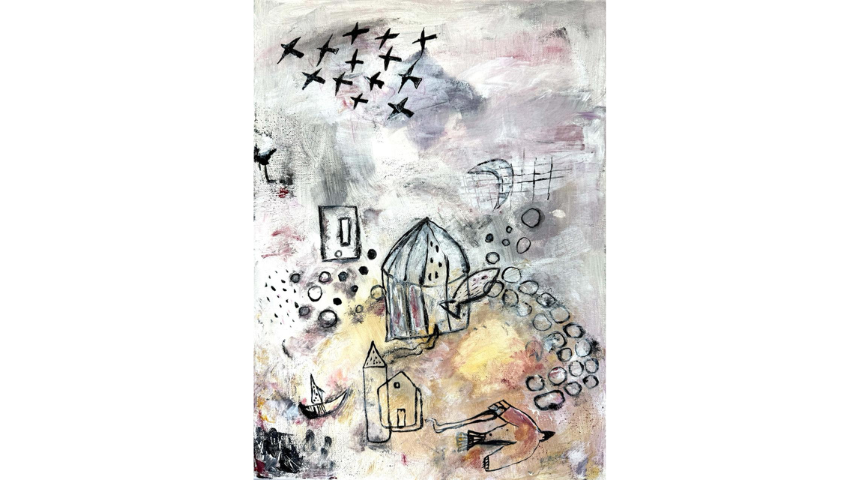
Sepideh Shahgholi Home (2024) mixed media. Courtesy the artist
Our conversation turns back to the emerald-suffused painting on my left; how differently I see it now. Shahgholi talks about coloured glass and enamelling. ‘The lamp in Drifting Self is a memory of the enamelled lamps I used to see while walking through the old bazaars in Iran.’ We talk about different words for enamel. Cloisonné and Mīnākārī, champlevé. ‘The lamp [in the painting] is also a cocoon or chrysalis of a butterfly,’ says Shahgholi. ‘The archways are in a specific city, too – it’s a historical bridge, Isfahan is the city. I have lots of memories of Khajoo Bridge.’ I am hesitant to ask, fearing that the work her grandfather did in preserving cultural edifices may have been damaged again, bombed in the current war.
Coloured glass is very popular in Iran, Shahgholi tells me. Stained glass? I ask. She describes the kaleidoscopic effect of light streaming through coloured glass windows, the beauty of it. I’m left with the impression, but not the certainty, that we are talking about the same thing. There’s a sense of the blended nuances of language, the dance of negotiating meaning that is so precious to humanity.
Shahgholi makes a distinction between how she works and the Iranian miniature tradition. ‘My work doesn’t really relate to Iranian art history but my influences do include the poetry of Omar Khayyám. Instead, my influences come more from Persian poetry, personal memories, and cultural symbols, which I reinterpret in a contemporary way. Iranian painting is different to Islamic art – miniature painting is the tradition. In miniature painting you don’t have perspective but lots of activities going on at the same time.’
What stories, or folk tales, or myths does Shahgholi remember from her childhood or upbringing that inspire her? ‘I am personally very influenced by the poetry of Omar Khayyám. In his work, he suggests that natural objects and things made from natural materials carry traces of the past within them. This idea appears again and again in his poems. For example, the handles of the jug, every blade of grass – all nature has memory, human emotions return in the form of colour. Flowers, grass, trees, waterfalls are all similarly experiencing human experience.’ Shahgholi refers me to one of his famous quatrains, in which he writes:
I think the Vessel, that with fugitive
Articulation answer'd, once did live,
And merry-make; and the cold Lip I kiss'd,
How many Kisses might it take — and give!
FitzGerald's original text (Quatrain 35, First Edition of the Rubáiyát of Omar Khayyám, 1859)
And also:
And this reviving Herb whose tender Green
Fledges the River-Lip on which we lean—
Ah, lean upon it lightly! for who knows
From what once lovely Lip it springs unseen!
FitzGerald's exact translation (Quatrain 20, First Edition of the Rubáiyát of Omar Khayyám, 1859)
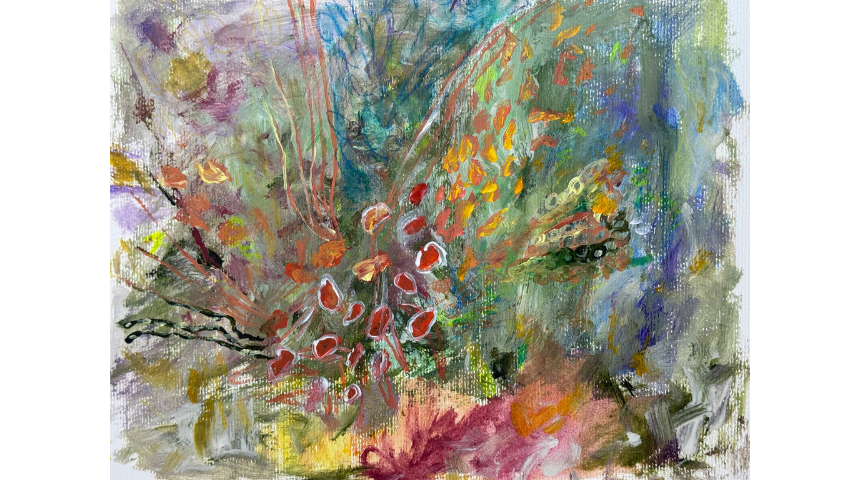
Sepideh Shahgholi Red in Memories (2026) mixed media on paper. Courtesy the artist
A week or so later, I am standing in front of Red in Memories (2026) in Stockport War Memorial Art Gallery. Shahgholi has described the disintegrated rose that remains in fragments of fallen petals. I can’t help but think of the bloodshed of war and what her people and her country are currently going through. ‘In my paintings, especially when I depict natural objects, I feel that human emotions return in the form of layers of colour. It is as if these objects—flowers, grass, trees, landscapes—are silently witnessing human experiences and carrying them forward. They almost stand as witnesses to human life, and with every growth and repetition of nature, something buried in time comes back to the surface.’
Shahgholi draws me back into the idea of the universality, the transnational human affinities that occur where art is conceived of and made. ‘Salvador Dalí has referenced Khayyám’s poetic imagery in some of his paintings. In general, as it is also said in theory, objects can be seen as carriers of emotion and memory. Each object holds traces of past feelings and experiences. In my work, nature becomes a medium that reflects those human emotions back to us—through layers of paint.’
As we sit together in the back room of the café, Shahgholi recites the Khayyám verses for me beautifully in Persian.
این کوزه چو من عاشق زاری بودهست؛
در بند سر زلف نگاری بودهست؛
این دسته که بر گردن او میبینی؛
دستیست که بر گردن یاری بودهست.
***********
هر سبزه که در کنار جویی رسته است؛
گویی ز لب فرشتهخویی رسته است؛
پا بر سر سبزه تا به خاری ننهی؛
کان سبزه ز خاک لاله رویی رسته است.
With reference to Khayyám’s visionary conception of the life invested in every object, inanimate or otherwise, Shahgholi refers to the paintings of Odilon Redon. He uses natural landscapes together with the motif of the eye, she notes. ‘It feels as if flowers and natural elements are filled with emotions and sensations, as if they are looking back at us. They become silent witnesses within the painting, creating the feeling that we are being observed as much as we are observing them.’
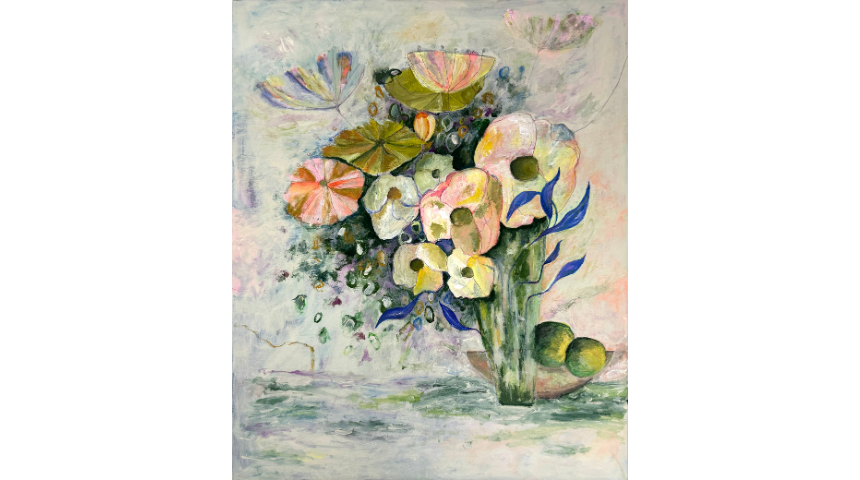
Sepideh Shahgholi My Amazing Gift (2025) mixed media on canvas. Courtesy the artist
I ask Shahgholi, is she aiming to create new, hybrid works of art that embrace home, yet at the same time incorporate something of what it is like to live in, and work creatively in the UK? She explains that the new works she is currently developing flow from exactly this idea. ‘They explore the relationship between the home I am living in now, the home I once had, and the constantly shifting boundaries between them.’ She tells me how they are also connected to her lived experiences up to this point, these new works moving slightly beyond her current practice and opening a new direction in her work. ‘I recall the past in the present moment, the here and now,’ she tells me. ‘I follow its traces within my current life, trying to understand how it has arrived here, and how its shadows have expanded into a kind of emotional volume that eventually becomes what I am today. In this sense, I constantly re-encounter myself through fragments and shadows of a past that continues to reach me and shape my present.’
I wonder about her experience of negotiating the artworld here, hope it has been kind. ‘My experience of engaging with the art world here, both in the Northwest and more broadly in the UK, has been a combination of openness and challenge,’ says Shahgholi. ‘On one hand, I found the environment quite diverse and rich in terms of opportunities, conversations, and access to different artistic practices. There is definitely a sense of openness, especially within educational and some institutional contexts.’
Counter to this, however, she says, as for many artists, ‘I think navigating the art world can be complex, especially when you are trying to establish your own voice and position yourself within it. It takes time to build connections and to find your place. Overall, I would say it has been a learning process for me.’ Shahgholi describes a continuing process of understanding and negotiating her position within this context, but sees it as a space that is gradually becoming more familiar and constructive for her practice. ‘I would also like to add that, despite the challenges, I now feel very positive. I have had the opportunity to engage with valuable experiences and connections that mean a lot to me, and I am constantly learning, developing, and expanding them as part of my artistic journey.’
I am left with the impression of a painter of great talent, steeped in the pictorial languages and artistic heritage of both her home country and the country she is now at home in, and adept at treading the line between the two, leaving images of affecting emotional and visual significance in her wake.
Instagram: @art.by.sepideh
Website: www.sepideh-shahgholi.com