EXPERIMENTAL Sept 2026 Line Packer & Stephen Beresford – Embodied: The Making of a Windermere Skiff
Josephine Manby
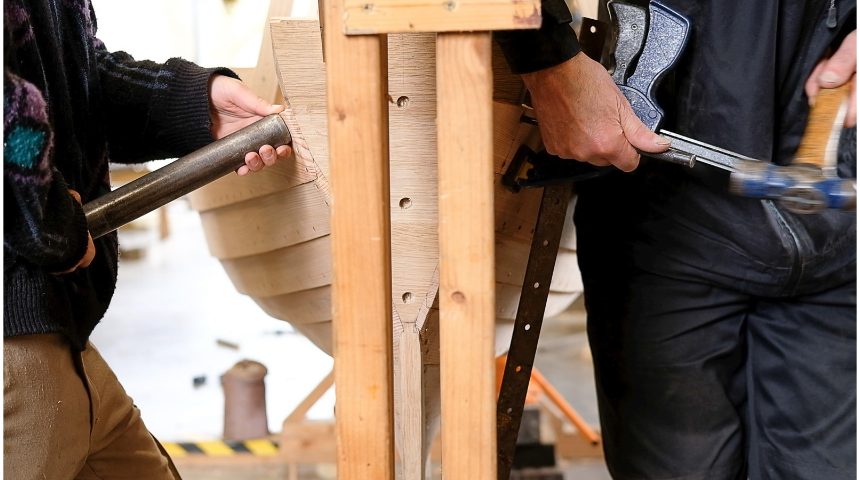
Line and Stephen working on Homo Faber project Photo credit Liam Collins
In the exhibition curated by Lakeland Arts at Windermere Jetty Museum, ‘Embodied: The Making of a Windermere Skiff’, an intensive knowledge exchange between Swiss-born Homo Faber Fellow, Line Packer and Senior Conservation Boatbuilder at Windermere Jetty Museum, Stephen Beresford, is represented in a fluent, engaging gallery exhibition.
The skiff in question (streamlined, elegant, nimble) occupies a central position in the gallery, along with associated objects and documents pertaining to the creative processes that produced it. Visitors are invited to experience heritage in this exhibition as a ‘radical process of becoming’ rather than a static museum display or fixed archive. We are encouraged to explore the putative futures, the hidden utopias, of our own imaginations.
the Fourdrinier editor Josephine Manby went to see ‘Embodied’ and to meet the boatbuilders. The following interview took the form of a conversation held in the gallery at Windermere Jetty Museum with Packer and Beresford together with Lauren Hine, Head of Marketing and Communications at Lakeland Arts. The exhibition runs until 14 February 2027.
The following text attempts to capture the fluidity of ideas, with key factual details mentioned by Packer and Beresford expanded on hydrodynamically, as in water flowing under rocks, in italics.
Line Packer meets me at the glass doors of the entrance to the Windermere Jetty Museum’s halls of Lakeland boating history. Simply dressed in boots and pale fabrics, they immediately come over as friendly, frank and open. We walk past the reliquaries of heritage objects and vessels to the museum’s gallery space, meeting up with Stephen Beresford and Lauren Hine on the way.
A conversation is exchanged between the four of us sitting on an unadorned wooden plank bench. The gallery space is painted white with a knee-deep green Plimsoll line, the becalmed water of Lake Windermere panning out beyond, visible through a low-set plate glass window.
We face the transom, the back view, of a skiff made out of a 220-year-old European larch tree grown on the banks of the Thirlmere Reservoir and its phantom proforma, the pencil-on-limewashed MDF board lofting drawing, hung at the back end of the gallery.
‘Originally used to fish Arctic Charr, the Windermere Skiff was then adopted as a leisure rowing boat with the 19th century boom of ‘Water Week’ holidays.’
Line Packer, Building the Interpretation of a Windermere Skiff (archive document)
There was something very special about the way Line and Stephen spoke in the setting of the exhibition with the lake just outside the window. Like twin sources, from which welling springs of ideas leaped to the surface.
‘Rich in term[s] of the region’s social history, this boat is also an exemplar of the power to transform and acquire new meanings according to social, economic and environmental contexts. Our co-creation is about water and life giving, about the smell of a foggy morning on the lake, and about wood grain as a whole subject. It is about remembrance, and metamorphosis.’
Line Packer, Building the Interpretation of a Windermere Skiff (archive document)
I typed up my handwritten notes afterwards and it produced a flowing dialogue with less emphasis on who had said what, but rather had affinities structurally with the concepts, working processes and non-linear/non-binary aspects of the project.
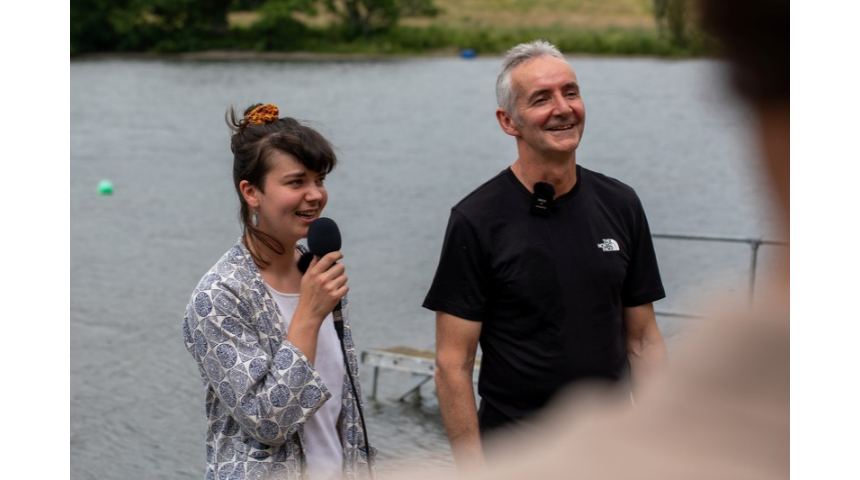
(Left) Line Packer and (right) Stephen Beresford talking during the Windermere Skiff Launch Photo credit George Carr
Born and raised among lakes and mountains in a town in Switzerland, Packer comes to Windermere with an affinity for its land and waterscapes. Packer studied anthropology, linguistics and social sciences, and trained in the Basque country of Spain on a three-year apprenticeship in boatbuilding.
Packer wanted to apply for the Homo Faber Fellowship, a Swiss Foundation Scheme *
* ‘Homo Faber is presented by the Michelangelo Foundation for Creativity and Craftsmanship
Homo Faber is a cultural movement centred on creative artisans. Its signature projects are education programmes for the next generations, an international biennial celebration and an online guide.’
https://www.homofaber.com/en/
‘You have to apply as a duo, with an established artisan paired with a young professional. There’s the idea of transmission of knowledge and skills. There were about 220 applicants, 22 duos were chosen – it was a great opportunity’
(Packer and Beresford were the only boatbuilders)
‘There were people involved in millinery, glass blowing, luthiery, textiles, ceramics, dyeing’.
‘All the emerging artisans met for a month in Seville* The masters came over to spend two days of workshop. There were 50 people altogether including all the teachers.’
*A ‘creative and entrepreneurial 1-month masterclass at the Alcalde Marqués de Contadero Space in central Seville’.
https://www.homofaber.com/en/news/fellowship-2025-26
‘Traditional boatbuilding is a red listed heritage endangered craft.’ *
* The list is led by Heritage Crafts https://heritagecrafts.org.uk/skills/redlist/ the only UK UNESCO-accredited NGO working primarily in the arena of traditional craftsmanship.
‘A possible aspect of the fellowship is to develop a next generation,’ says Beresford. ‘Continuing boatbuilding is important – for me it’s very craft centred, but this project brought a significant fine art aspect, because it included making an exhibition of it plus there was the anthropology aspect to it, with Lakeland Arts as an arts organization. That’s one of the interesting synergies of working with an art organization that does craft and vice versa. With an exhibition as the endgame – there’s a nice aspect to it in that it’s public facing. Attracts different clients to the craft. We can’t compete with a mass-produced product but this has been interpreted as well as crafted and will evolve over time.’
‘We’ve been able to link with lots of international networks, ‘cross-crafts’ as it were.’
(Tell me about the networking opportunities?)
‘Networking in Seville was a powerful, effective, useful thing’, says Packer. ‘As a European.’
(There is laughter about people in the UK [like Stephen] considering Packer as a European representative, despite Switzerland’s status as a neutral federal republic, a member of the United Nations and central to Europe geographically but not politically. The Michelangelo Foundation accepts candidate regardless of their citizenship).
‘We went to Milan Design Week*, Stephen came over for two of the days,’ they say. ‘Closing the fellowship was this MDW show.’
* ’For Arts & Crafts & Design at Milan Design Week 2026, Casa degli Artisti hosted Arts & Crafts & Design, a place for creative experimentation and collaboration. For the first time, Homo Faber Fellowship was presented at Milan Design Week alongside three other exhibitions by partners who share the Michelangelo Foundation’s dedication to nurturing talent and fostering collaboration… Fondazione Cologni dei Mestieri d'Arte (in collaboration with Living Corriere della Sera), Creative Academy Richemont and Serapian presented an exhibition each, shaped by shared values of creativity, experimentation and dialogue.’
‘There was also Three Days of Design in Copenhagen, Denmark’. *
* Homo Faber Fellowship exhibition Today’s Masters Meet Tomorrow’s Talents at 3DAYSOFDESIGN in Copenhagen.
‘The exhibition presents the co-created objects, developed over six months by 22 duos of master artisans and emerging talents working side by side across Europe and beyond. Each collaboration reflects a shared process of learning and exchange, grounded in hands-on practice, while the pieces explore materials, craftsmanship and light, offering insight into how traditional skills can be reinterpreted through contemporary perspectives and shared inspiration.’
Bianca d'Alessandro Gallery, Copenhagen
‘We represented the project with a version of the film showing in the gallery, because the boat was too big to be included. We also made and presented another piece based on the lofting drawing, and projected the film onto the piece – a reflection on boatbuilding as a craft within the artworld.’
‘The intention was to transmit the idea of how it is grounded in personal experience.’
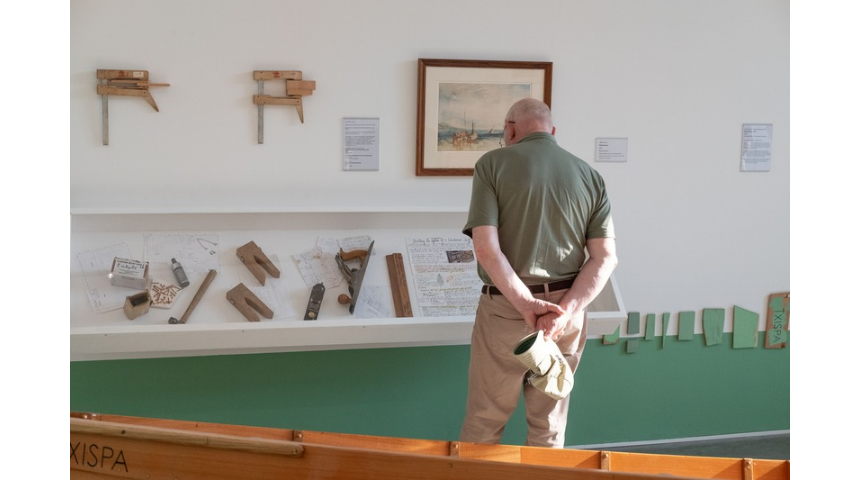
Embodied: The Making of a Windermere Skiff exhibition Photo credit Liam Collins
(Chat about lofting process led unexpectedly to Foucault (1926-1984), the French philosopher and historian, expert on knowledge, power and social dynamics).
‘Lofting is the full-scale drawing process, set out in three perspectives, that gives the maker a precise plan to determine a boat’s shape. By tracing fluid curves onto large boards laid flat, the maker projects how flat lines become three-dimensional form. This moment – where the shaping of lines becomes the shaping of matter – gives this exhibition, Embodied, its title.
‘The moulds along the wall illustrate the construction. The outer planks are shaped and fastened first, relying on the mould’s bevelling angles. Only after the wooden shell is self-supporting are the internal ribs bent into the hull and riveted to stiffen the structure. Boats built this way are exceptionally light and resilient.’
Lakeland Arts exhibition information
‘We had some ideas around the concept of heterotopia for Milan Design Week’, says Beresford.
‘From a concept from Foucault’, says Packer – ‘hetero as in other, topia as in places’, they explain. ‘Places that actually stand for the imaginaries that are beyond standards, beyond norms. The boat is a perfect example. As in utopia, there is a paradox, something placeless, you can’t grab hold of it, but a heretopia you can hold onto. Lofting is like the representation of a boat that is not actually there.’
In ‘Of other spaces, 1967, heretopias’ a lecture he gave called Des Espace Autres, Paul-Michel Foucault outlines 6 principles of heretopias:
1. sacred/prohibited places, and rest homes/psychiatric hospitals
2. cemetery – ‘dark resting place’ of the family
3. cinema/garden
4. libraries, museums/fairground
5. prison/barracks, motels (for illicit affairs)
6. brothels/colonies – and boats, ships.
‘The ship is the heretopia par excellence,’ he adds. ‘In civilizations without boats, dreams dry up, espionage takes the place of adventure, and the police take the place of pirates.’
https://foucault.info/documents/heterotopia/foucault.heteroTopia.en/
Beresford speaks about boats as ‘taking a step on / being the last freedom for mankind – the last freedom of taking a boat into international waters’.
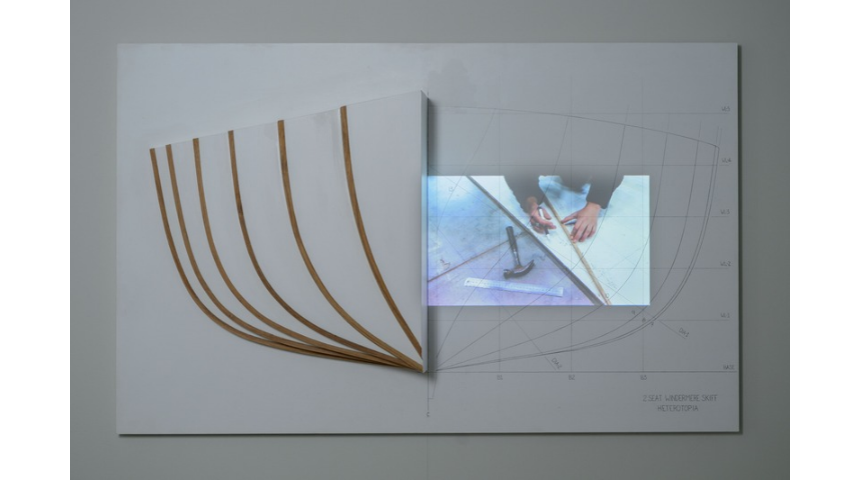
Stephen Beresford Artisan and Line Packer Fellow MFO Heterotopia Photo Christian Sinibaldi © Michelangelo Foundation
Royal Museums Greenwich outlines, What is the UN High Seas Treaty? as follows (edited):
‘On land, territory is divided by nation states and national borders….
The seas and oceans are considered to be a ‘global commons’, which means that they are free for all. But there are differences in how different areas of the ocean are governed:
Territorial Sea (up to 12 nautical miles): …under full control of the coastal state, similar to land territory. Foreign vessels have the right to navigate… known as 'innocent passage'.
Exclusive Economic Zone (EEZ) (up to 200 nautical miles): The coastal state has exclusive rights over all natural resources… living and non-living, in this area… also has responsibility for the protection and preservation of the marine environment, managing resources [like] fish stocks and preventing over-exploitation.
Continental Shelf: the coastal state has the right to exploit the natural resources of the seabed and its subsoil in this area… may extend beyond the 200-mile boundary, depending on the geography…
High Seas (beyond 200 nautical miles): …beyond any national jurisdiction.
The UN Convention on the Law of the Sea recognises that the area of the ocean beyond national jurisdiction is the ‘common heritage of mankind’, and that ‘No State shall claim or exercise sovereignty or sovereign rights over any part of the Area or its resources’.
https://www.rmg.co.uk/stories/ocean/what-un-high-seas-treaty
‘The idea of international waters is that you can easily navigate borders, whereas on land it would be impossible,’ says Beresford.
‘This idea of philosophy and symbolism, exploration and leisure – we played with the idea. It worked well at Milan Design Week where we couldn’t take the boat physically,’ says Packer.
‘That idea of water – international water – boatbuilding as a relational practice – [mingling] with other bodies – non human bodies, water and fluidity, cross – binarities etc.’
‘An exhibition of a boat’s ecosystem – reacting with its own universe.’
‘The boat is traditionally built to fish Arctic charr.’ *
[Ecological Heritage] – for environmental reproduction rights and health
The Arctic Charr: a fish inextricably linked to Windermere
[A Relic] The Charr lives in very cold and deep waters. Being trapped in the Windermere Lake when glaciers receded during last Ice Age, its presence is almost a miracle and has sparked a lot of fascination.
[An Indicator] Currently in decline, the Charr’s situation highlights a larger crisis of water pollution and rising temperatures in the lake.
Line Packer, Building the Interpretation of a Windermere Skiff (archive document)
* The Arctic charr (Salvelinus alpinus) is a cold-water salmonid related to salmon and trout. Populations in England are near the southern extent of the natural species range, with all English populations being located in the Lake District.
https://lovewindermere.co.uk/latest-news/species-on-the-edge-arctic-charr/
‘Instead of viewing humanity and nature separately, Embodied suggests that water and landscapes are fluid, diverse and deeply connected to our own physical senses and collective memory. This kinship extends directly to Windermere’s wildlife, such as the Arctic Charr – a rare, elusive fish that has inhabited its deep waters since the last ice age. This same species swims in Lac Léman, Switzerland, connecting the waters of Packer’s upbringing with their new home. By looking closely at the boat’s ecosystem, the exhibition invites us to rethink the very notion of heritage. What if our truest heritage isn’t defined by borders or categories, but by our ability to create kinship beyond humankind, cultivating archives of care and sensory memory with our natural environment.’
Lakeland Arts exhibition label
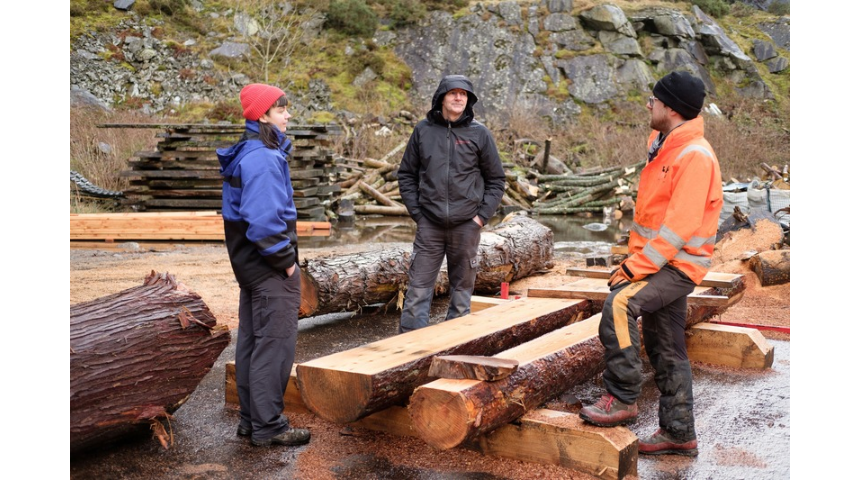
(Left) Line Packer, (middle) Stephen Beresford and (right) Jamie Chaplin-Bryce visiting larch at Saint Johns-in-the-Vale Photo credit Liam Collins
‘The larch is the only deciduous evergreen,’ says Beresford. ‘Although it turns golden brown in autumn, very unusual. A species on its own. This specific one is very important, it’s 220 years old. It was growing on the shores of the Thirlmere Reservoir. It’s amazing to think of Wordsworth visiting Coleridge, or the other poets, they would have walked past this tree.’
The area is dotted with trees planted by Wordsworth – yews in Grasmere Churchyard, a mulberry tree at Wray Castle, a cedar at Field-Foot in Grasmere. This exact cedar is commemorated in a poem cited by Anna Burton*: ‘Wordsworth’s tree-planting reputation of the 1840s is captured in a neglected sonnet written by Edward Quillinan, entitled, “Field-Foot Cedar Planted by Wordsworth, September 18, 1849”.
Coleridge refers to a larch tree in melancholy lines addressed to his beloved Sara Hutchinson:
‘In this heartless Mood,
To other thoughts by yonder Throstle woo’d,
That pipes within the Larch tree, not unseen,
(The Larch, which pushes out in tassels green
It’s bundled Leafits) …’
From Samuel Taylor Coleridge To Sara 4 April 1802, later Dejection, An Ode
*(Burton, A. (2024). Planting for “posterity”: Wordsworthian tree planting in the English Lake District. Nineteenth-Century Contexts, 46(4), 513–526. https://doi.org/10.1080/08905495.2024.2388161)
‘The timber as an Archive
‘The larch timber we have is 200 years old and from the surrounding forest. As part of the journey, we seek to meet the forester’s expectations that this particular tree should continue to carry a memory of the landscape.’
Line Packer, Building the Interpretation of a Windermere Skiff (archive document)
‘Thirlmere Valley has changed dramatically. We have the Lakeland collection engraving.’
(The engraving, William Green St John’s in the Vale (1804), from the Lakeland Arts Collection, shows the Thirlmere Valley [later flooded to become Thirlmere Reservoir] at around the time the European larch used to build the skiff first began to grow. To find a 220-year-old unhybridized European larch in the Lake District today is exceptionally rare).
‘It’s interesting to think of the tree witnessing changes.’
‘The summer or winter growth can be distinguished in the rings of a tree,’ says Beresford. ‘A boat builder exploits these growth rings to their best advantage. A skilled artisan has to have a deep knowledge of the grain of the wood. All grains are different and they lock in the different seasons.’
(What came first, the felling of the tree or the idea of applying for the fellowship and making the skiff?)
‘The tree needed to be felled. When the foresters saw the significance of the tree – Jamie Chaplin Bryce – he couldn’t stand to think that it would just end up being fencing or used for a shed’.
‘He contacted Stephen as a traditional boatbuilder,’ adds Packer.
‘In terms of chronology, it was felled in 2021. The wood had to season.’
‘Line had been involved, working in a team, in the making of three new built boats before the Windermere skiff. I’ve built about ten skiffs,’ says Beresford. The first new build done here at Lakeland is this one.’
‘Previously the work has concentrated on conservation of heritage boats, although I have built these other boats in my spare time, including skiffs.’
(Why did Line contact Lakeland?)
‘Homo Faber has a grey guide listing artisans all over Europe.* There were two [artisans] in northern Italy, one in Norway, one in Scotland – a woman,’ says Packer. ‘I did some research. She knew about Homo Faber. She had another project on though, but the woman recommended Stephen. I contacted him just before the deadline for applying for the fellowship’. (they both laugh)
* The Homo Faber Guide, created by the Michelangelo Foundation.
‘Stephen had to make a quick decision’
‘So it was a matter of risktaking’ (laughs)
‘As an employee there was an element of persuasion – senior leadership team, board of trustees. There was the finance department. But as a young artisan it is hard to find work, or someone to hire you and impart their knowledge. So there’s a need to respond, to give opportunities to young artisans. To illuminate, to turn the craft into art. There’s a lot of overlap – it’s a new build with an artistic slant.’
‘Actually having the opportunity to do an exhibition is excellent because thinking about – you can’t force people to be interested in heritage but you can tell stories of how things are made. You’ll get a different audience coming here.’
‘The exhibition idea and maybe people who don’t like boats will come here, what kind of stories can you tell, and so on.’
(What about the colour of the underside of the boat, that green that’s echoed round the base of the gallery wall?)
‘Load carrying boats generally use red. It’s more here used for protecting the underside of the boat.’
‘Traditional skills are used here but also how we think about it and how we own it in a contemporary way. The traditional becoming transformative.’
‘[Skills Conservation] – Traditional Boatbuilding as:
[A Relic] Traditional boatbuilding accompanied societies for millennia, serving as an essential infrastructure for the movement of goods, people and knowledge. The craft is rooted in beauty and utility.
[An Indicator] Currently in decline, the craft’s situation highlights the consequence of mass manufacturing, and loss of skilled artisans. By investing in know-how transmission, we want to perpetuate a sense of material rootedness and a reflection on modes of production.’
Line Packer, Building the Interpretation of a Windermere Skiff (archive document)
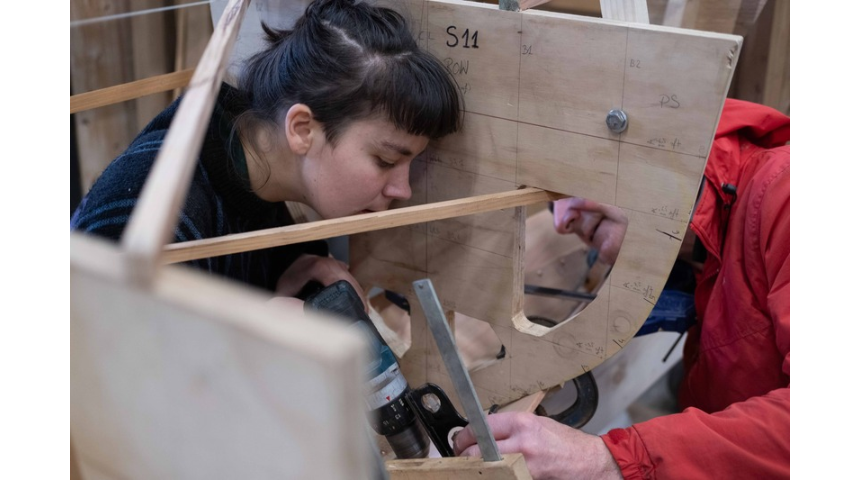
Line working on Homo Faber project Photo credit Liam Collins
(Were you able to incorporate personal things in it?)
‘The crossbeam/deckbeam is decorative in some way. But a lot of that is about ergonomics – how do you fit it to a person?’
(What’s it like to row?)
‘When you work on something, you always want to know, did it measure up? The moment it went on the water, there was a sense of, we actually made something – it was a sensory and emotional experience. To actually take the thing you’ve made, see the logic come together, all the nuances. Even though you knew it was ok rationally.’
(Where did the name come from?)
‘Txispa means spark in Spanish, and is the name of the boat. It’s also a good way to describe the project. Working with Stephen, a lot of sparks were going off in my mind –‘
‘And in mine as well,’ says Beresford.
‘Tx is used in the local languages of Basque Country/Asturias. They use Tx a lot. I lived there for three years. Took a while to learn to pronounce it. A good way to approach a language that is not yours. People will look at you a different way. Change perspective.’
(Line notes that Galicia uses a simple "x" for the same sound /tʃ/)
· Pintxo (Basque tapa/snack)
· Txakoli (Basque white wine)
· Kalimotxo (Basque red wine-coca cola mix invented in Algorta)
· Txozna (pop up bars at fiestas or celebrations)
· Etxea (‘house’ in Euskera)
https://bilbaoinsider.com/40-basque-words-you-should-know-if-you-visit-bilbao/
[talking about language and how you get your head around the people and the customs/culture via language]
‘Txispa was the name of my grandma’s dog,’ says Packer. ‘When I told Stephen about it he liked it.’
‘Language – spark – utopia – what we do with artisanry now – does it still matter?’ says Beresford.
‘As a young artisan we need reflection on how we are making stuff,’ says Packer.
· Spending so much time
· Not adapted to our system
· Deep time of handcrafting an object
· Perseverance, slowness, takes time
· Whole palette / range of emotions
· Opportunity to be in a deep time is a great privilege.
· Language
(How is the skiff specific to Windermere?)
‘The Windermere skiff is for fishing Arctic charr. Fishing shaped this environment. Across the UK the skiff was used because it was fast to row. A successful design.’
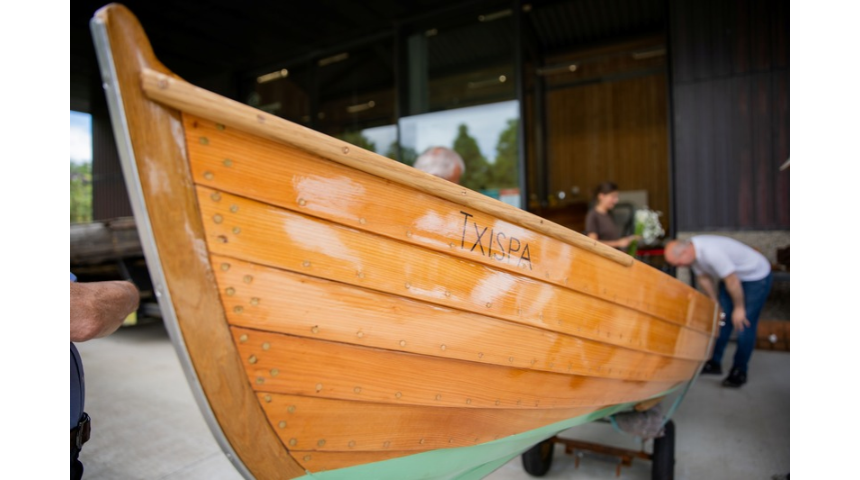
Close up of Windermere Skiff Photo credit George Carr
‘International thoughts, languages cultures, boats are about mobility of goods and know-how, and people connecting to different places.’
‘To live in my experience as a boat builder, moving to a new place, the first thing I do is to go seek out the boats. In the Basque country I worked as a boat builder. It has been my main focus on how to understand the social and environmental culture of a new place.’
‘Boats are telling you stories. It’s a metaphorical journey. About moving and finding different ways and materials to build boats. Coming here into Stephen’s world has been so enriching.’
‘If you look at traditional handmade boats you can link types of boats to specific geographies. They relate to weather, to fishing usage, there’s a vernacular boat heritage particular to geographical areas of the British Isles. In mass production, the skills to make by hand are lost.’
‘As conservators, heritage is an important factor. The skiff is perfect for here but for example in the north east it would be totally different. Each boat tells a story for a different community.’
‘There are differences in the way they are built – clinker is where one plank overlaps the other. Carvel is where each one meets, or abuts the next.’
‘There are differences in lofting approaches. A naval architect will start with a sheet of paper and draw a lines plan, and then let’s now loft it in full size.’
‘Some will carve a small model and comprehend it into a loft, then build from there.’
‘We took an old boat which was very dilapidated but of a good design. We measured it and adapted it, and made a loft from that. It was a matter of collecting measurements.’
‘So, the lines came from a traditional skiff. But we made a fair shape, no lumps and bumps, hydrodynamic.’
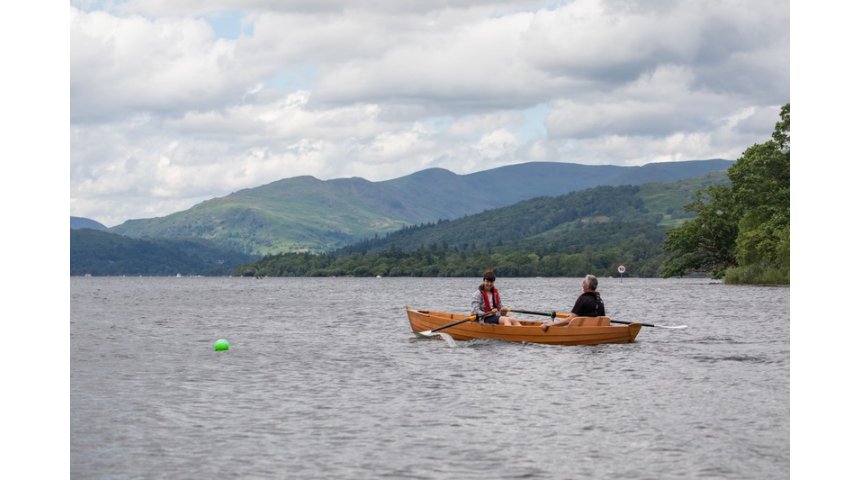
(Left) Line Packer and (right) Stephen Beresford rowing Windermere Skiff across Windermere Photo credit George Carr
This experimental interview is supported by Lakeland Arts