REVIEW Sept 2026 ‘Ali Kazim: Alphabets’ at Cristea Roberts London
Josephine Manby
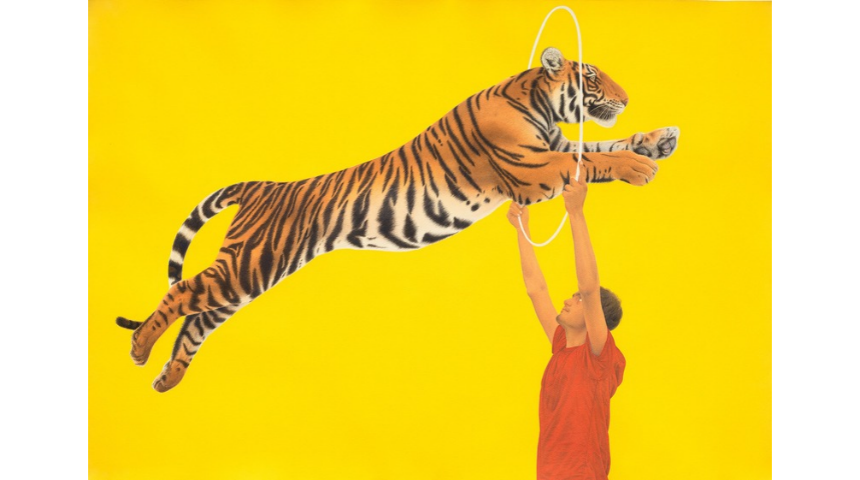
Ali Kazim Circus ka Sher II (2026) Watercolour pigments on paper 79.7 x 114 cm. Courtesy artist and Cristea Roberts Gallery, London © Ali Kazim
‘Ali Kazim: Alphabets’ is on show at Cristea Roberts, London until 3 October, the artist’s first solo exhibition at the gallery, where he reveals a new portfolio of etchings and aquatints alongside a selection of exquisite water colour paintings. the Fourdrinier editor Josephine Manby went to see these immaculate examples of image-making, from illustrative graphic prints for an Urdu Qaida, to portrayals of Mohana water bird fishermen from the Indus wetlands sporting feathered decoy hats, and reviews ‘Alphabets’ here.
Circus ka Sher II (2026) is the benign, saffron-coloured watercolour of an exquisite tiger leaping through a delicate white hoop held aloft by a red shirted youth, that greets you as you walk into ‘Ali Kazim: Alphabets’, currently showing at Cristea Roberts, London.
The Lahore, Pakistan-based artist’s intriguing curriculum vitae includes an early occupation as a painter of circus posters and Lollywood billboards, which seems to have instilled in him, apart from a deep sensibility and respect for animals, an awareness of the possibility of movement between terrains, realms, scales and genres. In ‘Ali Kazim: Alphabets’, the visitor can trace the landscape of the artist’s mind, the ease of passage through this world as he flits from one subject to another, alighting on an object, artefact, animal, person or idea, holding it in his meticulous technique long enough to depict it, then moving on to the next.
Kazim’s early training included study at the National College of Art, Lahore in Pakistan (NCA), where he gained his BA in 2002. In Circus ka Sher II, these two strands, so specifically traditions of his home city, are fused together: the spectacle of the iconic leaping tiger; the brilliant, almost vitreous, suffused colour; and the incredibly detailed painting technique. Across his career, Kazim has developed a rigorous formalism. His technique is explained on Met Museum website. (1) Kazim, to paraphrase, begins with a pencil underdrawing. He works into this with Siyah Qalam (also Siāh Qalam, referring to black ink brush work as well as a mysterious individual or group of painters, possibly a genre, dating to the fifteenth-century). This establishes the monochrome composition, to which colour is then applied using watercolour pigment in gum Arabic, presumably as a binder and a medium to ensure gloss, brilliance and translucency. The entire sheet is bathed in a shallow tray of water to affix the granulated pigments and left to dry flat.
Subsequent washes mean that certain layers of colour are subtracted, leaving behind pigment residue to create a textured surface. When Kazim is satisfied with the saturation of the surface he then applies pardakht (tiny dots or strokes, again using the ultra-fine Qalam brush). Kazim favours wasli paper, which is the substrate used for miniature painting, as its resilience allows repeated bathing. Typically, a painting will take two months for him to complete.
During his studies at NCA Lahore, he regularly frequented the adjacent Lahore Museum, making innumerable drawings and notes relating to artefacts in the collection. Since the time of John Lockwood Kipling, father of the famous author Rudyard Kipling who wrote The Jungle Books (1894 & 1895) and Kim (1901), the Art School (originally Mayo School of Industrial Art) and the Museum next door began to be closely linked.
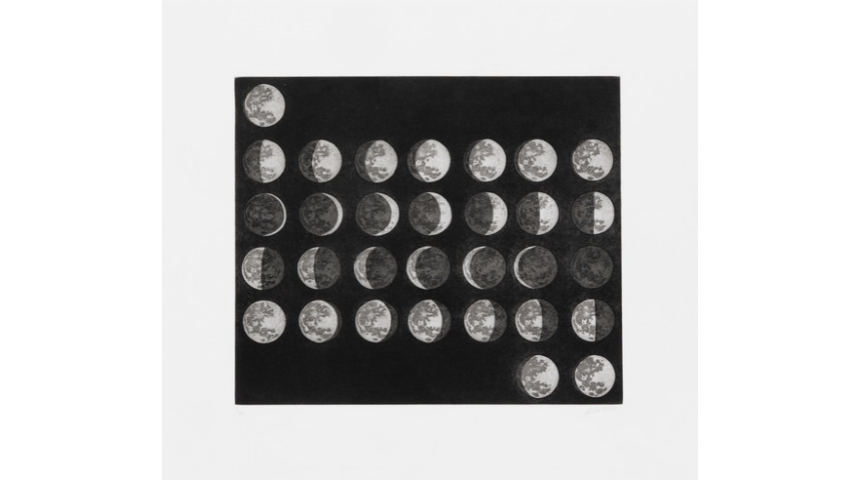
Ali Kazim Chaand (2025) Aquatint on Somerset Satin White 300gsm paper. Paper and image: 43.9 x 49.1 cm. Edition of 25, Courtesy artist and Cristea Roberts Gallery, London © Ali Kazim
Lockwood Kipling himself was originally an architectural sculptor at South Kensington Museum (later the Victoria & Albert Museum London). He became Principal of Mayo School of Industrial Arts after teaching art in Mumbai, and also curator of Lahore Museum. In his copious annual museum reports he chronicled the development of the museum as a living, working resource which he personally viewed as integral to the city and its culture, a proactive philosophy to some extent independent of the colonial system under which he was operating. ‘Designs, models, moulds and casts of works’ from the collection were built in to the school of art curriculum under his tenure. (2)
Inevitably, a father who was head of an art college and a museum would influence his literary son, and Rudyard Kipling gave him a ‘cameo role as the kindly curator and “Keeper of Images”, a “Sahib with a white beard”’ in his novel Kim. (2) Lockwood Kipling certainly inspired Rudyard’s use of image and text together, and the original The Jungle Books contained some illustrations by his father. The books with their tales of Shere Khan the tiger and Baloo the bear, along with their adopted Mowgli, are in turn inspired by ancient Sanskrit animal fables as found in extensive collection the Panchatantra, which used animals anthropomorphically to tell moral tales.
Kazim, in ‘Alphabets’, creates his own version of the childhood alphabet books, or Urdu Qaidas, that like children’s first books across the globe include simple illustrations to go with words that match each letter of the alphabet. Kazim’s friend, the writer and curator Hammad Nasar, who had been disappointed with the dearth of Urdu words and lack of imagination in the images in the Qaidas he browsed when planning to help his young son learn the language, had the idea to collaborate with Kazim on the book that they subsequently co-produced. Each of the 19 etchings and aquatints on show at Cristea Roberts is from this new portfolio, produced for the book. The watercolours, which include two of the leaping tiger, the second through a hoop bursting into citrus spirals of flames, and the portrait of the woman of faith depicted against a milky green background, are additional works that complement the suite of prints.
Just as Kipling communicated the idea of freedom to transcend boundaries in the idea of Mowgli moving in and out of the jungle world and human civilisation, and Kipling himself experienced transitions between Mumbai, England and Vermont, US, there is a sense in which ‘Alphabets’ permits a similar mutability and passage through time and geography. Another influence on the Jungle Books was the Jataka tales which draw on the idea of Buddha’s capacity to remember all his past lives and thereby to use these memories to provide guidance and teaching, whether in animal, human or spirit form.
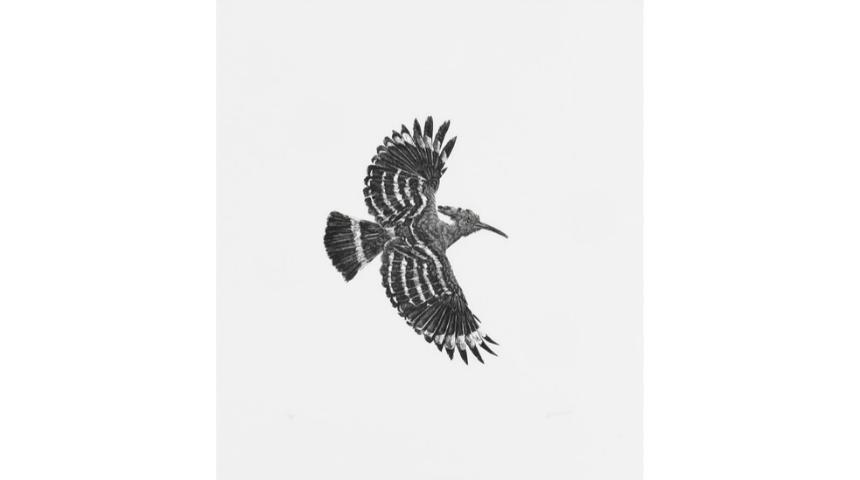
Ali Kazim Hudhud (2025) Etching and aquatint on Somerset Satin White 300gsm paper. Paper and Image: 49 x 43.8 cm. Edition of 25, Courtesy artist and Cristea Roberts Gallery, London © Ali Kazim
Kazim’s ancestral home is a village close to the ruins of the 3300-1300 BCE Harappan Civilisation. He has spent many hours walking the archaeologically rich topology of the area, where ancient artefacts rise to the surface when the plains flood in heavy rain. As the Editorial points out in The Neo Art Magazine, New Delhi, Kazim finds his alphabet ‘in South Asian urban and pastoral landscapes, like a falling wall, a tree, or a well.’ (3) A key literary text for Kazim, however, is not Kipling, but Farid-ud-Din Attar, the 12th century Sufi and author of the poem The Conference of Birds (Mantiq al-Tayr). Led by the hoopoe, a host of birds of many different types set out on a spiritual journey to find god, the legendary bird Simorgh. Some of the birds do not survive, but the thirty that do find that together they constitute the reflection of the divine. The Simorgh’s name means ‘the thirty birds’.
Spending time among Kazim’s works in the quiet of the gallery, away from the rush of the West End, the wide-open spaces in his works become, not blank, but more a state of mind, a linguistic medium, a philosophical plane. His hoopoe, an isolated monochrome etching and aquatint on white paper, Hudhud (2025), is suspended, like the tigers, in a dimension apart from time and space and physical material quality. The hudhud itself, graphic, granular, soot-black in hue, is a solid presence in a time of migration, flux and change, yet at the same time aspires to the state of myth. Its feathers appear to almost self-inscribe onto the paper surface beneath them.
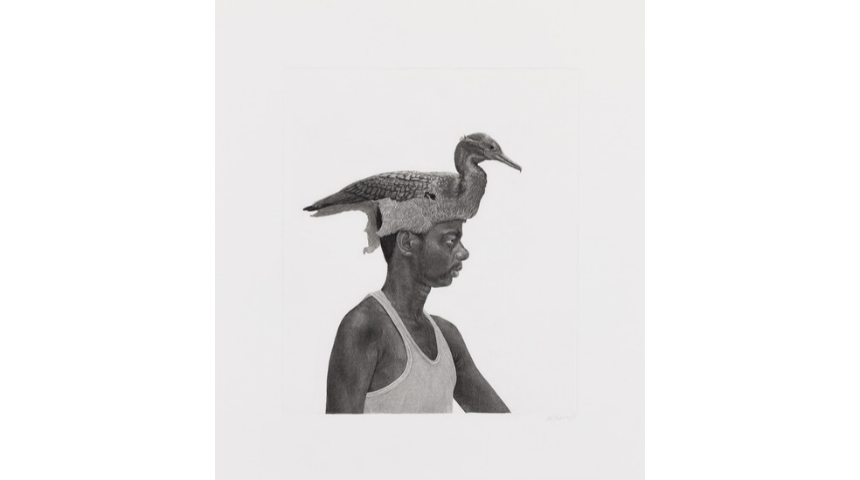
Ali Kazim Bird Hunter II (2025) Etching on Somerset Satin White 300gsm paper. Paper and Image: 48.9 x 43.9 cm. Edition of 20, Courtesy artist and Cristea Roberts Gallery, London © Ali Kazim
Kazim’s depictions of hunters wearing lures epitomise this mutability between states, this sighing through the passage of life. On the Indus River Delta in the Mohenjo Daro region, bird hunters still use a 5000-year-old method, tying pet water birds such as herons onto hoops in the river. They then ‘submerge their necks in the water wearing masks made from real bird skins. They… mimic a swimming bird.’ (4) Kazim is fascinated by these decoy wearing hunters. In a sense he is documenting a living myth. With the onset of climate change, this way of life will soon die out completely, relegating these people to legend. But for now, they are living, luring, hunting, and one can’t help but imagine Kazim views them with the compassion and sensibility that his portrayals of the tigers confirm, these men who transfigure into birds on water and then back again when the day’s work is done.
While saving up enough money to come to England and study for his MFA at The Slade, he worked as a nurse. The delicacy with which he treats all his subjects, averting their gazes so that they never have to look out at us directly, the tenderness of his Siyah Qalam and pardakht brushwork, the contemplative enigmatic backgrounds, all testify to a care for his fellow humans (and animals) that one can imagine served his patients well. His portrait of the last Mughal Emperor Bahadur Shah Zafar (1775-1862), in exile in Burma (now Myanmar), also on show at Cristea Roberts, depicts the old man lying mournfully on a divan, with a shisha pipe in his hand. It is copied from the last photograph ever taken of him. At first this seems incongruous, in comparison to his other works, so deeply original and laboured over. But here again is this overriding love of humanity, that stays with you long after you have left the exhibition to rejoin the business of London.
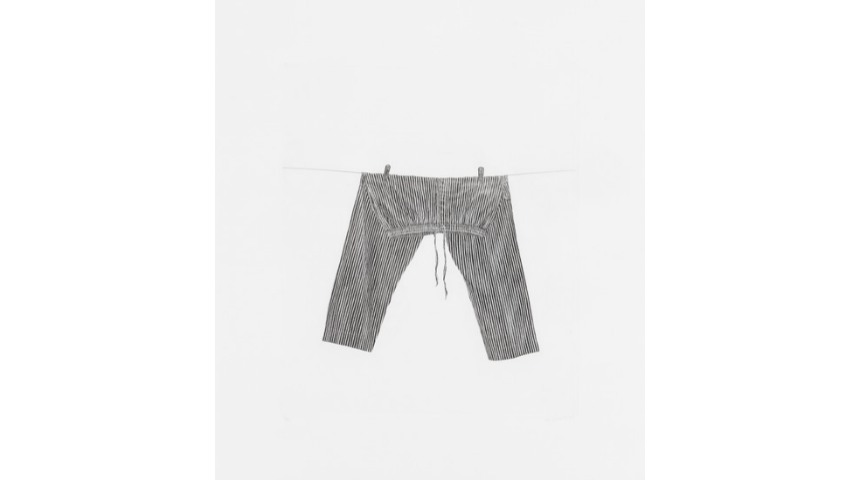
Ali Kazim Pyjama (2025) Etching and aquatint on Somerset Satin White 300gsm paper. Paper and Image: 49 x 43.8 cm. Edition of 25, Courtesy artist and Cristea Roberts Gallery, London © Ali Kazim
Footnotes
(1) Met Museum https://www.metmuseum.org/art/collection/search/499564
(2) Victoria and Albert Museum Research Project John Lockwood Kipling https://www.vam.ac.uk/info/research-project-john-lockwood-kipling/
(3) The Neo Art Magazine, New Delhi, India https://tnamag.xyz/exhibition/urdu-worlds-exhibition-dubai-review/
(4) Olson & Farlow, Editorial Images, Bird Hunter With Decoy, Indus River | Mohenjo Daro, Pakistan
https://olsonfarlow.com/editorial-images/bird-hunter-with-decoy-indus-river-mohenjo-daro-pakistan
This review is supported by Cristea Roberts