
FEATURE Sept 2026 Michaela Yearwood-Dan ‘The Practice of Liberation’ at The Whitworth
David Hancock & Maisie Rodgers
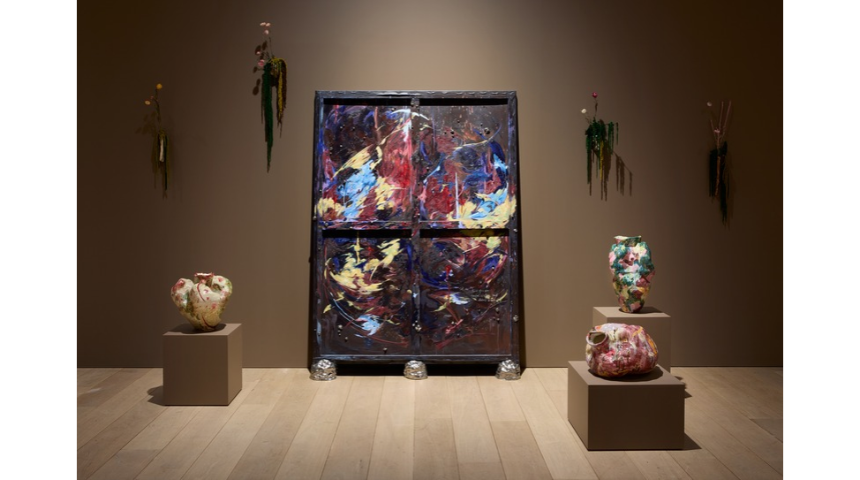
Michaela Yearwood-Dan, The Practice of Liberation (2026) installation view at the Whitworth © the Whitworth, The University of Manchester. Photographer: Michael Pollard.
Currently on show at the Whitworth, Manchester is Michaela Yearwood-Dan’s ‘The Practice of Liberation’, her first UK institutional solo exhibition. The artist presents her newly commissioned immersive installation incorporating painting, sound, ceramics and furniture. Fine Art lecturer, artist and writer, David Hancock, proposed Yearwood-Dan’s exhibition as a Widening Participation Summer Research Project for a second-year student at University of Salford.
Michaela Yearwood-Dan’s solo exhibition, The Practice of Liberation is an exhibition that occupies the senses. As a choral soundtrack drifts across the space, there is a strong desire to touch the tactile paintings and ceramic forms. Handwritten declarations of love, faith and resilience spill from the canvases. It is heartfelt and unaffected. The work feels bodily in the space, inviting a response.
It was this invitation to respond that formed the basis of a Widening Participation Summer Research Project at the University of Salford. For the past three years, the University has offered thirty-two Summer Research Bursaries to second-year students before they embark upon their final year of undergraduate study. The Summer Research Programme seeks promising undergraduates from underrepresented backgrounds, providing hands-on, paid experience of research during the summer break. Funded by the Doctoral School and the Brian Oldroyd Trust, I proposed a project based around the questions raised by Yearwood-Dan’s The Practice of Liberation.
The starting point for both Yearwood-Dan and the Summer Research Project is theory. Borrowing from bell hooks’ Theory as Liberatory Practice (1991), Yearwood-Dan similarly saw theory as a place of sanctuary, a place, to quote hooks, “where I could imagine possible futures, a place where life could be lived differently.” The exhibition became a jumping off point, a physical and conceptual space, and the beginning of an artistic conversation. For the student, what strands of research might be pulled from a deep engagement with Yearwood-Dan’s work? How could an exhibition become the catalyst for new work? How might another artist's practice encourage a student to question their own work?
BA (Hons) Fine Art student Maisie Rodgers was selected to undertake the project, developing her own research question alongside the production of a body of work supported by reflective writing. The brief asked Maisie to consider in relation to both hers and Yearwood-Dan’s practice the following questions: How can decoration function as a political language? In what ways can colour and abstraction communicate lived experience? How does a gallery space become an extension of domestic or intimate space? How can joy and pleasure operate as forms of resistance? What role does text or poetry play within visual practice? In visiting Yearwood-Dan’s exhibition, we hoped to answer some of these questions.
Michaela Yearwood-Dan is a London-based interdisciplinary artist whose practice spans painting, installation, ceramics, sound, poetry and spatial intervention. Her work explores Blackness, queerness, intimacy, pleasure, spirituality, ecology and domestic space. Through richly layered surfaces, expressive colour, handwritten text and immersive environments, she constructs spaces that centre care, joy and self-definition as radical political gestures.
The exhibition opens with what feels like an altar. A large canvas, painted on its reverse, exposes its stretcher bars, creating a cruciform structure that anchors the space. Three ceramic vessels surround it, one noticeably slumped, their bodily forms suggesting both fragility and resilience. They recall the three Marys gathered beneath the Cross, while simultaneously referencing the malleable forms of Ghanaian bolga baskets and Christ’s first miracle of turning water into wine. Yearwood-Dan has spoken of the exhibition as following the structure of the Stations of the Cross, presenting fourteen devotional works across the gallery. Religious symbolism is never presented as doctrine but as a framework through which intimacy, care and liberation might be experienced.
The painting, scattered with gold and silver glazed pebbles, reads, “I'M HERE IN MY BODY, I'M HERE IN MY SKIN, I'M NOWHERE BUT HERE.” The declaration feels less like affirmation than an act of grounding, insisting upon presence within a world that has historically denied visibility to certain bodies. Tiny dashed marks scatter across the painted surface like distant figures viewed from above, swirling in the cacophony of paint. They might equally be read as stars or fragments of notation. Uniform in their rendering, they recall the miniature figures that populate John Martin's apocalyptic landscapes, yet here catastrophe gives way to communion. The paintings remain expansive without becoming overwhelming, balancing monumentality with moments of extraordinary intimacy.
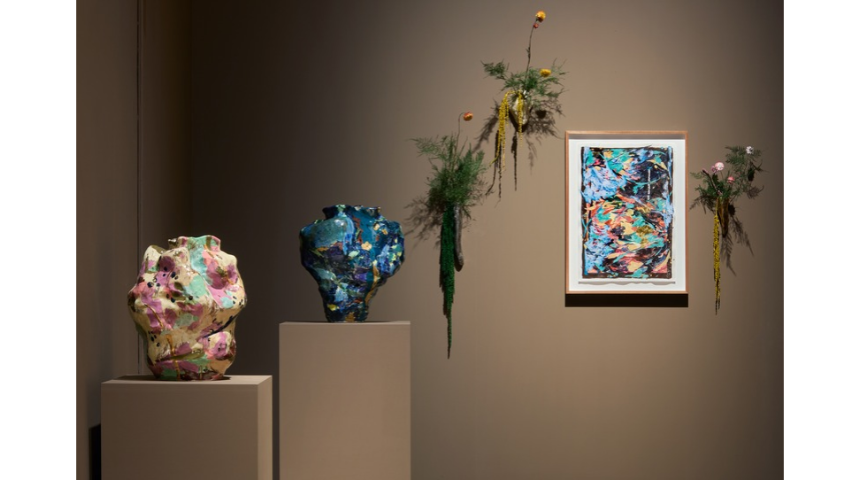
Michaela Yearwood-Dan, The Practice of Liberation (2026) installation view at the Whitworth © the Whitworth, The University of Manchester. Photographer: Michael Pollard.
The work itself speaks visually, sonically and textually. A soft, low soundtrack resonates across the gallery. A long, drawn-out saxophone reverberates. Strings glide across the surface of the works. A tinkle of piano. A gentle murmuring of phrases, harmonising. A choir intoning words that remain difficult to distinguish. Though muffled and barely audible, the sentiment mirrors the scrawled text across the paintings: “AINT NO SHAME IN ME”, “DONT THINK IM NOT STRONG”, “YOUR VOICE”. Quieter phrases, written without capitals, read, “I want to give you my life, or at least something for you to cherish”. Across the bottom of one work appears the line, “I ONCE WAS LOST, BUT NOW I’M FOUND, WAS BLIND, BUT NOW I SEE”. Running down the side, “I REACH OUT FOR THE PART OF ME THAT LIVES IN YOU”. Small handwritten notes are attached directly to the paintings on tracing paper or pastel pink sheets. One reads:
“Its OK to smile.
To love,
Be loved,
To desperately seek you.
To yearn to know that happiness,
And want to live a life…”
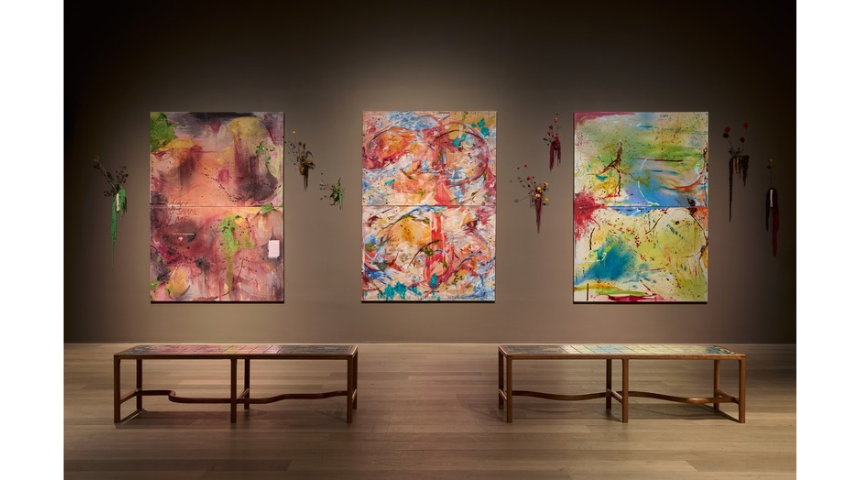
Michaela Yearwood-Dan, The Practice of Liberation (2026) installation view at the Whitworth © the Whitworth, The University of Manchester. Photographer: Michael Pollard.
The earnestness pours from the page. Some might dismiss such declarations as overly sentimental, but within the atmosphere Yearwood-Dan constructs they feel entirely warranted. Contemporary art is so often ironic or ambiguous, but here, vulnerability is embraced without apology. The handwritten texts are not explanations, instead they function as painterly gestures in their own right, layered alongside pigment, glitter and glass. Rather than illustrating the paintings, language becomes another material.
For Maisie, this openness became one of the defining aspects of the exhibition. Starting the Research Programme, Maisie was nervous due to the differences between Yearwood-Dan’s work and her own. Yearwood-Dan’s work was abstract, whereas Maisie’s was figurative, and the exhibition discussed Yearwood-Dan’s relationship to Catholicism, a topic Maisie is unable to relate to. But these worries were quickly dissipated. Maisie was struck by Yearwood-Dan's willingness to reveal emotion without embarrassment. It prompted an uncomfortable but productive question within her own practice. If Yearwood-Dan could be unapologetic in expressing who she is, what aspects of herself had remained hidden within her own work?
Yearwood-Dan's attempt to create a sense of reverence within the exhibition space has its roots in Rothko's Seagram Murals (1958-59/60), Bill Viola's immersive installations, and Chris Ofili's The Upper Room (1999-2002). The whole gallery becomes a single immersive work, held together by Alex Gruz's soundtrack and the placement of hand-pinched ceramic vessels spilling with dried flora.
Two paintings sit directly on the floor, sunk into heavy spherical clay forms glazed in bronze and gold, the precious surfaces belying their lumpen mass. Rendered on their reverse, the stretcher bars remain visible beneath swirling veils of colour. Across one central support Yearwood-Dan has written, "I THINK WE MIGHT BE WALKING TO THE DEATH OF LOVE-----". Yet the work is far from mournful. Joyously, they revel in the aftermath of the party. A trail of bunting draped across the upper portion attests to what was once a glorious celebration.
The artist's body is as present throughout the exhibition as the soundtrack itself. We can sense her breathing in the pulsating marks and intoning chords. The scattering of vases, lumpen and corporeal, smeared with coloured glazes, a smattering of gold glints in the dimmed lights. The paintings themselves are rendered in the lightest of marks. Poured and stained into the surface of the canvas. We see drips and sweeping swatches of paint. Strokes dance across the surface. It is easy to envisage each movement that Yearwood-Dan undertook in their creation. Dapples of daubed colour. Soaked brushes dripping as they are dragged and scumbled into corners. Stuck to the surface are splashes of glittery beads, sunk into paint or adhesive. On others, pebbles of glazed clay, in white and gold, embed themselves into the surface. The paintings are sensual and sincere.
There is a tremendous sense of feeling conveyed through the work. The artist laying themselves open to the audience, unedited, and passionate. The soundtrack heightens this emotional intensity without becoming overbearing. Like a carefully judged film score, it slows the rhythm of looking. Visitors unconsciously linger in front of individual works, while moments of silence allow the paintings to resonate alongside the hum of the building, invigilators’ radios, and the footsteps of other visitors. The exhibition reminds us that moments of contemplation exist within our everyday lives.
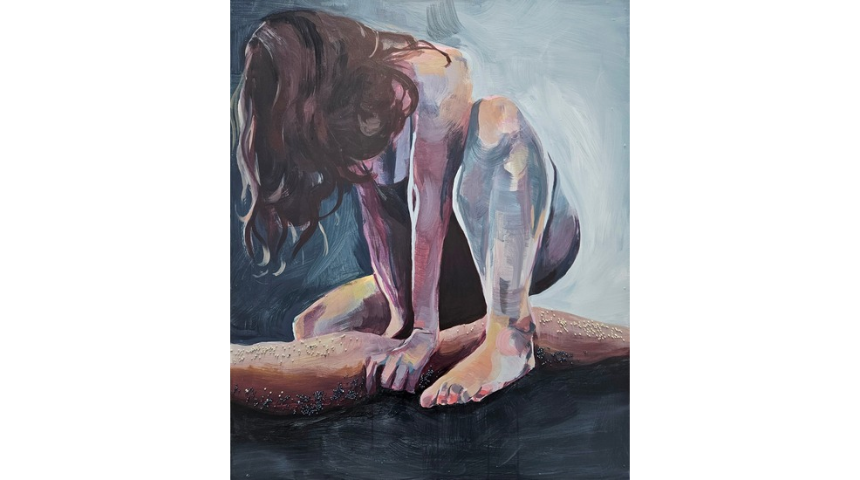
Image: Maisie Rodgers Crouch (2026) Acrylic, glitter and beads on board. Photo: David Hancock
It was this expanded understanding of painting that remained with Maisie long after leaving the Whitworth. Among the many elements of the exhibition, Gruz's soundtrack proved particularly influential. It enabled Maisie to be able to exist in the exhibition without feeling uncomfortable or aimless. She began to think about how sound might alter the experience of her own work, encouraging viewers not simply to look, but to dwell within an environment. This ultimately led to the production of a short sound piece using distorted recordings of slugs eating, extending her work beyond the purely visual.
Throughout the exhibition, the decorative elements within the work speak in languages through which joy, care and generosity are articulated. Pleasure itself becomes a political position. In Yearwood-Dan work, it becomes a form of liberation. This became one of the central questions within Maisie's own research. Yearwood-Dan’s boldness, use of decoration, and candour were key sources of inspiration in the development of Maisie’s work. Yearwood-Dan is unapologetic in expressing how she feels and who she is through her paintings. Seeing this encouraged Maisie to be braver with her own work. She was not interested in adopting Yearwood-Dan's visual language, but in understanding how her own recurring imagery might carry similarly personal meaning.
The recurring image in Maisie’s work is a slug.
As she later reflected, “I have used slugs in my work for a year, emerging from mouths or slipping between fingers, but I had never attempted to ask myself why I was so drawn to them.”
Inhabiting ambiguous bodily spaces, slugs had become familiar companions within her work, yet their significance remained largely intuitive. The Summer Research Project encouraged her to pause and interrogate this recurring motif rather than simply reproduce it. After some introspection, which she detailed in a small zine she produced as a way of documenting her research, Maisie realised that slugs have become a representation of the male sex, which she finds intimidating. Their representation and her interaction with them in her paintings, allows her to gain control. With this realisation, Maisie became more confident in portraying her ideas as she envisioned them. She worked to embrace both the body and the abject qualities of the slug.
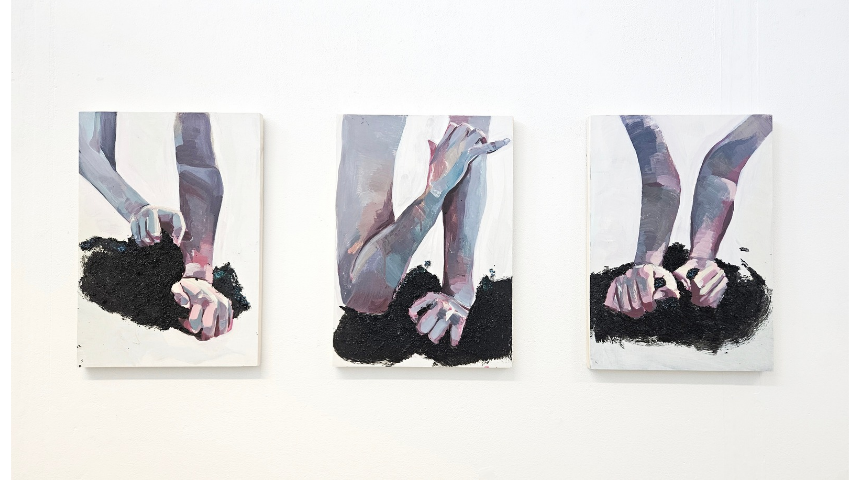
Image: Maisie Rodgers Hands #1-3 (2026) Acrylic, glitter and beads on board. Photo: David Hancock
Maisie also became more confident in stepping out of her comfort zone with the mediums she used. Yearwood-Dan’s mixed media practice inspired Maisie to make collages and incorporate that collage technique into video. Even though these ideas didn’t develop into finished pieces, they enabled Maisie to experiment with her relationship with slugs (in the collages the slugs were larger than the figure, and rather than the relationship being domineering, subconsciously, it was fun and playful) and experiment with sound and music.
Materially, Yearwood-Dan's influence also became evident. Glitter and beads, which appear throughout the work, are not simply embellishments. They affirm value, care and attention. Maisie adopted these materials within her own paintings, transforming the slug from a creature commonly associated with disgust into something unexpectedly delicate and beautiful.
The exhibition also led Maisie to expand her conceptual research. She started off with research on the Black fantastic, Black art and feminist art so she could better understand Yearwood-Dan’s practice. Maisie has struggled with organising and retaining research, so she used the research programme to improve her research skills. Maisie learnt she is a visual learner, so taking the time to compile her research into zines with pictures and colours helped her remember research and kept research in a neat place to refer back to. With support throughout the project, Maisie continued her research to look into the uncanny. The artists Kiki Smith and Paula Rego became key sources of inspiration. The uncanny led her to experiment with the composition of her paintings, using disembodied limbs and odd angles. Paula Rego’s work, in particular, became the inspiration for the ideas behind her painting, Skirt (2026).
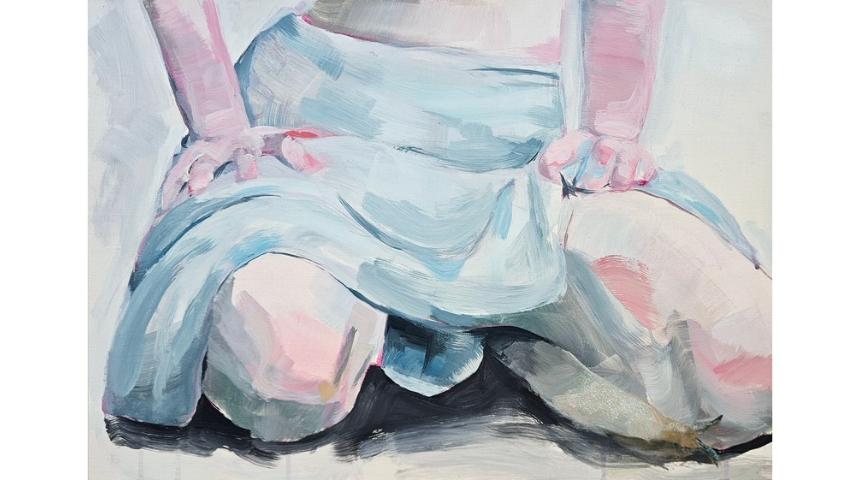
Image: Maisie Rodgers Skirt (2026) Acrylic, glitter and beads on board. Photo: David Hancock
What became increasingly apparent over the course of the project was that ‘The Practice of Liberation’ offers far more than visual inspiration. It proposes painting as an expanded practice in which installation, ceramics, poetry, sound and architecture combine to produce environments rather than isolated objects. For Maisie, the project was never about learning to make work like Michaela Yearwood-Dan. Instead, it became an opportunity to understand her own practice more deeply. The recurring presence of slugs, the incorporation of sound, the use of glitter and beads, and the production of reflective writing all emerged through sustained engagement with the exhibition rather than imitation of it. Looking became making, and making became a form of research.
This perhaps demonstrates the greatest value of the Summer Research Programme for Maisie. Here, The Practice of Liberation became the beginning of another conversation. Rather than ending on leaving the gallery, the exhibition continued to Maisie’s studio where it became a catalyst. Produced over a four-week period, Maisie’s paintings form a dialogue with those of Yearwood-Dan, discovering that the recurring motifs within her own practice already contained meanings she had yet to uncover. Perhaps this is the lasting achievement of the show. It demonstrates that painting can become a place of generosity, vulnerability, and affirmation, where making remains inseparable from thinking. These conversations continue long afterwards, carried into the studios of those artists who leave its galleries inspired not simply to look again, but to make.
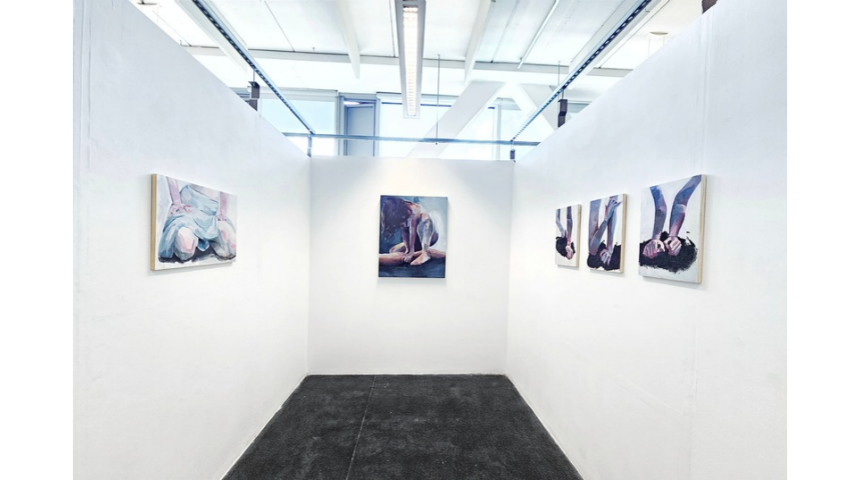
Image: Installation view of Maisie Rodgers Why Slugs? (2026). Photo: David Hancock