FEATURE Aug 2026 Weighted - Mahrokh Mofid Nakhaei
Charlie Currid
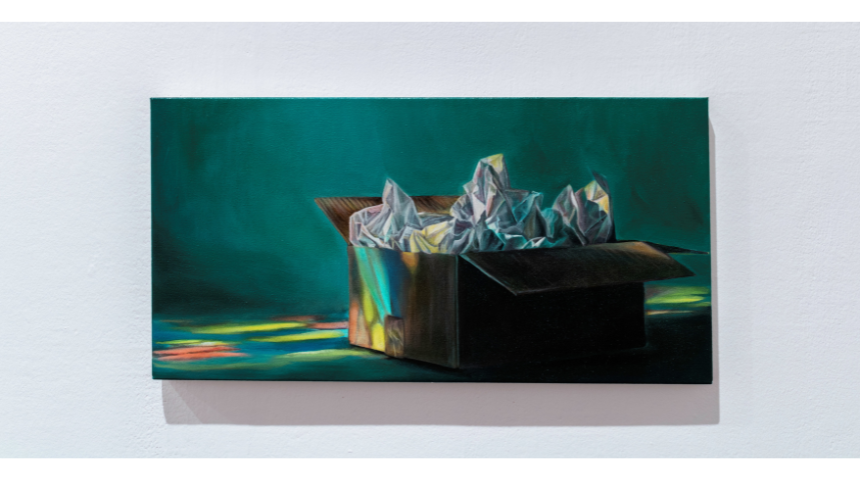
Mahrokh Mofid Nakhaei, Still Inside, No. 26, 2026, oil on canvas, 30 × 60 cm. Photo: Brendan McGregor.
Mahrokh Mofid Nakhaei is a painter of balloons, dimly lit dining rooms and haunting, empty photo frames. Originally from Iran, now based in Manchester, UK, her work often unfolds across four or five canvases, weeping into the corners of exhibiting spaces.
Artist and writer Charlie Currid recounts his experience meeting Nakhaei and visiting her studio, in the form of an extended dialogue.
I had spent the last week absolutely terrified. Amidst a concerning heatwave, I was finding it difficult to see sense in anything, and spent every waking hour tallying up my personal contributions to the climate crisis. It’s a debilitating activity, one we are (I hope, confusingly) all too familiar with. It acted like a defibrillator, a bolt of energy struck straight through my body, widening my eyes. It basically paralyzed me, yes, and put on blast my inability to deal with grief, but it also illuminated everything I value with a direct and intense spotlight.
I was looking for an outlet for some collective sobbing (think, Florence Pugh having her heaving cries mirrored by the Hårga in Midsommar). My optimism about the planet would hopefully return, but the problems circling my head are also circling everyone else’s, and in a world mandated by statistics and momentum and upward progression, we don’t allow ourselves the time or space to grieve. It is a comically dystopian concept, that a tragedy has utility in this way.
I was lucky then to speak to Mahrokh Mofid Nakhaei that weekend. Nakhaei is an Iranian painter based in Manchester whose practice is an exercise in environmental storytelling. Through a limited number of objects - balloons, table runners, champagne flutes - she explores worldly narratives of change, secrecy and displacement, told with a restricted twilit palette of colours. Her work has enough liminality and ambience that I could effectively cast my sadness right into the painted canvas surfaces while we spoke.
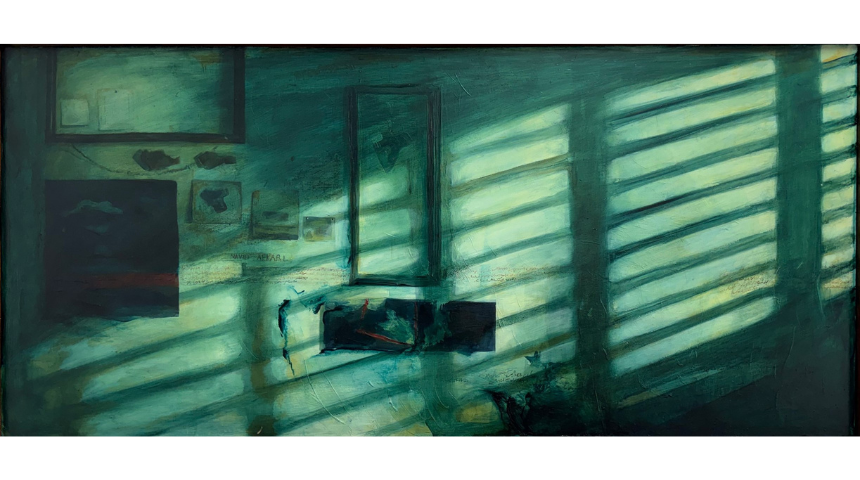
Mahrokh Mofid Nakhaei, Fragmented Messages, 2024, oil on board, 50 × 110 cm.
Backtracking a little, the first I saw of her work was ‘Containment No.2’ (2025), included in the Manchester Open 2026 at HOME Gallery. It’s a tetraptych of oil paintings, depicting a cluster of balloons lying underneath a table, from which hangs a swathe of delicate, lacy fabric. The height it was hung on the wall could have been irritatingly low to an artist, though, crouching down to take in the details of the painting, I was reminded of hiding under a duvet or behind a door at birthday parties. There was an almost instantaneous immersive quality to the painting and its installation, which is further explored on the artist’s own Instagram (@mahrokh_mofid_nakhaei), where she exhibits the four panels around a corner.
What interested me the most is how Nakhaei’s depiction of a dining table and tableware place her in the tradition of still life painting. My immediate opinion was that the piece transgresses the rules of the Dutch and Flemish Memento Mori, or Vanitas, paintings made to remind viewers of their vices, and their futility in the face of death. Skulls, hourglasses, wine, pricey fabrics – vessels painted in oils, used to explore dramatic stories of indulgence and inevitable loss in 16th and 17th century Europe. To explore this further, take, for example, Still Life with a Volume of Wither’s ‘Emblemes’ (1696) by Edwaert Colyer, a decadent painting of a table adorned with countless expensive items alluding to extravagance and enlightened living. However, shelved above the scene, hidden behind a wash of burnt brown paint, is a skull, situated next to a Latin inscription detailing the nature of vanity. The painting not only highlights the duality of life and death, it does a tremendous job transcribing our continued efforts, while living, to ignore death.
And it’s here where Nakhaei’s ‘Containment No.2’ seemed to take a unique spin on the genre: The piece revels in the destabilising nature of grief. For one, it does not contain happiness and sadness in equal measure (even the lightest, most vibrant areas of yellow paint felt sickly, muddied by the intense, artificial greens), but it also literally takes place underneath a table. We think of an arrangement of fruits, books and fancy glasses atop it. Rarely do we think of a still life happening beneath the same table. This has the same effect as shining a torch on the skull of Colyer’s ‘Still Life…’, centering the melancholic, and saturating its colours beyond sensibility.
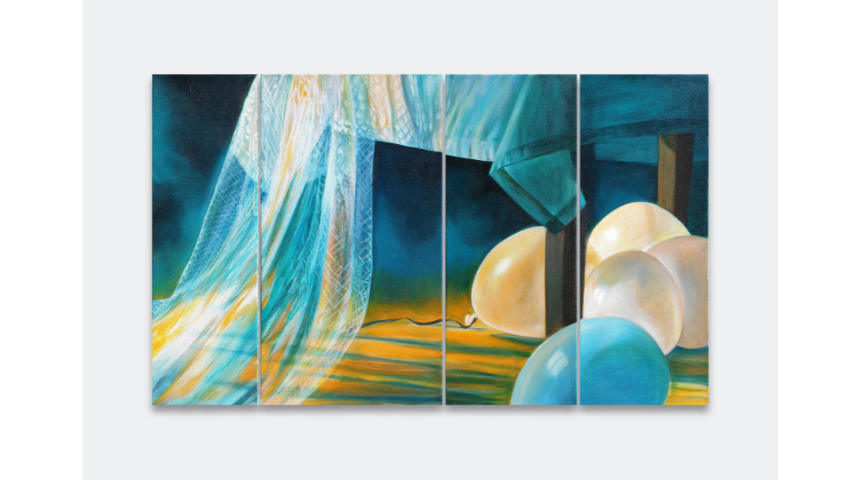
Mahrokh Mofid Nakhaei, Containment No. 2, 2025, oil on canvas, 50 × 85 cm. Photo: Tom Carter.
I arrived at her studio with lots of questions, keen to learn more in particular about her life, and her insistence on balloons. She appeared, led me to her studio, and showed me to one of two chairs she had already set out in preparation.
Nakhaei is an artist who, though relocating numerous times throughout her life, stays firmly rooted in the global contemporary art world. Before moving to the UK, she obtained an MA in painting from Sooreh Art University in Iran. A dab hand at photography too, she assisted in their photography darkroom. She recounts this period of her life to me as extremely busy, even referring to herself as an immigrant within Iran itself, constantly travelling between its cities.
It was while studying she discovered a love for the intuitive, grounding nature of life drawing. ‘Drawing is like swimming, driving a car, playing an instrument. It’s of the body. I’m connecting my mind, body and hands.’ She points as she speaks, ending the sentence by showing me her palms - I imagine another attempt to acknowledge her own physicality.
In 2024, she received a Master’s Degree from Manchester Metropolitan University, and shortly afterwards participated in the second cohort of the Apollo Painting School, a non-profit training programme taking place between Manchester and Latina, Italy.
I had expected to meet someone maybe a little unmoored; I myself am presently scraping together the money and evidence needed to apply for a Visa, and cannot imagine the fatigue she must be plagued with, having travelled persistently for the last few years. Couple that with her repeated ventures into academia, and I was sure she would be a very particular kind of tired. But amidst all this, she seemed unphased. She was able to laugh about her difficulty obtaining a Schengen Visa (which would have permitted her travel to Italy, though her application was denied), and calmly talked about the changes we were both seeing in immigration legislation and climate politics. I’m immediately drawn to this clarity, this sense of self, and momentarily question what this room was before it was a studio.
I scan the room. There’s a wall of stacked frames behind her chair, encased in bubblewrap, and a set of curtains with scalloped edges hanging above the window. They drape onto a circular saw, which she uses to cut her own stretcher bars, and onto a table with a microwave, roll of kitchen towels and one of those ‘Cobalt Blue’ Cass Art tote bags. The studio had all the excuses to be messy: curtains to hide things behind, numerous paintings on the go, a woodworking station and makeshift kitchen, but she had clearly put considerable effort into staging our meeting. To my left was a table with snacks of varying calorific content - ‘In case you [Charlie] don’t want any sugar’.
We talk about owning a space. For her, ownership is fundamentally transitional. ‘As an immigrant, I’m always changing. There is no fixed place for me, everything is changing constantly. When I moved to the UK, at that time I left everything in Iran. The school [Manchester Metropolitan University] gave me a studio… I would hang pictures from Iran on its walls.’ The paintings around me lie witness to her displacement, each adorned with signifiers of a life uprooted. Glasses are left unpacked, frames without photographs hang on walls, and, though I mistook it initially for a bolt of fabric, a roll of bubblewrap sits inconspicuously on the leftmost panel of Department 17 (2025). Building, stretching and framing her paintings is an act of homemaking, each piece a handmade portal to an illusory home somewhere between Iran and the UK (Tehranchester?).
There is something very affectingly superficial about the objects, in that they are universally understood signifiers of domesticity. Without direct references to her upbringing, or visibly Iranian ephemera, the work can be digested quickly by a multicultural audience. This is by no mistake - ‘How can I make an image in an international way?’ she asks me, before answering herself: ‘I choose my world in words. I want a balloon. I want a window. I want three of them [paintings]’. She expands on her uses of balloons, and their lying down in her work, saying that recent Iran has experienced so much political turmoil, and that there is a ‘collective waiting’ among the Iranian people. ‘The balloons are heavy. They are not allowed to celebrate.’
Confining herself to telling stories through objects, the works have an inherent multiplicity or ambiguity, though, I’ll admit, it does make me question the necessity of painting, when playing with proxemics might be easier in a sculptural or archival practice. What she convinces me of, however, is that painting grants access to a psychoanalytical world (which I will once again refer to as Tehranchester) that is essential for her to step into. Without it, the transformation of such weighty, difficult topics into aesthetically rich images would not occur, and the immersive qualities of her work could suffer.
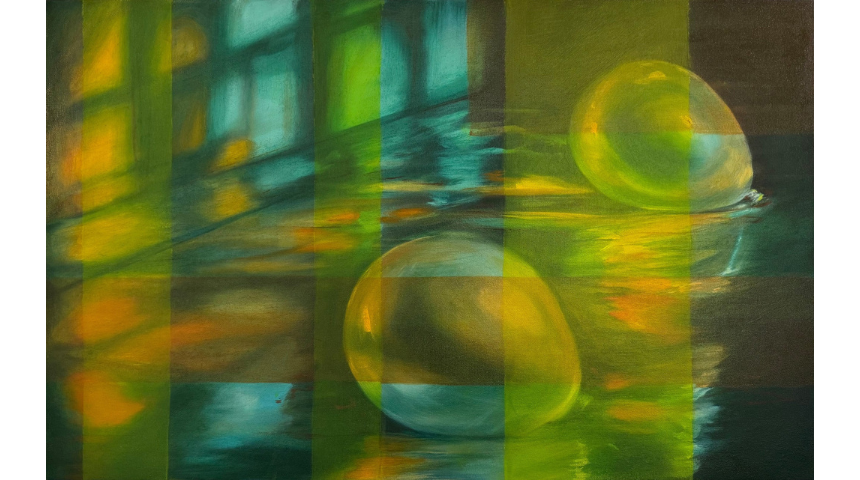
Mahrokh Mofid Nakhaei, Second Position No. 3, 2026, oil on canvas, 50 × 80 cm.
More recent works include an as yet untitled set of paintings of champagne flutes, painted in vibrant blues and oranges, a marked departure from her typical phthalo greens and browns. In the context of the studio, they seem to forecast a sense of security. Placed next to ‘Behind the Room No.7’ (2025) (which features various glasses in a cardboard box), it appears as the ‘unboxing’ of her, as she makes a home in the UK. The application of paint is fluid and repetitive, a series of dancing lines mapping the contours of the flutes in shades of gold.
Paint itself becomes an interesting vice in her work: Deciphering the origins of each pigment used in Nakhaei’s highly pigmented paintings would be too mammoth a task to undertake in the studio with her, but this itself says lots about the peculiarities of painting in the contemporary world. The flutes gesture towards bourgeoisie lifestyles, the colours reminding me of a boozy party scene from La La Land (2016), painted by an Iranian artist based in Manchester. I notice here too the influences of the Apollo Painting School in the disciplined movement of paint. It is effectively a transmuting cocktail, one that, when drunk, has the effect of spreading the drinker thin to the point of almost translucence. I wonder, presently, about the artist’s presence in the work. True, she has succeeded to make images in a supposedly international way, both in their conceptual and material content, but there is scope to imagine that some pigments have experienced a similar displacement to the artist, and their inclusion might indicate more about her identity (rather than the synthetic make up of phthalocyanines) without sacrificing the accessibility of the piece.
It would also be fair to say, however, that it is this exact disconnection from the earth that permits the opening of ‘The Marvellous’s gates, a world born from disenfranchisement and strained relationships with our respective environments. That this is a characteristic of not only Nakhaei’s, but generally the audience viewing her work too, crosses my mind as I gaze at Seventh And A Half Compartment (2026), wiping sweat from my brows, wondering how in hell we have managed to distance ourselves so vehemently from the custodian responsibilities we should assume. Light brushes of colour on the curved surface of the balloons shout out to me - Keep Going! - in shades close to those of shimmering oil on a roadside, crawling down a drain.
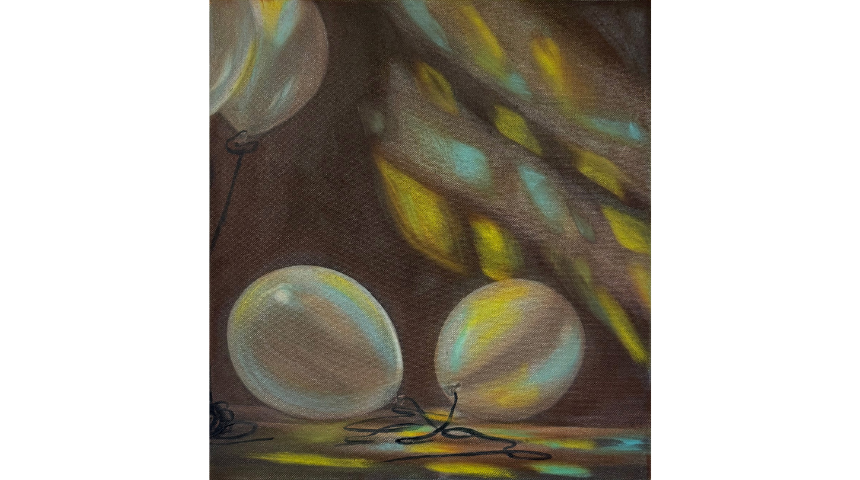
Mahrokh Mofid Nakhaei, Seventh and a Half Compartment, 2025, oil on canvas, 34 × 36 cm.
It weighs on my mind, as we wrap up our conversation, that neither of us can paint our way out of problems, that art is a drawn out way of rolling with the punches, and that indulging in escapism feels simultaneously crucial and impossible. It is only when we find ourselves in desperation that we realise the gap between our imagined world - one with wide open spaces to fill with grief - and our reality - where our worries are turned into capitalistic exploits - is insurmountably large. Even still, this realm, the ‘Marvellous’, ‘Tehranchester’ maybe, that Nakhaei’s paintings depict is one accessible to us all. Nakhaei toys with the conventions of still life [and] Vanitas paintings to venture into a world of melodrama, more interested in the poetic fervency of a David vs Goliath dynamic than Goliath’s eventual toppling.
She shrugs a little while telling me that at one point she took up Iranian singing, though she doesn’t like to sing in front of others. She believes that learning to play an instrument for accompaniment would encourage her to do so. I leave her studio the same way I went in: pondering the existence of a place not to call home, just somewhere to communally sing, yell, and cry. Her ostensibly international images appear to me now as invitations, and for what it’s worth, I hope she continues to fill the balloons with Iranian singing and doleful screams, hopeful that they will burst even louder.
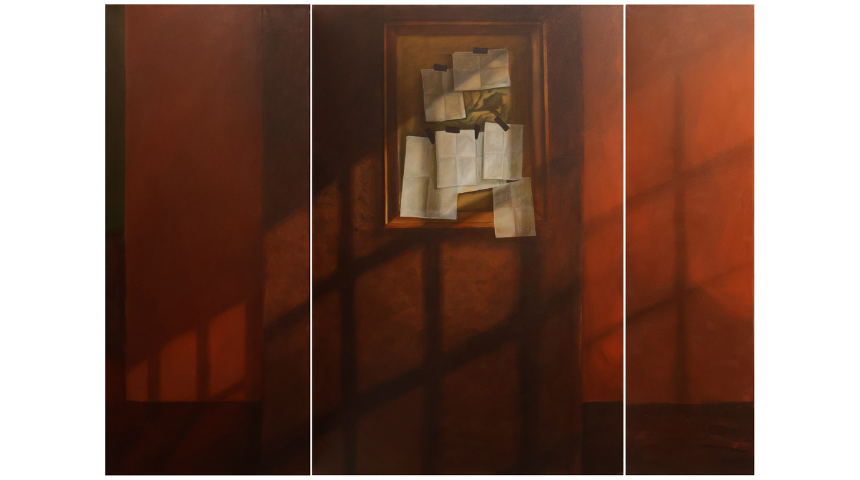
Mahrokh Mofid Nakhaei, The Sixth Wall, 2025, oil on canvas, 195 × 137 cm.