REVIEW Jul 2026 ‘Useful/Beautiful’ at Blackwell - the Arts and Crafts house
Kirsty Jukes
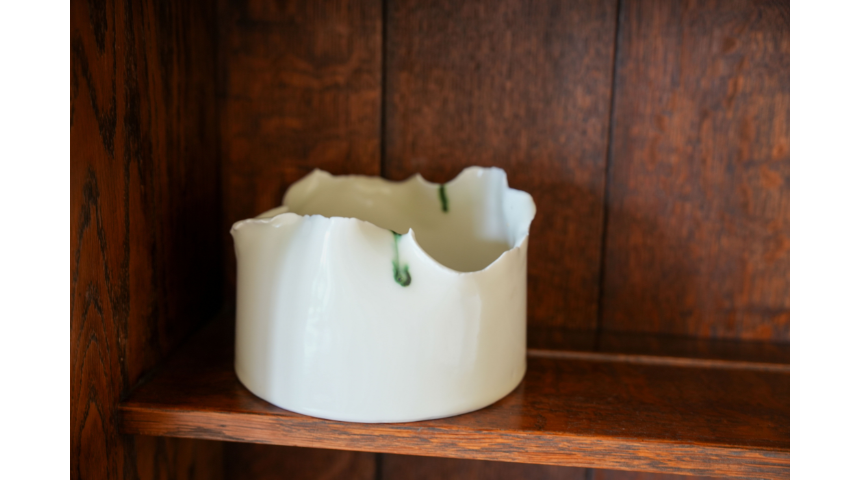
Chun Liao Tall Bowl is on the daffodil dresser at Blackwell, Photo Natasha Suriya for Lakeland Arts
Art historian and writer Kirsty Jukes reviews ‘Useful/Beautiful’ at Blackwell - the Arts and Crafts house, Bowness-on-Windermere. This exhibition marks twenty-five years of contemporary craft collecting and celebrates the makers, ideas and objects that have shaped the Blackwell since opening its doors to the public in 2001. Much-loved works from this nationally significant collection sit throughout the house alongside more recent additions. Visitors can rediscover standout pieces by well-known artists and explore how craft can tell stories about materials, making and everyday life. ‘Useful/Beautiful’ is on view until Saturday 29 August 2026.
On a warm and busy Windermere Saturday, I welcome the ride out of the town centre away from the wandering crowds of tourists. I am on my way to see ‘Useful/Beautiful’, an exhibition containing a quarter century of craft collecting on display at Blackwell - the Arts and Crafts house just over three miles away. Looking forward to seeing stunning pieces in the cool of the building's interior, I can picture sunlight refracting and reflecting off each surface. Windows down and breeze flowing in, the bustle of people and rows of shops blur until they give way to the coolness of treelined lanes, stone walls and the occasional B&B. This landscape is interrupted briefly by flashes of Lake Windermere. In less than ten minutes, we turn right into a curved driveway and come upon a surprising sight - a field of grazing Hebridean sheep.
Coarse black wool contrasts with rough lime-washed walls of the main house, multiple sets of horns and uncanny, almost human responsive bleating all cause me to leave the vehicle early to get a closer look. They briefly mirror my gaze before resuming their chewing. Originating in Scotland, this breed was brought to England in order to maintain lawns on the estates of the gentry, making these sheep the very definition of useful and beautiful. Entering the main house via an oak-panelled broad corridor, my eyes are drawn left to the high-ceilinged drawing room. Warm rays stream in through the bay window next to a grand inglenook fireplace, a detail repeated in the adjoining room, this time through delicate stained-glass panels.
Everything here is functional and refined. All the fixtures and fittings are signifiers of the building's namesake, a movement that embraces the skills of local craftspeople over mass production. There are also plenty of nods to the local area in friezes of plantlife and animals in wood, tile and glass. On the wall inside the permanent display upstairs is a quote from architect and designer of Blackwell, Hugh Mackay Baillie Scott. In it he states that “the love of the workman for his work is the essential difference between the lifeless commercial product and the vital work of art.” He certainly carried this with him throughout the design stages of the Blackwell and the difference it makes to the feeling of the place is clear to me each time I visit. It is this sentiment that also applies to each of the objects selected for ‘Useful/Beautiful’, stunning to look at but with utilitarian details.
Spread across both floors of the house and in practically every room, they form a kind of treasure hunt. Much like the Hebrideans grazing outside, each object sits harmoniously in its space just as though it had always been here. There is a mix of furniture, crockery, storage, lighting and decorative pieces by makers from across the world, some in the permanent collection, some on long-term loan and others newly acquired. From the ever recognisable dappled blues and creams of Lucie Rie’s thumbpots to the textured earthenware tea ceremony bowls of Masaaki Shibata, from the milky delicacy of Chun Liao’s collapsing porcelain piece to the figurative embossing of Magdalene Odundo’s wide and sturdy fluted bronze vessel, the breadth of style, medium, function and place of origin pleases my curiosity.

Chris Day Strange Fruit (The Congregation) (2012) Photo Robin Zahler
Next door to the permanent exhibition space are two rooms full of objects newly acquired for Useful/Beautiful. These most recent acquisitions were made possible by the Art Fund’s Sir Nicholas Goodison Award. This award enabled curator Naomi Gariff to conduct a sustained piece of research and rethink the Blackwell’s contemporary collecting practices as well as safeguard the collection by bringing more of it into their ownership. Before research started, generous supporters offered pieces from their own collections to display in the house. Up to now, 84% of objects were on long-term loan from a small number of lenders, meaning at any moment Blackwell could have lost a significant proportion of them.
This was obviously not ideal for curatorial programming or for guaranteeing permanent access to these objects. There was very little contemporary craft acquisition going on and according to Gariff, this was never a part of the organisation's Collection Development Policy. Three years of research and acquisition made possible by the fund allowed Gariff to travel up and down the country visiting makers' studios and other museum and gallery collections. The resulting Collection Development policy embraces four key values inspired by the Arts & Crafts movement itself:
● Creating beautifully crafted objects
● Embracing nature and natural materials
● Championing the continuation of heritage craft skills
● Driven by ethical principles and/or advocating for radical social change.
Makers who fit all the requirements of the new collection policy proved hard to find; however, when she did find them, they existed in a kind of ecology, much like the Arts & Crafts Movement itself. Learning about specific materials and practices native to certain places is the most special part of this exhibition. One thing is certain, the opportunity created by winning the Sir Nicholas Goodison Award has made a deep and genuine impact on the collection and has shaped what acquisitioning will look like in the future for Blackwell and Lakeland Arts more widely. Gariff states that it occurred to her that there was an inherent tension between the historic and contemporary collections:
“On the one hand you have the historic collection, which is made up of domestic objects (furniture, lighting, fire irons etc) very much in the ethos of Morris to be useful and beautiful, and on the other you have the studio ceramics, which by their nature are ‘form over function’. I found that to be an interesting dichotomy, how these two collections that contradicted each other had come together in such a harmonious way. But it did make me think about the purpose of our contemporary collecting and whether that useful element, which was such an intrinsic value of the Arts & Crafts Movement, should be at the forefront of our contemporary collecting too.”

Annabel Hood Glacial Flow Teaset on display in White Drawing Room. Photo Robin Zahler
Works are complemented by fascinating wall texts that allow the reader to visualise rarely seen and at risk practices. My favourite piece has to be Annabel Hood’s Glacial Flow Tea Set and Sketch Book (2018-19). The set consists of four pieces of hand-engraved silverware – a teapot, milk jug, cup and strainer – each small but substantial in form and complementing the next. In a separate case alongside is a bound paper sketch book with intricate drawings of glacial flow patterns. Chunky quadrilaterals of Scottish bog oak form the lid and side handle of the teapot, jutting out and dwarfing the rest of the set in an angular fashion. Semi-fossilised wood will have been preserved after falling into a peat bog reminding the viewer that the conservation of the ancient parts of this world relies heavily on our actions regarding climate change.
The effects extreme weather will have (and already has had) on our lives directly causes melting glaciers, dries up water sources and burns down forests, all of which are sources of life and inspiration for this creation. Hood’s beautiful bound paper sketch book reveals intricate drawings of glacial flow patterns that have been co-opted into the etched designs across the surface of the silverware pieces. Products of research with Glaciologist Professor Peter Neinow from University of Edinburgh have produced pale, winding water and ice forms that snake across the pages. This work is thought provoking and moving; I stand there a long time to drink in its details.
Also in this space are fine examples of basketry, one woven and the other tanned leather. Lorna Singleton’s woven oak and ash Spelk Baskets (2024) are a hyperlocal example of critically endangered craft. Made in Grizedale, Cumbria, Singleton grows and harvests her materials from local woodland. ‘Spelk’ is a local dialect word for splinter and references the way in which the wood is formed into thin, weaveable strands for the body with a steam bent handle. There are two baskets on display here, one larger, round bottomed form similar to a flower basket and another smaller handheld one in a Scandinavian style. Traditionally used for swilling cockles in the sea, they echo the ethos of many other pieces here in the way they remind me of times past whilst being truly decorative and functional for now. Just opposite on the central podium sits Iseabel Hendry’s Cruinnich (2023). Made from Scottish oak, red vegetable tanned leather and recycled nylon, it also employs steam bending to achieve its sculptural, spherical shape used for gathering. A wider crescent of bentwood backed in punched patterned leather is connected to a thinner handle that closes the circle.

Mac Collins Iklwa Chair (2024) Photo Robin Zahler
This is a zero-waste, vegan object using by-products of local farming and traditional methods employed in the creation of fishing boats in the Outer Hebrides. The materials are both biodegradable and recyclable making it a much better option for the environment than the plastic contained in manufactured pleathers. There are more items here I want to highlight such as Mac Collins Afro-futurist, throne-like Ikiwa Chair (2024) and Dalia James natural dyed, silk Blackwell Wall Hanging (2026); however, I feel the need to leave at least some of what is here to be seen in person.
In the room next door are a series of ceramics by Manchester-based artist Stephen Dixon displayed in rows on wall mounted shelves. Catching sight of them first upon entering the space, they are spread out much like a display of trinkets in the home. Upon inspection, their partial submersion in a layer of cracked red clay brings up in me a feeling of unease and I am keen to know more. The Passchendaele Series (2017) were made on the centenary of the Battle of Passchendaele to commemorate one of the deadliest conflicts of World War One. In waterlogged fields in Belgium, up to 500,000 lost their lives in 100 days with neither side making significant gains. Images from the site show an impossible landscape, barren, battle-scarred, swallowing up everything as far as the eye can see. Many of the soldiers who died were buried in the mud there, never to be recovered.
At home, British society on the whole seems dedicated to fiercely commemorating this conflict and others that follow but remains seemingly unable to learn any lessons from mass loss of life or to take proper care of those permanently scarred by proximity to war. These types of commemorative figures are familiar to me from my grandparents' ornament cabinet and wandering around antique shops which are often full of these objects.
Consisting of white porcelain with pastel painted detailing often in the shape of soldiers, weapons or memorials statues, Dixon’s collection is semi covered by a layer of cracked red clay. They are even more harrowing when considering the full context and I am most drawn to a bust of a ‘Tommy Atkins’ figure covered to just below his blank, painted blue eyes in mud. The effect is suffocating to look at. Whether soldier or not, the effects of wars are far ranging and long lasting. This collection of works puts me in a mindset to question just how much society has learned and changed over the past century, who is commemorated and who is forgotten and the uncomfortable truth about how much British society remembers the dead but can forget the living very quickly when the next opportunity for war comes around.
I ponder all of these questions on my way out. To my left, two playfully rendered Madonnas sit squatly above a stairwell recess as if proffering blessings on leaving guests. They are by the inimitable Philip Eglin and their brilliance comes from the perfect melding of the Gothic with an almost modernist abstraction of the figure. Expressive faces and cervine necks give way to a chunk of legs like cricket batting pads. They are whimsical and cheer me up somewhat. I feel as though there was something for every taste here. Those interested in art and design have a variety of objects to be inspired by, those interested in history have work from across time periods to analyse, those interested in engineering can marvel at the means of production and everyone else can relax in a space made for quiet contemplation.
I particularly enjoyed slowing my looking right down and letting my eyes wander (and wonder) over the surfaces of such stunningly different objects looking for clues about the makers. I learned a lot about different creative processes, through the research, design and building phases, as well as the ways in which craft can be a conduit for social, political and environmental concerns. Newer principles of contemporary making, such as ethical concerns surrounding the use of certain materials and the urgent need for the amplification of marginalised makers' voices, all sat in perfect harmony with historic lessons taught by craftspeople from the past whose voices echo all around. Blackwell - the Arts and Crafts House (and by default the local area) is richer for this opportunity to expand its collection and I hope more will come of Gariff’s research.
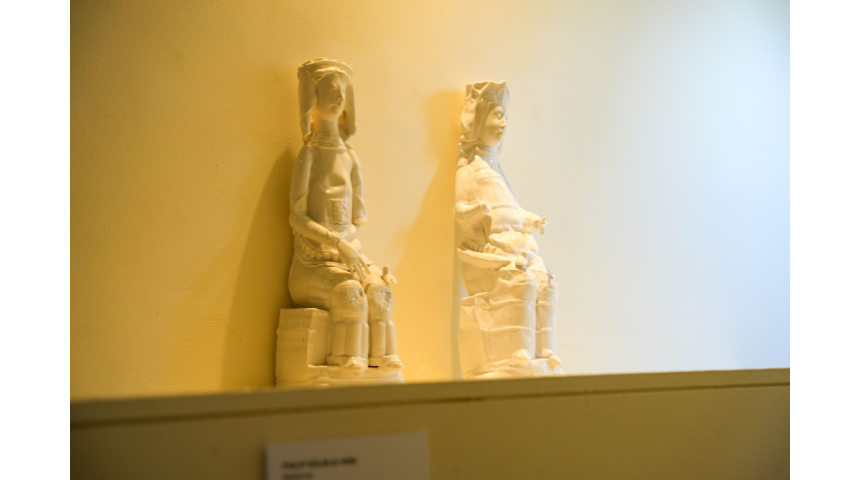
Philip Eglin Madonnas at Blackwell. Photo Natasha Suriya for Lakeland Arts
‘Useful/Beautiful’ runs until Saturday 29 August 2026 at Blackwell - the Arts and Crafts house.
Entry included with house admission. Pre book tickets online at blackwell.org.uk.
This review is supported by Lakeland Arts