FEATURE Jul 2026 Jude Wainwright: ‘Spectacle’ at The Whitaker, Rossendale
David Hancock
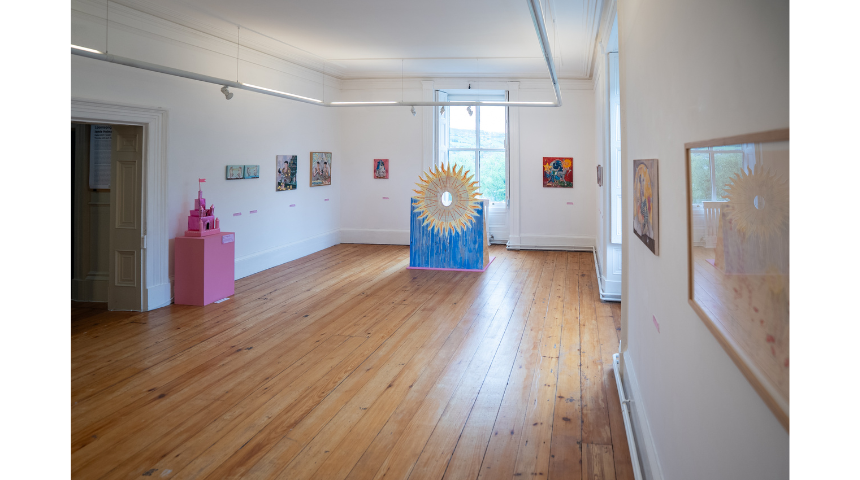
Jude Wainwright – Spectacle. Installation view at The Whitaker (2026). Photo: Courtesy of the artist.
Currently on show at The Whitaker in Rossendale is Spectacle, a solo exhibition by Manchester-based artist, Jude Wainwright, who presents her immersive exhibition of paintings, drawings, prints, and appliqué works. David Hancock visited the exhibition and then spoke to Wainwright about the exhibition and the intense period of production that culminated in Spectacle.
Spectacle by Jude Wainwright is on at the Whitaker until 27th September 2026.
https://www.thewhitaker.org/portfolio/spectacle/
On entering the upstairs gallery at The Whitaker, I am immediately transported to the land of Judtopia, a mythical realm of the carnivalesque that exists somewhere between dream and reality. The exhibition unfolds as a travelling circus, with multiple incarnations of Jude occupying centre stage. She is both performer and ringmaster, presiding over a fantastical menagerie of creatures and characters. Judtopia seems to sit somewhere between a fantasy realm, a personal mythology and a psychological landscape. I asked Wainwright what is Judtopia and what prompted her to create this world?
“It's like a make-believe place I like to go to in my head. It's my sort of perfect place. It's like building your own special place that you control. I want to say where nothing bad happens, but it's a dictatorship and I'm the leader, so nothing bad happens to me. It's never been written down or visualised. It's always been ongoing. Every so often I'll say, ‘I've got some beachfront properties in Judtopia if you want to come to one of them.’ It makes me feel happy to fantasise about this place.”
There is a recurring motif of sweets and treats being used as lures. I asked Wainwright how do we get to Judtopia? Wainwright replies elusively, “I'm not very good at giving directions. I must be in the moment to find my way there.” I suspect entry to Judtopia requires a particular way of seeing the world. Wainwright believes that “Judtopia is a state of mind.” When I ask who is being invited into Judtopia and whether it is a place that anyone can access, Wainwright replies quickly,
“Not everyone is invited. I've uninvited people that piss me off. It is a very real threat to say that you're no longer invited to Judtopia. It's mostly all my friends and family. I did have a badge that said, ‘my place is guaranteed’, which I used to give out. I never explained it, but I really liked that a lot of people got it. That they are part of it. I really love making up these wild scenarios in my head. My best friend Caitlin is the sheriff there and we always talk about what costume she'd like to wear. My mate Dan runs the bar, which he's not massively happy about, but we need a drink.”
Wainwright’s account reminds me of André Bretton’s description of the Marvelous. In his first manifesto, he talks about it being this ruined castle with loads of rooms, each one inhabited with one of his Surrealist friends. It's very exclusive and very male dominated. There are no women. Women functioned as the conduit to access the Marvelous, so they weren’t allocated rooms. I mention this to Wainwright.
“Yeah, it is kind of similar, except it's never been an artist only club. I feel I must tell everyone though that I'm the leader. It's definitely a place where we get to have some balls. There's a beach that you can go to. All the houses look pretty. I've got a really good sanitation department. So, you know, it's about being comfortable.”
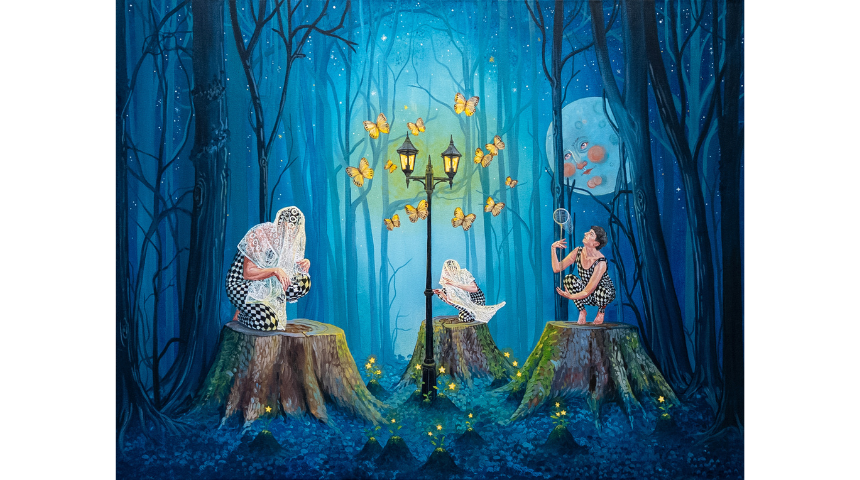
Jude Wainwright – Let Us Keep Our Promises (2026), Oil on Cradled Panel, 76 x 100cm. Courtesy of the artist.
Narrative runs throughout Wainwright’s work in the exhibition, drawing on a rich assortment of literary references, folklore and popular culture. The first work encountered on entering the gallery, Let Us Keep Our Promise (2026), sets the tone. A solitary lamppost stands within a glade, attracting a cloud of moths. Around it, three Judes are poised in anticipation: two veiled in lace doilies, the third holding a net, ready to ensnare her quarry. Above them, a rosy-cheeked moon hangs low in the night sky, appearing captivated by the scene unfolding below.

Jude Wainwright – Hold Still (2026), Oil on Cradled Panel, 56 x 46cm. Courtesy of the artist.
In Hold Still (2026), Jude sits upon a nest while two crows look on. The birds appear perplexed by this reversal of roles, uncertain of their own place within the narrative. Nearby, in You're It (2026), a masked Jude rides a uni-goat, Lancelot, beneath the watchful gaze of the stars and a moon sporting a top hat. I suggest to Wainwright that her paintings draw upon familiar visual tropes associated with folklore and children's stories, including wolves, forests, crows and moons. Yet these elements rarely behave as we might expect them to. I asked how consciously she uses these recognisable symbols in order to subvert traditional narratives and create new ones?
“90% of what I do is subconscious. I think there is a hive mind in the arts, where certain symbols do reoccur in many people's works. For me, however, I get very obsessed, and the snowball gets bigger and bigger. As soon as I decided I liked crows, I massively researched crows, and people would start sending me stuff about crows. Every time I do a painting, I'd put a crow in it. The crows for me are always a friendly presence. When they're there it makes me feel calm about the situation. I've done paintings in the past with crows in, and someone remarked that the crow is a symbol of death. But for me, it’s a warm presence. These are my friends. I like how clever they are, how they bring you trinkets, how they hold grudges and will fight for you. They will be your family. I always saw them as a lovely present.”
I mention how Wainwright uses these motifs to create a sense of familiarity with folk tales of the past before subverting them to create new narratives that speak of the present. Even though she might draw from fairy tale imagery, the animals in her paintings aren’t anthropomorphised. They remain feral.
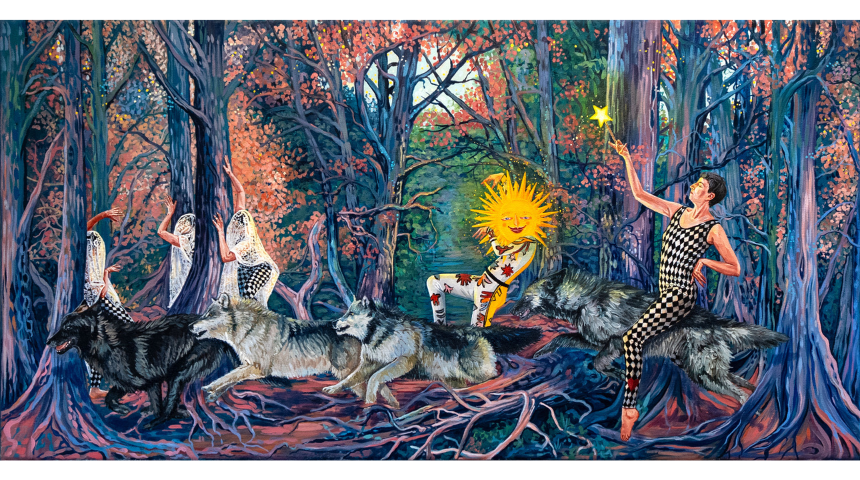
Jude Wainwright - Onwards (2026), Oil on Cradled Panel, 49 x 91cm. Courtesy of the artist.
One of the most striking works is Onwards (2026). Jude leads a pack of wolves careering through a forest. Around them, a coven of veiled Judes cavorts among the trees, while the sun, rendered in dancing human form, grins as it casts an ethereal pink glow across the woodland. The work invites comparison with Clarissa Pinkola Estés' Women Who Run with the Wolves (1989), a text that explores myth and fairytale and the suggestion that women harness their instinctual, feral nature. Throughout the painting there is a sense of reclaiming narratives traditionally shaped by patriarchal fairy tales. Wainwright found Onwards a difficult painting to create. Towards the end of 2025, her best friend, the artist Sara Hindhaugh, died from secondary breast cancer. Wainwright describes it as:
“a really long, horrific, drawn-out time. I used to go and see her once or twice a week in Timperley. I'd get the tram over. The whole journey was an hour and a half from my studio. When I was on the tram I used to sketch my painting ideas for the show. There was a lot of imagery coming into my head of danger or impending doom. I think it was because she was dying and the painting used to always come into my head when I'd be going to visit her. Once again, like the crows, the wolves are my gang. They're going to protect me. We're going to go forward together, and everything will be fine.”
Jude describes how she originally hated the painting.
“I used to go home crying about that painting because I thought it was so terrible. I nearly didn't put it in the show. I thought it was so bad. It was one of the first ones I started. I think it was because it was so closely linked to my friend and I used to talk to her about this painting. I just really struggled with it. The funny thing is that I hated it right up until I put a wand in my hand. I like it now I've got a wand.”
Throughout the exhibition, references to the museum's archive are woven seamlessly into the works. The feather fan in Room for Two (2026) and the embroidered handkerchief reading ‘brush and comb’ are incorporated into Wainwright's visual mythology. In Brush and Comb (2026), a veiled Jude is laid upon the gallery floor, staring at the stitched text and watched over by a strange owl. Beside her is a purple, well-groomed hairy creature that gazes through the window towards the Rossendale hills. The painting is positioned to mirror the view beyond the gallery itself so that the Lancashire landscape is transformed into a magical terrain of moonlit peaks, the creature caught between these two worlds.

Jude Wainwright - Brush and Comb (2026), Oil on Cradled Panel, 35.5 x 28cm. Courtesy of the artist.
In the Whitaker archives, Wainwright discovered materials from the circuses that visited the Rossendale area, which led her to the National Fairground and Circus Archive in Sheffield. One of the rides recorded in the archives were the Ghost Trains, and Wainwright has particularly fond memories of the one at Alton Towers.
“The Ghost Train was always my absolute favourite, but I used to find it hilarious. Horror films in general are my favourite thing to watch while I paint. When you were queuing for the Ghost Train, there was a doll's house that contained a hologram of a little girl. I wanted to stay looking at her forever. She would go around the house and she'd play with a cat. That was the only reason why I wanted to queue for this ride. I didn't care about the ride. It was this doll's house with the little girl. That's why I did the Pepper's ghost in the castle in the show. I like making your own world and then putting someone in to live in it.”
Programmed over the summer, Spectacle initially appears aimed at a younger audience. Wainwright takes on the role of a contemporary Pied Piper, enticing visitors into Judtopia with promises of wonder and delight. Yet beneath the exhibition's playful surface lies something far more complex. Its candy-coloured imagery conceals darker undercurrents and more urgent concerns. While Wainwright's work resists straightforward interpretation, it can be read as engaging with contemporary anxieties surrounding power, vulnerability and the policing of bodies, particularly those of women. The absence of traditional fairy-tale villains feels significant. There is no need for the artist to depict wicked witches or predatory wolves when such figures have contemporary equivalents.
Throughout the paintings, Jude becomes a powerful and ambiguous presence, simultaneously protector and trickster, luring the audience into the forest with sweets and treats. Dressed in her trademark harlequin suit, whose chequered pattern evokes the circus itself, Jude appears both magical and commanding. Yet she is also a figure capable of unsettling the viewer, not only the creatures inhabiting Judtopia but perhaps visitors to the realm as well. Historically, clowns and fools have often occupied the role of truth-tellers, able to reveal uncomfortable realities through humour, performance and absurdity. I asked Wainwright what truths might the Judes be imparting?
“The truths are probably just things that are going on inside me that I can't bear to say or find the words to say. All my paintings are notes from me to me, like diary entries. I can look at a painting and can list exactly what film I was watching that day or who I spoke to that day. Everything is captured in these works. Whether they're cries for help, I don't know. Some of them sit weirdly with me because of this. I have to paint quickly, and the making of this exhibition was really intense. Everything was created between November and April.”
Within Judtopia, Wainwright appears to create a space of refuge and resistance. She occupies the role of guardian and guide in equal measure. Perhaps it is not the innocent who are being lured into this world, but the monsters themselves, drawn in by promises of sweets and spectacle. In this reading, Jude becomes not merely the ringmaster of Judtopia, but its protector.
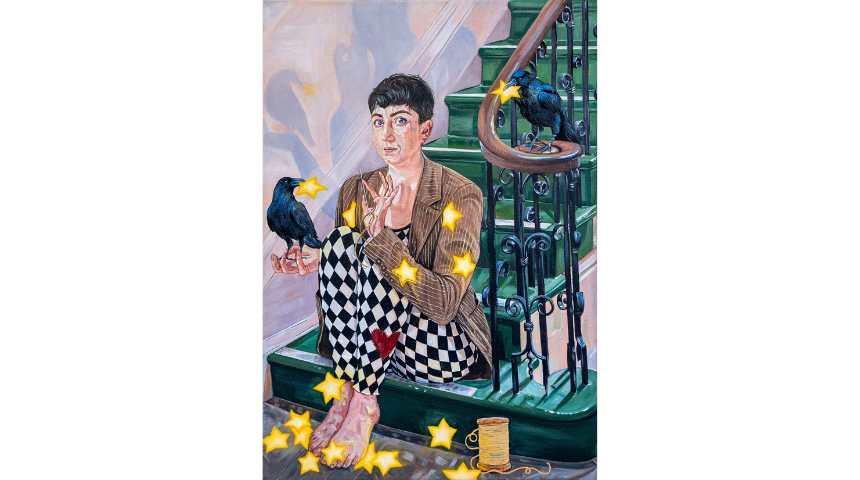
Jude Wainwright – When It’s Quiet (2026), Oil on Cradled Panel, 59 x 42cm. Courtesy of the artist.
Throughout the exhibition, The Whitaker itself becomes absorbed into the mythology of Judtopia and functions as a gateway into this realm. The gallery often becomes part of the narrative. In When It's Quiet (2026), Jude sits at the foot of the staircase leading to the attic stores, carefully stitching stars back onto her jacket. Her ever-present crows assist in the task, gathering and returning stray stars to their rightful place. Wainwright had an intense relationship with the Whitaker and would frequently visit the museum during the making of the work for the exhibition.
“I’d wander around and just sit in the gallery or sit in the grounds. All the figures in the paintings are taken from photos of me at the gallery as well. I spent a lot of time in the actual building. It's a gorgeous place. I love it there.”
In Curtain Call (2026), the moon is replaced by a brooch from the museum's collection, pinned high in the heavens as Jude frolics with a flamingo. It is a fitting conclusion to an exhibition in which archive, imagination and place are woven together to create a world that is at once enchanting, unsettling and deeply personal.

Jude Wainwright – Curtain Call (2026), Oil on Cradled Panel, 39 x 30cm. Courtesy of the artist.
What makes Spectacle particularly compelling is the way Wainwright allows these various strands to coexist without resolution. Wainwright’s personal mythology and the Whitaker’s collection intermingle to share contemporary concerns within a carefully constructed visual language that remains open to interpretation. Judtopia is not simply an escapist fantasy, it is a space in which playfulness and unease and wonder coexist. In inviting visitors into this world, Wainwright encourages us to reconsider the stories we inherit, the roles we perform, and the myths we continue to tell ourselves.