FEATURE Jul 2026 A Vocabulary for Painting: Yasaman Mollasalehi on Learning to Be Understood
Mollie Balshaw (they/them)
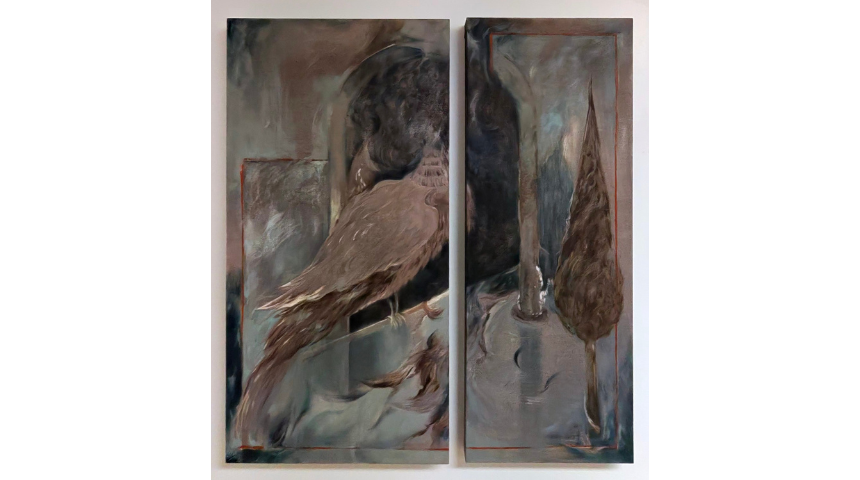
Yasaman Mollasalehi The Weight of Wings 1 (2026) oil on calico 90x70 cm Courtesy of the artist. Photo Yasaman Mollasalehi.
Mollie Balshaw is an artist, writer and cultural producer based in the North West. They are Co-Founder and Director of Short Supply, an artist-led organisation supporting early-career artists through exhibitions, publishing, mentoring and professional development. Their work focuses on artist-led practice, regional cultural infrastructure and creating greater visibility for artists working outside London. For the July issue of the Fourdrinier, they present the following critical appraisal of the work of artist Yasaman Mollasalehi.
“I have a limited box of vocabulary,” Yasaman Mollasalehi tells me. We are discussing the difficulty of answering a question she has never previously considered in English. She knows there is an answer, but finding it requires time: several ideas arrive at once, each pressing against the limits of the words immediately available to her.
Yet Mollasalehi speaks about painting with unusual precision. She may pause, restart or search for a translation, but the ideas themselves are clear. Painting, for her, has become a language formed not only through colour and composition, but through the effort of learning how to explain a practice across different cultural and linguistic settings.
Before moving from Tehran to Manchester, Mollasalehi describes painting primarily as a practical activity. It was a longstanding part of her life, developed through repetition, technical study and the physical act of making. Her decision to pursue painting academically came from wanting to place that private commitment within a wider field: to understand what was happening beyond her own studio and to take the practice more seriously as a way of thinking.
When she later moved to Britain to complete an MA in Painting at Manchester School of Art, she expected the course to transform her work technically. She imagined unfamiliar processes, new skills and greater instruction in the mechanics of painting. Instead, the most significant development was less visible.
“I expected that if I moved here, I would improve technically,” she says. “But actually, it wasn’t like that. Technically, everything was on myself.”
What changed was her confidence in presenting an idea before it had received the approval of an established authority. Mollasalehi describes an art world in Tehran where the permission to speak could feel closely attached to recognition from professional artists, galleries and cultural institutions. If those figures had not yet granted an artist credibility, it was difficult to feel entitled to claim it independently.
“Back at home, if the professionals don’t give you that credit, you’re not very able to express yourself,” she says. “Here, I feel more confident about what I’m doing.”
Manchester School of Art became useful not because it supplied answers, but because it gave her repeated opportunities to test her own. Tutorials, group critiques, studio visits and conversations required her to describe decisions in a language she was still learning. The difficulty of doing so became a form of evidence. If she could communicate the thought behind a painting in English and another person could follow it, then perhaps she understood the work more clearly than she had allowed herself to believe.
“I could explain what I did in my painting in a second language,” she says. “It gave me confidence that I realised what I was doing. I was aware of what was happening in my mind.”
There is an important distinction here between learning to communicate and learning to simplify. Mollasalehi does not want her paintings to become translations of ideas she can already express more efficiently in words. The language surrounding the work has become more assured, but the paintings themselves remain resistant to straightforward explanation. Their purpose is not to provide a visual equivalent of an artist statement.
This tension also affects the way she thinks about abstraction. Viewers can occasionally assume that a loosened or non-representational passage exists because an artist lacks the ability to produce something more technically exact. Mollasalehi finds this frustrating. At times, she admits, her detailed passages contain an element of demonstration: proof that the decision to move away from realism is deliberate.
“I like, in some parts, to show off that I can do the details,” she says. “I know how to paint a hand very well, but I don’t want to.”
The distinction is not between skill and its absence, but between skill and interest. A carefully rendered hand may prove something, but proof alone cannot sustain a painting. Mollasalehi is more interested in what happens when recognisable images lose their fixed function: when an object becomes a brushstroke, a body becomes a compositional shape, or an abstract form gradually begins to resemble something that was never planned.
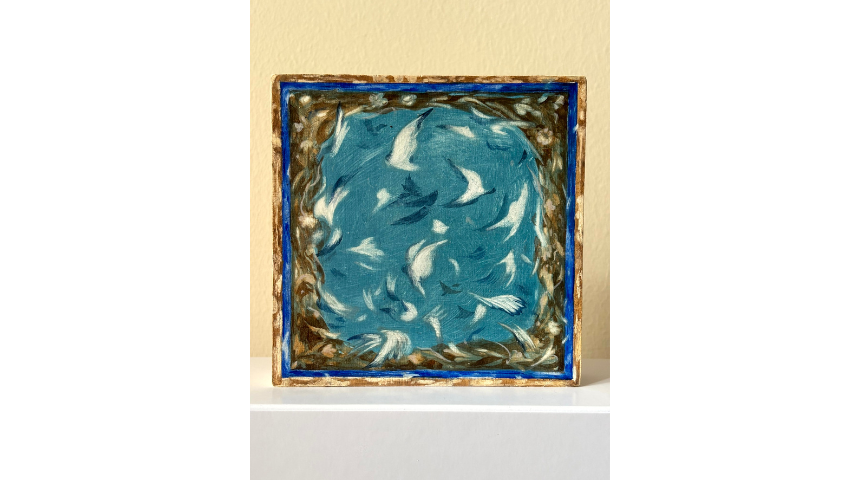
Yasaman Mollasalehi Azure Reverie (2026) oil on board 10x10 cm Courtesy of the artist. Photo Yasaman Mollasalehi.
This transformation often occurs after an image has entered the work for practical reasons. Mollasalehi gathers material from Persian miniatures, old books, photographs of family and friends, bodily forms and architecture connected to memory. She might combine these references in Photoshop or cut up printed images to create temporary collages. But the source material does not dictate the painting.
Sometimes an object is selected simply because the composition requires a rounded shape, a vertical interruption or a concentration of detail in one area. It enters as a formal answer before acquiring any symbolic importance. Forms that initially functioned only as marks have, in recent paintings, developed into birds. She is now thinking about bears. The meaning arrives through making rather than being assigned in advance.
This allows the paintings to surprise their maker. Mollasalehi may spend a week rehearsing a composition through sketches and deciding on the dimensions of the canvas, but the painting does not remain faithful to that preparation.
“When I start, it always continues differently,” she says.
Colour is one cause of this divergence. She wants many colours and also wants control over them. When too many arrive at once, the painting may need to be subdued, washed back or rebuilt. A surface can contain several abandoned versions of itself, but the significance of this process is as practical as it is conceptual. Mollasalehi is not staging uncertainty for effect; she is responding to the moment when the work no longer matches her visual judgement.
The materials available to her have also shaped this process. In Tehran, she worked mainly with acrylic paint because it was cheaper, more accessible and manageable without a dedicated studio. It dried quickly, produced less smell and could be used without transforming a domestic space into a permanent painting environment.
Oil paint became a realistic option after she moved to Manchester. A tutor, Jenny Eden, encouraged her to try it, and its slower pace offered new possibilities for adjustment. Oil could be moved, softened and revisited for longer. It changed not only the appearance of the work, but the length of the conversation she could have with it.
Mollasalehi is now considering bringing acrylic back into the process, using it to establish the first stages before applying oil over the top. This would not represent a return to an earlier practice or a rejection of a newer one. It would combine two material histories: one shaped by economy and limited space, the other by greater access and time.
Her relationship to Persian miniature painting operates through a similar combination of continuity and alteration. She returns to its compositions, detail, architecture, patterned tiles and ability to hold several spaces within one image. These traditions offer structures rather than subjects. They allow different viewpoints, scales and moments to coexist without being organised through a single Western perspective.
Yet Mollasalehi has no desire to reproduce a familiar miniature style or to be confined to the category of an Iranian painter repeating recognisable cultural motifs. She is interested in what those visual systems can do inside a contemporary practice, particularly when placed beside family photographs, personal memory and forms that have emerged through improvisation.
This creates different relationships with audiences in Iran and Britain. Iranian viewers may immediately recognise a colour, architectural reference or symbolic image because they have encountered it through poems, stories, buildings and paintings throughout their lives. The knowledge is already present.
British viewers may not recognise those references, but Mollasalehi has sometimes felt that they understand the transformation of the material more readily. They encounter the images less as known cultural signs and more as parts of a new visual structure.
Her description of her own position is revealing. She does not see herself as British, but neither does she feel fully described by the uncomplicated label of Iranian painter. She speaks instead about becoming a link between the painter she was in Iran and the painter she is now, though the second identity is not yet something she can easily name.
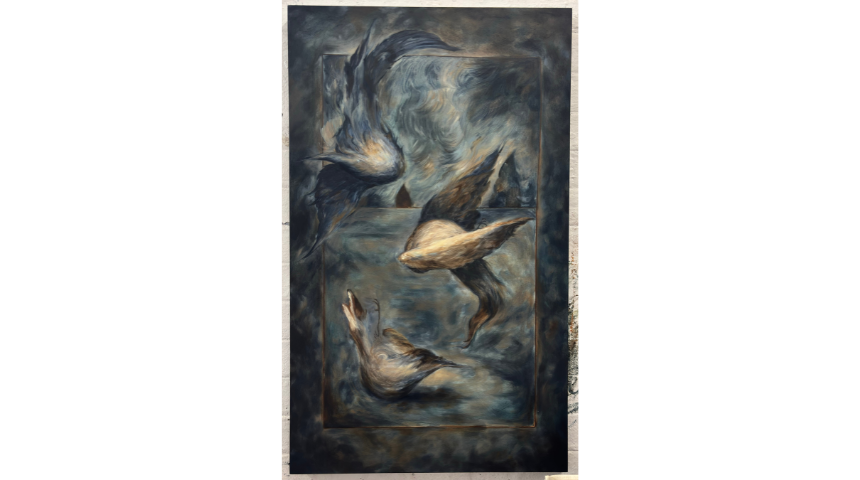
Yasaman Mollasalehi The Weight of Wings 2 (2026) oil on calico 100x60 cm Courtesy of the artist. Photo Yasaman Mollasalehi.
That lack of a settled category is not a weakness in the work. It may be one of the conditions allowing it to develop. The practice does not need to choose between cultural inheritance and contemporary experimentation, detailed figuration and abstraction, or acrylic and oil. It is being made through the friction between them.
Mollasalehi is equally resistant to the idea that interpretation should flow in only one direction. She is tired of encounters in which viewers repeatedly ask the artist to explain: What does this mean? What were you trying to say? Why is that object there? The questions presume that she holds the correct answer and has concealed it inside the painting.
“I prefer that they don’t ask,” she says. “They just tell me. I have a desire to hear, to listen to them.”
This reversal is central to how she wants the work to function. She does not want to prescribe happiness, sadness or any other emotional response. Instead, she hopes the paintings might help viewers encounter something they already carry within themselves. The artwork is not a delivery system for her feelings, but a point of contact between different experiences.
“Everyone has something inside themselves,” she says. “If my work is good enough, it can connect them with those feelings.”
Her interest in showing work across different cities follows from this desire to listen. Exhibitions are valuable not only as markers of achievement, or as opportunities to sell, but because they expose the paintings to unfamiliar interpretations. She wants conversations with people outside Manchester, encounters with audiences who do not share her cultural references, and residencies that place her in contact with different places and ways of living.
Residency, in this sense, would be more than professional development. It would extend the cross-cultural exchange already shaping the paintings. Mollasalehi is drawn to difference, to the possibility that another location might reveal aspects of her visual language that are harder to see from within its present context.
She also imagines her practice expanding into installation. Painting will remain central, she says, but an individual canvas can sometimes feel insufficient for the atmosphere she wants to construct. Installation could allow an audience to enter the relationships that are currently compressed into a two-dimensional space. Architecture, scale, distance and multiple viewpoints could become physical rather than pictorial.
“I need to make that atmosphere which is inside my mind,” she says.
This future direction is significant because it reveals that Mollasalehi is not searching for a perfected painting style to repeat. She is building a language capable of changing form. The same concerns may eventually require a room, an environment or a sequence of objects. Painting is the foundation, but it does not have to be the boundary.
What Manchester has offered her, then, is not a replacement artistic identity or a definitive set of techniques. It has given her a context in which practice, learning and self-presentation can happen together. She no longer feels that she must wait until another person declares her professional enough to speak.
The vocabulary is still being assembled. Some of it comes from Persian painting and architecture; some from acrylic used without a studio; some from oil paint discovered through greater access; some from critiques conducted in a second language; some from the comments of viewers who see connections she did not consciously place there.
Mollasalehi’s work is developing through this traffic between forms of understanding. She knows what she is saying, and sometimes she does not. She prepares carefully, and the painting changes. She is able to render the hand, and chooses not to. She wants to communicate, but refuses to explain everything.
This is not a failure to arrive at clarity. It is the basis of a practice in which meaning remains active: spoken across languages, altered by materials and completed, temporarily, by the people willing to look and respond.
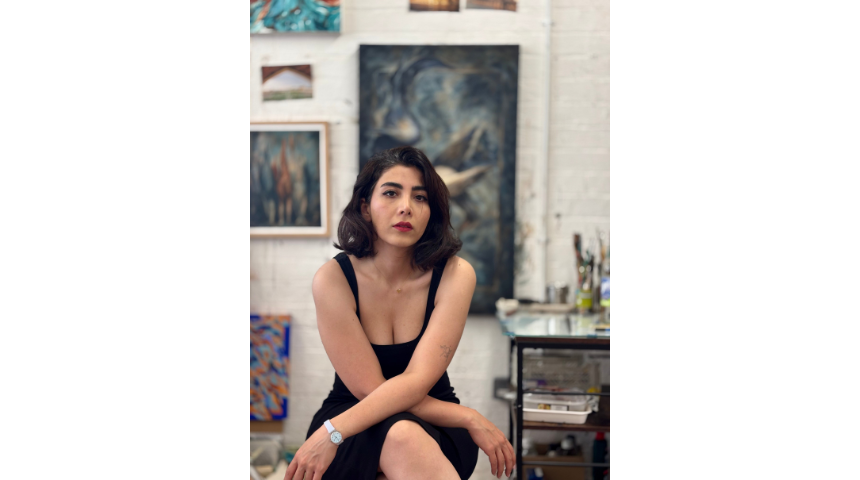
Portrait of Yasaman Mollasalehi (2026) Courtesy of the artist. Photo Amir Shirazi.