
REVIEW Aug 2026 Taking Centre Stage: Female Artists in The Atkinson’s Collection at The Atkinson
Nicole Slyu
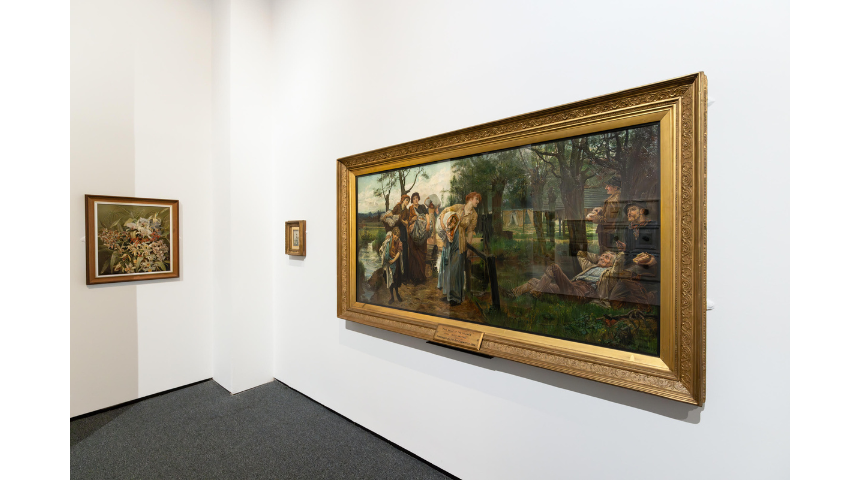
Taking Centre Stage. The Atkinson. 2026. Photograph Dave Jones.
Celebrating 150 years of connecting people with the visual arts and heritage of Southport and beyond this year, The Atkinson is currently showcasing a resplendent survey of the women artists in its collection. Running until Saturday 27 February 2027, the exhibition ‘Taking Centre Stage: Female Artists in The Atkinson’s Collection’ features works by Dame Laura Knight, Anne Redpath, Dame Tracy Emin, Chila Kumari Burman and Cornelia Parker, to name but a few. Writer Nicole Slyu revisited The Atkinson and reviews the show here, noting how with its long history of collecting contemporary art, The Atkinson has made the purchase of works from living women artists a particular focus.
At the start of this year, I found myself looking at a long spreadsheet containing approximately 160 works by female artists in The Atkinson collection, helping research material for an upcoming show focusing on The Atkinson’s women painters. This stint was sadly short-lived, and little did I know six months later I would be on my way to the museum to review ‘Taking Centre Stage: Female Artists in The Atkinson’s Collection’, a major exhibition tracing The Atkinson’s collecting history from the very first acquisition of a work by a female artist, by bequest in 1879 and via active purchase in 1883, through to today, narrated by the carefully selected 54 works on display.
The leading image of the exhibition is by none other than Dame Laura Knight, whose distinctive style and recurring subjects — musicians, dancers, performers — are on full display: a striking portrait of a woman in a red sleeveless dress, her porcelain skin in stark contrast with her raven-black hair, set against a teal background, in a stylised Art Deco fashion typical of the 1920s. The woman whose profile introduces ’Taking Centre Stage’ is that of Ethel Bartlett, a renowned 1920s musician, treated by Knight with a theatrical vocabulary borrowed from the stage: strong colour and dramatic lighting. Bartlett sits with the sheet music set aside, caught in a pause between rehearsal and thought, her gaze drifting somewhere just outside the frame. Knight places Bartlett centre stage, despite being one half of the famous piano duo she formed in her working life with her husband Rae Robertson. Next to this portrait hangs another painting, also recognisably by Knight: A Dressing Room at Drury Lane (1922) depicting dancers backstage from Diaghilev’s Ballets Russes.
This pairing makes the exhibition’s title ‘Taking Centre Stage’ unusually literal: not only are women gaining institutional visibility by way of acquisition and through their inclusion in this very exhibition, but they are depicted as performers themselves, in roles once unavailable to them. The Atkinson’s acquisition of Bartlett’s portrait caused some commotion in the local news; in 1927 the Skegness News reported that Southport had purchased this painting for 100 guineas; “the art world was so astonished at Southport spending half its income all at once that the lady whose picture they bought, Mrs Laura Knight, was promptly made an associate of the Royal Academy,” followed by a full membership in 1936, and a damehood in 1929.
The exhibition begins chronologically but still manages to be thematic. As a viewer with an acute visual sensibility, I much prefer an aesthetically curated exhibition to a meticulously chronicled one. While the dates and context matter, thematic grouping demonstrates a considered curatorial approach which this exhibitions does in a logical and sensitive way. Thematically the exhibition is divided into three parts: the introduction groups together the first works by female artists to enter The Atkinson collection, followed by the first theme of works of typical ‘female’ subjects (or at least those that were socially acceptable for women to paint), followed by women exploring female identity through self-portraits, and finally the world through women’s eyes as they travel and chronicle the world around them.
The first thematic grouping brings together four works by women artists that were collected by the institution between 1883 and 1899, three of which were actively purchased by the institution, and all of which were acquired during the artists’ lifetimes. Of these, the most significant is Alice Havers' Belle of the Village, bought by Southport Corporation for £100 in 1889 – a substantial sum for the time, and roughly a year before Havers' own death. It stands as an early, deliberate statement of institutional confidence in a woman artist, made while she was still alive to see it.
Jumping ahead more than a century, The Atkinson’s most recent acquisition, made just last year in 2025, is Chila Burman’s Glass Cornets and Screwballs (2012) a glass composition so sculptural that it is not clear at first glance what one is looking it. While Burman’s name may not sound familiar to all audiences, she is nonetheless a titan of the local art scene. Viewers may come to realise that they have in fact walked past her work recently — quite literally! Burman’s neon ‘graffiti’ adorned the facade of Tate Britain in 2020-21 as the Winter Commission that year. Gowing up in Bootle, Burman’s father owned an ice-cream van when she was a child, so ice-cream and wafer cornets become signifiers of her local identity. In fact, the ice-cream van featured in the winter commission at the Tate as well, a part of her childhood so important to her identity and upbringing that it has become a recurring motif. Burman’s recent solo exhibition, I Love You Southport, at The Atkinson in autumn 2025 was a homecoming of sorts, showcasing 40 years of work by Burman, and where the glass cornets were acquired for The Atkinson by the Contemporary Art Society (more on CAS further on).
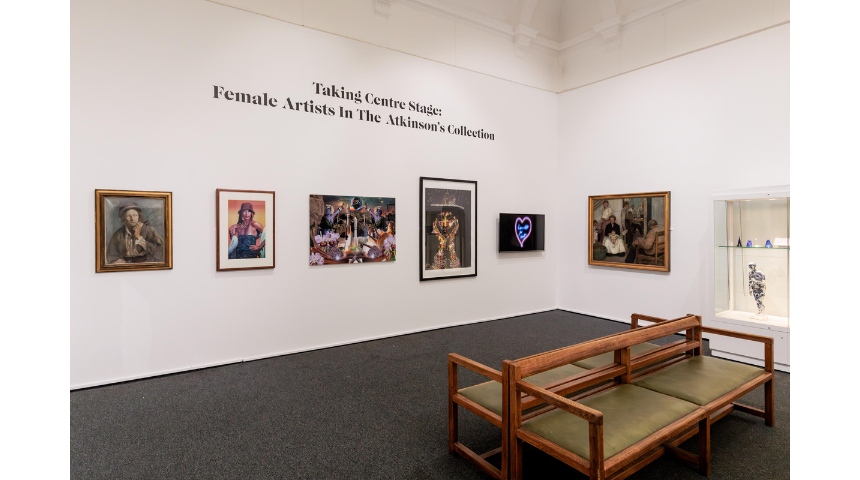
Taking Centre Stage. The Atkinson. 2026. Photograph Dave Jones.
While ’Taking Centre Stage’ primarily showcases two-dimensional works, there are a number of other noteworthy sculptural pieces besides Burman’s glass cornets, notably Claire Curneen’s Guardian II (2019) and Livia Marin’s Nomad Patterns (2020), both porcelain works in a classic cobalt blue colour palette. I have a soft spot for sculptural ceramics, and while the traditional (and arguable stuffy) blue willow pattern was certainly not what drew me to the works, they merit a second look, and a close one at that. Curneen’s Guardian is based on the Young Daughter of the Picts engraving by the 16th-century artist Jacques le Moyn, itself a romanticised and fictituous vision of an Ancient British people, heavily informed by the artist’s contemporary depictions of discoveries made in the New World. Curneen’s humanoid sculptures reveal very little about their identities via their physicality, their heads clean and round and their bodies smooth and abstract, maintaining a gender neutrality which makes them feel like depictions of souls and allowing the artist to focus on their inner worlds and not their outer appearance.
The Guardian’s body is covered in the classic Delft pattern that acts as “delicate camouflage” and is not only a reference to the body tattoos in le Moyne’s drawing, but also to the traditional ‘crafts’ historically associated with female art. The pattern therefore acts as a kind of inescapable blanket that completely covers this figure. Marin approaches the tradition of the cobalt-white colour scheme on porcelain in a different way. Her works explore throwaway culture in our modern society, in stark contrast to the endurance of the colours, patterns and motifs that outlive the physical lifespan of the objects they adorn. Nomad Patterns presents everyday tableware from which the traditional English Blue Willow pattern, which has been endlessly reproduced on cheap tableware since the 18th century, appears to have melted off and pooled around the dissolving objects. Despite the end of the objects’ lifespan, the pattern escapes and lives on.
Another work that struck a chord with me was Dod Procter's Sketch of Burmese Children (c. 1920s). The work is deftly executed in what would become Procter’s signature Art Deco style. Stylistically it is reminiscent of Knight’s polished portrait of Ethel Bartlett, displayed nearby, and aesthetically became one of my favourite works in the show, if judged on style and composition alone. But the work touches on a a subject I suspect would draw sharper scrutiny were it by a more famous male counterpart – the portrait of the Burmese children that Procter painted is ethically reminiscent of Gauguin’s Tahitian portraits, which have, over the years, become a symbol of Western colonialism.
So, while the painting hints at the talent and recent acclaim of the painter (in 1927, a year before this work was acquired, Procter's painting Morning was voted RA Picture of the Year), the subject matter goes uncritiqued. It becomes an uncomfortable work to look at, because it is mesmerising and off-putting in equal parts, sitting in an exhibition which reclaims the female painters’ right to be seen, while glossing over the people who had no say about how they were painted and whom we continue to look at to this day.
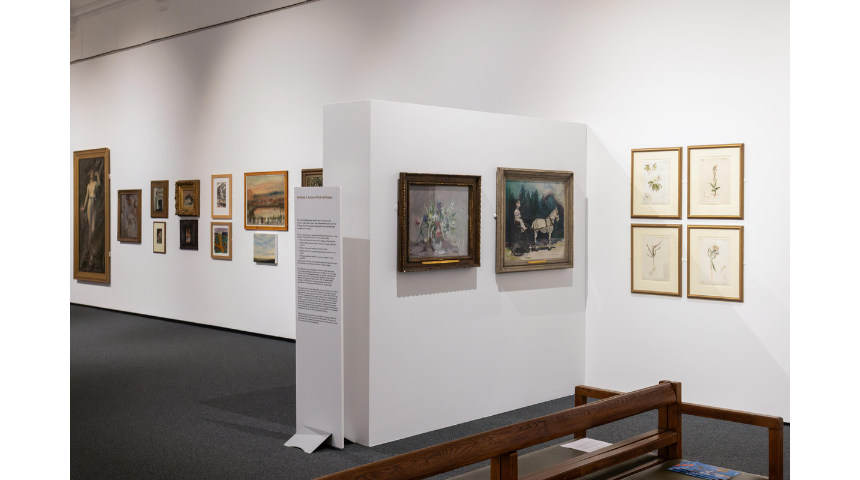
Taking Centre Stage. The Atkinson. 2026. Photograph Dave Jones.
Zooming out from individual objects to the collection as a whole and to introduce some statistics: 48 of the works on display appear to have been acquired during the artists’ lifetimes — a commendable achievement. Acquiring from a living artist signals the institution’s confidence in the artist’s work and has a significant effect on their career. Of the lifetime acquisitions, the majority were made in the 2000s and 2020s, a logical development, considering how important contemporary art has become since the 1960s. Also, a significant number of works by living artists was acquired in the 1970s which aligns with the second wave feminist movement, including two fantastic linocuts by Gertrude Hermes (who in 1966 challenged the Royal Academy for not allowing women to attend the AGM, herself being a member) and a local landscape of Morecombe by Stella Platt.
The Atkinson’s current collecting strategy is filling in the gaps and accumulating works by artists who are not well represented in the collection. And although The Atkinson is a regional museum, I was nonetheless very impressed to find works by artists with no direct connection to the museum itself, nor the wider North West region. Regional audiences get the chance to encounter works by leading contemporary artists that are present in the collection: Tracey Emin, who represented Britain at the Venice Biennale in 2007; Paula Rego, the National Gallery's first Associate Artist; Rachel Whiteread, the first woman to win the Turner Prize; Cornelia Parker, the official artist of the 2017 UK general election; as well as as Dame Elisabeth Frink, one of the few women to break into the male-dominated world of postwar British sculpture. Cindy Sherman is also here, and her inclsuion matters: her photographic self-portraits are so instantly recognisable that they have shaped how a generation of thinks about identity and performance. I first saw her work in an international museum at the age of fifteen, years before I considered a degree in art history, let alone a career in the arts, and her images were so distinct that I have never forgotten the impact they had on me. Not every fifteen-year-old has the chance to travel to a major international museum, so this exhibition brings that same kind of encounter to Southport’s doorstep.
Looking through the artwork captions, I was struck by how often works were gifted to The Atkinson with the help of the Art Fund, the V&A Purchase Grant Fund, and especially the Contemporary Art Society which has offered, donated or facilitated the acquisition of six works in this exhibition, a substantial number considering there are 54 works in total, spanning over a century. It is wonderful that a regional museum is able to bring such important works of art to their local audiences.
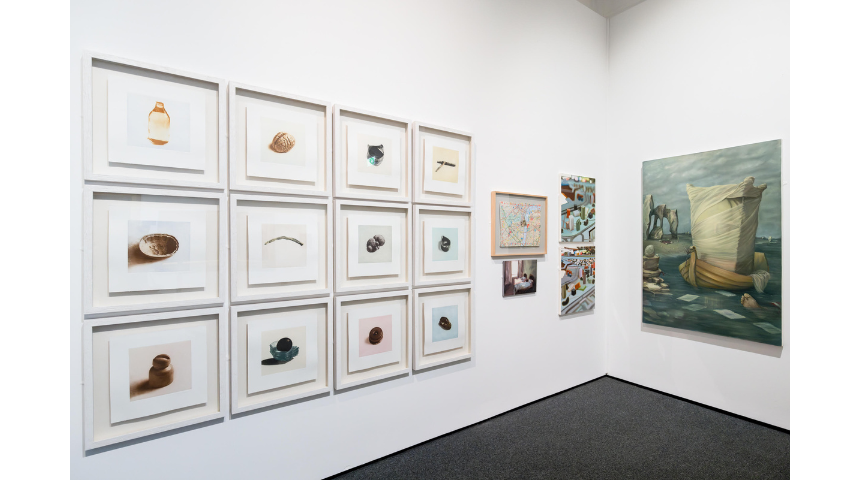
Taking Centre Stage. The Atkinson. 2026. Photograph Dave Jones.
Despite the fact that the majority of the artists in the exhibition are British women, I was pleased to see works by several foreigners, notably Japanese Rui Matsunaga, Hong Kong-born Nora Fok and Barbados-born Alberta Whittle, and especially Siberian Evgenia Arbugaeva, whose 2022 short documentary film Haulout, exploring the effects of global warming on a walrus colony in the Chukchi Sea in Siberia, was nominated for the Academy Award for Best Documentary Short Film. Three photographs from Arbugaeva’s breakout series ‘Tiksi’ (2010) depict candy-coloured houses and children playing in the snow against a backdrop of bleak, declining post-Soviet infrastructure, illuminated by the eerie green glow of the Northern Lights. Like Sherman’s self-portraits, these images are staged memories of Arbuagaeva’s childhood growing up in this Siberian town on the coast of the Arctic Ocean.
While I went through all 54 works meticulously, trying to identify patterns of acquisitions, themes, nationalities of the artists and the possible reasons for their presence in the collection, I found something interesting in almost every single work. Not because every work was striking or by a famous artist, but because the story the caption was telling was compelling enough for me to become curious enough about the artist or the circumstances of the acquisition to merit further investigation. While not all viewers will approach a visit to a gallery in the same systematic way, I would nonetheless like to commend The Atkinson exhibitions team for putting together such concise but nonetheless rich mini-narratives that shine a light on the stories of these works, and on the identities of the painters, many of whom have been sadly lost in time.
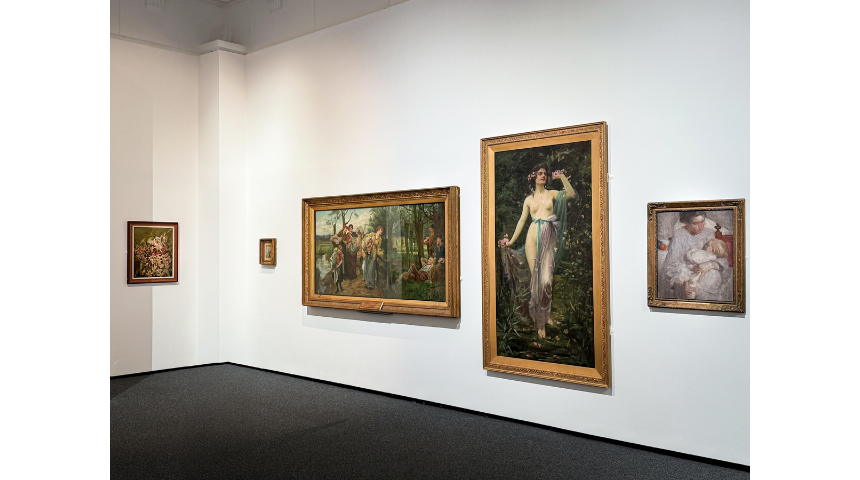
Installation view of 'Taking Centre Stage: Female Artists in The Atkinson's Collection,' The Atkinson, Southport, July 2026. Featuring (from left to right): K. B. Cussons, Flowers of Eden (c.1882-83); Helen Kathleen Shaw, Rest (c. 1887 or earlier); Alice Mary Havers, Belle of the Village (c.1880-85); Ethel Wright, The Path of Roses (c. 1880-90, before 1899); Julia Beatrice How, Maternité (c.1900-32). Photography by Nicole Slyu.
I could expand upon many other works in this exhibition that merit a closer look, but I will stop and leave something to the imagination. I would encourage readers to visit Southport this summer, dabble in a little domestic tourism and support the local economy, catch one of four exhibitions currently on at The Atkinson and grab a bite to eat at the local chippy (a word of caution regarding outside seating — beware the local seagulls who will not discriminate between a chip, a fish and a barm!) Afterwards, head down to Ainsdale beach for an endless expanse of sand that will unleash the inner child in you and inspire you to join your four-legged friends in a sprint to the waterline. Position your picnic blanket higher up on the grassy dunes away from the commotion, and take in the afternoon sun, reflecting on the wonderful works you have just seen, as I did last weekend.
‘Taking Centre Stage: Female Artists in The Atkinson’s Collection’ continues until February 2027.
This review is supported by The Atkinson