REVIEW Sept 2026 Helter Skelter: Arthur Jafa & Richard Prince – art as embrasure, Prada Foundation Venice
Josephine Manby

Arthur Jafa Love Is The Message, The Message Is Death, 2016 Video (color, black and white, sound) 7’25’’ The Museum of Contemporary Art, Los Angeles. Purchased with funds provided by the Director’s Council and Arthur Lewis and Hau Nguyen © Arthur Jafa
Miuccia Prada(1), granddaughter of Mario Prada, Milanese founder of Prada luxury brand, head designer of Prada and founder of its subsidiary Miu Miu, is also President and Director of Fondazione Prada, a cultural institution she founded in 1993 with Patrizio Bertelli to present an array of arts programming. Since 2011, Ca’ Corner della Regina has been Venice HQ of Fondazione Prada and has mounted 10 temporary arts projects so far.
Ca’ Corner della Regina was built between 1724-1728, a Venetian palazzo with an Istrian stone façade overlooking the Grand Canal in the Sestiere of Santa Croce, on the ruins of the Gothic birthplace of Caterina Corner, future queen of Cyprus (b 1454). In 1800 it was taken over by Pope Pius VII. Under Prada, a preservation and repair programme has been drawn up, including securing of the ornamental frescoes on the first noble floor which depict scenes from the life of Caterina Cornaro.
For the 2026 Venice Biennale, ‘In Minor Keys’, organised by the late Koyo Kouoh, the Prada Foundation presents ‘Helter Skelter: Arthur Jafa and Richard Prince’, curated by American Nancy Spector. Arthur Jafa (b 1960, Tupelo, Mississippi) is an artist and filmmaker based in Los Angeles who explores expressions of Black identity through film, artefacts and events. Richard Prince (b 1949, Panama Canal Zone) is a New York-based visual artist whose work overturns American identity, subcultures and archetypes, drawing on mass media, celebrity and advertising. Both have a significant international standing and their work, placed together under the stuccoed, frescoed and gilded surroundings of Palazzo Ca’ Corner della Regina, reveals crucial points of intersection relevant to the times we are living through right now.
Billposters posture on the vaporetto imbarcaderi, or boarding docks: a confrontational death’s head; a living face painted up as a skull, inviting wariness. What is ‘Helter Skelter: Arthur Jafa and Richard Prince’ about? Approaching Fondazione Prada from the narrow sotoporteges, darkened calles, little wooden and stone bridges, an alley opens up to blistering sun on pale stone. Understated branded signage. Inside, immensely high-ceilinged spaces. Tall leaded windows, marble floors. Introductory panels, print materials, revealing that the billposters reproduce a detail from Arthur Jafa’s Mickey Mouse was a Scorpio (2017). And there’s a second figure, standing next to the death’s head man – someone giving the nod, pointing a finger. Out at you – or me – the viewer.
Inside, we immediately turn right to find a courtyard, shaded in the heat of the day and oppressive with a stone-cold weight of torn-up rubber tyres. I get the sense of a cop car chase that can only end one way. Making a note on my phone to attempt to rationalise the feeling a few days later, I’ve just heard on the radio that ICE are bringing in gloves that discharge an electric shock. Saying it’s more humane because it means they avoid shooting people. Some kind of consolation, ECT at your fingertips, delivered with the touch of the hand on the unsuspecting (non-suspect) shoulder. Like many excuses for state sanctioned cruelty, the explanation is that it’s less trouble, less mess, less cost. ‘Let me guess,’ I’ve written in my phone notes, ‘that the colour of ICE’s gloves is white’ Then, ‘I checked, they’re charcoal grey, the colour of ashes whoever is getting burnt.’
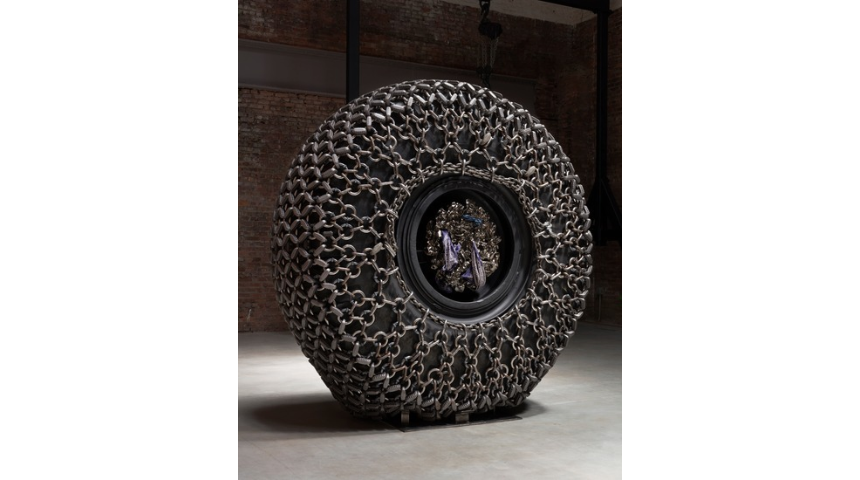
Arthur Jafa Big Wheel II, 2018 Chains, rim, hubcap, and tire 231.1 x 231.1 x 94 cm (tire) Private collection © Arthur Jafa
The work also gets me thinking about the pursuit of rubber by imperial realms and the treatment of people as a byproduct of this pursuit. This colonialist imperative that shows no sign of slackening its grip in today’s capitalist pillage-fest. But, overwhelmingly, the pair of works, monumental vertical drops of ripped up rubber suspended from two gallows pole-style iron gantries, most saliently recalls the lynchings of the Jim Crow era and by extension, the very current lynchings in a different form, of mainly young Black men and women. There aren’t many people looking round, but those who are, are not saying anything. The power of the work renders you speechless.
Before examining these ramifications further, there’s Jafa’s Big Wheel II (2018), one of a series, composed of a massive truck tyre shackled in snow chains, metallic blue bandanas caught in its rim, interrogating American road culture at the same time as playing off Richard Prince’s series Untitled (Girlfriend) (1993), photographs of young female grifters, and high-chromed motorbike, Untitled (2018-20) which are on the floor above. There are also, adjacent to Big Wheel II, to the right, Prince’s presciently dystopian Ektacolor prints Untitled (Sunsets) (1981-82) where the American dream melts orange and black in the white-hot temperatures of its own materialism; and Jafa’s moving, abstracted memorial LOML (2022) for his friend the musician, writer and critic Greg Tate who died in 2021.
On the left of Big Wheel II is Jafa’s film Love Is The Message, The Message is Death (2016) that most vividly unfolds ‘the power, beauty and alienation of Black music’ which he says his work intends to replicate (2) and in that sense acts as the key to ‘Helter Skelter’. The title of the show references The Beatles song (1968), distorted by cult leader Charles Manson to incite race war in the US; and the notorious ‘Helter Skelter: LA Art in the 1990s’ exhibition curated by Paul Schimmel at MoCA Los Angeles which featured mainly white men and no Black visual artists. It also of course references the spiral slide-tower of British fairgrounds, and by extension, scattering chaos.
Before you enter the partitioned, curtained side room for Love Is The Message, The Message Is Death, the flow cadence manipulation of Ultralight Beam from Kanye West’s 2016 album ‘Life of Pablo’ draws you in. Unlike most hip hop, it uses 12/8 time, an early twentieth-century shuffle beat, instead of standard 4/4 time. Vocals, drumming and instrumentals slide around this gospel style swing metre. Chance the Rapper’s celebrated sixteen-bar verse pushes against the 12/8 time signature in rapid fire 4/4, as if straining at the cross-rhythm leash of a swaying choral group.
Then the film, watched by room of people whom I suspect were silently crying (I may be mistaken). The film montages sound, video and photography of street wars, police brutality, racist incidents, historic and contemporary lynchings drawn from Jafa’s own massive collection of images and footage. Viewed in conjunction with the initial impact of Folk Songs (Blasting Mats), you can surely see how without the dam of Black dignity, fortitude and resilience, an avenging tide would explode against the ingrained racist injustice that just keeps delivering its deadly arson.
Time and again, as we are reminded, young Black men and women are stopped in the street by police and at that exact moment, their life hangs in the balance. At any other moment subsequently, they can become another modern-day version of the horrors some once thought left behind in the dark days of the racially segregated American south. The lyrics by the fourteen songwriters on Ultralight Beam rightly have a lot to say about that.
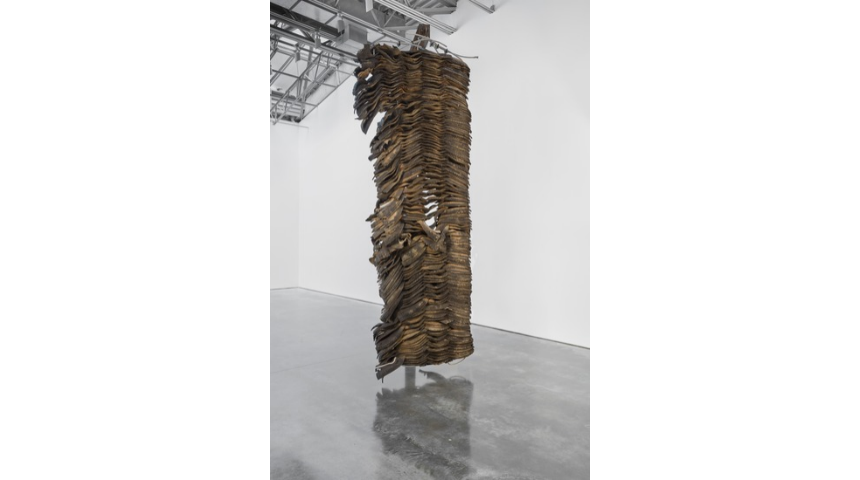
Richard Prince Folk Songs, 2006 Steel and rubber 624.8 x 167.6 x 121.9 cm overall dimension; 528.3 x 167.6 x 35.6 cm (blasting mat); 566.4 x 121.9 cm (beam structure) Private collection © Richard Prince
Prince’s found materials in Folk Songs (the versions of which, on show at Fondazione Prada, are gigantically tall and dark, exhibited in a shaded stone courtyard, not shown in the above photograph): blasting mats, comprise sliced-up recycled rubber tyres bound with rope, cable or chains, and are used during rock blasting in quarries and on construction sites to suppress flying rubble, debris and dust. High velocity rock fragments are called flyrock and the mats are placed over the blast area, either in a horizontal or vertical position, to prevent damage to surrounding buildings, people or the environment. In vertical format, hanging from cranes or other structures, they can be referred to as blasting curtains.
It strikes me that this work, along with Jafa’s Love is the Message, the Message is Death, is the cornerstone of ‘Helter Skelter’. The exhibition takes place in the baroque splendour of a Venetian palazzo. Prior to 1972, there were no Black artists showing work at the Venice Biennale. Sam Gilliam was the first, representing the United States. It took until 2015 for the first person of African descent and the first Black curator to head the Venice Biennale, Okwui Enwezor. The 2026 edition, In Minor Keys, is curated by a Black woman for the first time, the late Koyo Kouoh. It might feel like business as usual for a Black artist such as Alfred Jafa to be showing at an aristocratic Venetian palazzo run by a leading couture house, but that position is hard won. Both artists make work that could be considered as a form of political activism. Prince’s rite of passage was the anti-Vietnam War movement and the Civil Rights era.
Although Prince rejected violence at the time to make his defiantly cipher-like Protest Paintings (1989-94), refusing primary placard hues of red and black for shades of dove-grey and white, don’t mistake this as some kind of comfortable viewing experience, to be imbibed along with an afternoon’s gondola tour and a boutique shopping spree, at least not if that is without a second thought. Prince and Jafa have dug their works into Fondazione Prada like searing embrasures in a frontline. In this exhibition that incorporates Kanye West’s military bounce flow and Jafa’s street warfare footage, you can’t help think of grime and rap MC slang and how it relates to military argot.
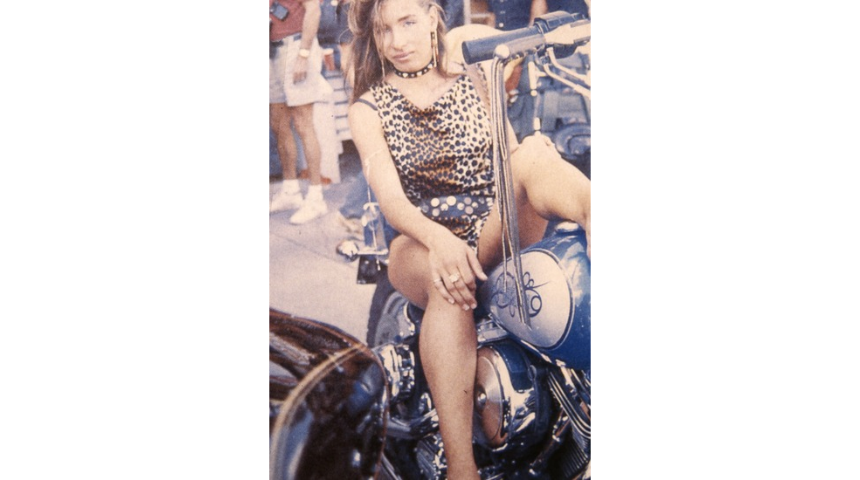
Richard Prince Untitled (Girlfriend), 1993 Ektacolor photograph 101.6 x 152.4 cm Private collection © Richard Prince
US Marine Corps fighting hole, New Zealand army fighting pit, British/Canadian slit trench, shell scrape, rifle pit. How the term ranger grave signifies the rap artist’s ultimate risk, digging a metaphorical defence for protection that can end up being their tomb; ranger (as in Range Rover SUV) hinting at the danger of chasing a high life and ending up dead; trench referring to housing estates in UK grime; trap house, where you can hide out from police and rival gangs. Jafa and Prince have installed the DFPs (Defensive Fighting Positions, that start off as hand-dug man-sized holes in the ground but can also be hollowed out with ‘beehives’, specially made explosive charges) and erected the blasting mats.
On the floor above – the piani nobili – a suite of rooms continues to churn with versions of this conflicted ground, weaving in and out of autobiographical experience, science fiction, the world of mass media and celebrity culture, cartoons; American sleaze, porn and horror; yard chic. In Viriconium (2026), Jafa assembles colour UV-printed honeycomb aluminium cut-outs of figures from these drifting, grifting cross-cultural realms – there are political activists (Angela Davis, Malcolm X), the jazz singer Billie Holiday, the poet Walt Whitman. Opposite, Prince’s The Entertainers (1982-83), peopled by tall black glossy Perspex boxes displaying the headshots of aspiring actors he encountered at the time, working for Time-Life Books in New York City.
Side rooms include an example of Prince’s car bonnet sculptures, American Place (2008), a striking piece of abstraction rendered in ready-made steel and fibreglass. Adjacent, Jafa’s Ex-Slave Gordon (2017), a vacuum moulded bas relief tracing the lacerated back of a formerly enslaved man. To quote the exhibition panel: “This very image, which is held in the Library of Congress, was recently removed from US National Parks by the Donald Trump administration as part of an effort to whitewash and rewrite American history in his vision.” It is essential to maintain circulation of an image such as this, as it is testimony not only to the brutality of historic Transatlantic Slavery but also a reminder of the horrific power yielded by white colonialism.
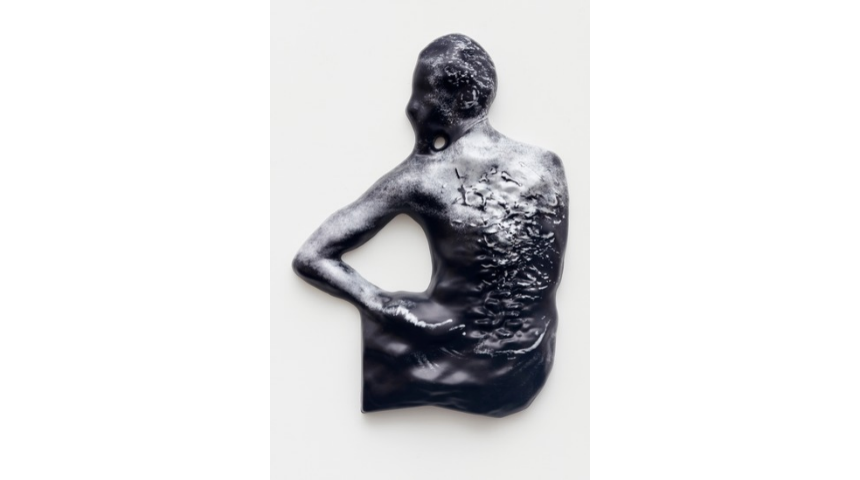
Arthur Jafa Ex-Slave Gordon, 2017 Vacuum formed plastic 144.8 x 111.8 x 22.9 cm Lent by Subodh Gupta © Arthur Jafa
Trump’s whitewashing is echoed in the film work BEN GAZARRA (2024). Jafa re-edits Martin Scorsese’s Taxi Driver (1976) to question ideas around race and sexual ‘transgression’. In the original screenplay, the pimp and johns who were killed in Robert De Niro’s vigilante-style massacre, as he rescues an underage prostitute, were supposed to be played by Black actors. However, the casting was altered in the final film due to concerns over the depiction of shooting Black men at close range. Jafa corrects this, restoring Black actors for the white pimps and johns, pinning down fears around interracial relationships and asserting cinematic ‘truth’.
To return to Folk Songs (blasting mats): ‘tire treads and tubes were the primary wartime applications [of rubber]… more than forty million heavy-duty truck tires were manufactured in the United States during the war…’ After Pearl Harbour in 1941, the American economy was in danger of collapse and they needed rubber for the war effort. Around 1939, the US ‘consumed half of all rubber produced globally,’ nearly all of it from colonial plantations. After Japan’s conquest of Indonesia, Malaya and Singapore, these imports terminated. The Roosevelt administration then ‘crash-built’ a new synthetic rubber industry, with production steeply rising ‘from 230 tons in 1941 to over one million tons in 1945’. (3) This led to the establishment of fifty-one plants across the US, opening the floodgates for industrial pollution.
A 1987 report issued by the United Church of Christ Commission for Racial Justice, ‘Toxic Wastes and Race In The United States – A National Report on the Racial and Socio-Economic Characteristics of Communities With Hazardous Waste Sites’ found that 3 out of 5 of ‘the largest commercial hazardous waste landfills in the United States were located in predominantly Black or Hispanic communities. These three landfills accounted for forty percent of the total estimated commercial landfill capacity in the nation.’ (4) ProPublica examined 5 years of emissions data and found that ‘on average, the level of cancer risk from industrial air pollution in majority-Black census tracts is more than double that of majority-white tracts.’ (5) Pollution extends the racism of the colonial plantation system, embedding discrimination and segregation into the environment.
‘Helter Skelter’ is about coming to terms with the American experience, and about processing its multilayered cultures. It also contains volumes of sorrow about loss of health, wealth, opportunity, mental and physical wellbeing; lost dreams, lost childhoods, lost livelihoods. The United States is full of vicious cycles – the running down of majority Black neighbourhoods through underinvestment and industrial pollution to force down property value, trap residents and deny viability for further investment. Its history is full of redlining, blockbusting, poverty, lack of opportunity and hastened death preventing people living the life they were intended at birth.
But, as this exhibition illustrates, it is also a ride. At once horrifying and beautiful, multifaceted and burning with end-of-empire fury, a smouldering mass of ‘affective proximity’, Jafa’s term borrowed from filmmaker John Akomfrah to describe the intensity of meaning that can come from the coalescence of disparate things thrown together. And above all the dialogue of two artists born a decade apart who sample and prototype and simulate the violence and the spirituality of American experience in an unending flow of confrontational work of significant and enduring emotional impact.
(1) Miuccia Prada writes the introduction to the exhibition catalogue, Helter Skelter: Arthur Jafa and Richard Prince (Fondazione Prada, Milan 2026)
(2) cited by Sharjah Art Foundation on Instagram @sharjahart
(3) American Affairs Journal https://americanaffairsjournal.org/2025/02/the-u-s-synthetic-rubber-program-an-industrial-policy-triumph-during-world-war-ii/
(4) https://www.nrc.gov/docs/ML1310/ML13109A339.pdf
cited in ProPublica https://www.propublica.org/article/how-black-communities-become-sacrifice-zones-for-industrial-air-pollution
(5) ProPublica https://www.propublica.org/article/how-black-communities-become-sacrifice-zones-for-industrial-air-pollution
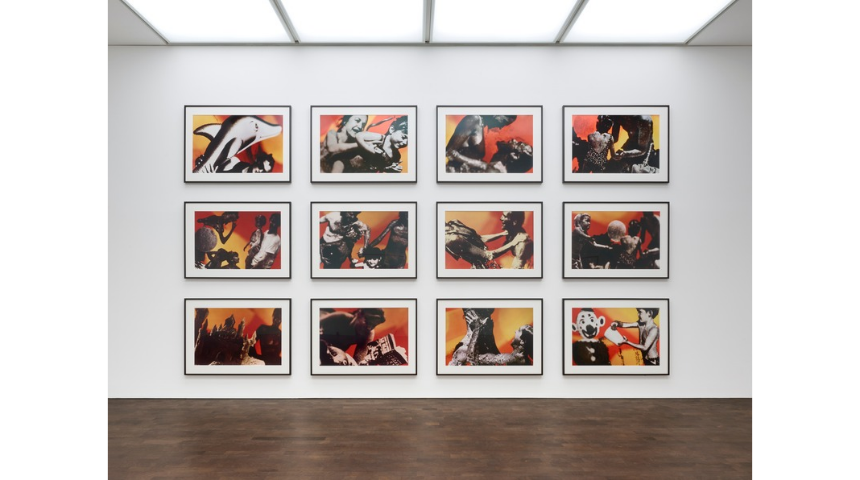
Richard Prince Untitled (Sunsets), 1981-82 12 C-Prints 76.2 x 114.3 cm each © Richard Prince Exhibition view, Gagosian, Grosvenor Hill, London, 2024. Courtesy of Richard Prince and Gagosian. Photo: Prudence Cuming Associates Ltd