
FEATURE Oct 2026 “Disneyland for Depressives”: Post-Punk Protest and ‘Provisional Identity’ in B Movie: Lust & Sound in West-Berlin 1979-1989 (2015)
Emily Barlow
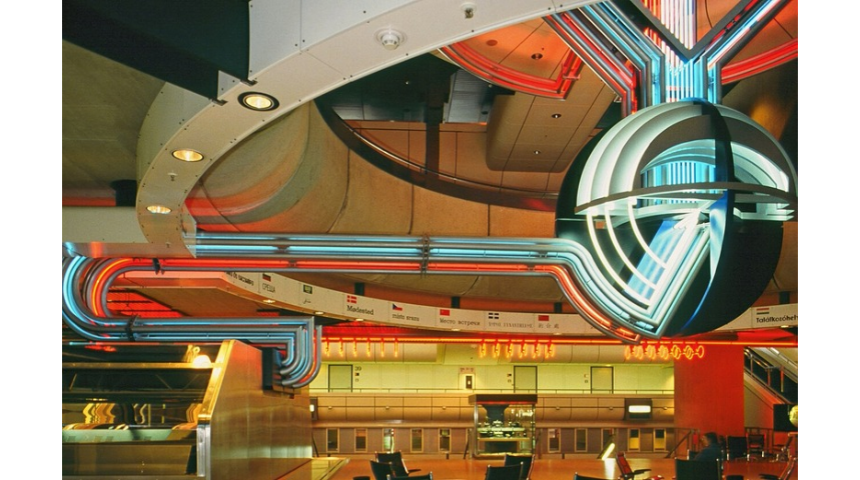
Große Lichtplastik, ICC, Steel, Neon, Electronic By Frankoehring - Own work, CC BY-SA 4.0, https://commons.wikimedia.org/w/index.php?curid=184745243
Emily Barlow is a writer, researcher and keen reader of critical theory. She is interested in the influence of social digitisation on contemporary culture, identity, personal agency and modes of resistance, focusing primarily on how these dynamics are conveyed through subversive and countercultural art and music. Here, she dissects the fall-out of mid-last-century totalitarian states, scattering post-punk ashes on the neoliberal present in a celebratory critique of the iconic documentary musical ‘B Movie: Lust & Sound in West-Berlin 1979-1989’, which starred people who were there pre-fall of the Berlin Wall – David Bowie, Keith Haring, Blixa Bargeld, Gudrun Gut, Nick Cave among many others.
Art and identity are symbiotic. When we make art, we reflect our subjective selves onto the world and hope for resonance - that we might connect to others by delineating an abstract, but potentially collective, human experience. When we are affected by art, we undergo a process of self actualisation; our perspectives and belief systems are permanently marked, and we emerge from the experience as more assured, more clearly illustrated versions of ourselves. In ‘From Pilgrim to Tourist – or a Short History of Identity’ sociologist Zygmunt Bauman claims that the concepts of identity-building and culture ‘were and could only be born together’; he charts this back to a nascent bourgeois ruling class, who amalgamated the ‘individual’s [newfound] freedom of choice’ with a ‘dependency on expert guidance.’ In its rejection of such guidance, counterculture asserts the existence of a truly autonomous self. Countercultural art, then, rebounds this agency back to us - it invites us to take hold of it.
‘B Movie: Lust & Sound in West-Berlin 1979-1989’ - the text at issue - amalgamates archival footage with the non-diagetic accounts of its narrator to retrospectively chronicle the subversive, hedonistic countercultural milieu of a space dichotomized by the Berlin Wall. My proposed critical reading employs this content to chart the emergence of postmodern “provisional” identity constructs, applying Bauman’s observations to examine how the depicted approaches to contemporary artistic practice reflect nascent aversions to ‘fixed’ ideas of meaning. (1996:19) Furthermore, I posit that the film’s deliberately nostalgic compositional framing signals the effective “canonization” of pre-digitized cultures in a neoliberal age, utilizing Harvey’s posturing of ‘neoliberalism as creative destruction’ (2007: 21) to support my claim. Ultimately, this article seeks to address the rippling effects of Western governmentality on the social and cultural climates they impose upon – and more specifically, how forms of creative and political resistance have seen themselves faltered and eroded by the neoliberal agenda.
There’s a distinct parallel between the 17th century and the 1970s. Underscored by the socio-political turbulence of the Reformation, the 17th century governed bourgeois modernity at its founding moment, with the defining elements of early modern identity forever laid bare by the artistic efforts of the Renaissance movement. Shakespearean soliloquy saw the Jacobean era’s ‘inner-worldly pilgrims’ (Bauman, 1996: 22) immortalised as tragic heroes, granting the likes of Hamlet and Othello universal tenure as ‘pattern-setters [or archetypes] for the modern man.’ (1996: 22) This ubiquity has since preserved itself; several centuries later, such figures remain anchored to most cultural frames of reference. As Bauman suggests, this is symptomatic of an era led by ‘steel and concrete,’ (1996: 18) in which existential meaning was assigned by vocation, slowly accrued through skill and ratified with durable objects. For the modern man, the construction of an ideal self was one single, life-encompassing endeavour with ‘the primary condition of delayed gratification.’ (1996:23) This mode of existence is thus reflected across modernity’s canonical works, long ascertaining the established conventions of high art. Bauman observes that, in committing to the task of ‘identity-building’, the modern subject passively expects a stable, hospitable external world will see them compensated - envisioning predictable, linear systems of order that point to no outcome but the steady cumulation of their self-fulfilment. (1996: 23) The modern world, however, later proved itself to be entirely inhospitable. Ultimately, by the 1970s, the socio-political turbulence inflicted by the mid-century’s great totalitarian states had ensured that these robust systems were irrevocably bent out of shape. At this point, subjects had seen hyperinflated currency render their hard-earned cash worthless, ‘durable objects’ built over lifetimes blitzed away in half-seconds, and vocations held over generations forcefully shrugged off, swapped out for “soldier” and forgotten in foreign trenches. This marked the dawn of postmodernism – an age rebuilt with ‘bio-degradable plastic.’ (1996: 18)
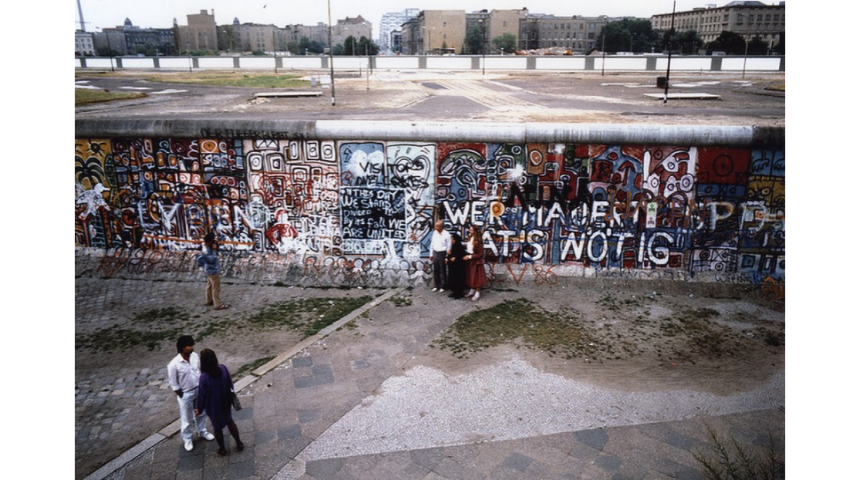
Looking at part of the Berlin Wall from a platform near Potsdamer Platz in 1986. Photo by Nancy Wong - Own work, CC BY-SA 3.0, https://commons.wikimedia.org/w/index.php?curid=26476566
If we conflate modern man with the term ‘identity-builder,’ eternally consumed by their pursuit of a solid, stable reflection of selfhood, we can perhaps comprehend the postmodern man to be an ‘identity-tourist’, forever evading their fear of being ‘bound’ to a fixed sense of meaning. (1996: 26) This description adequately applies to Mark Reeder, the subject and narrator of B-Movie. Born in Denton, in 1958, Reeder cultivated his own selfhood whilst working in Manchester’s ‘Virgin Records’ as a teenager, where he became well acquainted with the leading figures of his local music scene. He describes his postwar hometown as effectively ‘down and out’, recalling how he and his friends would signal their subversive sentiments to the outer world by reappropriating the insignia of the villainous ‘Nazi Germany’ they saw on television: ‘we played with this image. We would wear cheap bits of uniform, and even wear swastikas – anything to annoy our parents.’ (B-Movie, 2015) The emergence of this kind of self-presentation has since been defined by Frederic Jameson as ‘postmodern pastiche.’ Jameson argues that ‘pastiche is, like parody, the imitation of a peculiar mask, speech in a dead language: but it is a neutral practice of such mimicry, without any of parody’s ulterior motives, amputated of the satiric impulse, devoid of laughter.’ (Jameson,1991: 65) Pastiche implies the extirpation of context from image, echoing Bauman’s assertion that postmodern identity constructs demonstrate a collective concern to ‘forbid the past to bear on the present – in short, to cut the present off at both ends, to sever the present from history.’ (1996: 25) For the shellshocked postmodern subject, fixed meaning becomes a ‘liability’ rather than an ‘asset’- and for these punk and postpunk transgressors, it, too, becomes a method of resisting the ‘predictability’ anchoring their parents to traditional modes of thought.
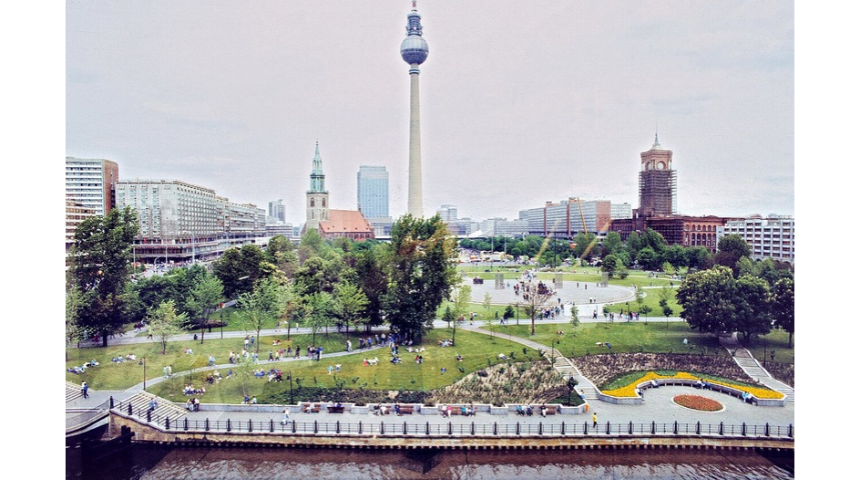
Berlin Marx-Engels-Forum 1986 by Gerd Danigel, gerddanigel.de., CC BY-SA 4.0 <https://creativecommons.org/licenses/by-sa/4.0>, via Wikimedia Commons
As factories closed by the dozen and vocations were thrown to the wind, postmodern pattern-skewers like the Buzzcocks and the Sex Pistols gave the disenfranchised youth a new name to assign themselves: musicians. This pursuit didn’t require a lifetime of careful configuration - an intermediate knowledge of one badly tuned instrument could see you fully accredited in weeks, allowing you to flit between groups and genres as you pleased. It was the ideal occupation for the postmodern transgressor; in an age where no safe future was promised, ‘all delay, including ‘delay of gratification’, [had lost] its meaning: there [was] no arrow-like time left to measure it.’ (Bauman, 1996: 25) In the film, this sentiment is perhaps most acutely reflected by Malaria! frontwoman Gudrun Gut, who is recalled as having been ‘always forming new bands and projects,’ ever ready to distance herself from ‘everything that was conventional.’ (B-Movie, 2015) In acquired footage of one of Malaria!’s first interviews, Gut repeatedly evades categorisation into musical genre: ‘we’re not “New Wave”, we’re not “punk rock” and we’re not... what are we?’ (2015) Her contrarianism is reified in a subsequent voiceover: ‘I was working at Zensor in Schöneberg, where I sold records. [...] They all wanted Joy Division, and nothing else. It was a bit like selling Madonna in that little shop. I couldn’t stand Joy Division anymore and I was really pissed off.’ (2015) As Bauman states, ‘in the life-game of the postmodern consumers, the rules of the game keep changing in the course of playing.’ (Bauman, 1996: 23) These shifts apply to consumers and contrarians alike; this is since, in an epoch characterized by its atomization of a fixed selfhood, it becomes increasingly harder to declare your own autonomous identity, as your autonomy is defined by its opposition to a perpetually fickle and changing reference point.
The appeal behind the noncommittal underscoring of this artistic practice is ratified by Blixa Bargeld - another subject of the film - when he states in a recording: ‘I asked myself what is my personal environment, for me as a West Berliner, without an ID card, without an address, without a job, without any income, without qualifications? Then I was in one band after another, and one of them was Einstürzende Neubauten.’ (B-Movie, 2015) Einstürzende Neubauten, Malaria! and another Berliner post-punk band known as Die Tödliche Doris later combined their efforts to form the collective ‘Geniale Dilletanten’ – a sardonically misspelled moniker translating to ‘ingenious amateurs.’ Together, they played the now notorious festival ‘Die große Untergangsshow’ - which roughly translates to “the great downfallshow” – on Sept. 4th, 1981. (Kleeber, 2013) If we consider Bauman’s observation that, within the confines of the modernist age, ‘both meaning and identity can only exist as projects, and it is the distance [and delay] which enables projects to be,’ (1996:23) such an event appears to predicate the ‘great downfall’ of modernity itself, with its postmodern ‘amateurs’ quickly scrambling to present their unpolished, unfinished and unenduring artistic endeavours.
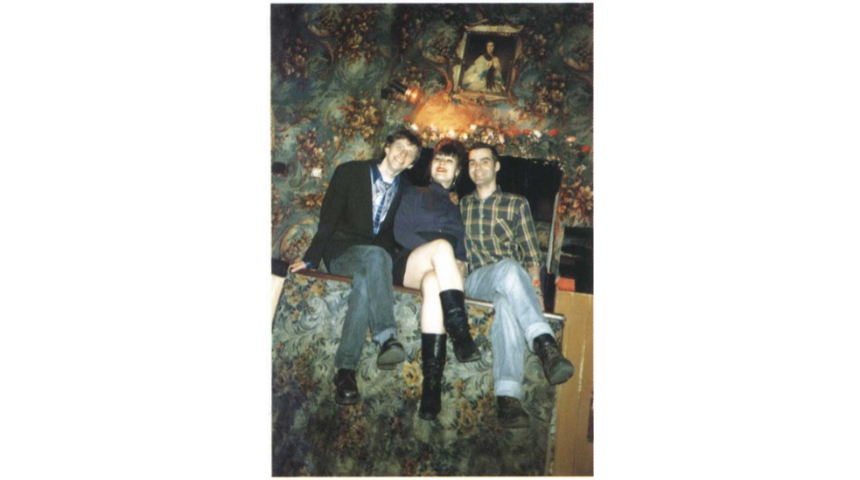
Kumpelnest 3000, Berlin 1987, Auflösungsfoto der Tödliche Doris (1)
It is ironic then, to see such efforts hailed as historically and culturally resonant through the lens of this film. In my opinion, the social plenum’s ability to thoughtfully engage with modes of artistic and cultural practice has immensely shifted since the depicted period. Bauman touches upon this in his article, writing - ‘the overall result [of postmodern consumerism] is the fragmentation of time into episodes, each one cut from its past and from its future, each one self-enclosed and self-contained. Time is no longer a river, but a collection of ponds and pools.’ (Bauman, 1996: 26) In a pre-digitized age, the process of engaging with another’s art, albeit less ‘delayed’ as it perhaps had been beforehand, still required a portion of the consumer’s active time; time to go to the record shop, time to buy the record, time to listen to the record from front to back. Within this process, the subject was significantly more receptive to the self-actualizing processes made available to them by the art in question, along with the collective efforts that inspired and resulted from such practices.
In the neoliberal present, this atomization of time – and of selfhood - has since accelerated to a critical degree. Mechanisms such as the ‘Spotify algorithm’ now recommend consumers small fragments of an artist’s body of work; instead of engaging with the countercultural beliefs and ideologies put forth by an artist or collective, the consumer passively resonates with whatever meaning they choose to apply to these, now vacant, sounds and images. The work becomes the product of pastiche in itself – intent and context become irrelevant, as does the subject’s ‘autonomous selfhood’ under the thumb of the consumer market. James Bridle corroborates this, writing that, at present: ‘we ourselves are utterly enmeshed in technological systems, which shape in turn how we act and how we think. We cannot stand outside them; we cannot think without them.’ (Bridle, 2018: 8) The centralisation of the ‘network’ has eroded all need for ‘individualism and empathy’ within modern life; counterculture has seen itself become an evasive and illusory effort, as there is no longer an ‘autonomous self’ to assert. (Bridle, 2018: 11-12)
Ultimately, “B Movie” has significant potential for rich, nuanced critical discussion when interpreted through a theoretical lens. Its presentations of the ‘Robocop- esque’ (2015) Stasi police force unfortunately surpassed the scope of the argument, but make significant parallels with the ‘Stasi-like forms of mass surveillance’ (2014: 144) observed by Bauman in the digitised, post-Wikileaks age. Postmodern, 1980’s Berlin, or - as the film calls it - ‘Disneyland for depressives,’ (2015) was hallmarked by modes of cultural subversion unlike anything else the world had seen up to that point. As a consequence, the art and music of this era reflect a truly idiosyncratic order of subjectivity, emblematising the socio-political purgatory which hung in the vacuum between the fall of modernity and the ascent of neoliberalism.
Footnote
(1) Das Bild ist das Auflösungsfoto der Tödlichen Doris. Es entstand im Kumpelnest 3000, Berlin 1987. Foto: "Die Tödliche Doris". Dieses Bild wurde von Wolfgang Müller, Mitglied der Tödlichen Doris zur Verfügung gestellt als PD. Aus der Korrespondenz mit Wolfgang Müller:
hallo Denis, völlig rechtsfrei: kannst Du nehmen: KN1987
This image is the final photograph of Die Tödliche Doris. It was taken at Kumpelnest 3000 in Berlin in 1987. Photo: "Die Tödliche Doris". This image was provided by Wolfgang Müller, a member of Die Tödliche Doris, for use in the public domain. From the correspondence with Wolfgang Müller:
Hello Denis, completely free of copyright restrictions: feel free to use it: KN1987