FEATURE Aug 2026 Come Closer: Anita Memar and the Politics of Attention
Mollie Balshaw (they/them), Warrington, UK
Anita Memar In each cell, a story (2026) Photo Amir Saatian
Mollie Balshaw is an artist, writer and cultural producer based in the North West. They are Co-Founder and Director of Short Supply, an artist-led organisation supporting early-career artists through exhibitions, publishing, mentoring and professional development. Their work focuses on artist-led practice, regional cultural infrastructure and creating greater visibility for artists working outside London.
From weathered bodies and fractured cages to a face assembled around handwritten names, Anita Memar makes sculpture that asks what becomes visible when we look closely—and what responsibility follows once we have seen it.
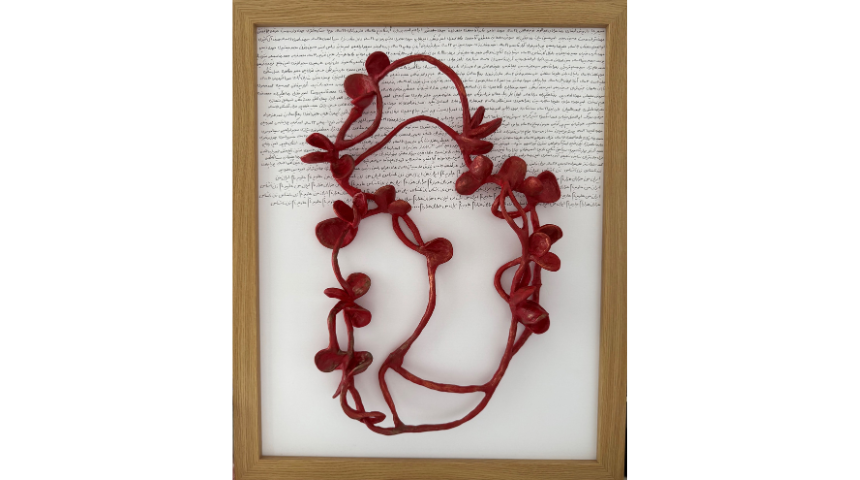
From a distance, In each cell, a story (2026) first presents a face. A network of deep-red stems, loops and petal-like forms rises from a white ground, loosely tracing the curve of a forehead, nose, lips and chin. Its shapes might be botanical or anatomical: flowers spreading across a trellis, vessels carrying blood, cells dividing and joining together. The relief is framed like a picture, but its uneven surface projects towards the viewer, casting small shadows across the writing underneath.
The handwriting is visible immediately, concentrated across the upper part of the work, but its individual names cannot be absorbed at a glance. To read them, the viewer has to approach.
“When you come closer, you see there’s a name behind that,” Anita Memar explains.
The distance between noticing that there is writing and recognising the people it records is central to the work. What initially appears as texture gradually becomes testimony. The face does not conceal the names completely; it gives them a body through which to be encountered.
That movement—from seeing a form to recognising a life—runs throughout Memar’s practice. Her sculptures rarely surrender their full meaning from a single position. They ask the viewer to approach, circle, peer through and attend to what might otherwise remain peripheral. A body seen from the front acquires another posture from behind. A cage reveals hands incorporated into its bars. A dark surface that resembles bronze turns out to be vulnerable clay. Silence, examined closely, contains evidence of struggle.
Memar does not represent political violence through graphic spectacle. Instead, she constructs encounters in which looking has ethical weight. The viewer is not shown everything at once, nor offered the comfort of immediately understanding what they see. Meaning arrives through proximity.
Her movement into sculpture developed alongside her migration to Britain. Previously working through illustration, Memar began searching for both a new material language and a different understanding of herself. Sculpture allowed her stories to occupy physical space. They could possess backs, obstruct the viewer, cast shadows and reveal different things according to where someone stood.
“You can turn around it,” she says. “You can see what is behind.”
Memar describes the transition with apparent simplicity: “The story is the same. I just changed my material.” Yet elsewhere she complicates the distinction: “Not only a story has something to say; material has something to say.”
The story may precede the object, but material changes how that story behaves. An illustration can depict depth, obstruction and movement; sculpture physically imposes them. The viewer must alter their own position in response, choosing whether to remain at a distance or investigate what cannot initially be seen.
This is especially apparent in Memar’s figurative works. The bodies are recognisably human but resist anatomical completeness. Limbs disappear into mass; proportions lengthen or contract; heads emerge from heavy, roughly modelled forms. The figures often develop without fixed models. Asked who they represent, Memar answers simply: “I think they are me.”
The resemblance is not necessarily deliberate. A friend once recognised something of Memar’s mother in one of the faces—specifically, the shape of her nose. Memory appears to enter the work through the process of making, whether or not Memar consciously invites it. Her figures contain traces of herself, her mother and her partner, while also carrying experiences that extend beyond autobiography.
This movement between the personal and the collective is crucial. The figures are intimate without functioning as straightforward self-portraits. Their identities remain open enough for other lives to enter them, but the political and personal conditions from which they emerged are never irrelevant.
Their surfaces reinforce this sense of accumulated experience. Air-dry clay is covered with hand-applied patina, producing dark metallic fields of black, copper, brown and muted red. Light catches unevenly across them, illuminating ridges, fingerprints and rough transitions between colours. The works possess the visual authority of weathered bronze while remaining materially fragile.
Memar wants these surfaces to suggest that the histories carried by the figures did not begin in the moment represented by the sculpture.
“This story has something from the back, from the ages,” she says.
There is a productive contradiction in making vulnerable materials perform monumentality. Bronze conventionally conveys permanence, authority and public recognition. Memar borrows its appearance without its physical security or institutional grandeur. Her sculptures look as though they could have been recovered from another period, yet their air-dry clay bodies remain susceptible to damage. They become fragile monuments: provisional vessels for histories that have not necessarily been protected elsewhere.
Anita Memar Resilience in Silence (2024) air dry clay, hand applied patina. Photo Amir Saatian
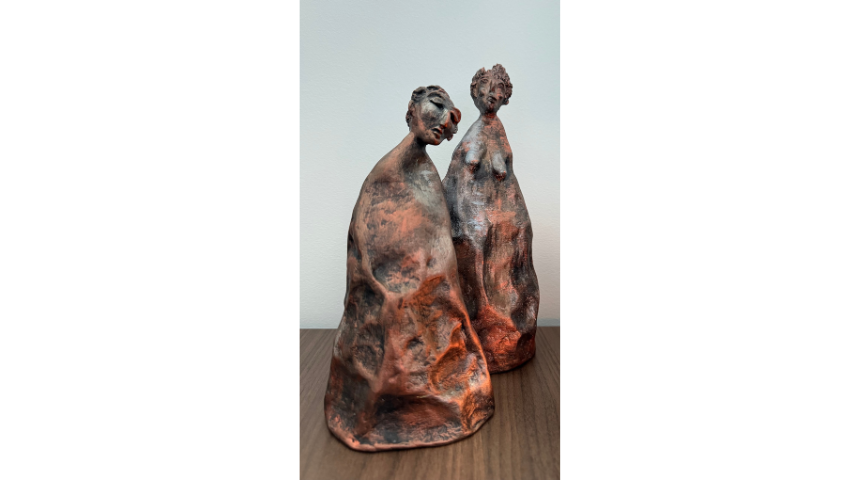
In Resilience in Silence (2024), two separate figures occupy the same emotional terrain without mirroring one another. Both have heavy, tapering bodies from which their heads and faces emerge, their arms absorbed entirely into their forms. One inclines forwards, its head tilting towards the viewer as though weighed down or listening. The other remains upright, looking slightly upwards. Their emotional difference is communicated not through gesture in the conventional sense, but through the direction of the whole body.
The figures represent Memar and her partner during their experience of migration. Their apparent stillness contains the labour of enduring uncertainty and reconstructing a life elsewhere.
“I was silent, but I was still strong,” Memar says. “I was resilient enough to have a life.”
Resilience is an overused word, particularly when applied to migrants, women and people living under political restriction. It can turn survival into a reassuring personal virtue, obscuring the conditions that made such strength necessary. Memar’s figures resist that uncomplicated celebration. Their resilience has physical weight. It closes around their bodies, replacing the possibility of outward movement with mass.
The bowed figure does not appear defeated, but neither does the work pretend that endurance is effortless. The upright figure’s gaze suggests continuation rather than triumph. Together, they give resilience two forms: carrying what bears down and maintaining the capacity to look beyond it.
Memar’s understanding of strength was shaped partly by her mother, who insisted on the necessity of continuing through difficulty. Yet silence, in her work, should not be confused with acceptance.
“Sometimes you show your silence,” she says, “but behind, I’m not silent.”
The sentence offers a way into much of her sculptural language. What is visible on the surface does not account for everything occurring within or behind it. Stillness can contain thought, refusal, memory or preparation. A silent figure is not necessarily a passive one.
Anita Memar Shadows and Light (2025) Photo Amir Saatian
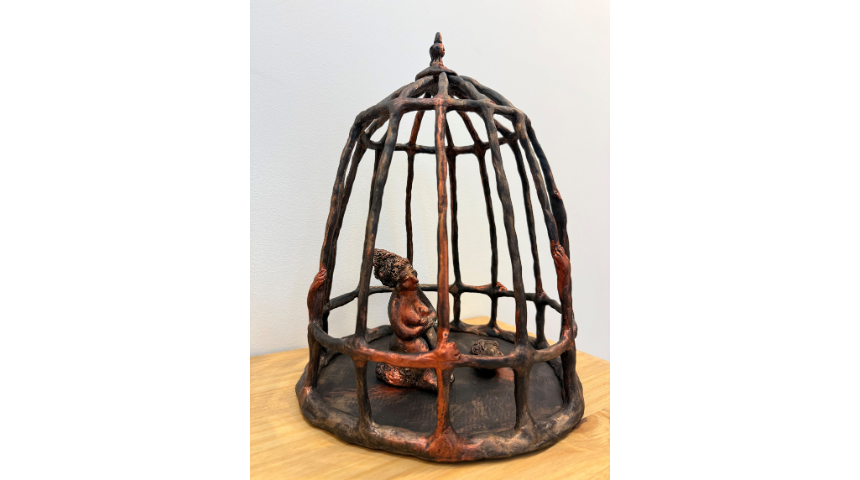
In Shadows and Light (2025), this tension becomes materially more violent. A domed birdcage fills the sculpture, its uneven bars curving together beneath a small bird-like finial. Inside, a woman kneels with her arms drawn tightly across her body and her head inclined to one side. A second, detached head lies on the floor beside her.
Hands emerge at intervals around the cage. Some appear to reach through or grip its bars, while others seem embedded directly into the structure. It is difficult to determine whether they belong to the woman, to unseen people outside, or to the cage itself.
The ambiguity is unsettling. These hands might be attempting to pull the structure apart, but they might equally be holding it in place. Protection, imprisonment, resistance and enforcement occupy the same form. The cage does not simply surround the body; it appears to be built partly from bodily fragments.
Its bars are irregular and organic, resembling ribs, roots, elongated fingers or limbs. The distinction between an oppressive system and the patterns it leaves inside a person begins to collapse. What confines the figure is not presented as a clean external architecture. It is tangled with bodies, habits and acts of touch.
As the viewer moves around the work, the bars repeatedly interrupt the sightline. The woman can be seen only in sections: a face between two uprights, a hand framed by a gap, the detached head briefly obscured and then revealed. The act of looking through the cage reproduces something of its restriction. There is no unobstructed position from which the scene becomes whole.
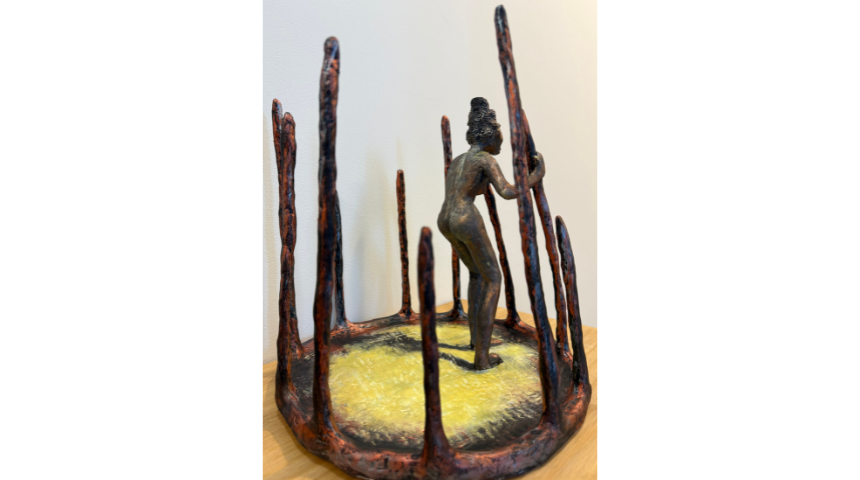
Anita Memar Beyond The Shadow (2026) photo Amir Saatian
In Beyond the Shadow (2026), the second work in this ongoing sculptural enquiry, the domed cage has disappeared. A circular base remains, surrounded by tall, irregular fragments that recall the earlier bars but no longer meet overhead. They rise like damaged posts, burnt trees or the remnants of an enclosure that has been forced apart.
At the centre stands a nude woman, legs braced and arms raised. She grips a broken bar in each hand.
Her agency is unmistakable. The structure is not merely collapsing around her; her body is implicated in its rupture. Yet the work does not present liberation as a complete or immaculate departure. The fragments remain upright around the perimeter. She is beyond the closed cage, but still standing within the material evidence of what it was.
The patina draws the figure and the broken structure into the same dark, coppered surface. She cannot be separated visually from the system she has broken. Freedom is presented not as the erasure of restriction, but as an altered relationship to its remains.
This development from Shadow and Light to Beyond the Shadow avoids a simple overcoming narrative. Memar does not divide experience neatly into captivity and freedom, silence and speech, past and present. A cage may promise safety before it restricts. A person can break a structure while continuing to inhabit its consequences. Liberation remains an active, unfinished process.
These tensions reach their sharpest expression in In each cell, a story. The work takes its language from blood cells: individual elements that together sustain a larger body. Yet Memar’s cells are not anonymous units. They swell into petals, organs and fruit-like forms, joining together to describe the outline of a human face.
Behind and around them, Memar has handwritten the names of people killed during protests in Iran. The writing forms a dense field at the top of the work before giving way to larger repeated lines in Persian and, eventually, to areas of unmarked white.
The red structure attracts attention first. Its colour is immediate and its organic forms possess a decorative beauty. From a distance, the writing may register primarily as pattern. Proximity alters the encounter. The viewer begins to distinguish one name from another, and what appeared to be a collective surface separates into individual lives.
Memar does not see beauty and political testimony as mutually exclusive. She is reluctant to place a statement beside a work and dictate the emotional terms on which it must be received. “I want people to ask: how do you feel when you see this work?” she says.
Yet In each cell, a story is not politically neutral, nor can the people named within it be dissolved into universal feeling. Memar speaks about wanting to “shout” that they existed.
“These people exist,” she says. “Even if you kill them, you cannot make them disappear.”
Writing their names was an act of sustained and emotionally demanding attention. “With each name that I wrote, I cried,” she recalls.
The work remains deliberately incomplete. There were people whose names Memar could not obtain and women whose identities had not been made public. Rather than disguising those absences, she left areas of the composition open for them. The white ground is not simply empty space; it marks the limits placed upon remembrance.
Incompleteness here is not a failure of commemoration. It becomes evidence of the conditions under which memory must operate: suppressed information, inaccessible records and lives known only partially. Memar cannot produce a complete archive, and the work does not claim the authority to do so. Its gaps prevent the memorial from appearing settled.
Memar describes the piece as a kind of micromonument. Instead of using monumental scale and permanent materials to declare an official history, it builds remembrance through handwriting, repetition and intimate encounter. The names are held inside an image of biological interdependence: each cell part of a body, but no cell interchangeable with another.
There is nevertheless a limit to what looking can achieve. Paying attention to an artwork is not equivalent to political action, and witnessing cannot restore the people whose names appear within it. Memar’s work does not make that claim. Its demand is quieter but still consequential: that an individual life should not disappear into distance, suppression or the anonymity of a statistic.
Across her practice, the viewer repeatedly meets something that refuses to remain what it first appeared to be. Silence becomes a compressed form of resistance. The hands on a cage might maintain it or try to tear it apart. A fragile clay body assumes the visual presence of bronze. An apparently botanical portrait becomes an assembly of individual names.
“Every artwork begins as a personal story,” Memar says, “but I hope it finishes as your own story—as someone else’s story.”
For that transformation to take place, the viewer must do more than glance. They must move around the object, acknowledge what is concealed or obstructed and remain long enough for recognition to occur. Memar’s sculptures resist both spectacle and disappearance by making this attention part of their form.
The viewer approaches expecting to look at an object. They leave carrying knowledge of a life.