INTERVIEW Nov 2026 Ruby Tingle in Whitby – lives of the cryptids
Josephine Manby

Performing at the Wildings private view with JONOA & KINRAR
Jeanie the cave-dwelling fairy, a hell-hound called Barguest, the giant Wade and his wife Bell; local ammonites christened Snakestones by 7th Century Saint Hild; the Whitby Abbey bells lost at sea during the Dissolution of the Monasteries and said to still toll from beneath the waves. Whitby is a wind-beaten coastal resort haunted by myth, legend and strange spirits – not to mention its claim to providing the key setting for Bram Stoker’s Count Dracula (1897), inspired by his visit there in 1890.
Until 29 November, visitors to the town can experience the mysterious magical touch of artist and musician Ruby Tingle who transports her own wetland studio and home, where she lives and works dressed in satin ballgowns, to the Pannett Art Gallery museum archives, to entwine her own personal research interests with those of the artists and amateur naturalist Soper sisters, Eileen and Eva. The result, curated by Ruby, is an extensive exhibition of their previously unseen work, along with new collaborations with artists Lizzie Rose, Sylvia Cook and olfactory specialist Steven Calver.
With music and sound collaborators KINRAR and Jonoa creating live performances, the exhibition ‘Wildings’ coincides with the launch on No Such Thing Records of the Wildings EP. For interactive performances at Whitby Literature Festival, Ruby will work with Simon Woolham ‘The Frog’, and has produced the film nature diary New Wildings – A Nature Diary: Home & Away for the Music Port Festival with KINRAR.
Through this bewitching blend of art, nature, performance, film and music, and supported by The Whitby Naturalists, Whitby Lobster Hatchery, the Art Fund and Whitby Town Council, science and the supernatural are pitched together to birth strange and enchanting new cryptids. Creatures who are rumoured to exist but have never been factually verified or substantiated. the Fourdrinier editor Josephine Manby was fortunate to talk to Ruby about her practice in the following interview.
Forthcoming Wildings events
November 21st
Whitby Literature Festival – share a story with the Frog
December 5th
Music Performance at Whitby Krampus Run – The Krampus Ball
https://www.pannettartgallery.org/whats-on/current-exhibition/

Ruby Tingle Creatures Wild & Small (Detail) Cabinet Installation in collaboration with Lizzi Rose
Josephine Manby I was intrigued to hear you describe on Jo Clements’ The Grateful Web Art Podcast that you sometimes start work with just a word or two, which spark multiple ideas, a form of lyric-making, and that this creates a space which you can then occupy to make new work. Can you expand on this fascinating process?
Ruby Tingle Words themselves are so powerful as a tangible portal into other sensory experiences – and as when attracted to certain pieces on the cutting table or objects from one day to another, they can spark different meanings, visual ideas and worlds at different times. Those words become almost sacred to me in the creative process – like a hanger or seed, and things just keep sprouting from it. I have to cut out words and phrases I love sometimes from lyrics, to make the music work as a song, but there’s still space to explore those in titles for the visual work and how I describe my work. As I also said to Jo on the Grateful Web, for me it has a link to synaesthesia, so a word is always so much more than just a word – there are already different connections going on in my brain. In the right place and time, there’s a magical moment where a word or phrase can spark all these wormholes into colours, textures and ambiguous or dreamlike spaces.
JM Thinking of the Soper family house, Wildings, and its surrounding wild environment of overgrown orchards, fields and gardens. How do you define your own personal take on wilderness, and do you seek to create (and then occupy) a kind of aesthetic wilderness, half-way between real and imaginary worlds?
RT Just as my practice deals with liminal spaces and draws on both the real and ‘imagined’, yes, I also exist mentally in real and unreal wild terrain. It’s an internal world that’s always evolving, somewhere between the scientific, ethereal and the hyper romantic – because these are all the things that I experience and seek out. This project was a really important step for me, mainly because the research project allowed me to design and create something where I could exist professionally between nature, conservation, archives and a gallery space all at once. I was interested in seeing how and why the Soper collection is at the Pannett now.
Aside from the obvious immediate landscape of Pannett park and the coast, exploring other spaces in Yorkshire like Bempton Cliffs, Fen Bog, Goathland; connecting with a fernery community in the Soper’s hometown in Hertfordshire; amphibian survey work in the field with the Whitby Naturalists; teaming up with Whitby Lobster Hatchery… so now my practice firmly sits more than ever in this hybrid role rooted in the wild. Not just as an artist, but as a curator – being able to explore and live in ‘wilderness’ and combine that physically with collections and objects that are connected to it inherently.

Ruby Tingle Creatures Wild & Small (detail) Cabinet Installation in collaboration with Lizzi Rose
JM Thinking about living as, or being, a work of art – is this your day-to-day aim in life? Or is it a professional persona? Or is it more about living synaesthetically, a kind of merging of aspects of lived experience that most people divide into categories (my work clothes, my Sunday best, etc)?
RT It’s definitely more natural than people assume. There’s always an element of contriving the way we put ourselves and personas together, especially today where we have so much more curatorial power online. I never get up in the morning and get dressed thinking about it in that way though. I’m not trying to be a work of art or live as one, although my dress comes from a similar unspoken urge to create. A word or feeling in a dream the night before might stick with me, then I’m more drawn to a colour palette that day. It’s always just for me and not a display of any kind, which I think is often misconstrued, because ball gowns and flowers and frogs in your hair isn’t potentially the norm for going to Aldi. But I feel very happy and comfortable in what I wear and that’s all it is to some extent.
The flip side to it is that I am a performer, in my artwork and as a musician and that definitely feels incredibly different when I’m deliberately putting myself on display. The giant prom ‘meringues’ that live in vacuum bags under the bed are probably ‘sunday best’ - for big gigs and festivals. The middle ground level where it blurs is the concept of a ‘swamp life’ where I do get dressed up to hang out in my local wetlands. I would rather go there than on a date to some restaurant or bar. And in that sense I think my outfits are quite practical. Layers of dress keep you nice and warm sitting out looking for frogs at night and all my Vivienne Westwood jelly shoes are waterproof whilst being princess-esque. I’ve always lived in and developed fantasy worlds which have roots in nature and reality.
JM Tell me about how you practically engage in your plurality of art forms. What does a creative day look like in the life of Ruby Tingle? Is an aspect of wilderness involved in it? Or is it something more delineated, more structured or more defined than wilderness? How do you let wilderness (or wildness) in?
RT Wildness in some form is always involved. I write a lot at the swamp and exist there in part all of the time, so it’s always pulled back into the studio with me. While having pets is the almost opposite of wildness, I do have animals that I care for, so the lives of amphibians and reptiles are constantly present. A creative day is usually sitting at my desk with a bunch of things: fragments of image, bits I’ve picked up from the street, or old jewellery parts that have broken, and a lot of piecing around and playing.
My collages take weeks or months to finalise into the landscapes they become. I always write so even if something ‘musical’ isn’t being fully developed it’s there, in field recording snippets, melodies and words. The songs take a long time too. Outside is a regular part of the day; feeding the ducks and geese at the swamp who have got to know me, then the evening is wine and sofa naps with my lizard. He’s usually sat with me while I create too depending on his mood, he likes to sleep on my knee while I work, or sometimes wants to be held – most of my computer or admin work is done one handed!

Sylvia Cook Winter Plants from the Danesbury Fernery (detail)
JM You have mentioned being quite hermit-like at times in your fondness for hiding out at the swamp, your local wetland realm. Does this include a desire to go off-grid, or are you too reliant on technology (in terms of making electronica that uses field recordings for example, and making film and video works)?
RT I have times where I do go off grid. I’m quite private and quiet in my home life and can easily sit for whole days without communicating to anyone, just pottering about. That usually comes after a big project and being public-facing for a while. I find it really exhausting sometimes, with physical, sociable energy and the release of big bodies of work (which I think all artists feel); I have to retreat to regather myself.

The Soper Gallery Temporary curated displays featuring the colour plates of Eileen Soper.
The swamp is healing and regenerating, and is a spiritual place for me where I can be there in my big dresses, or just in my running gear or pop there in the morning still in my pyjamas with an overcoat on and a cup of tea. Whenever I’m there or in any natural space though it doesn’t feel like it has anything to do with me. It’s about just being a part of it, immersed in nature and something bigger and more complex than us. Although I rely on technology, especially for music and film – sitting with a field recorder is incredibly different to doom scrolling – I still think I could leave that part behind and imagine I’ll retreat further into ‘the wilderness’ later in life.
JM It’s interesting that Whitby itself is a source of much folklore and legend. But at the same time, the supernatural elements in your work seem to be more about cryptozoology than Gothic hauntings. But then your music is threaded with ghostly utterances and creeping, whispering, spinetingling noises from the swamp. Tell me about the line you tread between these types of eeriness in Wildings, thinking of the song Eating Out of My Hands and the collage works that reveal tiny gloved beings in velvet breeches emerging from mossy terrains?
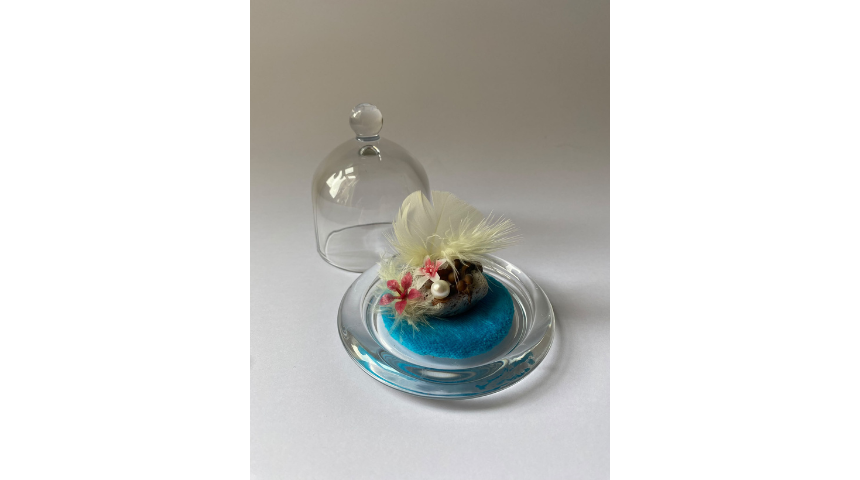
Gannet interactive olfactory work by Steven Calver
RT Eating out of my hands is definitely a mystic piece of music. It does come from a real place though. I was initially inspired by Eileen Soper’s love of badgers. She developed relationships with a number of clans, going out alone at night to watch them and eventually getting them to eat from her hands. I’m usually out at night exploring nature too, and I found a connection there, especially after discovering the large population of midwife toads at the lily pond in Pannett park which I recorded and sampled for the song.
Being out in nature at night is an otherworldly experience, and the ghostliness and magic is married with high alert and over stimulated imagination. The whole EP and project is laden with supernatural sounds and images which I believe can be found literally just by going outside and interacting with the natural and manmade world. The simulacra of Pannett park’s trees became stooped and alien figures in the collages, the toad song, walking over moorland bracken, gannets calling, all became electronic soundscapes, and found plastic fragments formed stars, crystal balls and orbs in the textile paper habitats. The research project also provoked this supernatural route after spending time with Eileen Soper’s colour plates, which mix education, wildlife and fairies in technicolour and pastel dioramas.
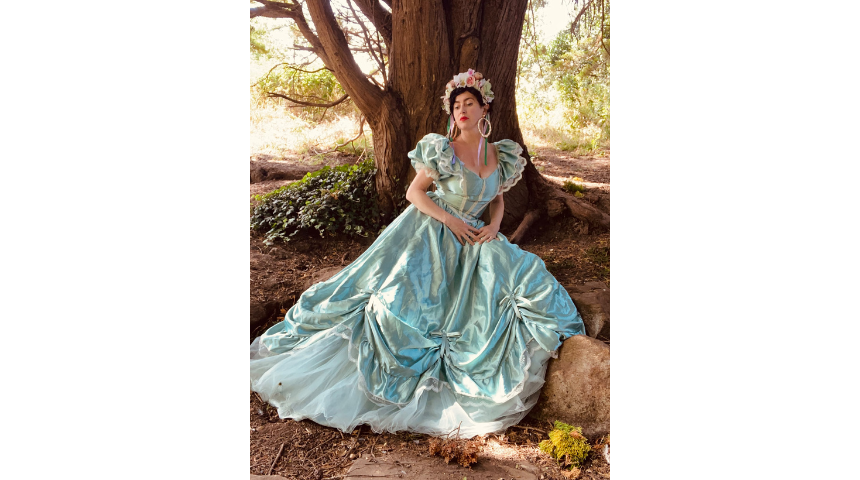
Ruby Tingle in Pannett Park
I love cryptozoology, as much as I love the very real strangeness of natural history. The two are intwined for me along with myths, legends, local stories: exploring folklore as nature through a human lens. So there was a lot that I was drawn to that overlapped with my nature research –Whitby’s cave hyenas, the Wyrm, St Hilda’s Snakestones – and the contemporary folklore happenings by Whitby Krampus Run which have become a central hub, community and celebration in keeping folklore alive. It’s been so wonderful to be welcomed into all these different communities during the residency, and every person and group has played a part in making the new ‘Wildings’ world what it is.
JM Is it a gift or privilege of an artist to be able to breathe life into new cryptids, new hybrid beings, to reanimate figures lost in the depths of the museum archive? Do you feel artists play an important social role in helping facilitate our imaginations with these evocations?
RT Working with collections is always a huge privilege. Sometimes it doesn’t seem real or fair that just because you’re an artist you can suddenly interact with these things! So I’m always incredibly grateful to be able to get close to and be able to tell new stories about them. I think it is really important to keep these archives alive and activated. And every artist does it so differently, which I think is fascinating and really important in how they can reach different communities.
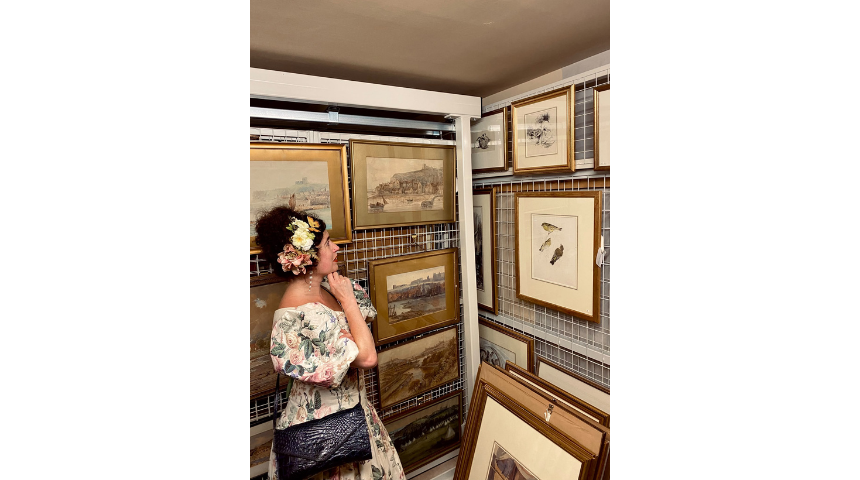
Ruby Tingle in the Pannett’s archives during her research project
With the Soper collection, I hope I’m the first in a long line of artists who can interact with it. I think Eileen Soper is basically the unsung Beatrix Potter of Hertfordshire, and now I’m involved in the community around the collection I’ll do all I can to push that forward. That’s another thing about working with museums and collections that I love. The projects are long and immersive in themselves but it doesn’t end when the exhibition has ended; the people, connections and fascination with the archive doesn’t stop. You kind of carry it as part of your own collection and story, and things keep evolving from it.
JM With current talk about prepping for some as yet unidentified near-future scenario, do you feel a comfort in knowing you have the refuge of the swamp close at hand? Could you live out a decade there, if necessary?
RT My biggest fear is wild spaces disappearing, whether that’s one that’s close to my heart or to others, globally. Losing our loved spaces is only the second tragedy in these scenarios though, as firstly they are home for a vast variety of incredible eco systems and beautiful creatures. In some ways, the comfort of the swamp is always tainted by the very fact of living in our times. I don’t ever take it for granted and feel like it could all be snatched away at any moment. My standpoint is that this world is not ours, and that we are not superior as beings. If anything I feel the opposite, we are just a small part of it, despite our populousness, and now more than ever, our role should be to look after the earth and animals.

The Soper Gallery Temporary curated displays featuring the colour plates of Eileen Soper, works, objects and soft sculpture by Ruby Tingle
JM What will be your legacy as an artist and musician? Will it be the work you leave behind or will it be a revealing of an alternative, creative lifestyle, or something else?
RT I hope maybe all of those things. The work is there to invite you into another world, part fantasy, part reality, and its questions lie in the narratives, the figures, and the materials. The sustainability of my practice has before come into question because I’m in some ways an eco-artist, but working with the very materials that are destroying the planet. I hope there can still be a dialogue about where they came from. They include found pieces from charity shops, from the pavement floor or just saving things from landfill and turning them into art. Then I feel there’s an act of preserving the material and elevating it, whilst attempting to do my bit for the environment. When I turn to an artist I love, whether historic or living, I always feel rejuvenated and with a little more magic and wonder. Also a feeling of encouragement to fulfil those things, so I’d like to be that for someone. I’d like my songs to transport and touch anyone who still listens in the future. Hopefully the love of nature and its very real enchantments will be something that will endure, and if I can play a small part in that because of my art and music then that would be enough.

Ruby Tingle with music collaborators JONOA & KINRAR on the steps of Pannett Art Gallery